
KET 2 Practice Test 4
Reading & Writing
Seabrook Night Market: explore evening events, follow everyday conversations and practise reading and writing in useful situations. This original A2 practice keeps the classic nine-part structure used on this page.
Notices at the night market
Read notices A-H. Match statements 1-5 to the notices. Use each letter once at most. H is the example.
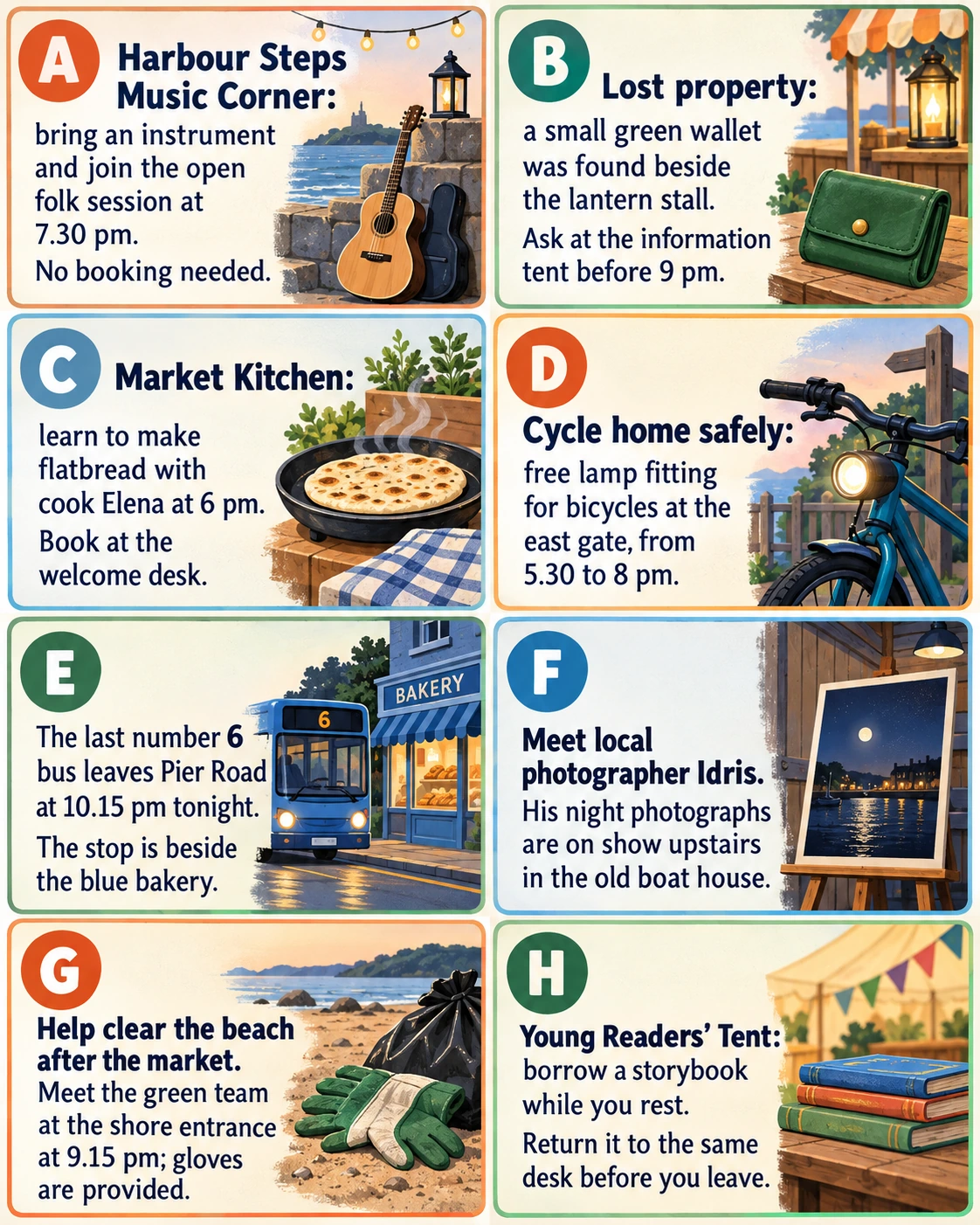
Read notices A–H as text
Harbour Steps Music Corner: bring an instrument and join the open folk session at 7.30 pm. No booking needed.
Lost property: a small green wallet was found beside the lantern stall. Ask at the information tent before 9 pm.
Market Kitchen: learn to make flatbread with cook Elena at 6 pm. Book at the welcome desk.
Cycle home safely: free lamp fitting for bicycles at the east gate, from 5.30 to 8 pm.
The last number 6 bus leaves Pier Road at 10.15 pm tonight. The stop is beside the blue bakery.
Meet local photographer Idris. His night photographs are on show upstairs in the old boat house.
Help clear the beach after the market. Meet the green team at the shore entrance at 9.15 pm; gloves are provided.
Young Readers' Tent: borrow a storybook while you rest. Return it to the same desk before you leave.
Example (not scored): You would like to read while taking a break. → H
1. Answer: A. Notice A invites visitors to bring an instrument and join an open folk session, so visitors can make music together.
2. Answer: B. Notice B says a green wallet has been found. Its owner should ask at the information tent before 9 pm.
3. Answer: C. Notice C offers a booked lesson in making flatbread with a cook, which directly matches learning to prepare food.
4. Answer: D. Notice D offers free bicycle lamp fitting, which is the service needed to make a bicycle safer at night.
5. Answer: F. Notice F says local photographer Idris is showing his night photographs in the old boat house.
A stall at the market
Read the story. Choose the best word A, B or C for each gap 6-10.
Example (not scored): Before preparing the food, Nia put on an ____ to keep her clothes clean. → apron
6. Answer: B. A stall is the small place where the family sells food. A shelf stores things and a stage is used for performances.
7. Answer: A. 'Arrived early' means they got there before the market opened. 'Reached' needs an object here, and 'visited' needs a place or person.
8. Answer: C. A recipe gives instructions and ingredients for making a dish. A ticket allows travel or entry, while a map shows locations.
9. Answer: B. 'Sold out' means every pie had been bought, explaining why the family had no pies left. The other phrases do not fit this meaning.
10. Answer: A. The customers thanked the family for offering a meat-free choice. 'Invited' and 'asked' would need different sentence meanings.
Market conversations
Choose the best reply A, B or C for exchanges 11-15. Then complete the longer conversation 16-20 with replies A-H. H is the example; use each other letter once and leave two unused.
Example (not scored): Omar asks who came with Leah. She says her sister is nearby. → H
11. Answer: C. The question asks where the toilets are. C gives their location; A gives a closing time and B gives a price.
12. Answer: A. 'Let's ask at the entrance desk' offers a practical response to a lost ticket. The other replies do not address her problem.
13. Answer: B. 'By train' answers how someone travelled. 'At half past six' is a time and 'with my cousin' names a companion.
14. Answer: C. 'Yes, please. It smells delicious' politely accepts the offer. The other choices do not respond naturally to food being offered.
15. Answer: A. 'At a quarter to nine' gives a start time. The other replies give a place and an opinion rather than a time.
A longer conversation
A
Yes, the paper ones are on the table beside the candles.
B
It takes about ten minutes to walk there.
C
No, they use battery lights, so they are safe.
D
I bought it from the craft stall near the clock.
E
Yes. I'll wait beside the clock until seven.
F
The music is louder near the harbour.
G
They are made of glass and cost five pounds.
H
I came with my sister, and she is waiting by the clock.
16. Answer: D. Omar asks where Leah bought her lantern. D names the craft stall where she bought it, answering the question directly.
17. Answer: A. Omar asks whether the stall sells paper lanterns. A confirms that the paper lanterns are on the table beside candles.
18. Answer: C. Omar asks whether lanterns use real candles. C says they use battery lights, which directly answers his safety concern.
19. Answer: B. Omar asks whether the information tent is far. B gives a short walking time, showing it is nearby.
20. Answer: E. Omar asks Leah to wait near the clock. Reply E agrees and says how long she will wait there.
Music at the market
Read Ellis's story. Choose the correct answer A, B or C for questions 21-27.
Example (not scored): How old is Ellis? → Sixteen years old
Ellis and the Friday music group
Sixteen-year-old Ellis first visited Seabrook Night Market with his grandfather, who had sold fruit there for many years. Ellis expected it to be noisy and crowded, but he soon noticed the small jobs that helped the market work. Before stalls opened, volunteers placed signs at each entrance and checked that paths were clear for wheelchairs. His grandfather showed him an old wooden box where stallholders kept spare string and price labels. Ellis liked the smell of warm bread, but his favourite part was the music area by the harbour. A group of neighbours played traditional songs there every Friday. Ellis learned the group began in a community room during a wet winter, when people wanted somewhere to meet. He now helps carry music stands before the first song. Last month, he brought his own small drum, although he had practised for only two weeks. He felt nervous at first, but the others helped him keep the beat. The market closes at ten, and Ellis usually walks home with his grandfather. They do not take the bus because the family lives only a few streets away. Ellis hopes to learn the guitar next year, but he has not chosen a teacher. He says the market is special because neighbours can share what they make and enjoy doing.
21. Answer: B. The opening sentence says Ellis first visited the market with his grandfather, who had sold fruit there for years.
22. Answer: A. The story says volunteers checked that paths were clear for wheelchairs before the stalls opened.
23. Answer: C. Ellis's grandfather showed him the box where stallholders kept spare string and price labels.
24. Answer: B. Ellis learned the neighbours' group began in a community room during a wet winter.
25. Answer: A. The article says Ellis had practised for only two weeks before he brought his own drum.
26. Answer: C. The article says they do not take the bus because the family lives only a few streets away.
27. Answer: B. Ellis hopes to learn the guitar next year, although he has not chosen a teacher yet.
A visit to the boat workshop
Read the story. Choose the best word A, B or C for each gap 28-35.
Example (not scored): We travelled to the workshop ____ bus. → by
28. Answer: B. 'Visited' is the past form used with a place the class went to see. Borrowed and invited do not describe going to a workshop.
29. Answer: C. But connects two contrasting facts: the room was noisy, yet everyone could hear the guide. Because gives a reason and unless introduces a condition.
30. Answer: A. 'From' names the material the boats were made from. At and by do not express the material relationship in this sentence.
31. Answer: B. 'Decided to try' is the correct pattern: decide is followed by an infinitive with to.
32. Answer: C. 'Bigger than' compares the model with the example. The comparative adjective needs than; biggest is superlative and big is not comparative.
33. Answer: A. Use 'wait for someone or something to do something': they waited for the glue to dry. Since and during do not fit this pattern.
34. Answer: B. 'Each student' is singular, so the past verb 'was' agrees with the subject. Were is plural and are is present tense.
35. Answer: C. 'Next time' refers to the future occasion when the class may return with their families.
Words from their meanings
Complete each word from its definition. The first letter is given in brackets. Type the whole word for questions 36-40.
Example (not scored): A place where people watch plays or shows. (t______) → theatre
36. Answer: lunch. Lunch is the midday meal; it begins with l and contains five letters.
37. Answer: baker. A baker makes bread and cakes. The job name begins with b and has five letters.
38. Answer: station. A station is where trains stop for passengers. The word begins with s and has seven letters.
39. Answer: label. A label can show an item's price. This five-letter word begins with l.
40. Answer: musician. A musician makes music by playing an instrument or singing. The word begins with m and has eight letters.
Messages about a cooking evening
Complete the messages with ONE word in each space 41-50. The hints show the kind of word needed.
Example (not scored): Thank you ____ your message. → for
41. Answer: to. 'Would love to' is followed by the infinitive join.
42. Answer: on. Use on before a day of the week: on Friday.
43. Answer: at. Use at before an exact clock time, as in at seven.
44. Answer: because / as / since. Because, as and since each introduce the reason Kai wants to learn; all fit before this full clause.
45. Answer: for. 'Save a place for me' means keep one place available for the speaker.
46. Answer: than. The comparative 'longer than' compares the evening with a normal class.
47. Answer: an. Use an before apron because the word begins with a vowel sound.
48. Answer: with. 'Help you with the recipe' uses the usual preposition after help.
49. Answer: to. 'Looking forward to seeing you' uses to before an -ing form.
50. Answer: there. 'There is room' introduces the fact that a place is available.
An evening boat trip
Read both sources and complete notes 51-55. Write the requested date, place, time, number or price. Short phrases are allowed.
Example (not scored): Return time: (pm) → 8.10 pm
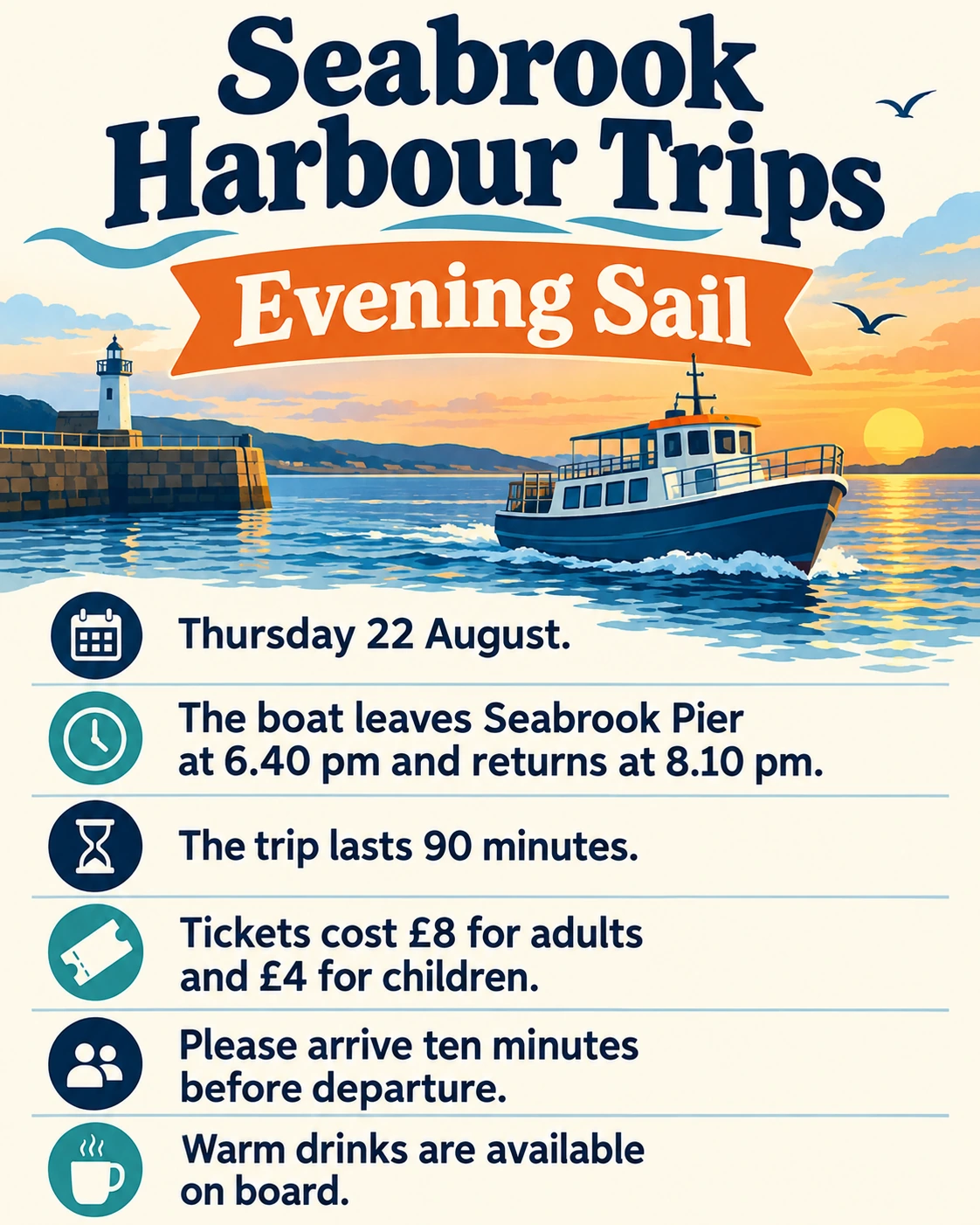
Read text version
Seabrook Harbour Trips – Evening Sail
Thursday 22 August. The boat leaves Seabrook Pier at 6.40 pm and returns at 8.10 pm. The trip lasts 90 minutes. Tickets cost £8 for adults and £4 for children. Please arrive ten minutes before departure. Warm drinks are available on board.
Message from Maya to Dan
Hi Dan, I booked our places on the evening sail for 22 August. Let's meet beside the yellow ticket office at 6.20 pm so we can get on the boat early. I'll bring two cheese rolls for us to share. Please bring your camera; I'll pack my blue jumper in case it is cool. Maya
51. Answer: 22 August / August 22 / 22nd August / August 22nd / 22 Aug / Aug 22 / 22/8 / 22/08. Both sources give the sail date as 22 August. Day-month and month-day formats are clear.
52. Answer: Seabrook Pier / the Seabrook Pier. The notice states that the boat leaves from Seabrook Pier, which is the departure point.
53. Answer: 6.40 / 6:40 / 6.40 pm / 6:40 pm / 6.40pm / 6:40pm / 06.40 / 06:40 / 06:40 pm / 18:40 / 18.40 / 6:40 p.m. / 6.40 p.m. / six forty / twenty to seven. The notice gives the departure time as 6.40 pm. Maya's 6.20 pm is their meeting time instead.
54. Answer: two / 2. Maya says she will bring two cheese rolls for them to share.
55. Answer: 4 / £4 / four / four pounds / 4 pounds / 4.00 / £4.00 / £ 4. The notice lists child tickets at £4 each, while an adult ticket costs £8.
Write an email
Write an email of 25-35 words for question 56. Include all three points. Check the sample after you finish; this writing is assessed separately from the automatic score.
Your English-speaking friend Maya is visiting your town for one evening. Write an email inviting her to an activity. Write 25-35 words and cover all three points.
- Invite Maya to an activity.
- Say where and when you will meet.
- Explain why she might enjoy it.
0 words · target 25–35
This writing task is self-checked and is separate from your score out of 55.
Hi Maya, Would you like to visit the night market with me on Saturday? Let's meet by the clock at six. You can try local food and listen to music. See you, Noor
Check: all three points answered; message clear; verbs and spelling checked; 25–35 words.
Ready to check your work?
Submit to grade your whole test, OR use 👁 Show Answer per part / per question.
Learning review & writing checklist
Read each notice for its purpose. Link dialogue replies to the turns before and after each gap. In Part 4, read each question carefully and choose the option supported by the article. Use both source documents for the notes in Part 8.
For grammar gaps, read the whole sentence, choose the correct form, and read it again. For open gaps, type one word only. Check the first letter and spelling in Part 6.
Your writing should answer all three points in 25–35 words. Compare your message with the sample after you finish. The writing sample does not add points to the automatic score.
Show Answer reveals the answer and explanation without filling your response or awarding a mark. After editing a graded answer, submit again for an updated score.