
KET 2 Practice Test 3
Reading & Writing
Everyday Discoveries: practise everyday reading, follow conversations and write a short message. This original A2 practice keeps the classic nine-part structure used on this page.
Messages for visitors
Match statements 1–5 with notices A–H. Use each letter once at most. H is used in the example.
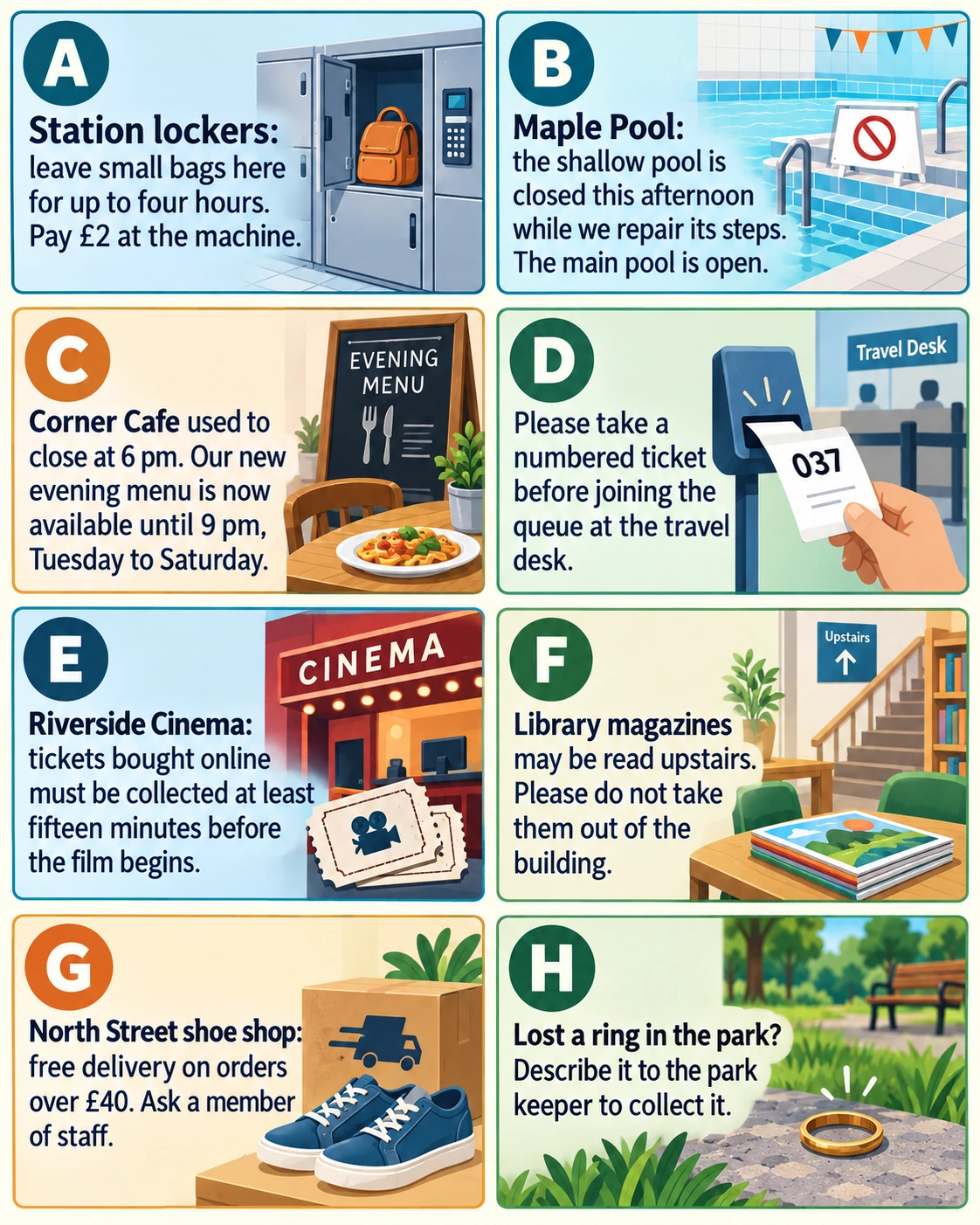
Read notices A–H as text
Station lockers: leave small bags here for up to four hours. Pay £2 at the machine.
Maple Pool: the shallow pool is closed this afternoon while we repair its steps. The main pool is open.
Corner Cafe used to close at 6 pm. Our new evening menu is now available until 9 pm, Tuesday to Saturday.
Please take a numbered ticket before joining the queue at the travel desk.
Riverside Cinema: tickets bought online must be collected at least fifteen minutes before the film begins.
Library magazines may be read upstairs. Please do not take them out of the building.
North Street shoe shop: free delivery on orders over £40. Ask a member of staff.
Lost a ring in the park? Describe it to the park keeper to collect it.
Example (not scored): You need to explain what a missing piece of jewellery looks like. → H
1. Answer: A. Notice A offers station lockers for small bags for up to four hours.
2. Answer: F. Notice F allows readers to use the magazines upstairs but forbids taking them out.
3. Answer: C. Notice C says the cafe previously closed at six but now serves its evening menu until nine. Dinner is available three hours later than before.
4. Answer: E. Notice E says tickets bought online must be collected at least fifteen minutes before the film. These customers have already paid and need to arrive early.
5. Answer: B. Notice B closes the shallow pool for repairs to its steps while the main pool stays open.
An unusual delivery
Read about a delivery at a hotel. Choose A, B or C for each gap 6–10.
Example (not scored): The parcel arrived early in the morning. → arrived — reached a place
6. Answer: B. An address identifies the building that should receive a parcel. Its price and weight do not identify which hotel it should go to.
7. Answer: A. Call means contact someone by telephone. Nobody answering the phone confirms that Farah tried to call the other hotel.
8. Answer: C. Lift describes raising the heavy box onto a trolley. The phrase too heavy for one person explains why Mr Bell needs help lifting it.
9. Answer: B. Mr Bell is pleased that the plates are safe: this is good news for him. Being lost or empty does not describe his reaction to undamaged plates.
10. Answer: A. Say thanks for her help is a natural expression of gratitude. The soup invitation is his way of thanking Farah for helping him.
Everyday replies and a costume
Choose the best reply A, B or C for exchanges 11–15. Then choose replies A–H for gaps 16–20 in the conversation. C is the example. Use each letter once; two replies are unused.
Example (not scored): Luca asks whether Priya is choosing clothes for a play. → C
11. Answer: C. Offering the blue pen directly answers the request to borrow one. The other replies concern the writing surface or a person.
12. Answer: A. Do not worry accepts the apology, and saying the foot does not hurt reassures Clara. Neither other reply responds to her apology.
13. Answer: B. Choosing outside and giving the pleasant weather as a reason answers the request to choose a place to sit.
14. Answer: C. Saying everyone was friendly describes the experience of the first working day. The other options give transport and location details.
15. Answer: A. Offering to wash cups solves the problem that all the cups are dirty. Neither a comment about sugar nor a chair helps with this problem.
A longer conversation
A
Yes, but I must bring it back on Monday morning.
B
The blue jacket. The red one is too tight.
C
Yes. I'm playing a train driver in the school show.
D
Just a small suitcase. There are two beside the door.
E
My cousin is learning to play the piano.
F
No, I've already got a pair of black trousers.
G
She'll shorten them while I try on the hat.
H
In the hall at seven. Shall I save you a seat?
16. Answer: B. Luca asks which jacket Priya will wear. B chooses the blue one, and Luca then says blue will look good.
17. Answer: F. Luca asks whether Priya also needs trousers from the cupboard. F says she already has black trousers, explaining why she does not need another pair.
18. Answer: A. Luca asks whether Priya may keep the jacket over the weekend. A agrees and gives the Monday return deadline, which explains his reminder advice.
19. Answer: D. Luca asks what Priya needs to carry on stage. D identifies a suitcase and its location, and Luca then recommends the brown one.
20. Answer: H. Luca asks both where and when the show takes place. H supplies the hall and seven o'clock and offers a seat, which Luca accepts.
Nina's Friday weather report
Read the article. For each question 21–27, choose the correct answer A, B or C.
Example (not scored): Where does Nina's weather club meet? → At her school.
Watching the sky
When Nina joined her school's weather club, she expected to spend every meeting indoors looking at maps. Instead, the teacher took the group outside and showed them a box that measured the temperature. Nina liked checking the number, but she was most interested in the simple equipment for collecting rain.
After two weeks, Nina asked whether she could make a weather report for the school website. Her teacher agreed, but said that a new report every day would take too much time. They decided to publish one each Friday. Nina's friend Oscar offered to take photographs, while Nina wrote the words.
Their first report included a picture of dark clouds above the playground. Nina wrote that heavy rain would arrive that afternoon. However, the clouds moved away and the afternoon stayed dry. Nina felt embarrassed until her teacher explained that even experts sometimes get the weather wrong.
Now Nina checks information from two weather websites before writing. She also explains what the weather might mean for school activities. Last week, for example, she advised the football team to bring extra water because the afternoon would be hot.
The club has become more popular since the reports began. Several younger pupils have joined, and Nina enjoys showing them how to use the equipment. She still likes writing, but helping the new members is now her favourite part. Next term, she hopes to interview a weather expert for the website.
21. Answer: B. Nina expected indoor meetings with maps, but the teacher took the group outside to see equipment. That difference was the surprise.
22. Answer: C. The first paragraph says Nina was most interested in the simple equipment for collecting rain. The temperature box was interesting, but less so.
23. Answer: A. The teacher said a daily report would take too much time, so they agreed on one each Friday. Neither bad photographs nor a lack of readers caused this decision.
24. Answer: B. Nina predicted heavy rain, but the clouds moved away and it stayed dry. Her forecast therefore differed from the actual afternoon weather.
25. Answer: C. The teacher explained that even experts sometimes get weather predictions wrong. This reassured Nina after her mistaken first forecast.
26. Answer: A. Nina now explains the effects on school activities and gave the football team advice about water. This is practical advice linked to her forecast.
27. Answer: B. The final paragraph explicitly says helping new members is now Nina's favourite part, although she still enjoys writing the reports.
The smallest shop on the street
Read about a family shop. Choose the correct word or form A, B or C for each gap 28–35.
Example (not scored): The shop is near the bus station. → is — singular present form of be
28. Answer: C. Three years ago places the opening in the finished past. Opened is the past simple; opens and opening cannot complete this past-tense sentence.
29. Answer: A. Full of is the fixed phrase used to describe a container or place containing many things. Full at and full by do not fit here.
30. Answer: B. Who introduces information about people. Where refers to a place, while which is not the normal relative pronoun for these people.
31. Answer: A. Ask someone to do something requires the to-infinitive. Here my aunt asks me to clean the window before the shop opens.
32. Answer: C. Than signals a comparison between two shops, so the comparative smaller is needed. Small is the base form and smallest is the superlative.
33. Answer: B. Mind is followed by the -ing form of the verb. The correct phrase is do not mind waiting for a few minutes.
34. Answer: B. Umbrella begins with a vowel sound and is a singular countable noun, so the indefinite article is an. A and some do not fit this phrase.
35. Answer: A. By bus is the standard expression describing this means of transport. At bus and with bus cannot express travelling on a bus.
Things in the home
Read each definition. The first letter and spaces show the complete word. Type the whole word, including the first letter, for questions 36–40.
Example (not scored): You hang this on a wall to see the time. (c____) → clock — five letters
36. Answer: mirror. A mirror reflects your face. The clue asks for a six-letter household object beginning with m.
37. Answer: pillow. A pillow supports your head in bed. The answer has six letters and begins with the supplied p.
38. Answer: fridge. A fridge keeps food cold without freezing it. The six-letter word begins with f; freezer has seven letters and does not match the spaces.
39. Answer: toothbrush. A toothbrush is the household object used to brush your teeth. It begins with t and has ten letters.
40. Answer: key. A key turns in a lock to unlock a door. The three-letter answer begins with k, as the clue shows.
Letters about a seaside stay
Complete both letters. Write ONE word in each gap 41–50. Use each short grammar hint to help you.
Example (not scored): Dear Leon, Thank you for your letter. → for — follows thank you
Daisy
Leon
41. Answer: than. The comparative smaller is followed by than when comparing the holiday flat with the house.
42. Answer: on. On is the day preposition used before Sunday afternoon. The named day makes on necessary here.
43. Answer: for / on. Went for a walk is the usual fixed phrase for walking for enjoyment. Went on a walk is also grammatical in this context, so both prepositions are accepted.
44. Answer: were. Six different pictures is plural, and the choice happened yesterday. The past plural form in there were is required.
45. Answer: been. Have you ever been to asks whether someone has visited a place. Been is the past participle needed after have in this travel question.
46. Answer: never. Leon answers No and says he has not visited the area at any time. Never supplies this meaning and fits the present perfect sentence.
47. Answer: to. Have to is followed by an infinitive to express necessity. The full question asks whether Daisy has to take a bus.
48. Answer: of. Lots of is the quantity phrase used before the plural noun photos. The missing preposition is of.
49. Answer: and. Between joins its two reference points with and: between the school and the station.
50. Answer: it. The subject of It opens is it. The negative question tag therefore repeats the pronoun: doesn't it?
Book a place at the table
Read both documents. Complete the booking notes for Elise with words or numbers. Type your answers; there are no answer options.
Example (not scored): Name for the booking: → Elise Turner
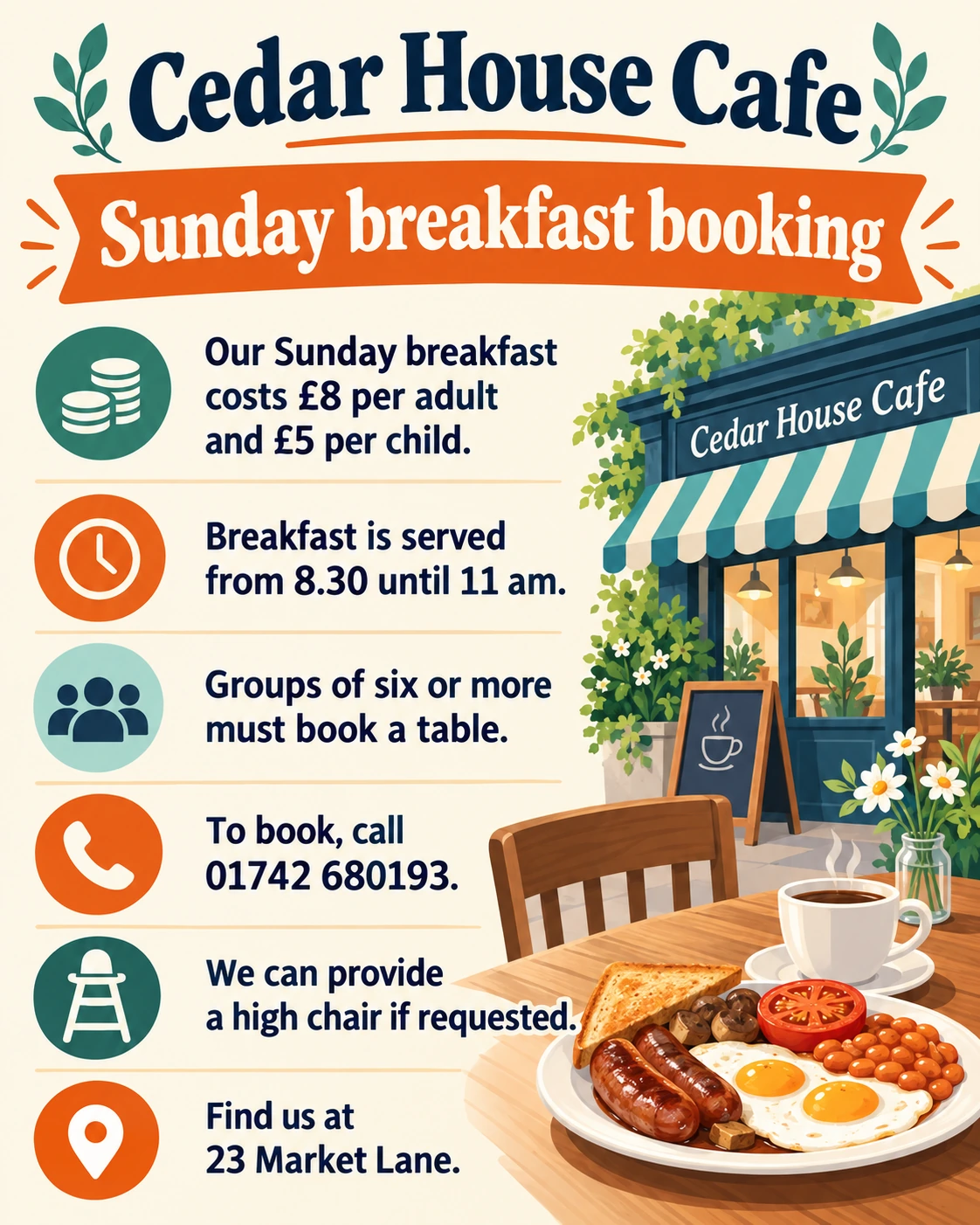
Read text version
Cedar House Cafe — Sunday breakfast booking
Our Sunday breakfast costs £8 per adult and £5 per child. Breakfast is served from 8.30 until 11 am. Groups of six or more must book a table. To book, call 01742 680193. We can provide a high chair if requested. Find us at 23 Market Lane.
Message from Martin to Elise
I've spoken to everyone about Sunday breakfast. There will be seven of us: five adults and two children, including baby Finn. Let's ask for a table at 9.45, so we can walk to the museum afterwards. Please book in your name, Elise Turner, and ask for a high chair for baby Finn. I'll bring his food. Thanks, Martin.
51. Answer: 23 Market Lane / 23 Market Ln / 23 Market Ln.. The cafe notice gives the address as 23 Market Lane. Neither document gives a different street or building number.
52. Answer: 7 / seven. Martin says there will be seven people: five adults and two children. The baby is one of the two children, not an extra eighth person.
53. Answer: 9.45 / 9:45 / 09.45 / 09:45 / 9.45 am / 9:45 am / 9.45am / 9:45am / 09.45 am / 09:45 am / 9.45 a.m. / 9:45 a.m.. Martin requests 9.45 in his message. The notice's 8.30 and 11 are the start and end of breakfast service, not their requested table time.
54. Answer: high chair / a high chair / highchair / a highchair. Martin asks Elise to request a high chair for baby Finn. The cafe notice confirms that a high chair can be provided if requested.
55. Answer: 8 / eight / £8 / 8 pounds / eight pounds / 8.00 / £8.00. The cafe notice charges eight pounds per adult. Five pounds is the child price and must not be entered for an adult.
Write a message about a borrowed book
Write a message of 25–35 words for question 56. Include all three points. Check the sample after you finish. Writing is assessed separately from the score out of 55.
You borrowed an English book from your friend Amira. You have finished reading it. Write her a message of 25–35 words.
- Say what you liked about the book.
- Say when you can return it.
- Ask Amira to recommend another book.
0 words · target 25–35
This writing task is self-checked and is separate from your score out of 55.
Hi Amira, I loved the funny conversations in your book. I can return it after school tomorrow. Could you recommend another story by the same writer? Thanks for lending it to me!
Check: all three points answered; message clear; verbs and spelling checked; 25–35 words.
Ready to check your work?
Submit to grade your whole test, OR use 👁 Show Answer per part / per question.
Learning review & writing checklist
Read each notice for its purpose. Link dialogue replies to the turns before and after each gap. In Part 4, find the exact evidence for each answer and check all three options. Use both source documents for the notes in Part 8.
For grammar gaps, read the whole sentence, choose the correct form, and read it again. For open gaps, type one word only. Check the first letter and spelling in Part 6.
Your writing should answer all three points in 25–35 words. Compare your message with the sample after you finish. The writing sample does not add points to the automatic score.
Show Answer reveals the answer and explanation without filling your response or awarding a mark. After editing a graded answer, submit again for an updated score.