
KET 2 Practice Test 2
Reading & Writing
A Weekend at Willow Quay: explore community activities, follow everyday conversations and practise reading and writing in new situations. This original A2 practice keeps the classic nine-part structure used on this page.
Notices around Willow Quay
Which notice (A–H) matches each statement (1–5)? Use each letter once at most. Notice H is the example.
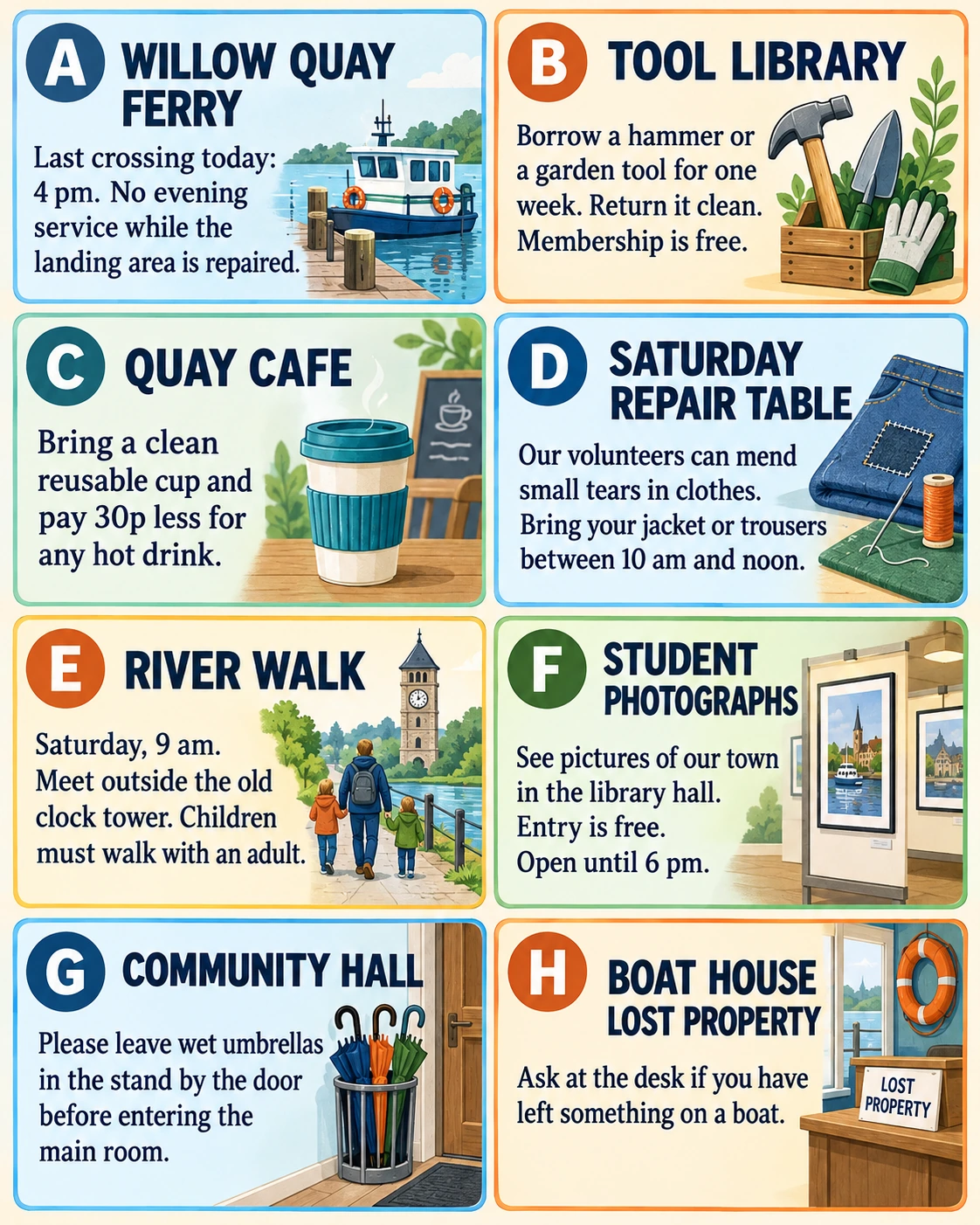
Read notices A–H as text
WILLOW QUAY FERRY
Last crossing today: 4 pm. No evening service while the landing area is repaired.
TOOL LIBRARY
Borrow a hammer or a garden tool for one week. Return it clean. Membership is free.
QUAY CAFE
Bring a clean reusable cup and pay 30p less for any hot drink.
SATURDAY REPAIR TABLE
Our volunteers can mend small tears in clothes. Bring your jacket or trousers between 10 am and noon.
RIVER WALK
Saturday, 9 am. Meet outside the old clock tower. Children must walk with an adult.
STUDENT PHOTOGRAPHS
See pictures of our town in the library hall. Entry is free. Open until 6 pm.
COMMUNITY HALL
Please leave wet umbrellas in the stand by the door before entering the main room.
BOAT HOUSE LOST PROPERTY
Ask at the desk if you have left something on a boat.
Example (not scored): You cannot find something you took on a boat. → H
1. Answer: C. Notice C offers a 30p reduction on hot drinks for customers who bring their own clean reusable cup.
2. Answer: A. Notice A says that the last ferry crossing is at 4 pm and that there is no evening service.
3. Answer: D. Notice D offers help with small tears in jackets or trousers at the Saturday repair table.
4. Answer: G. Notice G asks visitors to leave wet umbrellas in a stand by the door before entering the room.
5. Answer: B. Notice B lets members borrow tools for a week. Membership is free, and the tools must be returned clean.
Preparing a school radio programme
Read the passage. Choose the best word (A, B or C) for each space.
Example (not scored): Our school radio club meets after lessons. → meets — the club comes together regularly
6. Answer: B. A list is a set of things written one after another; here it contains the interview questions.
7. Answer: C. Talked to means had a conversation with someone. Aisha interviewed the boat builder.
8. Answer: A. Loud describes a strong noise. Traffic noise could make the interview recording difficult to hear.
9. Answer: B. Noticed means became aware of something. They heard a mistake when checking their recording.
10. Answer: C. Invited him to visit means asked him to come again. The other verbs do not fit that meaning and pattern.
Everyday conversations
For questions 11–15, choose the best reply (A, B or C). Then complete the longer conversation using choices A–H. Choice E is the example.
Example (not scored): Ruby: Are you free on Saturday? Ellis: Yes, I have no plans. → E
11. Answer: B. Of course offers to do the favour, and the second sentence tells Zara where the pen is.
12. Answer: A. Every twenty minutes describes how often the ferry runs. The other replies give a price and a location.
13. Answer: C. Well done is a natural way to congratulate someone on passing a test.
14. Answer: B. That would be very kind accepts Hugo’s offer of help with the heavy box.
15. Answer: A. Do not worry reassures Poppy, and having another ruler explains why the damage is not a problem.
A longer conversation
A
At the side entrance, next to the bicycle racks.
B
Yes, but which bus goes there?
C
That sounds useful. What time does it begin?
D
Good idea. I will bring my old jacket, then.
E
Yes, I have no plans. (example)
F
Only on Sundays, when the shop is closed.
G
Ten is fine. Where should we meet?
H
Yes, please. My bottle is nearly empty.
16. Answer: C. Ruby suggests a useful activity. Choice C accepts the idea and asks when it begins; Ruby then gives opening times.
17. Answer: G. Ruby proposes arriving at ten. Choice G agrees to ten and asks where to meet, which Ruby answers next.
18. Answer: B. Ellis asks which bus reaches the hall. Ruby answers with the bus number in the following turn.
19. Answer: H. Ruby offers water. Choice H accepts and explains that Ellis’s bottle is nearly empty, so Ruby offers an extra one.
20. Answer: D. Ruby asks Ellis to bring an item needing repair. Choice D names an old jacket, and Ruby then mentions its damaged sleeve.
Nia’s first repairs
Read the article. For questions 21–27, choose A (Right), B (Wrong) or C (Doesn’t say). Choose Doesn’t say when the article gives no information about the statement.
Example (not scored): Nia took a damaged bag to the community hall. → A — Right
A useful Saturday morning
When Nia moved to Willow Quay, she did not know many people. One Saturday, she visited the community hall with a broken school bag. A volunteer called Mr Hale helped her repair the handle. Nia enjoyed the morning so much that she asked if she could help at the next repair cafe.
Mr Hale did not ask her to repair things immediately. Her first job was to welcome visitors and write their names in a notebook. She also made sure that everyone had a chair. The volunteers were busy, but they always explained their work to anyone who was interested.
After a few weeks, Nia learnt to sew buttons onto shirts. She practised on clothes at home before working on a visitor’s coat. Her first repair took twenty minutes. The owner was pleased and came back the following month with a friend.
The repair cafe meets once a month. Visitors do not pay for the volunteers’ time, but they can leave money to help buy materials. Nia likes seeing people use their favourite things again. She also enjoys talking to older neighbours and hearing their stories.
Now Nia is making a simple poster for the next meeting. She hopes more young people will come. She says that learning one small skill can be a good way to meet people.
21. Answer: B. The opening says she did not know many people after moving there. This contradicts the statement that she already had lots of friends.
22. Answer: A. Her first job was welcoming visitors and writing their names. Mr Hale did not ask her to repair things immediately.
23. Answer: C. The article names Mr Hale as a volunteer but gives no information about any earlier job he had.
24. Answer: A. The article explicitly says she practised on clothes at home before working on a visitor’s coat.
25. Answer: B. Visitors do not pay for the volunteers’ time. Leaving money for materials is optional, so a payment for every repair is not required.
26. Answer: C. The article describes her activities at the cafe but never says how she travels there.
27. Answer: A. In the final paragraph, she is making a poster and hopes that more young people will come to the next meeting.
A night at the small museum
Read the passage. Choose the correct word (A, B or C) for each space.
Example (not scored): Last Friday, our class visited a small museum. → visited — a completed action
28. Answer: B. Our is the possessive form before the noun phrase first visit. We and us cannot describe whose visit it was.
29. Answer: C. So introduces the purpose or result: the torches allowed the pupils to see clearly. But and or do not express that link.
30. Answer: A. Through describes movement from one part of a room to another and onward through several rooms.
31. Answer: B. Than introduces a comparison. Older is the comparative adjective needed after much and before than.
32. Answer: C. Ask someone to do something is the correct verb pattern: the teacher asked us to draw.
33. Answer: A. Which introduces a relative clause describing an object, the lamp. Who refers to people, and where describes a place.
34. Answer: C. Visitors is a plural countable noun, so not many is the correct quantity expression. Much is used with uncountable nouns.
35. Answer: B. The visit happened last Friday, so the past simple closed fits the completed event at nine.
Useful everyday objects
Read each description and write the whole word. The first letter is given. Include it in your answer.
Example (not scored): You use this to keep your teeth clean. (t_________) → toothbrush
36. Answer: towel. A towel is a piece of cloth used for drying your body. It has five letters, including the first letter t.
37. Answer: helmet. A helmet is a protective hard hat worn when cycling. It has six letters, including h.
38. Answer: key. A key is the small object put into a lock to open it. The word has three letters, including k.
39. Answer: broom. A broom has a long handle and a brush for sweeping floors. It has five letters, including b.
40. Answer: mirror. A mirror reflects your face so that you can see yourself. The word has six letters, including m.
Helping at the river event
Complete the email with ONE word in each space. The short grammar cues can help you.
Example (not scored): Dear Imogen, Thank you for your message. → for — thank someone for something
Felix
41. Answer: to. Would love is followed by to and the base form of a verb: I would love to help.
42. Answer: to. The verb belong takes the preposition to to identify the owner: the tables belong to the school.
43. Answer: at. Use at to give an exact clock time: arrive at half past eight in the morning.
44. Answer: than. The comparative younger is followed by than when comparing the brother’s age with Felix’s age.
45. Answer: many. Chairs is a plural countable noun. How many asks about the number of chairs needed.
46. Answer: of. The fixed quantity expression is plenty of: there is plenty of space in the car.
47. Answer: an. Old begins with a vowel sound. Use an before the singular noun phrase old camera.
48. Answer: in. The adjective interested is followed by in and an activity: interested in learning.
49. Answer: been. Has never been describes a life experience up to now. Been is the past participle of be.
50. Answer: where. The alternatives are two places, the hall and the quay. Where asks which place they should meet at.
Book a river photography workshop
Read the workshop notice and Keira’s message. Complete Rowan’s booking notes using short answers. Times may use a colon or a full stop.
Example (not scored): Workshop subject: → boats and reflections
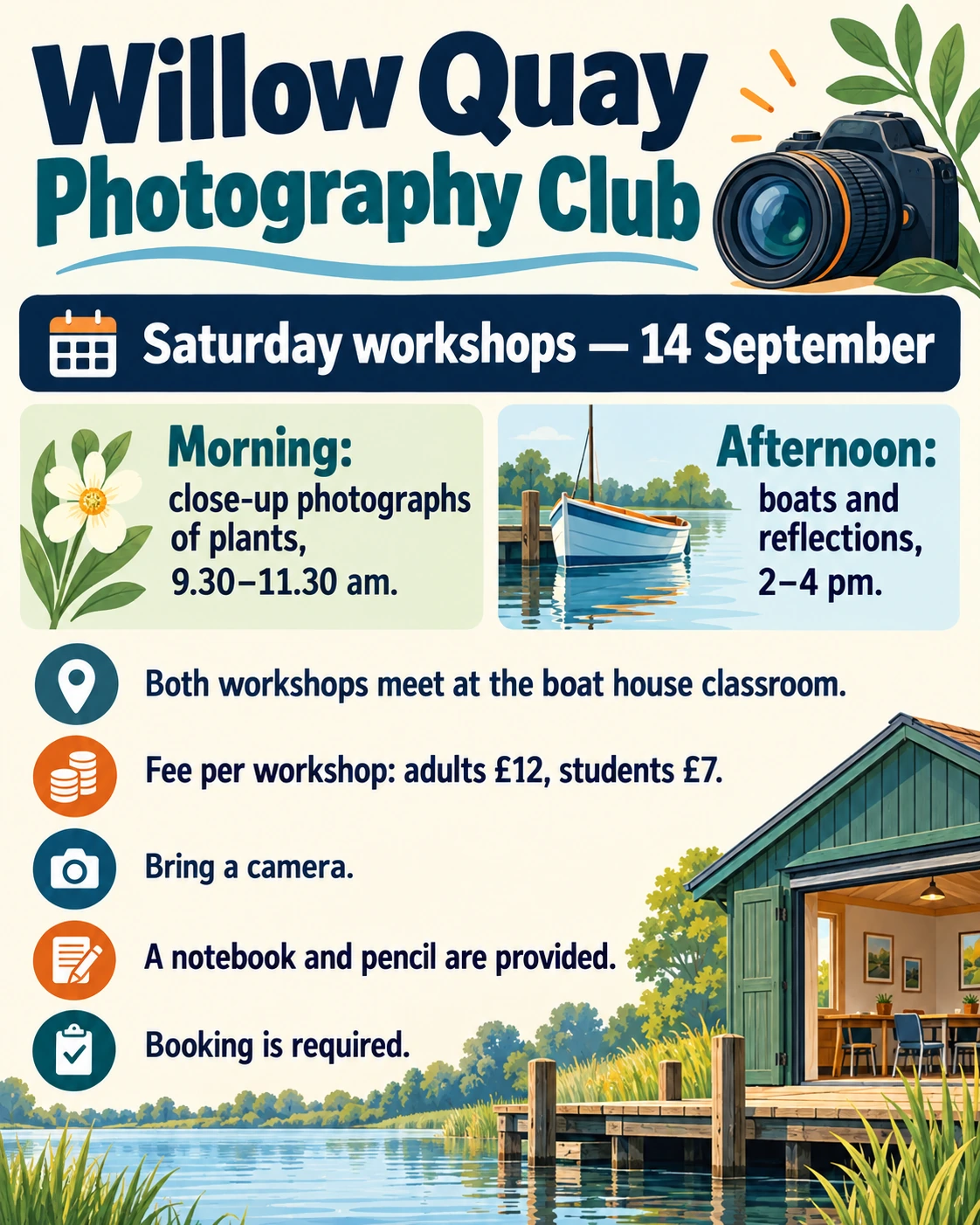
Read text version
Willow Quay Photography Club
Saturday workshops — 14 September
Morning: close-up photographs of plants, 9.30–11.30 am.
Afternoon: boats and reflections, 2–4 pm.
Both workshops meet at the boat house classroom. Fee per workshop: adults £12, students £7. Bring a camera. A notebook and pencil are provided. Booking is required.
Message from Keira to Rowan
Hi Rowan, I have booked us onto the afternoon workshop on 14 September because you wanted to take pictures of boats. We can both use the student price with our college cards. Meet me by the clock tower at 1.40 pm and we can walk to the classroom together. I have a camera for myself, so remember to bring yours. Keira
51. Answer: 14 September / September 14 / 14th September / September 14th / 14 Sept / 14 Sep / Sept 14 / Sep 14 / 14/9 / 14/09. The notice lists workshops on 14 September, and Keira confirms that she has booked the afternoon session for that date.
52. Answer: boat house / the boat house / boathouse / the boathouse / boat house classroom / the boat house classroom / boathouse classroom / the boathouse classroom. Both workshops meet at the boat house classroom. The clock tower is their earlier meeting point, not the classroom.
53. Answer: 2 / 2.00 / 2:00 / 2 pm / 2pm / 2.00 pm / 2:00 pm / 2.00pm / 2:00pm / 14:00 / 14.00 / two / two o’clock / two o'clock. They booked the afternoon workshop, which starts at 2 pm. The 1.40 pm meeting with Keira takes place before the class.
54. Answer: 7 / 7.00 / £7 / £7.00 / seven / 7 pounds / seven pounds. Keira says they both have college cards and can use the student price. The notice gives a student fee of £7.
55. Answer: camera / a camera / his camera / her camera / their camera / own camera / his own camera / her own camera / their own camera. The notice asks participants to bring a camera. Keira has one for herself and reminds Rowan to bring their own; a notebook and pencil are provided.
Write to a friend
Write 25–35 words. Answer all three points. This task is self-checked separately from the automatic score.
Your English-speaking friend Layla wants to join you at a weekend activity. Write an email inviting her. Say what the activity is, where you will meet and what she should bring. Write 25–35 words.
- Say what activity you will do.
- Say where you will meet.
- Say what Layla should bring.
0 words · target 25–35
This writing task is self-checked and is separate from your score out of 55.
Hi Layla, Would you like to join our riverside drawing walk on Sunday? Meet me outside the library at ten. Please bring a pencil and some paper. See you soon, Evan.
Check: all three points answered; message clear; verbs and spelling checked; 25–35 words.
Ready to check your work?
Submit to grade your whole test, OR use 👁 Show Answer per part / per question.
Learning review & writing checklist
Read each notice for its purpose. Link dialogue replies to the turns before and after each gap. In Part 4, distinguish explicit agreement, contradiction and missing information. Use both source documents for the notes in Part 8.
For grammar gaps, read the whole sentence, choose the correct form, and read it again. For open gaps, type one word only. Check the first letter and spelling in Part 6.
Your writing should answer all three points in 25–35 words. Compare your message with the sample after you finish. The writing sample does not add points to the automatic score.
Show Answer reveals the answer and explanation without filling your response or awarding a mark. After editing a graded answer, submit again for an updated score.