
KET 1 Practice Test 4
Reading & Writing
Oakfield Discovery Day: read local notices, follow conversations and discover Leo’s community garden. This original A2 practice keeps the classic nine-part structure used on this page.
Notices around town
Read the eight notices A–H. Match each statement 1–5 to one notice. Use each letter once at most; H is used in the example.
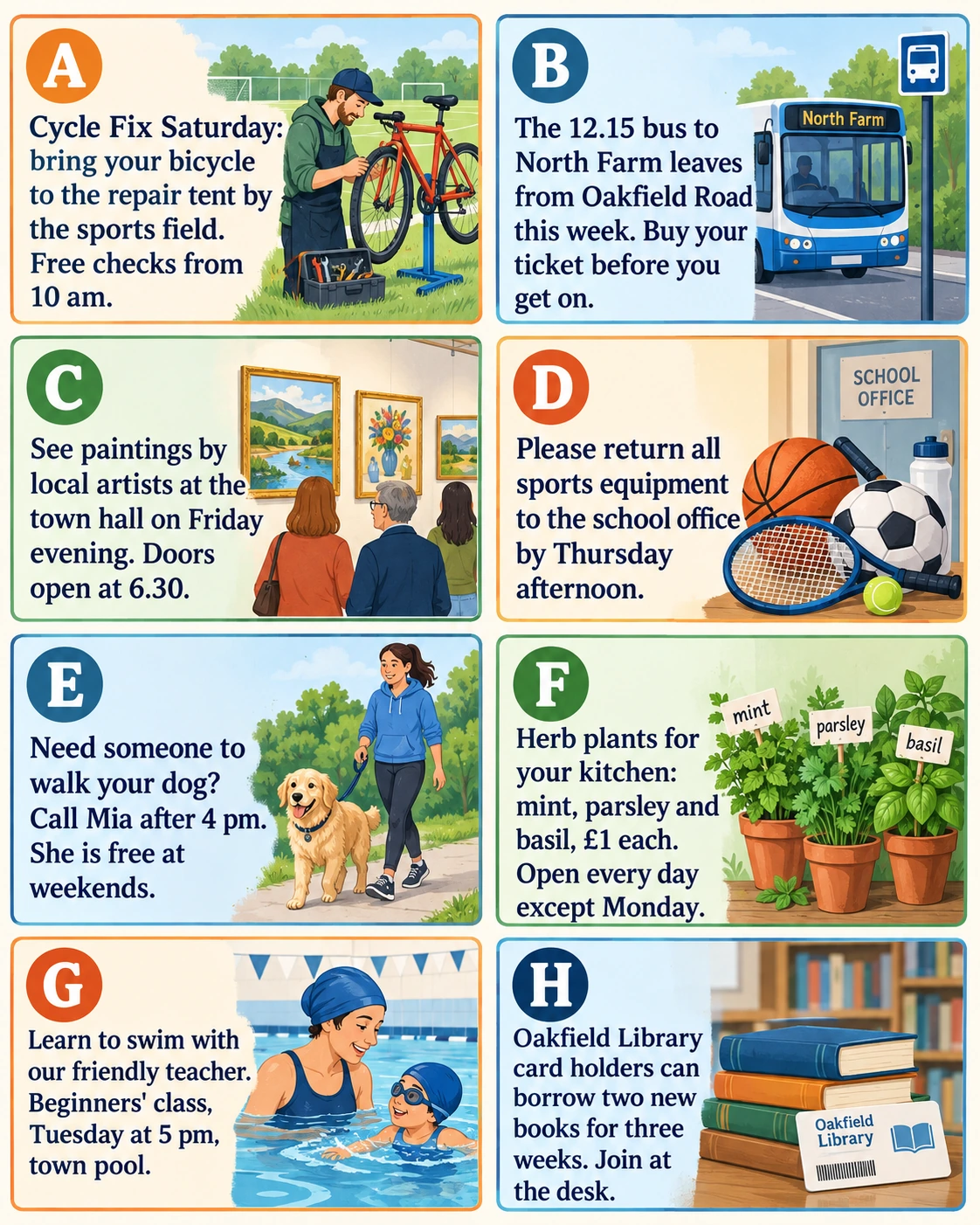
Read notices A–H as text
Cycle Fix Saturday: bring your bicycle to the repair tent by the sports field. Free checks from 10 am.
The 12.15 bus to North Farm leaves from Oakfield Road this week. Buy your ticket before you get on.
See paintings by local artists at the town hall on Friday evening. Doors open at 6.30.
Please return all sports equipment to the school office by Thursday afternoon.
Need someone to walk your dog? Call Mia after 4 pm. She is free at weekends.
Herb plants for your kitchen: mint, parsley and basil, £1 each. Open every day except Monday.
Learn to swim with our friendly teacher. Beginners' class, Tuesday at 5 pm, town pool.
Oakfield Library card holders can borrow two new books for three weeks. Join at the desk.
Example (not scored): You want to borrow books from a local place. → H
1. Answer: C. Notice C invites visitors to see paintings by local artists at the town hall. It is the only notice about looking at local art.
2. Answer: A. Notice A offers free bicycle checks at the repair tent.
3. Answer: G. Notice G advertises a beginners' swimming class for people learning to swim.
4. Answer: E. Notice E says Mia can walk dogs and is free at weekends.
5. Answer: F. Notice F sells mint, parsley and basil plants for a kitchen; these herbs can be used in cooking.
Helping at the animal centre
Read about Ben’s morning as a volunteer. At each numbered gap 6–10, select the word A, B or C that best completes the story.
Example (not scored): Ben went to the centre on Saturday. → went — a completed action in the past
6. Answer: A. A visit is a period spent at a place. Ben went to the animal centre to spend time helping there. An invitation is a request to attend; a journey is the travelling itself.
7. Answer: B. Need extra hands means require more people to help. Workers can need help at busy times; hope and remember do not fit before extra hands here.
8. Answer: C. A basket is a container that can hold several towels. A ticket is a travel or entry document; a mirror is used to see a reflection. Neither is a container for towels.
9. Answer: A. Returned them to the shelf means put the clean bowls back where they belonged. Borrowed and forgot cannot express putting the bowls back in this sentence.
10. Answer: B. Thanked him for giving up his morning means expressed gratitude for his help. Thank someone for is the correct pattern; waited and invited do not fit it.
Replies and a new activity
Choose the most suitable reply A, B or C for each short exchange 11–15. In the longer conversation, choose Anna’s replies A–H for gaps 16–20. E is the example; use each letter once and leave two replies unused.
Example (not scored): Tom asks whether there is room for both of them in the workshop. Anna says two places are still available. → E
11. Answer: B. Of course not agrees politely to the request. I will close it now confirms the action. The other replies describe a room or its location.
12. Answer: A. Offering a larger pair responds to the problem that the shoes are too small. The other replies describe a bus and the weather.
13. Answer: C. Every Friday gives the frequency of the meetings. The library is a place, and twelve is a number of members, so neither answers how often.
14. Answer: B. Well done congratulates Ben on his achievement. The other replies concern a lost bag or a meeting place and do not respond to his good news.
15. Answer: A. Number twelve identifies the bus and outside the market gives its stop. A ticket price and a closing time do not identify which bus to take.
A longer conversation
A
The tall one, so I can put flowers in it.
B
About forty minutes. We will finish before lunch.
C
No, we must leave them here to dry overnight.
D
I left it on the number 8 bus.
E
Yes. The teacher said there are two places left.
F
We only pay for the clay; using the tools is free.
G
Yes, there are spare aprons in that cupboard.
H
My brother usually cycles to school.
16. Answer: F. Tom asks about paying to use tools. F says tool use is free and distinguishes it from the charge for clay. Tom then accepts this arrangement.
17. Answer: B. Tom asks how long the lesson takes. B gives a duration of forty minutes and a finishing time before lunch, allowing him to catch his bus.
18. Answer: C. Tom asks whether they can take their pots home today. C explains that they must leave them overnight first. Tom then agrees to collect his pot tomorrow.
19. Answer: A. Tom asks Anna to choose between the wide bowl and the tall pot. A chooses the tall pot for flowers; Tom’s next sentence refers to those flowers.
20. Answer: G. Tom needs to borrow an apron. G answers yes and identifies the cupboard containing spare aprons. Tom then says he will get one.
A new neighbour in the garden
Read Leo’s story and judge statements 21–27. Choose A Right when the story supports the statement, B Wrong when it contradicts it, or C Doesn’t say when the needed information is missing.
Example (not scored): The garden was behind the old library. → A — Right
Leo and the community garden
When Leo moved to Oakfield, he did not know anyone in his new street. One Saturday, he saw a poster for a community garden and decided to visit. The garden was behind the old library. A volunteer called Ruth showed him the small beds where neighbours grew vegetables and flowers. Leo chose to plant lettuce because it would be ready before the summer holiday. He came back every Wednesday after school to water it. At first, he worked alone, but soon he began talking with two other children, Sam and Noor. They made a sign together to show visitors which plants they could touch. In June, the garden held a lunch for everyone who had helped. Leo's family brought bread and cheese, while Ruth made a large salad with lettuce from the beds. Leo had never eaten lettuce that he had grown himself before. He was surprised that it tasted sweeter than the lettuce from the supermarket. He now helps at the garden most weeks. He hopes to grow tomatoes next year, although Ruth says the garden needs a warmer place for them. Leo still feels shy when he meets a large group, so he usually works with Sam or Noor. He enjoys the garden because he learns new things and has friends nearby.
21. Answer: A. The story says he saw a poster for the community garden and then decided to visit.
22. Answer: B. The story places the garden behind the old library. In front of and behind are opposite positions, so the statement contradicts the story.
23. Answer: A. He chose lettuce because it would be ready before the summer holiday.
24. Answer: C. Ruth showed him the beds, but the story does not say who supplied the seeds.
25. Answer: B. The story explicitly says that at first he worked alone. He began talking and working with Sam and Noor later.
26. Answer: C. The text names two children but gives no information about whether they were twins.
27. Answer: B. Leo's family brought bread and cheese; Ruth made the salad.
A visit to the nature centre
Read the account of a class visit. For gaps 28–35, select the grammatical word or form A, B or C that completes the sentence.
Example (not scored): The visit took place last month. → took — past form of take
28. Answer: B. Visited is the past form needed for a completed visit last month.
29. Answer: A. Because introduces a clause explaining the reason for arriving early: the activity began at nine. During and without must be followed by a noun or an -ing form, not this complete clause.
30. Answer: C. While links staying together with the time they walked.
31. Answer: B. That refers to the bird; who is for people and where for places.
32. Answer: B. Than introduces a comparison between standing still and talking. Easier is the comparative of easy; easy is the base form, and easiest is the superlative.
33. Answer: C. Helped me is the past expression for the guide giving assistance.
34. Answer: A. Each takes the singular noun cup, referring to every individual cup.
35. Answer: B. In a few weeks describes a future time after several weeks.
Word definitions
Use the definition, first letter and number of spaces to identify each word. Type the complete word, including the first letter, for questions 36–40.
Example (not scored): A place where you can buy medicine. (p_______) → pharmacy — eight letters, including p
36. Answer: museum. A museum displays interesting or historical objects; it begins with m and has six letters.
37. Answer: nurse. A nurse cares for patients in a hospital; the five-letter answer begins with n.
38. Answer: ticket. A ticket gives permission to travel and begins with t; it has six letters.
39. Answer: dentist. A dentist checks and treats teeth. The seven-letter job name begins with d; type the full word dentist.
40. Answer: library. A library lends books to readers; spell the full word beginning with l.
Two emails about an art class
Complete both emails. Write ONE word in each space. The parenthetical hints show the kind of word needed.
Example (not scored): The teacher has told us about the activity. → about — introduces the topic of the information
Lucy
Ben
41. Answer: to. Would love to is followed by the infinitive come.
42. Answer: on. Use on before the name of a day: on Thursday. At and in are not used directly with a day name.
43. Answer: at. Use at before a specific clock time: at six o’clock. On is used for days, while in is used for months, years and parts of the day.
44. Answer: because / as / since. Because, as and since can each introduce the reason Lucy wants to go: she has never tried pottery. Each accepted answer is one word.
45. Answer: for. A place for me is a place reserved for Lucy.
46. Answer: and. Between links two reference points with and: between the library and the sports hall.
47. Answer: it. The statement begins It starts. Its negative question tag is doesn’t it, so the missing subject pronoun is it.
48. Answer: than. Comparatives use longer than when comparing durations.
49. Answer: an. Old begins with a vowel sound, so the phrase is an old shirt.
50. Answer: to. Look forward to is followed by a noun or an -ing form. Here the complete expression is looking forward to seeing you.
A school photography walk
Read the notice and the message. Complete the notes with words or numbers. Follow each hint in parentheses.
Example (not scored): What should Lucy bring? (device) → her phone
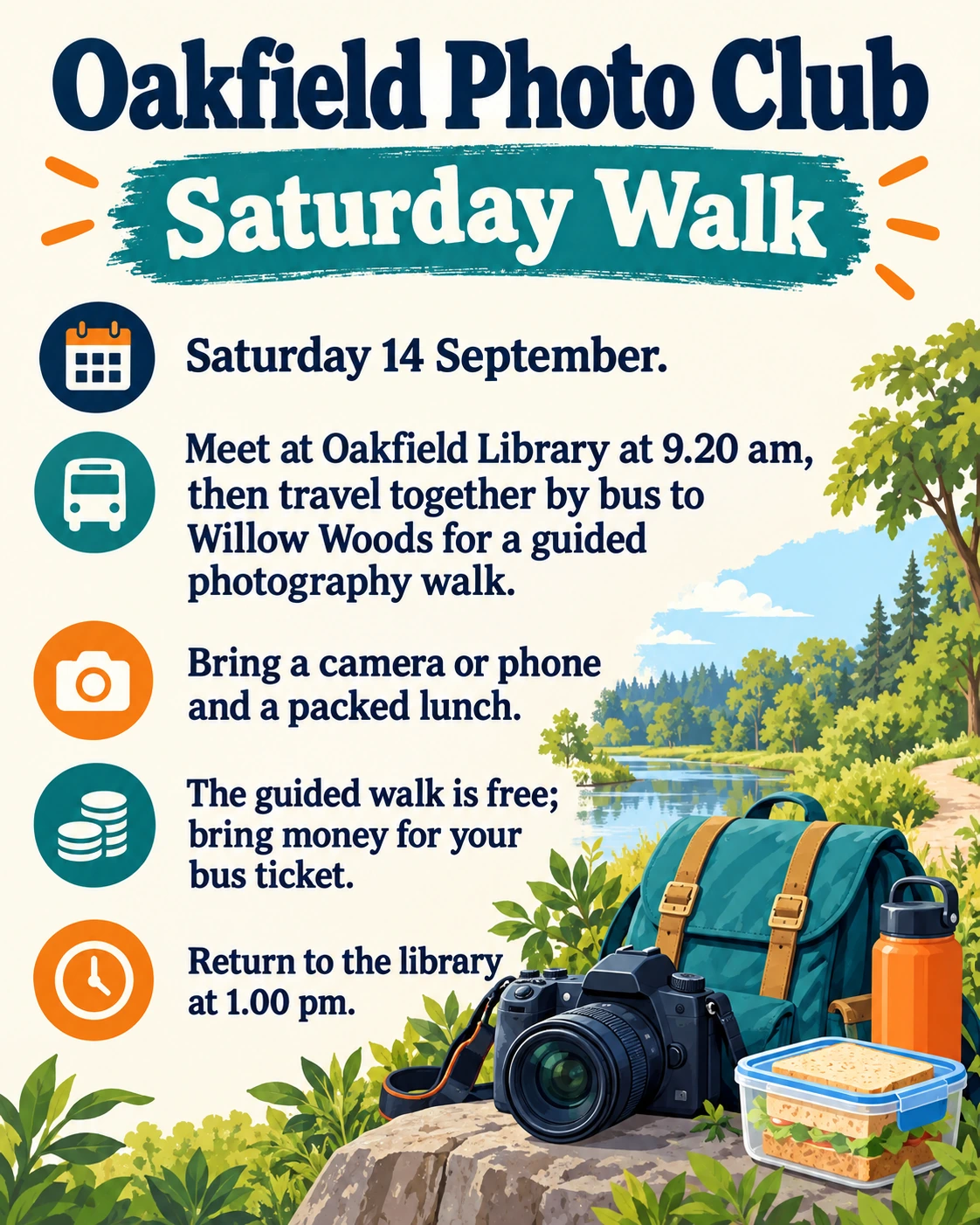
Read text version
Oakfield Photo Club — Saturday Walk
Saturday 14 September. Meet at Oakfield Library at 9.20 am, then travel together by bus to Willow Woods for a guided photography walk. Bring a camera or phone and a packed lunch. The guided walk is free; bring money for your bus ticket. Return to the library at 1.00 pm.
Message from Tom to Lucy
Hi Lucy, I have put your name on the list for the photo walk on 14 September. We will meet at the library at 9.20 am. Please bring your phone because I will bring my camera. I will pack two sandwiches for lunch. Our group will take the number 4 bus to Willow Woods. See you, Tom.
51. Answer: 14 September / September 14 / 14th September / September 14th / 14 Sep / Sep 14 / 14/9 / 14/09 / 14 Sept / Sept 14 / 14th Sep / 14th Sept / 14 September.. Both sources give 14 September; either day-month or month-day order is clear.
52. Answer: Oakfield Library / the Oakfield Library / library / the library. Both sources say they meet at Oakfield Library, the meeting point.
53. Answer: 9.20 / 9:20 / 9.20 am / 9:20 am / 9.20am / 9:20am / 09.20 / 09:20 / 09:20 am / 09.20 am / 9:20 a.m. / 9.20 a.m. / 09:20am / 09.20am. The sources give 9.20 am; the return time is 1.00 pm.
54. Answer: two / 2. In his message, Tom says he will pack two sandwiches. The announcement asks everyone to bring lunch but does not give a number.
55. Answer: 4 / four. Tom says they will take the number 4 bus to Willow Woods.
Write a short email
Write one email of 25–35 words for question 56. Include all three points below. Use the sample to check your work after writing; this task is separate from the automatic score.
Your English-speaking friend Ben has a free afternoon and asks for your ideas. Write him an email suggesting an activity. Cover the three points below in 25–35 words.
- Say what you would like to do together.
- Say where you would go.
- Explain why you would enjoy the activity.
0 words · target 25–35
This writing task is self-checked and is separate from your score out of 55.
Hi Ben, Let’s explore the old castle beside the river. We can climb the tower together. I love finding out how people lived long ago, so it should be fun. From Lucy
Check: all three points answered; message clear; verbs and spelling checked; 25–35 words.
Ready to check your work?
Submit to grade your whole test, OR use 👁 Show Answer per part / per question.
Learning review & writing checklist
For the notices, identify what each service offers before matching it to a need. Follow the pottery conversation turn by turn. A reply must fit both the question before it and Tom’s next response.
For Leo’s story, separate a contradiction from missing information: a detail that is not mentioned is not automatically wrong. In the nature-centre cloze, look for time words, clause patterns and the comparison with than. Write whole words in Part 6 and only one word per email gap in Part 7.
Check dates and times in both photo-walk documents; the meeting time differs from the return time. For your email, suggest an activity, locate it and explain your reason. Aim for 25–35 words and compare with the sample after writing. Writing earns no automatic marks.
Show Answer reveals the answer and explanation without filling your response or awarding a mark. After editing a graded answer, submit again for an updated score.