
KET 1 Practice Test 2
Reading & Writing
Meadowbridge Weekend Plans: read everyday notices, complete conversations and use short texts to practise A2 reading and writing. This original practice keeps the classic nine-part structure used on this page.
Read the notices
Which notice (A–H) matches each statement (1–5)? Use each letter once at most. Notice H is the example.
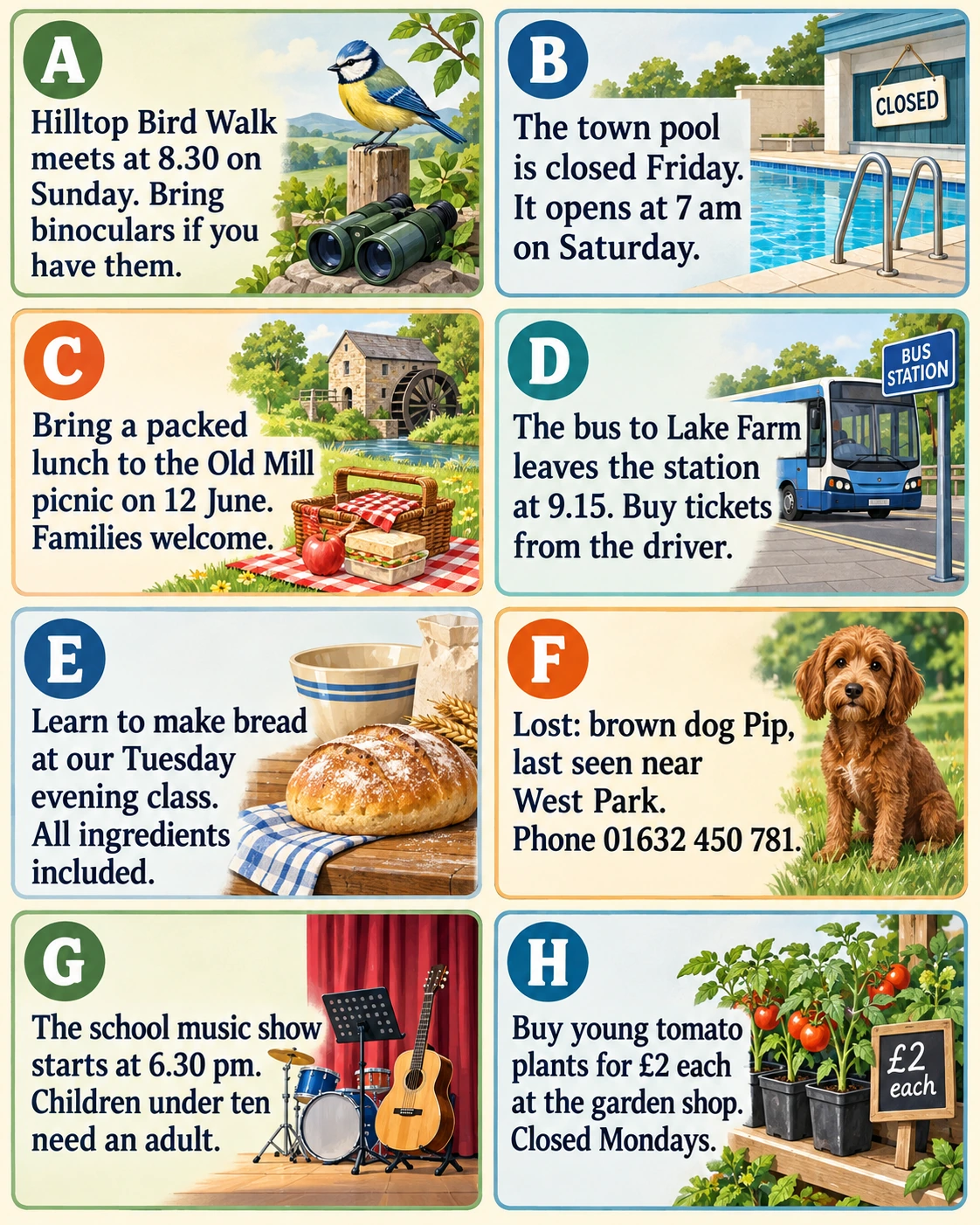
Read notices A–H as text
Hilltop Bird Walk meets at 8.30 on Sunday. Bring binoculars if you have them.
The town pool is closed Friday. It opens at 7 am on Saturday.
Bring a packed lunch to the Old Mill picnic on 12 June. Families welcome.
The bus to Lake Farm leaves the station at 9.15. Buy tickets from the driver.
Learn to make bread at our Tuesday evening class. All ingredients included.
Lost: brown dog Pip, last seen near West Park. Phone 01632 450 781.
The school music show starts at 6.30 pm. Children under ten need an adult.
Buy young tomato plants for £2 each at the garden shop. Closed Mondays.
Example (not scored): You want to buy something to grow in your garden. → H
1. Answer: G. G advertises the school music show at 6.30 pm. It is the only notice about watching a musical performance.
2. Answer: D. D says the bus goes to Lake Farm and leaves from the station. It also explains where to buy a ticket.
3. Answer: F. F describes Pip, a missing brown dog, and gives a contact number. The other notices do not ask for help finding a pet.
4. Answer: E. E offers an evening bread-making lesson and says all ingredients are included, so learners do not have to bring them.
5. Answer: C. C invites families to an Old Mill picnic and asks them to bring a packed lunch. A picnic is a meal eaten outdoors.
Our aquarium visit
Choose the correct word A, B or C for each space.
Example (not scored): Our family visited the aquarium on Sunday. → visited — a completed action in the past
6. Answer: B. Visitors show their tickets at an entrance before going inside. A ceiling is above a room, and a blanket is a covering.
7. Answer: C. A better view means being able to see something more clearly. Price and taste do not describe seeing the sharks.
8. Answer: A. Keep our voices low means speak quietly, which avoids disturbing sleeping animals. Wide and thick do not describe speaking quietly.
9. Answer: B. Chose a table means decided where to sit in the cafe. Posted means sent something, and carried means moved it by holding it.
10. Answer: A. Tell someone about a day means give them news of it. Tell takes a person directly; speak and say do not fit before my friend here.
A visit to the science centre
Ben and Sophie are two friends planning a visit to the science centre. For 11–15, choose the best reply A, B or C. For 16–20, choose Sophie's missing reply A–H. Use each letter once. E is the example; two other replies are not needed.
Example (not scored): Ben: Have you been to the new science centre? Sophie: Yes, I went there with my cousin last week. → E
11. Answer: B. Yes, nobody is sitting there tells Ella that he can use the seat. The other replies describe a ticket or a journey.
12. Answer: C. Never mind offers comfort after a disappointing result. Noah can try again; the other replies do not respond to her news.
13. Answer: A. Until next Friday gives the return deadline, answering how long Grace may borrow the book. The other replies describe its position or topic.
14. Answer: C. Of course accepts the request to make the music quieter, and Sorry acknowledges the disturbance. The other replies do not agree to reduce the volume.
15. Answer: B. That would be kind accepts the offer of help. The other replies give a purchase time or mention a different trip.
A longer conversation
A
We can meet at the front gate at ten.
B
I can bring my camera and take some.
C
I need to catch the bus at four.
D
No, I have never tried it.
E
Yes, I went there with my cousin last week.
F
I will ask my mum tonight.
G
Only if it rains heavily.
H
It is beside the post office, opposite the bakery.
16. Answer: F. Ben invites Sophie to the centre. She needs to ask her mum first, and Ben then tells her to ask and send him a message.
17. Answer: H. Ben asks where the centre is. The reply gives its position beside the post office and opposite the bakery.
18. Answer: B. Ben asks Sophie to take some photos. Offering to bring a camera and take some answers this request directly.
19. Answer: A. Ben asks both where and when to meet. The front gate gives a place, and ten gives a time.
20. Answer: G. Sophie agrees to use the bus only in heavy rain. Ben then confirms that they will walk with umbrellas if the rain is light.
Three people and their free-time activities
Read the three texts. For each question choose A, B or C. A letter can be used more than once.
Example (not scored): Who takes pictures outdoors? → B — Emma photographs birds in nearby fields.
A · Jack learns to cook
Jack began cooking so he could help at home while his parents were working. Every Wednesday, he makes the evening meal. He follows recipes that his grandfather wrote in an old notebook. His little sister cannot eat eggs, so he checks every ingredient before he starts. In summer, he wants to invite his friends round for dinner.
B · Emma's nature photos
Emma takes photographs of birds in the fields near her home. She goes out early, before the paths become busy. Some of her pictures appear in the school newsletter. She uses a tablet to make the pictures clearer but keeps their natural colours. In August, her favourite photographs will be on display at the town library.
C · Sam's running group
Sam wanted to get fitter, so he joined a running group. The members meet in the park on Tuesday evenings. Their coach helps beginners find a speed that feels comfortable. Sam enjoys chatting to the other runners. Next month, they will run five kilometres to collect money for the local animal centre.
21. Answer: A. Jack began cooking to help at home while his parents were working. This is the stated reason he started the activity.
22. Answer: B. Emma chooses early mornings because the paths are less busy then. Neither Jack nor Sam chooses a time to avoid other people.
23. Answer: C. Sam belongs to a group whose coach helps beginners choose a comfortable running speed. This is support for new members.
24. Answer: B. Emma will display her favourite photographs in the town library in August. The library is the public building mentioned.
25. Answer: A. Jack checks ingredients because his little sister cannot eat eggs. His checks help him prepare a meal she can eat.
26. Answer: C. Sam and his running group plan to collect money for the animal centre. This is the event that supports a good cause.
27. Answer: A. Jack follows recipes written in his grandfather's notebook. Recipes are instructions for cooking, and his grandfather is a family member.
The school book fair
Choose the correct word A, B or C for each space.
Example (not scored): Our school is holding a fair next week. → is holding — planned event
28. Answer: B. That refers to books and introduces a clause describing them. Who refers to people, and where refers to places.
29. Answer: A. Near the library means close to it. Between needs two reference points, and across would need from before the library here.
30. Answer: A. Look signals an action happening now. The plural subject two teachers takes are moving; is moving is singular and moved is past.
31. Answer: B. Each book is singular, so it takes is. Is marked is the passive form used here to describe the price label.
32. Answer: A. The expression is pay in cash. By card uses a different preposition; on cash and at cash are not correct here.
33. Answer: B. Go to names the destination of the money: the garden project. Go for the project and go from the project do not express this meaning.
34. Answer: B. The plural subject organisers takes have + past participle: have already sent. Has is singular, and is sent would have a different structure.
35. Answer: B. Hope is followed by to + base verb: hope to sell. For and that cannot be followed directly by sell in this sentence.
Complete the definitions
Type the whole word, including the first letter. The lines show the missing letters.
Example (not scored): A place where you can borrow books. (l______) → library — type all seven letters
36. Answer: photographer. Photographer is a twelve-letter noun for someone who takes photographs, especially as a job. Type the whole word, including p.
37. Answer: aquarium. Aquarium is an eight-letter noun for a place with tanks displaying fish and other water animals. Include the first letter a.
38. Answer: coach. Coach is a five-letter noun for a person who trains a team or helps people improve at a sport. Include the first letter c.
39. Answer: notebook. Notebook is an eight-letter word for a book of empty pages used for notes. Type all eight letters, including n.
40. Answer: forest. Forest is a six-letter noun for a large area covered with trees. Type all six letters, including the first letter f.
Planning the picnic
Write ONE word in each space. Short hints in parentheses may help.
Example (not scored): I am writing about our picnic. → about — the topic of the message
Chloe
41. Answer: to. Would like is followed by to + base verb: would you like to help. The missing word links like with help.
42. Answer: how. How many asks about the number of countable things. Plates is a plural countable noun.
43. Answer: an. Idea begins with a vowel sound. The singular countable noun needs the article an here: I have an idea.
44. Answer: when. The next sentence says Chloe needs to know the time. When asks about the time that the picnic starts.
45. Answer: not. Does not + base verb makes the negative condition: if it does not rain. They plan to cycle in dry weather.
46. Answer: than. The comparative longer is followed by than when comparing the cycle ride with the bus journey.
47. Answer: to. The fixed expression belongs to identifies the owner of something: the bicycle belongs to my sister.
48. Answer: much. Food is uncountable. The comparison is as much food as; many would need a plural countable noun.
49. Answer: have. The plural subject we takes have + past participle for the present perfect: we have already bought.
50. Answer: as. The fixed comparison uses the same … as: in the same place as last year.
Lucy's pottery class notes
Read the class notice and James's message. Complete Lucy's notes with a short answer. You can write words or numbers; a time can use a colon or a full stop.
Example (not scored): Where can people pay? → at reception
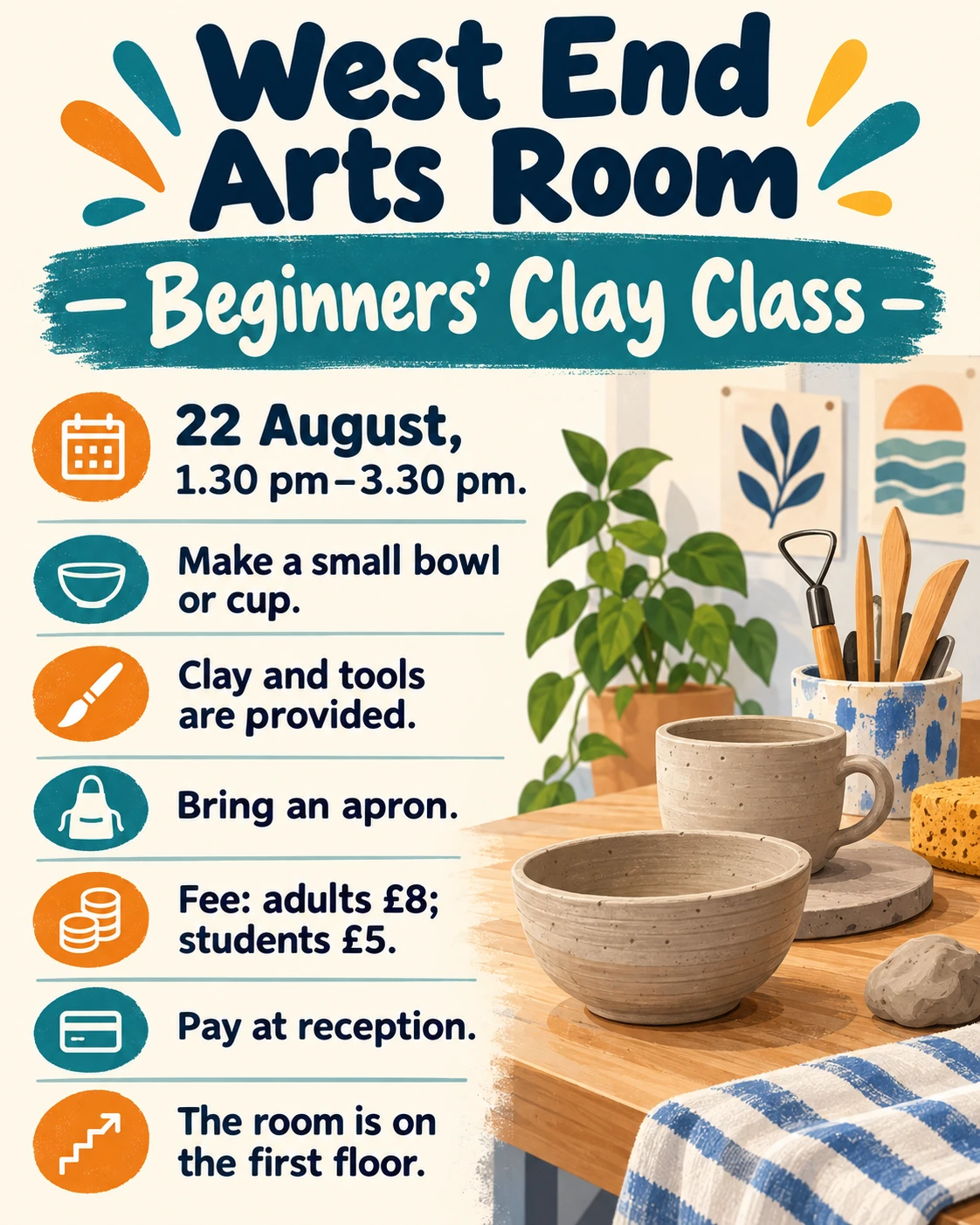
Read text version
West End Arts Room — Clay Class
West End Arts Room — Beginners' Clay Class
22 August, 1.30 pm–3.30 pm. Make a small bowl or cup. Clay and tools are provided. Bring an apron. Fee: adults £8; students £5. Pay at reception. The room is on the first floor.
Message from James to Lucy
Hi Lucy, I booked two places for the afternoon class on 22 August. I chose to make a bowl and put your name down for a cup, as you asked. We both have student cards, so I chose the student price. Meet me at the front entrance at 1.10 pm. I'll bring my own apron, so please bring one for yourself. James
51. Answer: 22 August / August 22 / 22nd August / August 22nd / 22/8 / 22/08 / 22 Aug / Aug 22 / 22nd Aug / Aug 22nd. Both the notice and James's booking message give 22 August. The date is the same whichever object they choose to make.
52. Answer: cup / a cup / small cup / a small cup. James says he booked a cup for Lucy, as she asked. He will make a bowl, which is the other choice in the notice.
53. Answer: 1.30 / 1:30 / 1.30 pm / 1:30 pm / 1.30pm / 1:30pm / 13:30 / 13.30 / half past one. The class begins at 1.30 pm. Their 1.10 pm meeting is twenty minutes earlier, so it is not the class starting time.
54. Answer: 5 / 5.00 / £5 / £5.00 / 5 pounds / five pounds / five. The notice gives a student fee of £5, and James confirms that they both have student cards. The £8 adult fee does not apply.
55. Answer: apron / an apron / her apron / own apron / her own apron. The notice asks everyone to bring an apron. James will bring his own and asks Lucy to bring one for herself; tools and clay are provided.
Write an email
Write 25–35 words. Answer all three points. This task is self-checked separately from the automatic score.
Your English-speaking friend Alex wants to try a new hobby. Write an email about a hobby you enjoy. Say what you do, when you do it and why you like it. Write 25–35 words.
- Say what hobby you enjoy.
- Say when you do it.
- Explain why you like it.
0 words · target 25–35
This writing task is self-checked and is separate from your score out of 55.
Hi Alex, I enjoy watching birds in the park. I go there on Saturday mornings with my camera. I like it because I can relax and learn about nature. Best wishes, Emily.
Check: all three points answered; message clear; verbs and spelling checked; 25–35 words.
Ready to check your work?
Submit to grade your whole test, OR use 👁 Show Answer per part / per question.
Learning review & writing checklist
Read each notice for its purpose. In conversations, check what comes before and after the gap. Use the exact evidence in the texts when matching people or completing notes.
For grammar gaps, read the whole sentence, choose the correct form, and read it again. For open gaps, type one word only. Check the first letter and spelling in Part 6.
Your writing should answer all three points in 25–35 words. Compare your message with the sample after you finish. The writing sample does not add points to the automatic score.
Show Answer reveals the answer and explanation without filling your response or awarding a mark. After editing a graded answer, submit again for an updated score.