
All English 4U · CELPIP Writing · Set 9 · Practice Test 1
Sharing Neighbourhood Memories on Local Radio
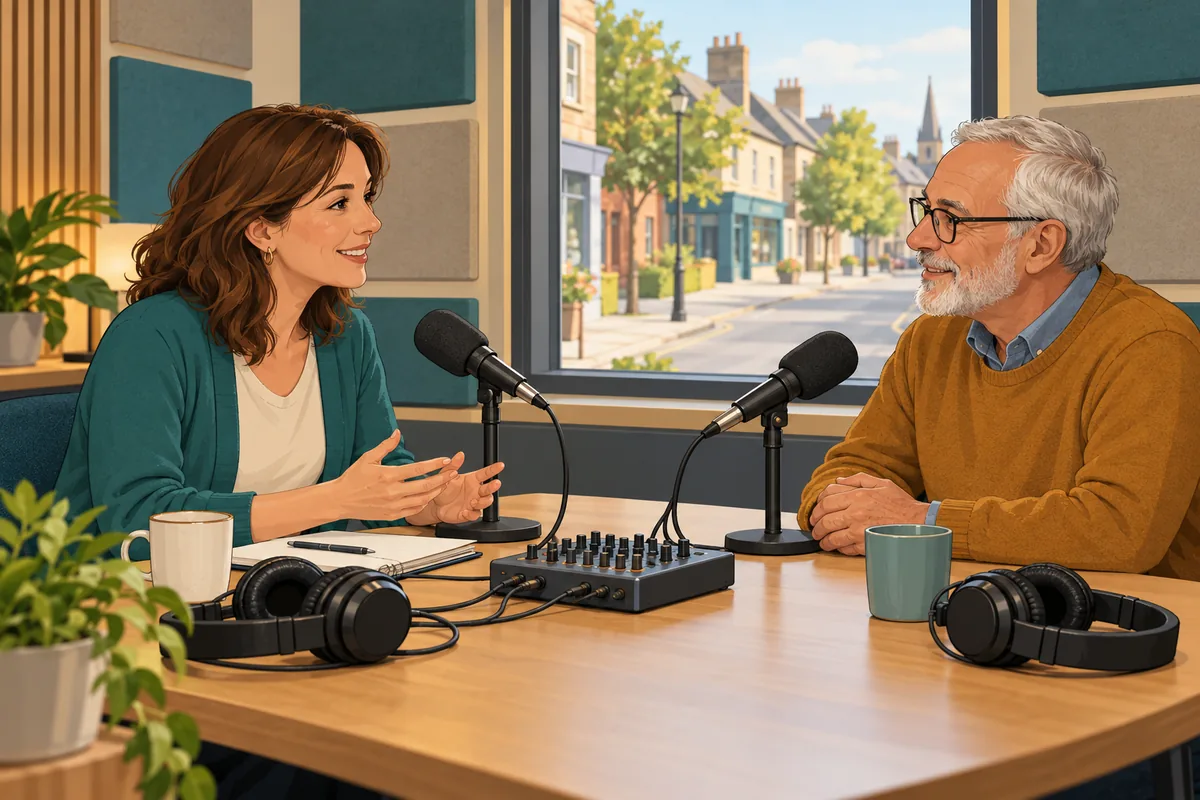
Practise writing to a local radio producer about an oral-history contribution, then recommend a format for inviting more residents to share their memories. Use the original models and revision notes to plan and improve your responses.
Write both responses, review each checklist, then check completion.
Your draft stays in this browser when storage is available. Export a copy to keep it.
0 of 2 tasks checked
This practice uses self-review. It does not automatically grade language or award an official score.
Task 1 · Writing an Email
27 minutes · 150–200 words
Your situation
A local radio station is preparing a short series about everyday changes in the neighbourhood. Its website invites residents to suggest a memory or experience for a possible recorded segment. You have lived nearby for several years and would like to contribute a story about how the Saturday farmers market became a regular meeting place for neighbours. The invitation does not explain how recordings are arranged or how residents who do not want to be recorded can take part.
Write to the radio producer in 150-200 words. In your email:
- Describe the neighbourhood story you would like to share.
- Ask about the arrangements for recording and using your contribution.
- Suggest a way listeners could also share their memories.
The timer is a practice aid. At zero, your writing stays editable. Starting the other timer pauses this one.
Plan this response
- Introduce yourself briefly and name the story you are proposing.
- Describe a concrete memory from your own experience; make clear that it is your recollection, not a claim about every resident.
- Ask where and when recording would happen and how the station plans to use the contribution.
- Suggest an inclusive way for listeners to respond, while presenting it as an idea rather than a confirmed station plan.
- Close courteously and invite the producer to share next steps.
Models viewed. Compare the ideas, then write in your own words.
Original All English 4U learning examples. These labels describe writing features; they are not certified CELPIP scores. Several answers are possible.
Developing: shares a personal memory · 182 words
Subject: A market memory for your series
Dear Producer,
I saw your invitation for neighbourhood stories and would like to describe the Saturday farmers market. When I first moved here, I only visited to buy bread. After several months, I began recognising the stallholders and other shoppers. Now I often stop to exchange news with neighbours. These small conversations have helped me feel at home in the area.
Could you explain where the recording would take place and how long I should speak? I have never contributed to a radio programme, so I need know what to prepare. Please also tell me how the recording might be edited and when it could be broadcast.
Listeners who does not want to speak on air could send a short written memory through your website. You could ask their permission to read it during the programme. This might include people who have a story but feel nervous about recording their voice.
Thank you for considering my suggestion. I would be happy to discuss whether my market memory would suit the series.
Kind regards,
Taylor Brooks
What to notice: The email covers the market memory, recording and use questions, and a written participation route. Two errors are deliberate: need know must be need to know, and Listeners who does not want must be Listeners who do not want. The revision notes explain both.
First draft: I have never contributed to a radio programme, so I need know what to prepare.
Revision: I have never contributed to a radio programme, so I need to know what to prepare.
Use need to know. Also replace Listeners who does not want with Listeners who do not want: listeners is plural. These are the two deliberate errors in this model.
Clear: asks about the recording process · 186 words
Subject: Sharing a Saturday market story
Hello Radio Producer,
I would like to offer a contribution to your neighbourhood series. I have visited the Saturday farmers market for several years, and my story would describe how a shopping trip became a chance to meet people. I remember buying apples from the same stall each week and gradually learning the names of other regular visitors. I would focus on those ordinary conversations and what they meant to me.
Could you explain how the recording is arranged? Please let me know whether contributors visit the station or record remotely, and how much time to allow. I would also appreciate information about editing, permission to use my voice and the likely broadcast date.
For listeners who prefer writing, you could put a short question on the station website: which local place brings back a happy memory? People could submit a few sentences and say whether they agree to have them read aloud.
Thank you for inviting suggestions from residents. Please let me know whether this contribution fits your plans and what I should do next.
Best wishes,
Rina Shah
What to notice: This model develops one personal memory and asks focused questions about recording, permission, editing and timing. The website question is a proposed listener activity, not an existing station policy.
First draft: I would also appreciate information about editing, permission to use my voice and the likely broadcast date.
Revision: Please also explain editing, permission to use my voice and the likely broadcast date.
A direct request can remain polite and makes the three information needs easy to find.
Strong: connects a story with listener participation · 178 words
Subject: Proposed contribution about the farmers market
Dear Producer,
Your invitation to share neighbourhood memories caught my attention. I would like to describe how the Saturday farmers market became part of my social life. At first, I went there simply to buy vegetables. Gradually, familiar greetings turned into conversations with stallholders and neighbours. One rainy morning, several of us sheltered beside a stall and exchanged recipes. That small moment captures the sense of belonging I hope to convey.
Could you tell me the expected recording length and whether interviews take place at the station or remotely? I would also like to understand how you obtain permission to edit and broadcast a contribution. Knowing the process would help me prepare an appropriate account.
To involve listeners, you could invite brief written memories of places where they meet familiar faces. With each writer's permission, the host could read a selection. This would offer a route for people who prefer not to record themselves.
Thank you for considering this proposal. I would welcome advice about the next step.
Sincerely,
Morgan Lee
What to notice: The account uses a specific rainy-market moment to support its main point. It separates questions about the recording process from a proposal for listener participation and permission.
First draft: That small moment captures the sense of belonging I hope to convey.
Revision: That shared shelter from the rain captures the sense of belonging I hope to convey.
The revision links the reflection to the particular event rather than referring vaguely to a moment.
Task 2 · Responding to Survey Questions
26 minutes · 150–200 words
Your situation
The station is deciding how to present residents’ neighbourhood memories. Option A is a live phone-in discussion where callers share stories during one scheduled programme and the host can ask follow-up questions. Option B is a series of edited recorded interviews, collected in advance and broadcast in shorter segments over several weeks. The producer is asking which format listeners would prefer.
Choose the proposal you prefer. Explain your reasons in 150-200 words, using relevant examples and considering the other option.
The timer is a practice aid. At zero, your writing stays editable. Starting the other timer pauses this one.
Plan this response
- Name Option A or B near the start and keep your position consistent.
- Explain how your choice could help residents share memories, using a realistic example.
- Consider the other format fairly: live follow-up conversation or edited stories spread over time.
- Mention a limitation of your preferred format and a strength of the alternative.
- End with a clear recommendation; do not add production details that the survey has not specified.
Models viewed. Compare the ideas, then write in your own words.
Original All English 4U learning examples. These labels describe writing features; they are not certified CELPIP scores. Several answers are possible.
Developing: supports Option B · Option B · 179 words
I prefer Option B, edited recorded interviews. People can shares a memory in advance and have time to organise their ideas. If I described the farmers market, I would want to think about which details help a listener picture the scene. Preparing a few notes could help me explain why the place matters to me.
The shorter segments would also let the station share stories over several weeks. Listeners might enjoys hearing different accounts gradually. They could discover how other residents remember familiar places, without having to follow every contribution in one programme.
Option A has an appealing quality because the host can ask questions immediately. A caller might remember an interesting detail after hearing a question. However, people who work during the broadcast might be unable to join, and some would feel nervous speaking live. Recorded interviews could feel less spontaneous, so careful editing would be necessary.
Overall, I recommend B because contributors could prepare and listeners could hear a continuing series. The station should explain its editing process so speakers understand how their stories may be shortened.
What to notice: The response chooses B, supports preparation and a continuing series, and acknowledges live follow-up questions. Two errors are deliberate: can shares must be can share, and might enjoys must be might enjoy. Both modals take the base verb.
First draft: People can shares a memory in advance and have time to organise their ideas.
Revision: People can share a memory in advance and have time to organise their ideas.
Use the base verb share after can. Also change Listeners might enjoys to Listeners might enjoy, because might also takes the base verb. These are the two deliberate errors in this model.
Clear: supports Option A · Option A · 179 words
I would choose Option A, the live phone-in discussion. A host could ask a caller to explain a detail, helping listeners picture the memory. If I described my first visit to the neighbourhood market, a question about the atmosphere might remind me of the conversations around the stalls. That immediate exchange could make an ordinary experience interesting to others.
One scheduled programme could also feel like a shared local event. Residents would hear different memories together, and a caller might mention a place another listener recognises. However, a live call can be stressful. Clear instructions and a patient host would help people know what to expect.
Option B offers time to prepare, and shorter recorded segments would spread the stories over several weeks. That format may suit contributors who cannot join a live broadcast. Still, editing might remove some of the natural flow of a conversation.
I recommend A because follow-up questions could bring out unexpected details. Although the scheduled time will not suit everyone, a welcoming host could make the programme a lively meeting point for neighbourhood voices.
What to notice: The writer connects live follow-up questions to a concrete memory, recognises the difficulty of speaking live and fairly explains why advance recording might suit other residents.
First draft: One scheduled programme could also feel like a shared local event.
Revision: Hearing neighbours during the same programme could make listening feel like a shared local event.
The revision explains how the common broadcast time could create a shared experience.
Strong: supports Option B · Option B · 182 words
Option B would be my preference because advance recording gives contributors time to reflect. A resident describing a meaningful local place could decide which moments to include and practise explaining unfamiliar details. This preparation might be especially helpful for someone who has a worthwhile memory but feels uneasy about speaking live.
Shorter segments broadcast over several weeks could also sustain interest in the series. One account might introduce a familiar street from a surprising perspective, encouraging listeners to notice their surroundings differently. The station would need to edit carefully, however. Removing a sentence could change the meaning of a story, so contributors should understand the process before agreeing to take part.
Option A offers the energy of a live exchange. The host can ask follow-up questions, which may uncover details a speaker had not planned to mention. Yet residents who are unavailable at the scheduled time could miss the chance to contribute.
I recommend B because preparation and a continuing series could help varied memories reach listeners. Clear information about editing would support contributors while preserving the personal character of their accounts.
What to notice: The recommendation weighs preparation and a continuing series against the immediacy of A. It explains a risk of editing and proposes clear information without claiming the station already follows that process.
First draft: The station would need to edit carefully, however.
Revision: The station would need to preserve each speaker's meaning when shortening an interview.
The revision replaces a general call for care with a concrete responsibility already developed in the paragraph.
Writing guide · plan, develop and revise
Tell one grounded story
Use a clear personal memory and explain why it matters to you. Keep your own recollection separate from broader claims about the neighbourhood or other residents.
Ask about the process
For the email, ask how and where a recording would happen, how long it should be, and whether it may be edited or broadcast. These are questions because the invitation has not specified the arrangements.
Compare the formats fairly
Option A is a live phone-in with host follow-up questions during one programme. Option B is recorded in advance, edited into shorter segments and broadcast over several weeks. Explain your preference, acknowledge a trade-off and keep the recommendation within those stated features.
Four lenses for self-review
Content and coherence — Develop relevant ideas and organise them so the reader can follow the proposed story or recommendation.
Vocabulary — Use clear, natural language for local memories, interviews and radio participation, with a tone suited to the producer or survey audience.
Readability — Use readable paragraphs and check grammar, spelling and punctuation so your meaning is easy to understand.
Task fulfilment — Address the requested email points or explain your selected format, support your view, consider the alternative and stay within the practice word range.
This practice counts groups of letters or numbers as words; contractions and hyphenated forms count as one. Subject lines, greetings and sign-offs are included. This is a practice counter and makes no claim about official scoring or examination software. Times and numeric ranges may count as several groups. Completion checks confirm only word range and your own checklist.