
KET 3 Practice Test 2
Reading & Writing
Small Ideas, Useful Changes: explore community activities, follow everyday conversations and practise reading and writing in new situations. This original A2 practice keeps the classic nine-part structure used on this page.
Notices at the repair workshop
Which notice (A–H) matches each statement (1–5)? Use each letter once at most. Notice H is the example.
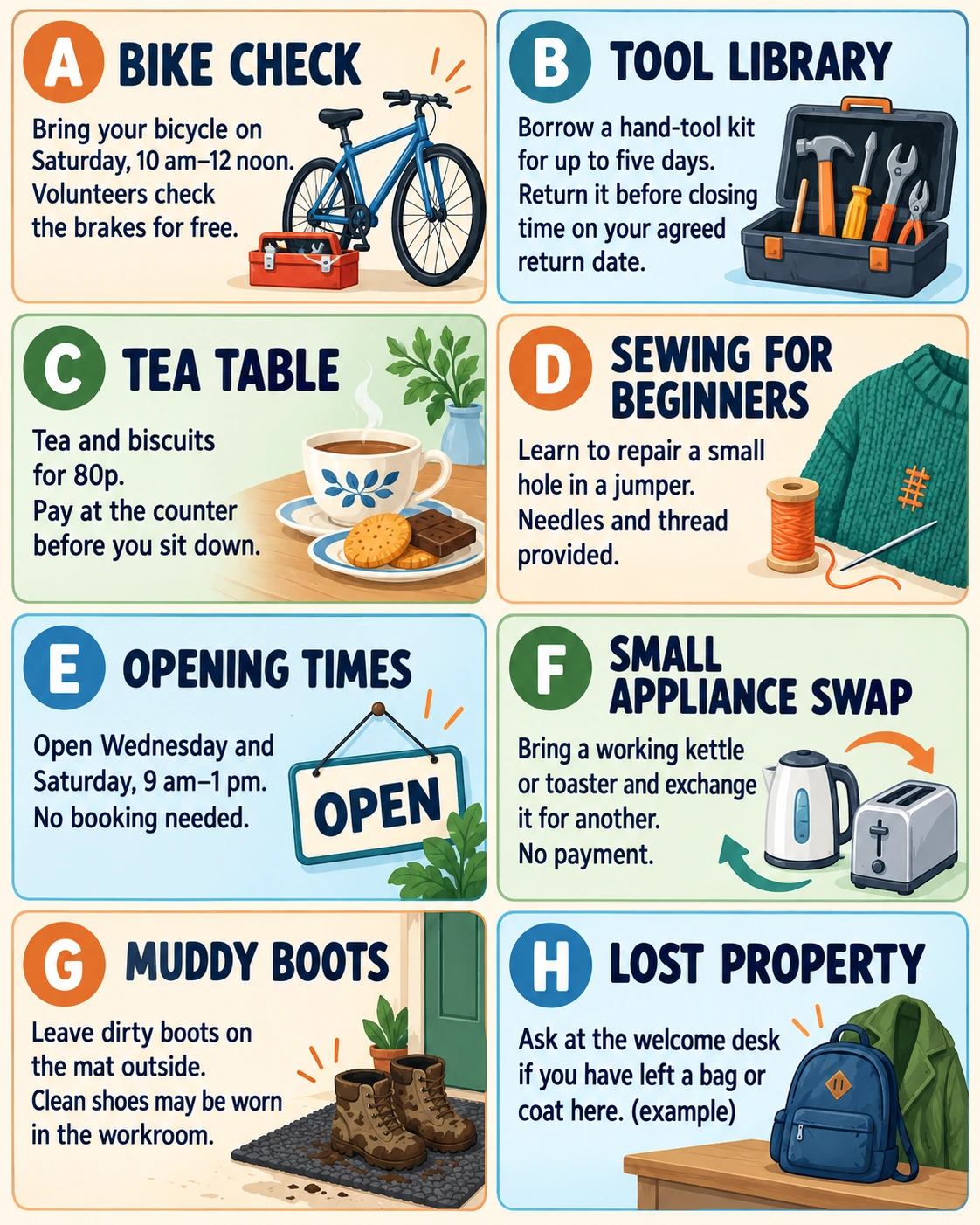
Read notices A–H as text
BIKE CHECK — Bring your bicycle on Saturday, 10 am–12 noon. Volunteers check the brakes for free.
TOOL LIBRARY — Borrow a hand-tool kit for up to five days. Return it before closing time on your agreed return date.
TEA TABLE — Tea and biscuits for 80p. Pay at the counter before you sit down.
SEWING FOR BEGINNERS — Learn to repair a small hole in a jumper. Needles and thread provided.
OPENING TIMES — Open Wednesday and Saturday, 9 am–1 pm. No booking needed.
SMALL APPLIANCE SWAP — Bring a working kettle or toaster and exchange it for another. No payment.
MUDDY BOOTS — Leave dirty boots on the mat outside. Clean shoes may be worn in the workroom.
LOST PROPERTY — Ask at the welcome desk if you have left a bag or coat here. (example)
Example (not scored): You cannot find your coat after a visit. → H
1. Answer: D. Notice D offers a lesson on sewing small holes in jumpers.
2. Answer: B. Notice B allows visitors to take a hand-tool kit away for up to five days, so it can be used at home.
3. Answer: G. Notice G asks people to leave muddy boots on the mat outside.
4. Answer: F. Notice F offers a free swap: visitors can exchange a working kettle or toaster for another small appliance.
5. Answer: A. Notice A offers a free bicycle brake check.
A parcel for the island
Read the passage. Choose the best word (A, B or C) for each space.
Example (not scored): Last Tuesday, Harriet sent a parcel to her cousin. → sent — the past form of send
6. Answer: B. A strong box can contain a glass bowl and the paper around it. A label or stamp cannot hold the present.
7. Answer: C. The soft paper protects the glass bowl, keeping it safe from damage while it travels.
8. Answer: A. After weighing a parcel, the clerk can tell the customer its price: how much it costs to send.
9. Answer: B. Writing clearly makes each letter easy to read. Quietly concerns sound, and heavily concerns weight or force.
10. Answer: C. The expression thank someone for something shows that the cousin is grateful for the present.
Talking about repairs
For questions 11–15, choose the best reply (A, B or C). Then complete the longer conversation using choices A–H. Choice H is the example.
Example (not scored): Mara: Are you free after lunch? Noah: Yes, I am. (example) → H
11. Answer: C. C lends the ruler and says she has finished with it.
12. Answer: A. The price answers how much it costs.
13. Answer: B. The reply agrees and gives a time. Read the complete sentence and the surrounding context to check this meaning.
14. Answer: C. Offering to show Sam how it works is helpful.
15. Answer: A. You're welcome is the usual response to thanks.
A longer conversation
A
Yes, please. I forgot to fill my bottle before I left.
B
That sounds interesting. What should I bring?
C
The radio is quite old, but it still has a good sound.
D
Which bus goes to the workshop from here?
E
I usually repair things with my grandfather.
F
My small radio. The sound has stopped working.
G
Two o'clock is fine. Where shall we meet?
H
Yes, I am. (example)
16. Answer: B. Noah accepts the suggestion and asks what he should bring; Mara answers.
17. Answer: G. Noah agrees to the proposed time and asks where to meet.
18. Answer: D. Noah asks about the bus, which Mara answers next.
19. Answer: A. Mara offers to bring water. Reply A accepts that offer and explains that Noah has forgotten to fill his bottle.
20. Answer: F. Mara asks what Noah wants to work on. Reply F names a radio with no sound, and her next turn suggests checking its battery.
Sana's window museum
Read the article. For questions 21–27, choose A (Right), B (Wrong) or C (Doesn't say). Choose Doesn't say when the article gives no information about the statement.
Example (not scored): Sana wanted people to learn about the town. → A — Right
Stories behind the glass
Last spring, Sana noticed that several shops in her street were empty. She had an idea: people could put interesting old objects in the windows so that anyone walking past could learn about the town. Sana works in a cafe, but she has always enjoyed listening to stories about local life.
She first asked the owner of an empty shoe shop for permission. He agreed to lend her the window for two months without payment. Sana then borrowed a large wooden model of a fishing boat from her aunt. Beside it, she placed a short description and an old photograph of the harbour.
At first, Sana wrote long descriptions. However, people stopped for only a minute or two, so she made the writing shorter and larger. A local teacher checked the words to make sure children could understand them. Visitors could read everything from the pavement; they did not need to enter the building.
By June, four more shop owners had offered their windows. Each one showed a different object, including a school bell and a camera. Sana asked everyone lending an object to tell her its story. She changed the displays once a month to give regular visitors something new to see.
Next winter, Sana plans to add recordings of local people talking about their memories. Her brother has offered to help her record them. She hopes the little window museum will encourage neighbours of different ages to talk to each other.
21. Answer: A. The opening says Sana noticed empty shops and then thought of displaying old objects in their windows.
22. Answer: B. The owner lent Sana the window for two months without payment. This directly contradicts the statement.
23. Answer: C. The boat belonged to her aunt, but the article does not say who made it. Owning it does not tell us its maker.
24. Answer: A. People stopped for only a minute or two, so Sana changed the long descriptions to shorter, larger writing.
25. Answer: B. The article explicitly says visitors could read from the pavement and did not need to enter the building.
26. Answer: C. June and additional shop windows are mentioned, but there are no daily visitor numbers in the article.
27. Answer: A. The last paragraph says her brother has offered to help her record local people talking about their memories.
Lunch on the roof
Read the passage. Choose the correct word (A, B or C) for each space.
Example (not scored): A new garden opened above our college last month. → opened — a completed past action
28. Answer: C. By followed by an -ing form explains the method: we reach the roof by taking the stairs.
29. Answer: A. A few is used before the plural countable noun tables. A little is for uncountable nouns; every needs a singular noun.
30. Answer: B. Their is the possessive form before own lunches, referring to the students.
31. Answer: C. Smaller is a comparative adjective. Than introduces the park with which the garden is compared.
32. Answer: A. A modal verb such as must is followed by the base form of a verb: must close.
33. Answer: B. From twelve until one gives the beginning and end of the period spent in the garden.
34. Answer: C. Had visited is the past perfect. It describes the time before Poppy came to the garden yesterday.
35. Answer: A. The pattern so much that introduces the result of enjoying something a lot: they decided to return.
Things we use every day
Read each description and write the whole word. The first letter is given. Include it in your answer.
Example (not scored): You use this to keep rain off your head. (u_______) → umbrella
36. Answer: ladder. A ladder has steps that you climb to reach something high. The six-letter answer begins with l.
37. Answer: pocket. A pocket is a small space sewn into clothing for carrying small objects. It has six letters.
38. Answer: scissors. Scissors have two handles and two blades for cutting. The whole word has eight letters.
39. Answer: needle. A needle has a small hole for thread and a pointed end used for sewing. It has six letters.
40. Answer: basket. A basket is a container that can be woven from thin pieces of wood and used to carry fruit. It has six letters.
An email about a library game
Complete the email with ONE word in each space. Use the short grammar or meaning cue to help you.
Example (not scored): Thank you for your message. → for — thank someone for something
Dylan
41. Answer: like / love / prefer. Would like to, would love to and would prefer to can all express a wish or preference to join. All three verbs are accepted.
42. Answer: past. Half past two means 2.30. Half to two is not the standard English expression.
43. Answer: to. The fixed expression next to means beside another place.
44. Answer: go / get / travel / ride. Go there, get there, travel there and ride there are natural descriptions of making this bus journey. All four verbs are accepted.
45. Answer: plenty / lots / loads / dozens. Plenty of, lots of and loads of seats express a large available quantity; dozens of seats gives a large count. All four are accepted.
46. Answer: an. The singular countable noun umbrella begins with a vowel sound, so the indefinite article is an.
47. Answer: that / which. That or which introduces the relative clause describing the book. Both are accepted here.
48. Answer: as. The expression as quickly as possible requires as before quickly.
49. Answer: will / should / may / might / could / can / shall. A future or possibility modal fits the result clause: will, shall, should, may, might, could and can are accepted. Each is followed by have.
50. Answer: if / whether. Let me know if you can come and let me know whether you can come both ask for confirmation.
Book a repair workshop session
Read the workshop notice and Alex's message. Complete Jamie's booking notes with short answers.
Example (not scored): Session Jamie will attend: → afternoon
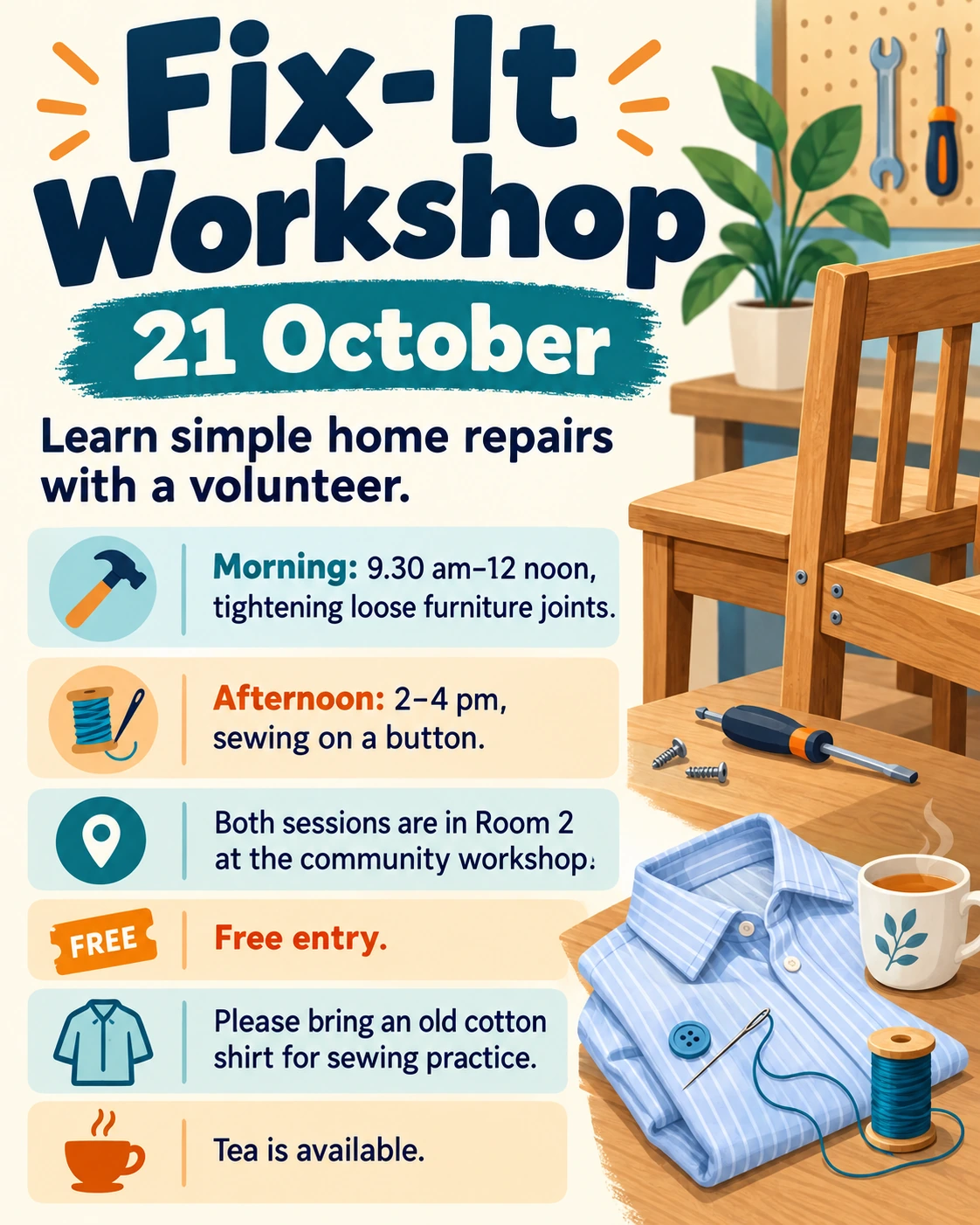
Read text version
Fix-It Workshop — 21 October
Learn simple home repairs with a volunteer. Morning: 9.30 am–12 noon, tightening loose furniture joints. Afternoon: 2–4 pm, sewing on a button. Both sessions are in Room 2 at the community workshop. Free entry. Please bring an old cotton shirt for sewing practice. Tea is available.
Message from Alex to Jamie
Hi Jamie, I booked us into the afternoon session on 21 October. I know you wanted to learn to sew on a button. Let's meet by the main entrance at 1.45 pm and find Room 2 together. I can bring a sewing kit, so please remember an old cotton shirt. See you then, Alex.
51. Answer: 21 October / October 21 / 21st October / October 21st / 21 Oct / Oct 21 / 21/10. The message confirms the afternoon session on 21 October.
52. Answer: sewing / sew a button / sewing a button / button sewing / sew on a button / how to sew on a button / sewing on a button / sew on buttons / sewing on buttons / sewing buttons / sew buttons / button sewing. Jamie wants to learn to sew on a button.
53. Answer: room 2 / room two / 2 / two / workroom 2. The notice says both sessions are in Room 2.
54. Answer: 1:45 pm / 1.45 pm / 1:45 / 1.45 / quarter to two / 13:45 / 13.45 / 1:45pm / 1.45pm / 1:45 p.m. / 1.45 p.m. / quarter to two in the afternoon. Alex asks Jamie to meet at 1.45 pm. Read the complete sentence and the surrounding context to check this meaning.
55. Answer: shirt / an old shirt / old shirt / cotton shirt / old cotton shirt / an old cotton shirt / a shirt / a cotton shirt. The notice requests an old cotton shirt for sewing practice.
Write to a friend
Write 25–35 words. Answer all three points. This task is self-checked separately from the automatic score.
Your English-speaking friend Oliver would like to visit The Little Repair Workshop with you. Write a message. Say what you want to repair, when you will meet and what Oliver should bring. Write 25–35 words.
- Say what you want to repair.
- Say when you will meet.
- Say what Oliver should bring.
0 words · target 25–35
This writing task is self-checked and is separate from your score out of 55.
Hi Oliver, Let's meet at the Little Repair Workshop on Saturday at ten. I want to fix my desk lamp. Please bring a small screwdriver if you have one. See you there, Ben.
Check: all three points answered; message clear; verbs and spelling checked; 25–35 words.
Ready to check your work?
Submit to grade your whole test, OR use 👁 Show Answer per part / per question.
Learning review & writing checklist
Read each notice for its purpose. Link dialogue replies to the turns before and after each gap. In Part 4, distinguish explicit agreement, contradiction and missing information. Use both source documents for the notes in Part 8.
For grammar gaps, read the whole sentence, choose the correct form, and read it again. For open gaps, type one word only. Check the first letter and spelling in Part 6.
Your writing should answer all three points in 25–35 words. Compare your message with the sample after you finish. The writing sample does not add points to the automatic score.
Show Answer reveals the answer and explanation without filling your response or awarding a mark. After editing a graded answer, submit again for an updated score.