
KET 4 Practice Test 1
Reading & Writing
Discoveries Close to Home: explore community activities, follow everyday conversations and practise reading and writing in new situations. This original A2 practice keeps the classic nine-part structure used on this page.
Discoveries around town
Which notice (A–H) matches each statement (1–5)? Use each letter once at most. Notice H is the example.
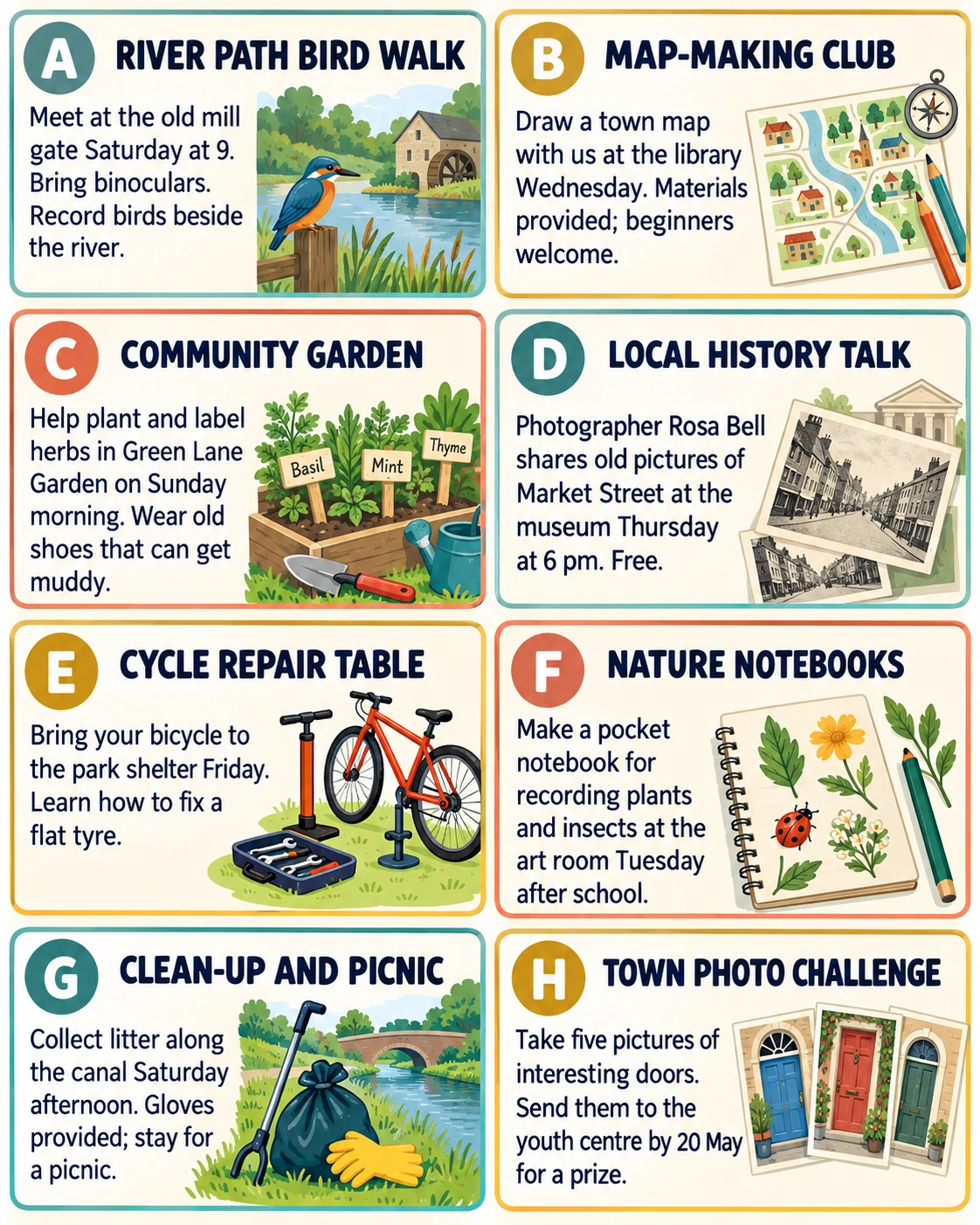
Read notices A–H as text
RIVER PATH BIRD WALK
Meet at the old mill gate Saturday at 9. Bring binoculars. Record birds beside the river.
MAP-MAKING CLUB
Draw a town map with us at the library Wednesday. Materials provided; beginners welcome.
COMMUNITY GARDEN
Help plant and label herbs in Green Lane Garden on Sunday morning. Wear old shoes that can get muddy.
LOCAL HISTORY TALK
Photographer Rosa Bell shares old pictures of Market Street at the museum Thursday at 6 pm. Free.
CYCLE REPAIR TABLE
Bring your bicycle to the park shelter Friday. Learn how to fix a flat tyre.
NATURE NOTEBOOKS
Make a pocket notebook for recording plants and insects at the art room Tuesday after school.
CLEAN-UP AND PICNIC
Collect litter along the canal Saturday afternoon. Gloves provided; stay for a picnic.
TOWN PHOTO CHALLENGE
Take five pictures of interesting doors. Send them to the youth centre by 20 May for a prize.
Example (not scored): You want to photograph doors and enter a competition. → H
1. Answer: E. Notice E offers help fixing a flat tyre.
2. Answer: B. Notice B invites people to draw a town map together.
3. Answer: F. Notice F offers a pocket notebook workshop for recording plants and insects.
4. Answer: G. Notice G includes an outdoor clean-up followed by a picnic.
5. Answer: D. Notice D offers a talk about old pictures of Market Street.
A walk beside the canal
Choose the correct word (A, B or C) for each space.
Example (not scored): They went for a walk on a sunny ____. → day
6. Answer: B. A path is a narrow route beside the canal.
7. Answer: A. A map shows public paths and helps walkers choose a route.
8. Answer: C. Listen to describes paying attention to a sound; look and watch describe using your eyes.
9. Answer: B. Draw a picture is the natural expression for making a picture with a pencil.
10. Answer: A. They want others to know about the sighting, so they share it.
Small discoveries in the station garden
Choose the best reply (A–C) for 11–15. Then complete Nina and Omar’s conversation (16–20) using sentences A–H. Use each letter once at most; three sentences are extra.
Example (not scored): A: I found a shell. B: ____ → That's a lovely find!
11. Answer: A. The question asks if the room is open today; this reply confirms and gives the closing time.
12. Answer: B. The reply reacts to the discovery and suggests recording its location.
13. Answer: C. This reply naturally accepts a proposed meeting time.
14. Answer: A. The question asks how it was attached; glue explains the method.
15. Answer: B. This is a kind response to someone who is ill.
A longer conversation
A
I can bring my small camera, if that helps.
B
Good idea. We can compare the leaves there.
C
It was built about a hundred years ago.
D
The bus leaves from the square at quarter past nine.
E
I'll ask the caretaker whether we may visit that part.
F
I didn't know the garden had a pond.
G
Let's write down the date before we forget.
H
No, I usually walk home with my cousin.
16. Answer: B. Nina suggests looking at trees. Comparing their leaves is a relevant way to accept her suggestion.
17. Answer: E. Nina asks about access to the walled section. Omar offers to ask the caretaker, and Nina thanks him for checking.
18. Answer: D. Nina asks when the bus leaves. Sentence D gives its departure time, quarter past nine.
19. Answer: A. Nina wants plant photographs but has a broken phone. Omar offers his camera, which solves that problem.
20. Answer: G. Nina suggests recording the locations. Omar adds the date, and Nina explains why the date will be useful.
The garden under the ivy
Read the article. Mark each statement Right (A), Wrong (B) or Doesn't say (C).
Example (not scored): The neighbours found an old stone. → A · Right
A garden returns to Cedar Street
Last September, neighbours in Cedar Street decided to clear an empty piece of land behind their houses. While they were cutting back the ivy, they found a small stone with the words “Public Garden” and the date 1912 on it. They had expected to find old bricks, so the stone was a surprise.
Maya Lewis took a photograph of the stone to the town archive. A volunteer there found an old map. It showed a path leading from the market to a garden on the same piece of land. However, nobody could find out who had planted the first flowers. The archive is still looking for a photograph of the original garden.
The neighbours wanted to make the place a garden again. They removed the rubbish, kept the stone and planted flowers that grow naturally in the local area. Children from Cedar School made wooden labels for the plants. A carpenter gave the group a bench, which they placed beside the widest path.
The new garden opened in June. Visitors can follow the paths and read the old stone. There is no charge to enter. The volunteers meet on the first Sunday of each month to water the plants and collect any litter. Maya says her favourite moment is seeing someone stop to look at a flower they have never noticed before.
21. Answer: A. They found the stone while cutting back ivy during the September clean-up, so the statement agrees with the article.
22. Answer: C. Nobody could find out who planted the first flowers. The present-day school labels do not tell us who planted the original garden.
23. Answer: A. The archive volunteer found a map with a path leading from the market to the garden on the same land.
24. Answer: B. It says the archive has not found a photograph.
25. Answer: C. A carpenter gave the group a bench, but the article gives no information about where that person lives.
26. Answer: A. The final paragraph says that the new garden opened in June, which directly supports the statement.
27. Answer: B. They meet on the first Sunday each month, not every Sunday.
Making a nature board
Choose the correct word (A, B or C) for each space.
Example (not scored): We chose a place ____ the library. → near
28. Answer: B. By choosing describes the method of starting.
29. Answer: A. From shows the place where the leaves were collected: they came from the ground.
30. Answer: B. Suggest is followed by an -ing form here.
31. Answer: A. For followed by an -ing form describes the purpose of the phone: taking clear photographs.
32. Answer: C. More … than is the comparative pattern. Leaves is a plural countable noun, so much does not fit.
33. Answer: B. The plural subject our labels needs the plural present verb are.
34. Answer: A. Learn about introduces the subject that visitors will learn: the plants growing nearby.
35. Answer: C. Next month refers to a future plan. Will is followed by the base form add.
Useful words for a local walk
Read each meaning and write the word. The first letter is given.
Example (not scored): You wear this on your wrist to see the time. (w____) → watch
36. Answer: map. A map shows streets and helps a person find a route.
37. Answer: label. A label gives information about an object or picture.
38. Answer: binoculars. Binoculars make distant objects look nearer.
39. Answer: crossing. A crossing is a place for crossing a road.
40. Answer: gardener. A gardener works with and cares for plants.
A message about a nature walk
Complete the message with ONE word in each space.
Example (not scored): I am pleased ____ hear from you. → to
Noah
41. Answer: for. Thanks for is followed by the thing someone is being thanked for: your message.
42. Answer: like / love / prefer. Would like to, would love to and would prefer to all express a wish or preference to join the walk.
43. Answer: in. Interested in is the fixed adjective and preposition pattern; learning follows the preposition.
44. Answer: so / and. So introduces advice following the rain forecast. And also links the forecast with that advice naturally.
45. Answer: that / which. Both can introduce a relative clause about the path.
46. Answer: for. A notebook for recording describes what the notebook will be used for during the walk.
47. Answer: not / never. Should not disturb gives advice against making a disturbance. Should never disturb expresses the same advice more strongly.
48. Answer: than. The comparative shorter is followed by than when comparing the two routes.
49. Answer: if / whether. Both introduce this yes/no indirect question.
50. Answer: to. Ready to is followed by a base verb. Here the phrase is ready to leave.
Plan a visit to the town archive
Read the open-day notice and Finn's message. Complete the notes with short answers.
Example (not scored): Where is the archive room? → behind the town library
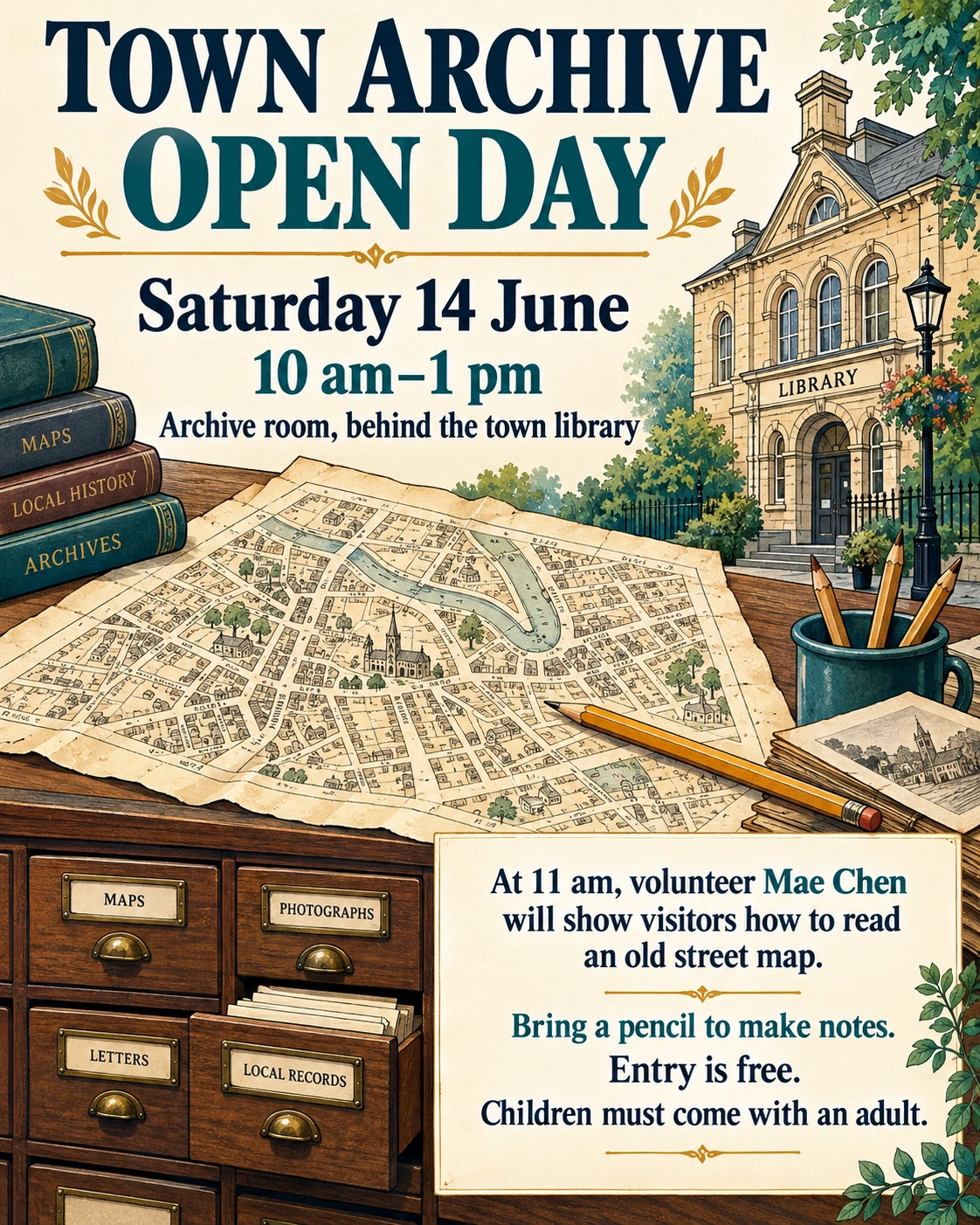
Read text version
Town Archive Open Day
TOWN ARCHIVE OPEN DAY
Saturday 14 June
10 am–1 pm
Archive room, behind the town library
At 11 am, volunteer Mae Chen will show visitors how to read an old street map. Bring a pencil to make notes. Entry is free. Children must come with an adult.
Message from Finn to Ruby
Message from Finn to Ruby: Hi Ruby, I can come to the archive on Saturday. I'll meet you at the library entrance at 10.40 so we can find the archive room before Mae's map talk. I'll bring my notebook and a blue pencil. Mum is coming with me. Finn.
51. Answer: Saturday 14 June / 14 June / June 14 / 14th June / June 14th / 14th of June / Saturday 14th June / Saturday, 14 June. The notice gives the event date as Saturday 14 June.
52. Answer: Mae Chen / Mae. The notice names Mae Chen as the volunteer leading the map activity.
53. Answer: 10:40 / 10.40 / 10:40 am / 10.40 am / ten forty / 10:40 a.m. / 10.40 a.m. / 1040 / twenty to eleven. Finn says he will meet Ruby at 10.40.
54. Answer: notebook / his notebook / a notebook / a small notebook. Finn says he will bring his notebook.
55. Answer: Mum / his mum / mother / his mother. Finn ends his message by saying that Mum is coming with him, so his mother is the accompanying adult.
Write to a friend
Write 25–35 words. Answer all three points. This task is self-checked separately from the automatic score.
Your English-speaking friend Ava wants to explore a place near your home. Write a message. Say where you will go, what you hope to discover and what she should bring. Write 25–35 words.
- Say where you will go.
- Say what you hope to discover.
- Say what Ava should bring.
0 words · target 25–35
This writing task is self-checked and is separate from your score out of 55.
Hi Ava, Let's walk along the old railway path on Sunday. I hope we find interesting birds near the stream. Please bring your camera and a bottle of water. See you, Mia.
Check: all three points answered; message clear; verbs and spelling checked; 25–35 words.
Ready to check your work?
Submit to grade your whole test, OR use 👁 Show Answer per part / per question.
Learning review & writing checklist
Read each notice for its purpose. Link dialogue replies to the turns before and after each gap. In Part 4, distinguish explicit agreement, contradiction and missing information. Use both source documents for the notes in Part 8.
For grammar gaps, read the whole sentence, choose the correct form, and read it again. For open gaps, type one word only. Check the first letter and spelling in Part 6.
Your writing should answer all three points in 25–35 words. Compare your message with the sample after you finish. The writing sample does not add points to the automatic score.
Show Answer reveals the answer and explanation without filling your response or awarding a mark. After editing a graded answer, submit again for an updated score.