
KET 1 Practice Test 1
Reading & Writing
Riverside Community Makers: read everyday notices, complete conversations and use short texts to practise A2 reading and writing. This original practice keeps the classic nine-part structure used on this page.
Read the notices
Which notice (A–H) matches each statement (1–5)? Use each letter once at most. Notice H is the example.
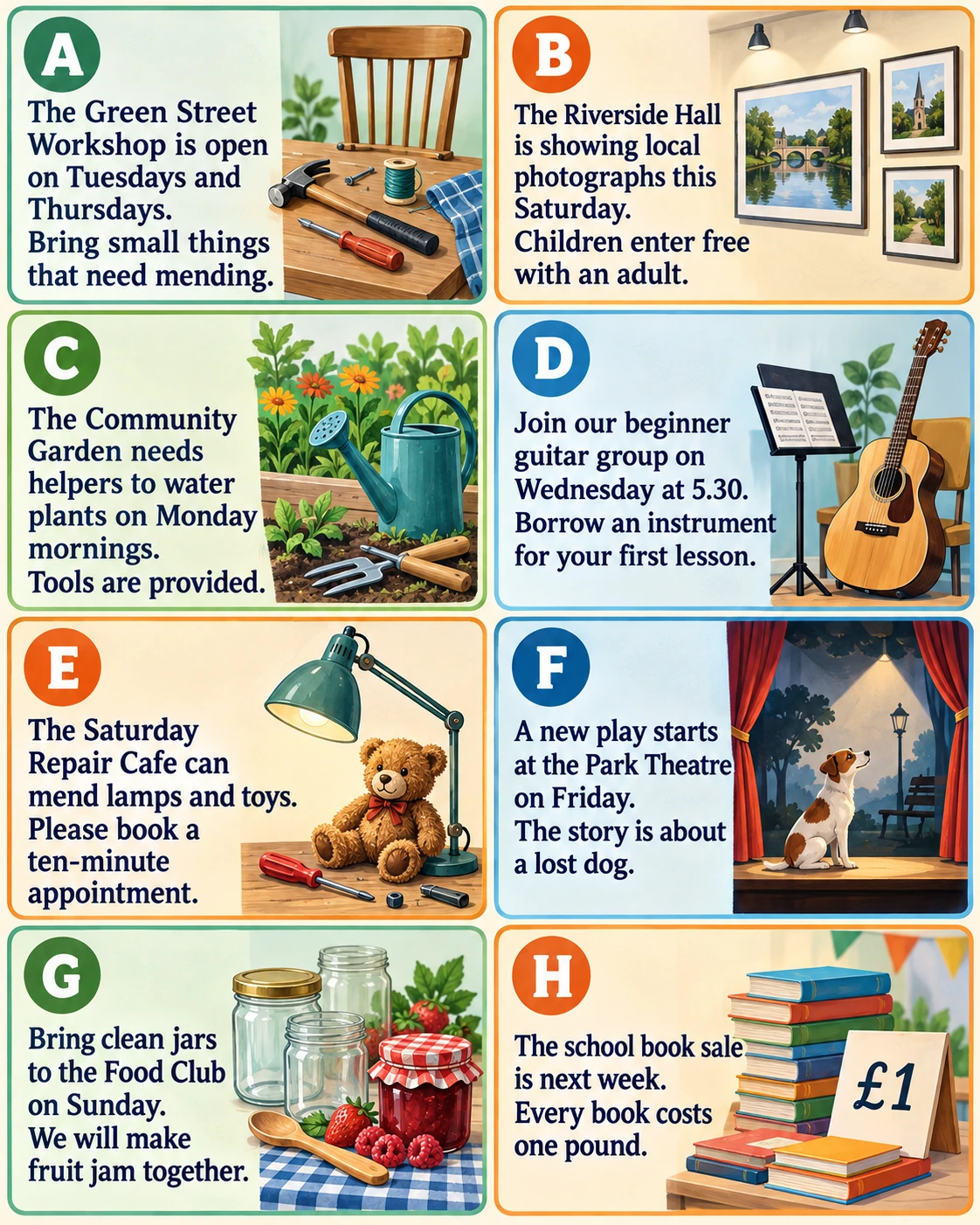
Read notices A–H as text
The Green Street Workshop is open on Tuesdays and Thursdays. Bring small things that need mending.
The Riverside Hall is showing local photographs this Saturday. Children enter free with an adult.
The Community Garden needs helpers to water plants on Monday mornings. Tools are provided.
Join our beginner guitar group on Wednesday at 5.30. Borrow an instrument for your first lesson.
The Saturday Repair Cafe can mend lamps and toys. Please book a ten-minute appointment.
A new play starts at the Park Theatre on Friday. The story is about a lost dog.
Bring clean jars to the Food Club on Sunday. We will make fruit jam together.
The school book sale is next week. Every book costs one pound.
Example (not scored): You would like to buy a book for one pound. → H
1. Answer: D. The guitar group welcomes beginners and lends an instrument for the first lesson; that meets both needs.
2. Answer: E. The Repair Cafe is specifically for mending lamps and toys and is held on Saturday.
3. Answer: C. The garden asks for Monday-morning helpers to water plants.
4. Answer: G. The Food Club asks people to bring clean jars to make fruit jam on Sunday.
5. Answer: B. The Riverside Hall has a photograph show on Saturday and free entry for children with an adult.
A useful wooden box
Choose the correct word A, B or C for each space.
Example (not scored): Each visitor can choose a different project to make. → project = something you plan and make
6. Answer: B. Sandpaper makes rough wood smooth. Heavy describes weight, and deep describes distance down into something.
7. Answer: C. New paint needs time to dry. Grow and travel do not describe what happens to wet paint.
8. Answer: A. You hold a handle to open a lid. A ticket and a pocket do not help you open it.
9. Answer: B. The right size means there is enough room for the buttons. Weather and price do not describe how well they fit.
10. Answer: C. Teach us how to use tools means explain and demonstrate the correct method. Lend and promise do not fit this meaning.
Conversations at the community centre
Tom and Anna are two friends at a community workshop. For 11–15, choose the best reply A, B or C. For 16–20, choose Anna's missing reply A–H. Use each letter once. E is the example; two other replies are not needed.
Example (not scored): Tom: Have you made anything from wood before? Anna: I made a picture frame last term. → E
11. Answer: B. Jack asks for a location. On the first floor gives a place; the other replies give a day or an opinion.
12. Answer: C. Yes, please accepts the offer. The other replies do not say whether Ben wants more soup.
13. Answer: A. That is all right accepts the apology, and fixing it together responds to the broken boat.
14. Answer: C. Mia asks for an opinion about a past experience. Tiring but enjoyable answers that question.
15. Answer: B. That is a pity responds to Sam being unable to attend. Asking about tomorrow suggests a different time.
A longer conversation
A
I'll collect it before we start.
B
I can't find the entrance.
C
I'll bring an old shirt.
D
Yes, I'll take some with my phone.
E
I made a picture frame last term.
F
I need to leave at three.
G
Yes, I'm free until five.
H
Do I need to buy any paint?
16. Answer: A. Tom asks Anna to get the workroom key from the office. I will collect it agrees to that request.
17. Answer: D. Tom asks for photos. Taking some with a phone responds directly to that request.
18. Answer: C. An old shirt can cover and protect clothes from paint; Anna is answering the instruction about what to wear.
19. Answer: H. Tom replies that the club provides paint and brushes. Anna must therefore ask whether she needs to buy paint.
20. Answer: G. The session finishes at four and tidying takes one more hour. Being free until five lets Anna help.
Three creative projects
Read the three texts. For each question, choose A, B or C. Each answer depends on a detail in the texts.
Example (not scored): Who keeps old bicycle parts to use again? → A — Lucy saves old bells and lights.
A · Lucy's Bike Corner
Lucy enjoys repairing bicycles, especially older ones. She works in a small room behind her aunt's shop. On Thursday afternoons she teaches children how to check their tyres. She saves old bells and lights because she uses them on bikes that are missing parts. She hopes to organise a neighbourhood cycle ride in spring.
B · Noah's Sound Room
Noah records the sounds of local places for a school project. He visits the harbour early, when the boats arrive, and the park after lunch, when families are playing. He edits the recordings on his laptop at home. He has invited classmates to help make a short radio programme, but nobody needs special equipment.
C · Emma's Paper Studio
Emma makes notebooks from paper that would otherwise be thrown away. At the town library, she shows visitors how to fold and sew the pages. Her next workshop is on Saturday morning. Visitors should bring a ruler, but Emma supplies the thread and covers. She is now designing a notebook that can stand open on a desk.
21. Answer: A. Lucy teaches children to check bicycle tyres, a practical way to look after a vehicle.
22. Answer: B. Noah records local sounds specifically for a school project.
23. Answer: C. Emma turns unwanted paper into notebooks, which people can write in.
24. Answer: C. Emma's Saturday workshop asks visitors to bring a ruler; the other profiles do not give that instruction.
25. Answer: A. Lucy hopes to organise a neighbourhood cycle ride in spring, an outdoor group activity.
26. Answer: B. Noah invited classmates to help make a radio programme for listeners.
27. Answer: B. Noah edits his sound recordings on a laptop at home. Neither of the other profiles mentions using a computer.
The town tool library
Choose the correct word A, B or C for each space.
Example (not scored): The library opened last month in an empty shop. → opened — a completed action in the past
28. Answer: B. For + -ing describes what the tools are used for: for making repairs. At and with do not express that purpose here.
29. Answer: C. Where introduces a clause about a place: a room where people learn skills. Who refers to people, and what cannot follow a room in this structure.
30. Answer: A. Look and at the moment show an action happening now. The plural subject two volunteers takes are building.
31. Answer: C. Which refers to a thing, the drill. Who refers to a person; whose needs a following noun to show possession.
32. Answer: B. Before places the return earlier than the date on the card. Between needs two limits, and during is used with a period.
33. Answer: A. The fixed phrase is instead of + -ing: instead of trying. Instead than and instead from are incorrect.
34. Answer: B. The plural subject organisers takes have with the past participle made. Has is singular; are does not form the present perfect.
35. Answer: C. Planning takes a to-infinitive here: planning to add. For and that cannot be followed directly by add in this sentence.
Complete the definitions
Read the definitions and type the WHOLE word, including the first letter shown. The lines show the number of missing letters.
Example (not scored): A small object you use to open a lock. (k__) → key — type all three letters
36. Answer: journey. Journey is a seven-letter word for a trip and begins with j.
37. Answer: repair. Repair is a six-letter verb meaning to fix something broken.
38. Answer: invite. Invite is a six-letter verb meaning to ask someone to attend an event.
39. Answer: borrow. Borrow is a six-letter verb; it means using another person's item and then returning it.
40. Answer: quiet. Quiet is a five-letter adjective describing very little noise.
An email about repair day
Write ONE word in each space. Use the short hints in parentheses to help you. Read the whole email before answering.
Example (not scored): I am writing about our next event. → about — the topic of the message
Sam
41. Answer: for. Thank you for is the fixed expression used before a noun phrase such as your message.
42. Answer: on. We use on before a day: on Saturday morning.
43. Answer: an. Old starts with a vowel sound, so the singular countable noun phrase needs an: an old shirt.
44. Answer: were. There were is the past form used with a plural noun phrase: more than thirty people.
45. Answer: have. The plural subject organisers takes have + past participle: have already booked.
46. Answer: to. The future plan uses be going to + base verb: are going to build.
47. Answer: how. How many asks about the number of countable things, here shelves.
48. Answer: to. The expression belongs to names the owner: belongs to my uncle.
49. Answer: that / which. That and which can both refer to the cafe as the subject of sells in this defining relative clause.
50. Answer: as. As soon as is the fixed expression meaning at the earliest possible time.
Alex's workshop notes
Read the notice and Kim's message. Complete Alex's notes with a short answer. Use words or numbers, as appropriate.
Example (not scored): Place where they will buy tickets: → the library desk
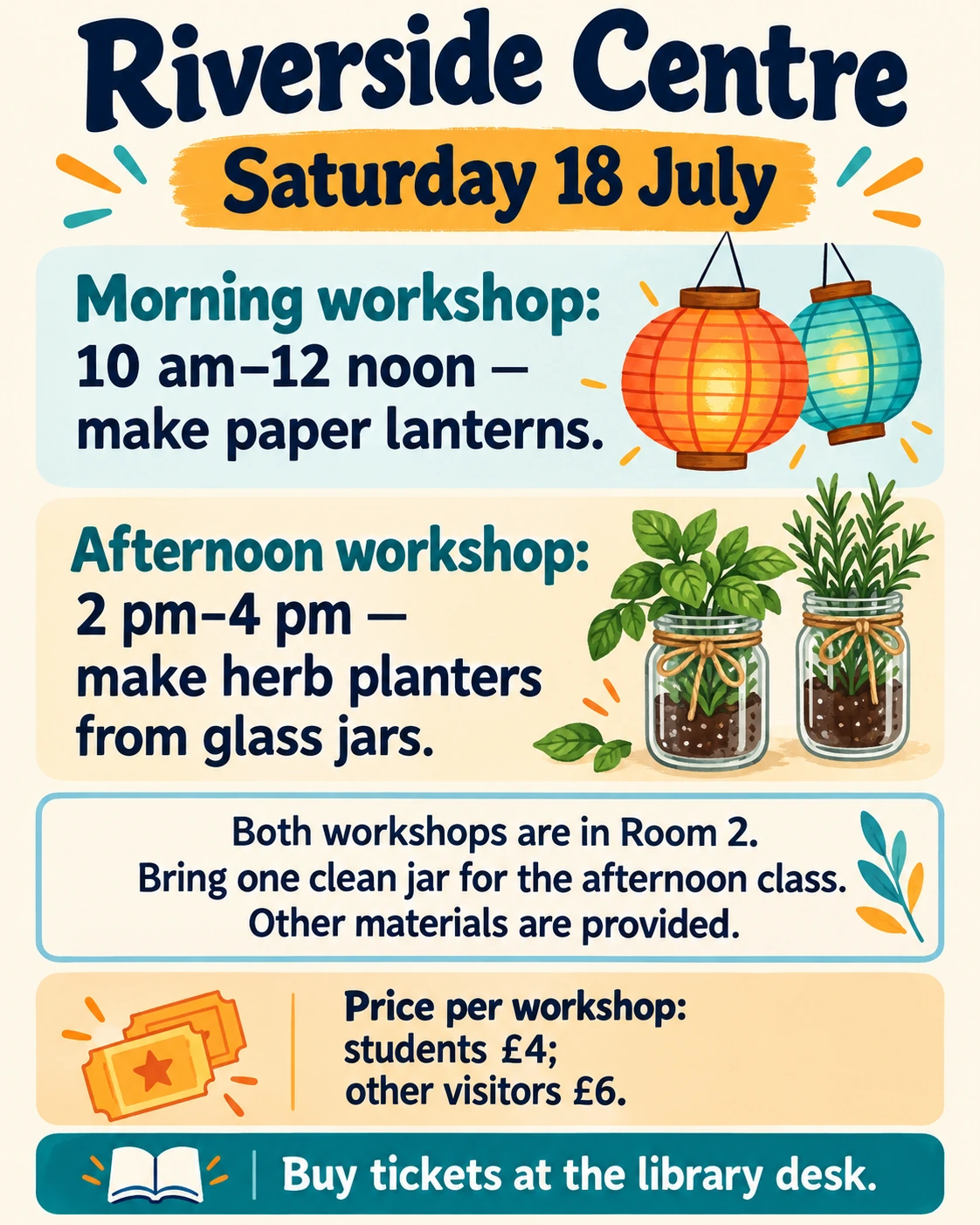
Read text version
Riverside Centre — Saturday 18 July
Morning workshop: 10 am–12 noon — make paper lanterns.
Afternoon workshop: 2 pm–4 pm — make herb planters from glass jars.
Both workshops are in Room 2. Bring one clean jar for the afternoon class. Other materials are provided.
Price per workshop: students £4; other visitors £6. Buy tickets at the library desk.
Message from Kim to Alex
Hi Alex, I have swimming in the morning, so please book us into the afternoon class on 18 July. We both have student cards, so remember to ask for the student price. I have two clean jars for us. Let's meet outside the cafe at 1.40 pm and walk to the centre together. Thanks, Kim.
51. Answer: 18 July / July 18 / 18th July / July 18th / Saturday 18 July / Saturday 18th July / 18/7 / 18/07. The notice and Kim both give 18 July. Kim chooses the afternoon class on that date.
52. Answer: herb planters / herb planter / a herb planter / herb planters from glass jars / planters / a planter / planter. Kim chooses the afternoon class, which makes herb planters. Paper lanterns are made in the morning.
53. Answer: 2 pm / 2pm / 2 p.m. / 2 p.m / 2.00 pm / 2.00pm / 2:00 pm / 2:00pm / 14:00 / 14.00 / 2 / 2.00 / 2:00. The afternoon workshop starts at 2 pm. The 1.40 pm time is their meeting before it starts.
54. Answer: £4 / 4 / 4 pounds / four pounds / £4.00 / 4.00 / 4.00 pounds. Both friends have student cards, so each pays the student price of £4, rather than the £6 visitor price.
55. Answer: outside the cafe / outside the café / outside cafe / outside café / the cafe / the café / cafe / café. Kim asks Alex to meet outside the cafe. Room 2 is the workshop location; the library desk sells tickets.
Write an email
Write 25–35 words. Include all three points. This task is self-checked, separate from the automatic score.
You have joined a local weekend club. Write an email to your English-speaking friend about it. Say what the club does, when you meet and why you enjoy it. Write 25–35 words.
- Say what the club does.
- Say when the members meet.
- Explain why you enjoy it.
0 words · target 25–35
This writing task is self-checked and is separate from your score out of 55.
Hi Ben, I joined the Riverside Repair Club. We meet on Saturday mornings and learn to fix household things. I enjoy it because I can help my family and make friends. See you, Ella.
Check: all three points answered; message clear; verbs and spelling checked; 25–35 words.
Ready to check your work?
Submit to grade your whole test, OR use 👁 Show Answer per part / per question.
Learning review & writing checklist
Read each notice for its purpose. In conversations, check what comes before and after the gap. Use the exact evidence in the texts when matching people or completing notes.
For grammar gaps, read the whole sentence, choose the correct form, and read it again. For open gaps, type one word only. Check the first letter and spelling in Part 6.
Your writing should answer all three points in 25–35 words. Compare your message with the sample after you finish. The writing sample does not add points to the automatic score.
Show Answer reveals the answer and explanation without filling your response or awarding a mark. After editing a graded answer, submit again for an updated score.