
CELPIP Speaking · Set 2 · Practice Test 1 · Original practice
Everyday Choices, Shared Spaces
One warm-up and eight speaking tasks. Plan, speak aloud, then review your response. Keep your own examples and viewpoint.
Follow the preparation and response times shown. Task 5 has an additional silent choosing stage. This practice does not calculate an official score.
Original speaking practice · Plan, speak and reflect.
0 of 8 practice tasks attempted
Optional microphone recording requires browser permission and a supported secure context. Nothing is uploaded. Recordings, notes and ratings are kept only in this tab and disappear on reset, reload or closing; download recordings you want to keep. Without a microphone, use the timer and speak aloud.
Warm-up: Warm-up
What is one small habit that makes your morning better? Explain when you started it, how it helps, and whether you would recommend it to someone else.
Optional recording stays in this tab. Timer-only practice is always available.
Show guide and sample responses
Plan your response
- Name the habit before adding background.
- Give a specific morning example.
- Finish with a personal reason or recommendation.
One small change I made was… · It helps because… · I would recommend it to someone who…
A focused response identifies a habit, supports it with a concrete example, and closes with its effect or a recommendation.
Clear response
One small habit that improves my morning is preparing my lunch the night before. I started doing this when my work schedule became busier and I kept leaving home without enough time to make good choices. Now I put a sandwich, fruit, and a bottle of water in my bag after dinner. It takes only a few minutes, but I feel calmer because I do not have to rush around in the morning. I would recommend it to anyone who often skips lunch because their mornings are rushed.
Why it works: Names one manageable habit and gives a personal reason. The ending answers the recommendation part explicitly.
Illustrative 88-word response. Practise aloud at a comfortable pace within 60 seconds; adapt the detail to your own speaking speed.
Developed response
A small habit that makes my mornings noticeably better is taking a short walk before I check messages. I began doing it last spring, when I realized that looking at my phone immediately made me feel behind before the day had even started. I walk around the block for about ten minutes, usually with a coffee in a travel cup. That short break helps me begin work more calmly, so I would recommend trying it for a week.
Why it works: Names one manageable habit and gives a personal reason. The ending answers the recommendation part explicitly.
Illustrative 78-word response. Practise aloud at a comfortable pace within 60 seconds; adapt the detail to your own speaking speed.
Check your response
- Did I identify one habit clearly?
- Did I explain a real benefit with an example?
- Did I finish with a clear personal view?
Task 1: Giving Advice
Your friend is thinking of joining a community repair club where volunteers help residents fix small household items. Your friend is unsure because they have never repaired anything. Give practical advice about whether and how to try the club.
Optional recording stays in this tab. Timer-only practice is always available.
Show guide and sample responses
Plan your response
- Acknowledge your friend's concern before advising.
- Suggest a low-pressure first step.
- Explain how the club could benefit both your friend and the community.
I understand why you might feel… · You could start by… · That way, you would…
Strong advice combines empathy, a doable first step, and reasons linked to the friend's concern.
Clear response
I understand why you might feel nervous about joining the repair club, especially if you have never used tools before. However, I think you should try one meeting before deciding. You do not have to arrive as an expert. You could tell the organizers that you are new and ask whether you can observe or help with simple tasks, such as sorting screws or holding a flashlight. That would let you learn at a comfortable pace. You could also bring one small item that is not urgent, like a wooden box with a loose hinge, and ask someone to show you the steps. The club may help you save money and meet practical, friendly people. If you enjoy the first visit, you can return; if not, you will still have learned something useful. I think giving it one chance is a sensible choice, especially if you are curious about learning practical skills.
Why it works: Responds directly to a beginner, offers a trial visit and uses conditional suggestions rather than assuming the club's rules.
Illustrative 152-word response. Practise aloud at a comfortable pace within 90 seconds; adapt the detail to your own speaking speed.
Developed response
It makes sense that you feel uncertain, but I would encourage you to visit the repair club once before ruling it out. Ask whether the group welcomes beginners as well as experienced repairers. Someone has to welcome visitors, organize parts, take notes, or hold an item steady, and those are useful ways to contribute while learning. Before you go, send the coordinator a short message explaining that you are a beginner and ask what to expect. You might also choose a simple item from home, such as a wooden box with a loose hinge, but only bring it if the club confirms it is appropriate to handle. There is no need to promise a long-term commitment. Treat the first evening as a trial. You could gain a practical skill, avoid throwing away something repairable, and meet neighbours with similar interests. If the atmosphere feels welcoming, continue; otherwise, you can thank them and leave with no pressure.
Why it works: Responds directly to a beginner, offers a trial visit and uses conditional suggestions rather than assuming the club's rules.
Illustrative 156-word response. Practise aloud at a comfortable pace within 90 seconds; adapt the detail to your own speaking speed.
Check your response
- Did I respond to the friend's hesitation?
- Did I offer a practical first action?
- Did I explain benefits without promising a perfect outcome?
Task 2: Talking about a Personal Experience
Describe a memorable time when you had to adapt a plan. What changed, what did you do, and what did you learn from the experience?
Optional recording stays in this tab. Timer-only practice is always available.
Show guide and sample responses
Plan your response
- Set the scene briefly so the change is understandable.
- Describe your response in a clear sequence.
- End with a specific lesson rather than a general slogan.
I had planned to…, but… · At first, I…, then… · Looking back, I learned…
A useful personal story makes the change, response, and lesson easy to follow.
Clear response
Last year, I planned to meet my cousin at an outdoor market on Saturday morning. When I arrived, heavy rain had closed the market, so our original plan was impossible. At first we were disappointed because we had both travelled across town. Instead of going straight home, I suggested finding a nearby community centre with a small café. We checked the opening hours online, walked there, and spent the morning talking over lunch. We also looked at a noticeboard and found information about a local photography group. The day turned out to be enjoyable in a different way. I learned that changing a plan does not have to ruin an occasion.
Why it works: Uses a clear past-tense sequence: original plan, interruption, response and a relevant lesson.
Illustrative 111-word response. Practise aloud at a comfortable pace within 60 seconds; adapt the detail to your own speaking speed.
Developed response
A memorable time I had to adapt a plan was during a weekend visit to a coastal town with two friends. We had booked a bicycle tour, but the guide cancelled that morning because strong winds made the route unsafe. We were already dressed for the activity, and one friend was frustrated because cycling had been the main reason for the trip. I suggested that we keep the same goal—exploring the town—but do it on foot. We asked at the visitor desk for a sheltered walking route, then followed it past a small museum, a covered market, and a quiet harbour café. We stopped more often than we would have on bicycles, so we noticed details we might have missed. I learned to preserve the purpose of a trip while changing the activity.
Why it works: Uses a clear past-tense sequence: original plan, interruption, response and a relevant lesson.
Illustrative 133-word response. Practise aloud at a comfortable pace within 60 seconds; adapt the detail to your own speaking speed.
Check your response
- Did I explain what changed?
- Did I describe what I did next?
- Did I state a lesson tied to this experience?
Task 3: Describing a Scene
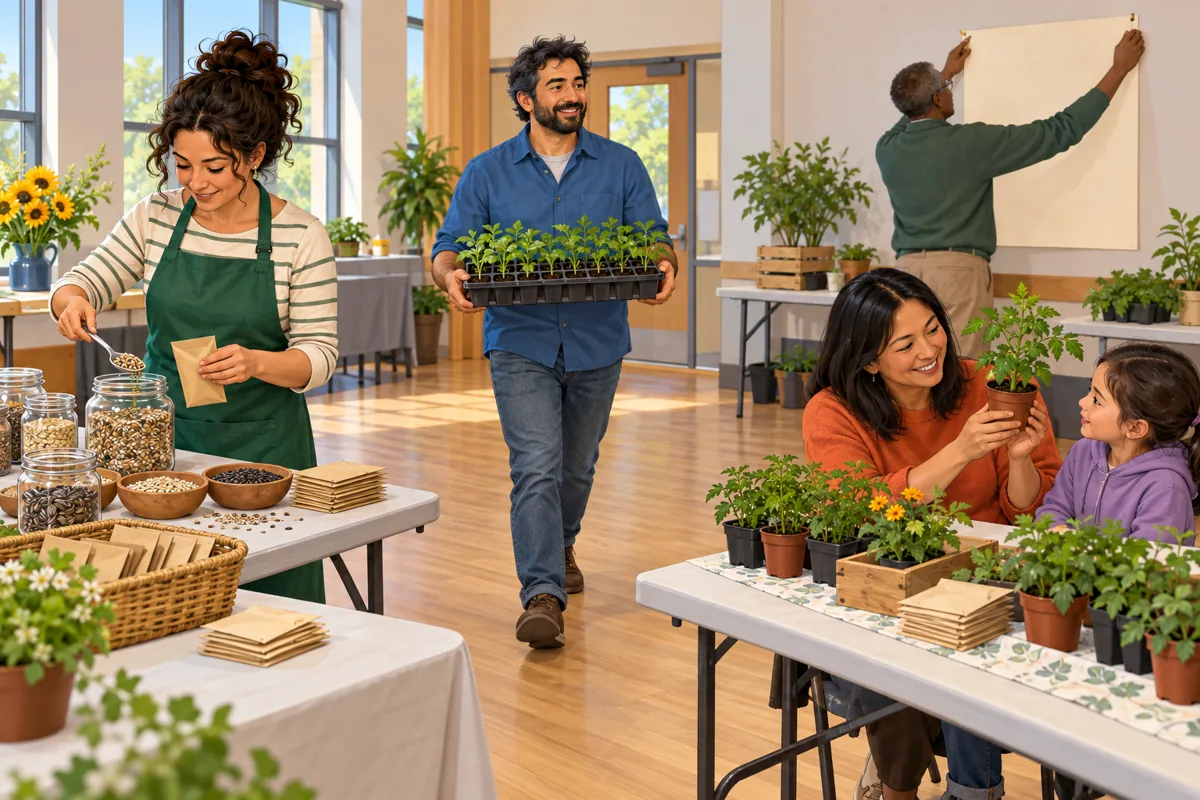
You are on the phone with a friend who cannot see this picture. Describe the people and activities at this indoor seed-swap event. Help your friend picture where things are happening.
Optional recording stays in this tab. Timer-only practice is always available.
Show guide and sample responses
Plan your response
- Begin with the overall setting and activity.
- Move through the picture using left, centre, right, and background.
- Separate visible evidence from guesses about what people are saying or planning.
The scene appears to show… · On the left…, while… · It is possible that…, although…
Organize a visual description by location and action, and label interpretations as possibilities rather than facts.
Clear response
The picture shows what appears to be an indoor community seed-swap event. On the left, a woman wearing a green apron is scooping seeds into an envelope at a table. Near the centre, a man in a blue shirt is carrying a tray of small seedlings. On the right, a woman in an orange jumper is seated and showing a plant to a child wearing a purple hoodie. In the background, another man is attaching a blank poster to the wall. The people seem to be sharing plants or gardening materials, although we cannot tell exactly what they are discussing. The scene looks calm and practical. The table and seedling tray suggest that visitors may be able to exchange seeds or learn about growing plants.
Why it works: Moves through the actual picture by location. Visible actions are described directly; interpretations are qualified.
Illustrative 125-word response. Practise aloud at a comfortable pace within 60 seconds; adapt the detail to your own speaking speed.
Developed response
This looks like a public indoor event focused on seeds and plants. The room contains several people doing different tasks. At the left side, a woman in a green apron is carefully putting seeds into an envelope at a table. In the middle, a man wearing a blue shirt is carrying a tray of seedlings, perhaps to another part of the room. On the right, a seated woman in an orange jumper is holding up or presenting a plant to a child in a purple hoodie, who appears to be looking at it. Behind them, a man is attaching a blank poster to the wall; because it is blank, we cannot read a title or assume what it says.
Why it works: Moves through the actual picture by location. Visible actions are described directly; interpretations are qualified.
Illustrative 119-word response. Practise aloud at a comfortable pace within 60 seconds; adapt the detail to your own speaking speed.
Check your response
- Did I mention several visible people and actions?
- Did I use clear location words?
- Did I avoid inventing text or dialogue?
Task 4: Making Predictions
Look at the same seed-swap scene. Tell a friend what you think is likely to happen next. Support two or more predictions with visible clues, using language that shows uncertainty.
Optional recording stays in this tab. Timer-only practice is always available.
Show guide and sample responses
Plan your response
- Make two predictions that follow from visible actions.
- Use evidence words such as because, so, and suggests.
- Mark uncertainty clearly; do not claim to know what happens next.
The next thing that might happen is… · I say that because… · This is only a possibility since…
Good predictions connect an uncertain future action to a specific visible clue.
Clear response
One thing that might happen next is that the woman in the green apron will finish filling the envelope and give it to a visitor. I predict this because she is already scooping seeds at the table, which looks like part of an organized exchange. Another possibility is that the man carrying the seedling tray will place it on a display table so people can look at the plants. The child on the right may ask a question or touch a leaf after the seated woman has finished showing the plant. These are reasonable guesses based on what the people are doing, but the picture does not tell us their exact plans.
Why it works: Connects predictions with the seed spoon, carried tray, held plant or unfinished poster; future actions are possibilities.
Illustrative 112-word response. Practise aloud at a comfortable pace within 60 seconds; adapt the detail to your own speaking speed.
Developed response
The picture gives a few clues about what could happen next. The woman in the green apron may seal the envelope of seeds and pass it across the table, since she is already measuring seeds into it. The man in the blue shirt could set his tray of seedlings down somewhere for visitors to examine; carrying the tray suggests he is moving plants through the room, but we cannot know his destination. I also think the child may continue learning about the plant from the seated woman, because she is holding it up for the child to see. At the back, the other man might step away once he has attached the poster.
Why it works: Connects predictions with the seed spoon, carried tray, held plant or unfinished poster; future actions are possibilities.
Illustrative 113-word response. Practise aloud at a comfortable pace within 60 seconds; adapt the detail to your own speaking speed.
Check your response
- Did I make more than one plausible prediction?
- Did I connect predictions to visible evidence?
- Did I signal that the outcomes are uncertain?
Task 5: Comparing and Persuading
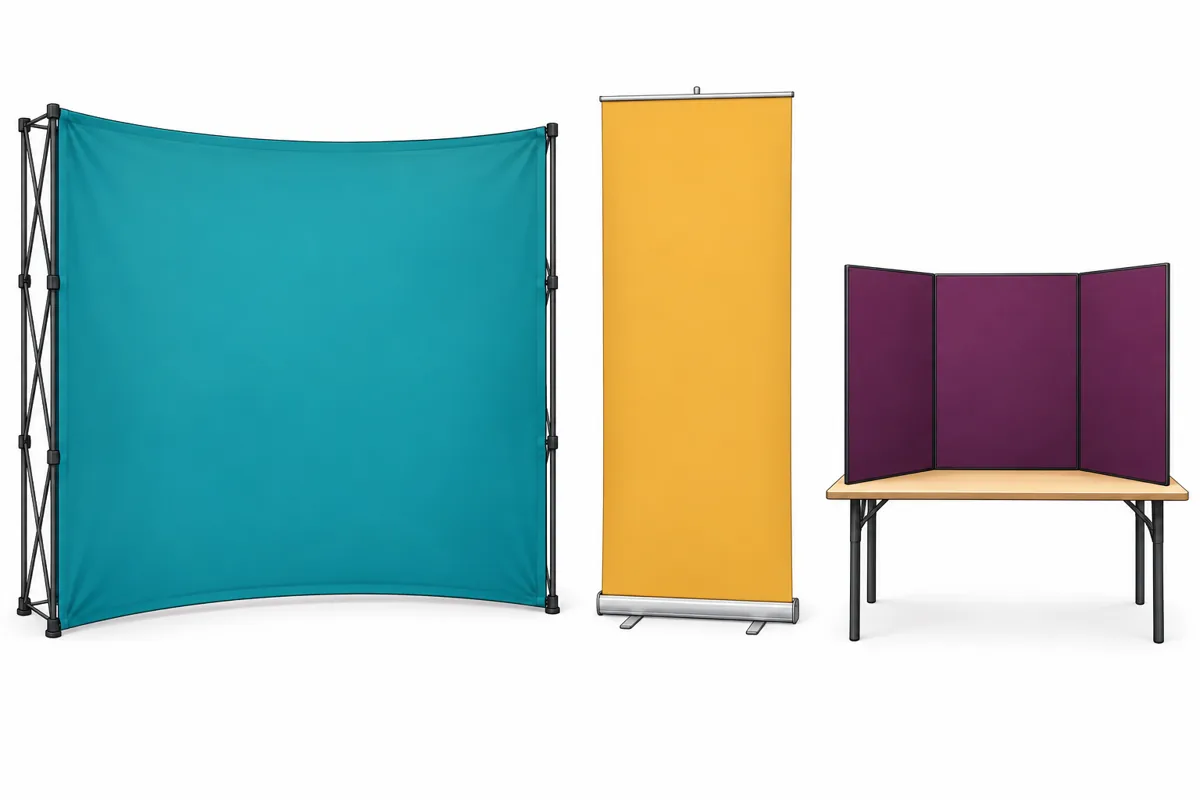
Your library is buying a portable display for indoor outreach events. Choose A or B during the separate 60-second choosing stage. You do not speak during that stage. Then persuade your supervisor to choose your display instead of C.
Silently choose A or B for the library outreach pop-up. Both will be used indoors. You will then compare your choice with your supervisor's suggestion. You have 60 seconds to choose.
If you have not selected an option when the choosing timer ends, A is selected. No speaking is needed during this stage.
Your supervisor prefers C, the tabletop board. Speak directly to your supervisor and persuade them to buy the display you selected. Compare relevant details and acknowledge a disadvantage of your choice.
Optional recording stays in this tab. Timer-only practice is always available.
Show guide and sample responses
Plan your response
- Choose A or B silently first; no response is required during the choosing stage.
- Compare your selected display with C using exact card facts. The artwork also shows whether each display needs a table.
- Acknowledge a real disadvantage, explain your chosen priority, and finish with a clear request.
I would choose option… because… · Compared with the tabletop board… · Although it costs/needs…, it offers…
Both choices can be defended. A costs $30 more, weighs 1 kg more and takes 3 minutes longer to set up than C; B costs $85 more, weighs 3 kg more and takes 1 minute less. The drawings show freestanding A/B and tabletop C. These are illustrative responses, not a unique answer key.
Clear response: choose A
I see why you prefer the tabletop board: it costs fifty-five dollars and weighs only two kilograms. However, I would choose the folding fabric banner for our indoor outreach events. In the picture, it stands on its own, so we would not need a table to support the display. It costs eighty-five dollars, which is thirty dollars more than the board, and it weighs one kilogram more. I think that trade-off is reasonable if we need to put our display beside the entrance. It does take five minutes to assemble, compared with two for your board, so we should arrive early. Could we choose the banner and allow those extra three minutes in our setup plan?
Why it works: Addresses the supervisor directly, compares the selected item with C accurately and states the cost/weight trade-off.
Illustrative 116-word response. Practise aloud at a comfortable pace within 60 seconds; adapt the detail to your own speaking speed.
Developed response: choose B
I understand the appeal of the tabletop board, particularly its fifty-five-dollar price. Nevertheless, I recommend the roll-up stand if our priority is getting ready quickly. Its setup takes one minute rather than two, and the picture shows a freestanding display that does not require a table. Across several short indoor visits, that could simplify our arrival routine. The disadvantage is substantial: it costs eighty-five dollars more than your board and weighs three kilograms more. I would not dismiss those differences. If our budget allows and staff can transport five kilograms, I think the quicker setup is worth considering. Could we approve the stand for that use, while keeping the lighter board in mind if carrying weight becomes the deciding factor?
Why it works: Addresses the supervisor directly, compares the selected item with C accurately and states the cost/weight trade-off.
Illustrative 120-word response. Practise aloud at a comfortable pace within 60 seconds; adapt the detail to your own speaking speed.
Check your response
- Did I choose one option clearly?
- Did I use accurate listed details and explain a trade-off?
- Did I compare my choice with the tabletop board?
Task 6: Dealing with a Difficult Situation
You promised your neighbour Sam that you would help them move at 10 a.m. on Saturday. The repair club then asks you to lead a workshop at the same time because its presenter has cancelled. Choose one person to address: Sam or the coordinator, Riley. Explain the conflict and offer a practical solution while being considerate.
Optional recording stays in this tab. Timer-only practice is always available.
Show guide and sample responses
Plan your response
- Choose one audience and speak directly to that person.
- Be honest about the existing commitment and its timing.
- Offer a concrete solution without assuming the other person will accept it.
I wanted to let you know as soon as possible… · I realize that I had agreed to… · Would it help if I…?
A tactful response names the conflict, respects the chosen listener, and proposes a realistic next step.
Clear response: address Sam
Hi Sam, I need to ask you about Saturday, and I am sorry to complicate our plan. I promised to help with your move at ten, but the repair club has just asked me to cover a workshop at the same time because its presenter cancelled. Would it be possible for me to help you pack on Friday evening and come over after the workshop on Saturday? I realize that may not work if your van arrives at ten. If you need me then, please tell me; I will keep my original promise and decline the workshop. I wanted to ask rather than assume you could change everything. Can you let me know which parts of the move need the most help?
Why it works: Addresses the selected listener, explains the exact ten-o'clock conflict and offers help without assuming consent.
Illustrative 122-word response. Practise aloud at a comfortable pace within 60 seconds; adapt the detail to your own speaking speed.
Developed response: address Riley
Hi Riley, thanks for asking me to help with the workshop. I understand that the presenter cancelled and that you need to find a replacement quickly. Unfortunately, I already promised my neighbour Sam that I would help with a move at ten on Saturday, so I cannot lead the session at that time without breaking an earlier commitment. I can still support the club in another way. I could prepare a short set of written activity instructions tonight, or I could contact two members who have led similar sessions and ask whether either is available. If the workshop can be moved to later in the day, I may be able to join after the move, but I cannot promise until I confirm the timing with Sam.
Why it works: Addresses the selected listener, explains the exact ten-o'clock conflict and offers help without assuming consent.
Illustrative 126-word response. Practise aloud at a comfortable pace within 60 seconds; adapt the detail to your own speaking speed.
Check your response
- Did I address only one chosen person directly?
- Did I explain the promise and time conflict accurately?
- Did I offer a specific, considerate solution?
Task 7: Expressing Opinions
Some people think public libraries should reserve some quiet seats for visitors who cannot book them in advance. Do you agree or disagree? Give a balanced opinion with concrete reasoning.
Optional recording stays in this tab. Timer-only practice is always available.
Show guide and sample responses
Plan your response
- State your position early and define what 'some seats' means to you.
- Consider both walk-in access and visitors who need a dependable quiet place.
- Support your view with a practical example and a fair limitation.
I support this idea in part because… · A reasonable balance would be… · One possible concern is…, which could be addressed by…
A balanced opinion states a position, recognizes a competing need, and proposes a workable boundary.
Clear response
I agree that public libraries should keep some quiet seats available without advance bookings, as long as the number is limited and clearly explained. Walk-in visitors may need a place to study unexpectedly, use a computer, or wait between appointments. If every seat can be reserved ahead of time, people without reliable internet access or a fixed schedule may have fewer opportunities to use the library. At the same time, reservations can help someone who is travelling a long distance or needs a quiet place for a planned task. A practical balance would be to reserve most seats as usual but keep a small section available for walk-ins. Staff could also display the availability rules near the entrance. The library might review how often those seats are used and adjust the number over time. This approach gives visitors flexibility while preserving a dependable option for people who plan ahead.
Why it works: Takes a position on walk-in seats, considers advance planning and proposes a limited, reviewable allocation.
Illustrative 149-word response. Practise aloud at a comfortable pace within 90 seconds; adapt the detail to your own speaking speed.
Developed response
I support keeping a portion of quiet seats open to visitors who cannot book in advance, although the library should set a clear limit. A library is a shared public space, and access should not depend entirely on someone knowing their schedule several days ahead. For instance, a student may discover that a home internet connection is unavailable before an assignment is due, or a visitor may need a quiet place after an appointment. Walk-in seats give those people a realistic chance to focus. However, reservations also serve an important purpose. Someone with a long commute, a disability-related need for a particular setup, or a planned research session may rely on knowing a seat is available. I would suggest keeping a modest number of seats unbooked, marking them clearly, and applying the same time limits to everyone. The library could monitor demand rather than guessing permanently. That balance respects both spontaneous use and advance planning, while recognizing that space is limited.
Why it works: Takes a position on walk-in seats, considers advance planning and proposes a limited, reviewable allocation.
Illustrative 161-word response. Practise aloud at a comfortable pace within 90 seconds; adapt the detail to your own speaking speed.
Check your response
- Did I state my position clearly?
- Did I consider a reasonable opposing concern?
- Did I support my view with concrete reasoning?
Task 8: Describing an Unusual Situation
You are at a craft market, looking at the unusual umbrella in the picture. Call a friend who cannot see it. Describe its distinctive appearance and invite your friend to meet you beside this display in ten minutes. You may invent simple details about your own location, but base the object description on the picture.

Optional recording stays in this tab. Timer-only practice is always available.
Show guide and sample responses
Plan your response
- Describe the umbrella's distinctive shape and attached details.
- Use spatial language so your friend can picture it without an image.
- End with a specific meeting point and a simple confirmation request.
Look for an umbrella with… · The most unusual feature is… · Could we meet beside… at…?
Distinctive visual details help the listener identify an object; precise meeting instructions make the call useful.
Clear response
Hi, I am at the craft market, and I have found an umbrella you have to see. Its open canopy looks like a huge pale green leaf, with branching veins and a clear surface that lets light through. Around the edge, several little terracotta pots are clipped to it, and each one contains a plant. The curved wooden handle reaches down to a small base on the stall table. It looks more like a hanging garden than something you would carry in the rain. Could you meet me beside this display in ten minutes? I will stay at the table, so look for the umbrella with plants around its rim. Send me a message if you cannot find it.
Why it works: Describes the visible leaf canopy, clipped pots and curved handle, then makes a usable meeting request.
Illustrative 119-word response. Practise aloud at a comfortable pace within 60 seconds; adapt the detail to your own speaking speed.
Developed response
Hi, I am calling from a craft stall with a remarkable umbrella on display. Imagine a broad, transparent green leaf opened above a wooden handle. You can see a network of veins across the canopy, and its uneven outline makes it look more like a leaf than an ordinary round umbrella. The surprising part is the collection of tiny plant pots clipped around the rim. There are leafy plants growing in them, so the whole thing resembles a miniature garden. A curved handle rests on a little stand on the table. Could you come and meet me beside it in ten minutes? I will wait here rather than wander around. If the plant-covered umbrella is not obvious, call me when you reach the market.
Why it works: Describes the visible leaf canopy, clipped pots and curved handle, then makes a usable meeting request.
Illustrative 124-word response. Practise aloud at a comfortable pace within 60 seconds; adapt the detail to your own speaking speed.
Check your response
- Did I describe the transparent leaf-shaped canopy and clipped pots?
- Could someone recognize the umbrella without seeing a photo?
- Did I give a specific meeting place and time?
Finish speaking, then review your attempts and self-assessment.