
CELPIP Speaking · Set 10 · Practice Test 2 · Original practice
The Community Repair Weekend
One warm-up and eight speaking tasks. Plan, speak aloud, then review your response. Keep your own examples and viewpoint.
Follow the preparation and response times shown. Task 5 has an additional silent choosing stage. This practice does not calculate an official score.
Original, unofficial practice · Speak first, then compare with the guides and UK model recordings.
0 of 8 practice tasks attempted
Optional microphone recording requires browser permission and a supported secure context. Nothing is uploaded. Recordings, notes and ratings are kept only in this tab and disappear on reset, reload or closing; download recordings you want to keep. Without a microphone, use the timer and speak aloud.
Practice: Warm-up
What is one item you own that you think is worth keeping for a long time? What makes it useful or meaningful to you?
Optional recording stays in this tab. Timer-only practice is always available.
Show guide and sample responses
Plan your response
- Name one specific item.
- Explain its practical or personal value with a concrete example.
One item I have kept for years is… · It is worth keeping because…
A focused answer connects the item to a clear reason and a personal detail.
Model response
One item I plan to keep is my father's old hand-cranked coffee grinder. He gave it to me when I moved into my first apartment, and it still works well. I use it on weekends when I have time to make coffee slowly. The wooden handle is worn smooth, but that makes it comfortable to turn. I could replace it with a new electric grinder, yet this one does its job without taking up much counter space or needing a charger. More than that, it reminds me of visiting my parents on Sunday mornings. Keeping it is practical and personal at the same time. If a small part ever breaks, I would first ask whether it could be repaired instead of throwing the whole grinder away.
Why it works: The response identifies a useful object, explains both its function and personal meaning, and gives a concrete routine.
126 words · Practise within 60 seconds at a natural pace. Adapt this example to your own voice.
Listen after your own attempt. The MP3 is an example, not an official score benchmark.
Check your response
- Name the item.
- Explain why it matters or remains useful.
- Include one specific example.
Task 1: Giving Advice
Your friend is coordinating volunteers for a Community Repair Weekend. They are worried that people may arrive without knowing where to go or what jobs need doing. Give your friend practical advice.
Optional recording stays in this tab. Timer-only practice is always available.
Show guide and sample responses
Plan your response
- Address your friend's concern directly.
- Suggest clear steps before arrival and a simple system on the day.
- Explain how volunteers can ask for help or switch tasks.
To make the first few minutes easier… · You could assign… · That way, volunteers would…
Useful advice reduces uncertainty for new volunteers and gives the coordinator a manageable way to organize work.
Model 1
I can see why you are concerned, especially if people arrive at the same time. Before the weekend, send every volunteer a short message with the address, transit or parking details, the start time, and a contact number. Ask people to reply with the kind of task they are comfortable doing, such as greeting visitors, sorting tools, or helping with a repair. At the entrance, put up one clear sign and have a greeter welcome people. You could also use a simple check-in sheet and give each volunteer a name sticker showing their first task. Keep a printed list of jobs and the person responsible for each area, so newcomers know where to go. Plan a brief orientation every half hour for late arrivals. Finally, tell everyone they can ask the coordinator before attempting an unfamiliar repair. These small steps should make the event feel organized without making it formal or difficult to join. You could also schedule a short break halfway through the event.
Why it works: The suggestions cover advance instructions, arrival, task assignment, late arrivals, and safe escalation.
165 words · Practise within 90 seconds at a natural pace. Adapt this example to your own voice.
Listen after your own attempt. The MP3 is an example, not an official score benchmark.
Model 2
I would make it easy for volunteers to see what is happening and choose a useful role. A few days beforehand, share a one-page schedule with the address, opening time, and the name of the day-of contact. Ask experienced volunteers to lead small teams, but leave some flexible jobs for people who are new. When everyone arrives, give a five-minute welcome and point out the tool table, sign-in area, and break space. A board with three columns—waiting, in progress, and finished—could help the group see which jobs need attention. Use task cards that include the item, the volunteer lead, and any supplies required. If a repair is beyond someone's experience, they should pause and ask a team lead rather than guess. You could pair first-time visitors with a returning volunteer for their first task. This gives people a friendly contact and lets you coordinate several jobs without trying to answer every question yourself. You could keep a small supply of gloves and labels near the sign-in area, too.
Why it works: This alternative uses team leads and a visible task board to orient newcomers while setting a sensible limit on unfamiliar work.
168 words · Practise within 90 seconds at a natural pace. Adapt this example to your own voice.
Listen after your own attempt. The MP3 is an example, not an official score benchmark.
Check your response
- Acknowledge the concern.
- Offer at least two achievable suggestions.
- Explain how each suggestion helps volunteers or the coordinator.
Task 2: Talking about a Personal Experience
Describe a time when you solved a practical problem by repairing or adapting something instead of immediately replacing it. What was the problem, what did you do, and what happened?
Optional recording stays in this tab. Timer-only practice is always available.
Show guide and sample responses
Plan your response
- Set the scene briefly.
- Explain the steps you took and the result.
The problem started when… · I decided to try… · In the end…
A clear personal story links a problem, a decision, an action, and an outcome.
Model response
About a year ago, the zipper on my work bag stopped closing properly. I thought I might need a new bag, but the fabric and handles were still in good shape. I watched how the zipper moved and noticed one side had come slightly out of line. I emptied the bag, used a small pair of pliers to gently press the slider, and tested it a few times without forcing it. The zipper began to close again. I also stitched a loose seam near the strap before it became a bigger problem. The repair took less than half an hour, and I have used the bag ever since. I was pleased that I saved money and avoided discarding something that still had plenty of use left.
Why it works: The story gives a specific problem, measured repair steps, and a realistic result without overstating the repair.
126 words · Practise within 60 seconds at a natural pace. Adapt this example to your own voice.
Listen after your own attempt. The MP3 is an example, not an official score benchmark.
Check your response
- Describe the practical problem.
- Explain your repair or adaptation.
- State the result and what you learned.
Task 3: Describing a Scene
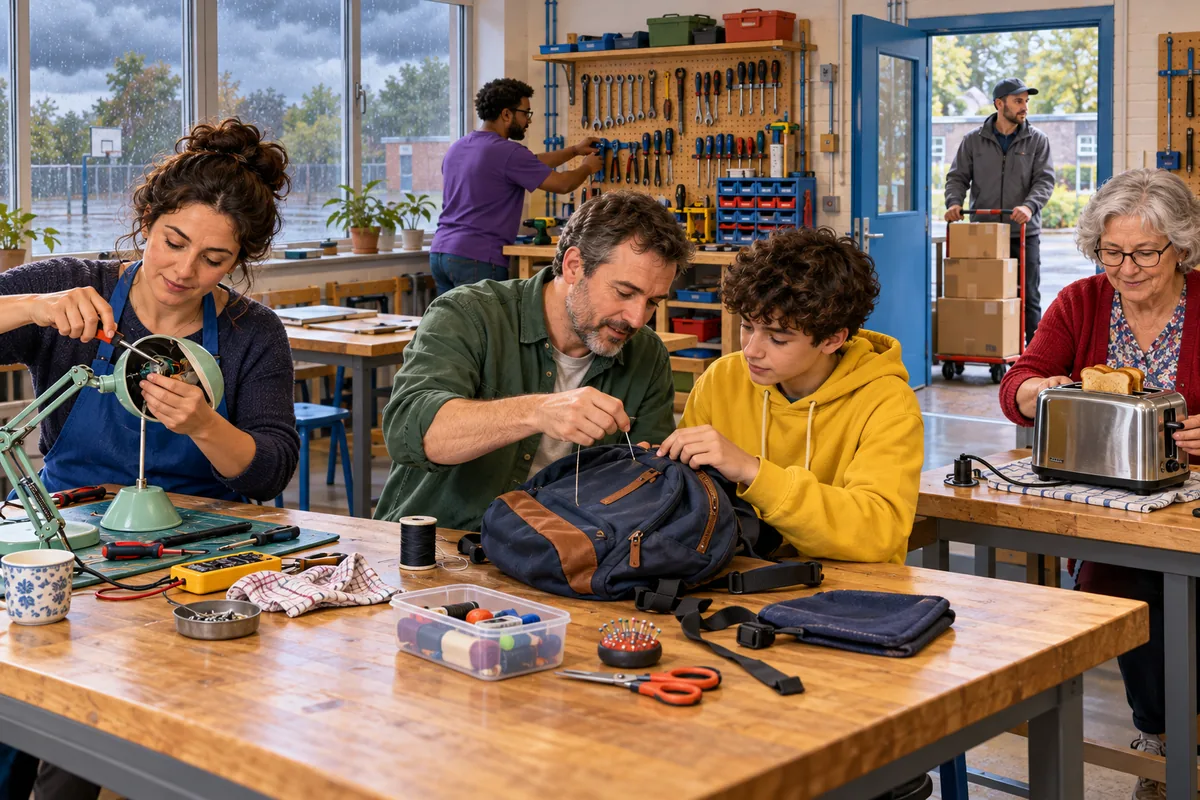
Describe the Community Repair Weekend picture to someone who cannot see it. Organize the people and objects by position, and include the weather and doorway details you can observe.
Optional recording stays in this tab. Timer-only practice is always available.
Show guide and sample responses
Plan your response
- Give an overview, then describe the foreground from left to right and the background.
- Report what is visible without guessing people's names or roles.
On the left… · Near the centre… · In the background…
A spatial description helps a listener build an accurate picture. Include each visible person and their stated action.
Model 1
The picture shows a busy community repair event indoors. On the left, a woman wearing a blue apron is repairing a desk lamp at a table. Near the centre, a man in a green shirt is showing a teenager in a yellow hoodie how to stitch a backpack. On the right, an older woman in a red cardigan is testing a toaster. Behind them, a volunteer in a purple shirt is arranging tools. By the open doorway, an adult in a grey jacket stands beside a trolley and several boxes. Through the window, I can see dark clouds and rain. The people are spread across different work areas, and the room looks active, with repairs taking place at the table and tools being organized in the back.
Why it works: The response covers the six people, their clothing and actions, the equipment and doorway, and the visible clouds.
127 words · Practise within 60 seconds at a natural pace. Adapt this example to your own voice.
Listen after your own attempt. The MP3 is an example, not an official score benchmark.
Model 2
There are six people in a room that seems to be hosting a repair weekend. At the table on the left, a woman in a blue apron is working on a desk lamp. In the middle, a man wearing green is demonstrating how to stitch a backpack to a teenager dressed in a yellow hoodie. To their right, an older woman in a red cardigan is testing a toaster. Farther back, a volunteer in a purple shirt is arranging tools. At the doorway, an adult wearing a grey jacket is beside a trolley and some boxes. The doorway is open, and dark clouds and rain are visible through a window. The image shows several separate activities at once: a lamp repair, a sewing demonstration, a toaster test, and tools being prepared.
Why it works: This version follows a different route through the image while preserving the same observable details.
131 words · Practise within 60 seconds at a natural pace. Adapt this example to your own voice.
Listen after your own attempt. The MP3 is an example, not an official score benchmark.
Check your response
- Describe all six people and their visible actions or positions.
- Mention the repair items, doorway, trolley and boxes.
- Describe the clouds and rain through the window as observations.
Task 4: Making Predictions
Using the same Community Repair Weekend picture, predict what might happen next. Connect each possibility to a visible clue and make it clear that you are predicting rather than reporting a fact.
Optional recording stays in this tab. Timer-only practice is always available.
Show guide and sample responses
Plan your response
- Use details such as the tools, repairs, doorway, trolley, boxes or clouds as clues.
- Use might, may, could, or perhaps to show uncertainty.
Since I can see…, they might… · It is possible that… · The dark clouds could mean…, although…
A sound prediction is a plausible possibility tied to something in the image, not a claim about what definitely happens.
Model 1
The repair event may continue with the six people working in their different areas. Since the woman in the blue apron is repairing a lamp, she might test it once the repair is finished. The teenager could try stitching another part of the backpack while the man in green watches. The older woman may finish checking the toaster and return it to its owner. In the background, the volunteer arranging tools might put them into groups for the next visitors. The adult beside the trolley could bring one of the boxes inside. Rain is visible through the window, so the organizers may move items away from the open doorway to keep them dry. The delivery person might bring the trolley inside before more rain gets in.
Why it works: Predictions are tied to visible repairs and equipment, and the weather inference is carefully qualified.
126 words · Practise within 60 seconds at a natural pace. Adapt this example to your own voice.
Listen after your own attempt. The MP3 is an example, not an official score benchmark.
Model 2
Perhaps the volunteer in the purple shirt will finish sorting the tools and pass a suitable one to someone at the table. The man in green might let the teenager practise a few more stitches, since he is already demonstrating the backpack repair. The woman testing the toaster could try another test or decide it needs further attention; the picture does not tell us whether it works. At the doorway, the person in the grey jacket may bring the trolley and boxes farther into the room. Because rain is visible through the window, someone could close the door after the delivery person brings the boxes inside. These are reasonable next steps suggested by the scene, but none of them is certain.
Why it works: The response connects each possibility to a visible action or clue and avoids treating any outcome as known.
121 words · Practise within 60 seconds at a natural pace. Adapt this example to your own voice.
Listen after your own attempt. The MP3 is an example, not an official score benchmark.
Check your response
- Make more than one prediction.
- Link each prediction to a visible detail.
- Use language that marks each idea as uncertain.
Task 5: Comparing and Persuading
You and your colleague are choosing a venue for 16 repair volunteers and visitors. Compare the booking cards, choose A or B silently, then explain your choice to your colleague, who prefers C.
Choose A, the indoor school workshop, or B, the covered courtyard. You have 60 seconds to compare the cards silently. If you make no choice, A is selected.
If you have not selected an option when the choosing timer ends, A is selected. No speaking is needed during this stage.
Your colleague prefers C, the shopping-centre stall. Address them directly and persuade them to choose your selected A or B instead. Compare the shown facts, explain your priorities, and acknowledge a disadvantage. You have 60 seconds to prepare and 60 seconds to speak.
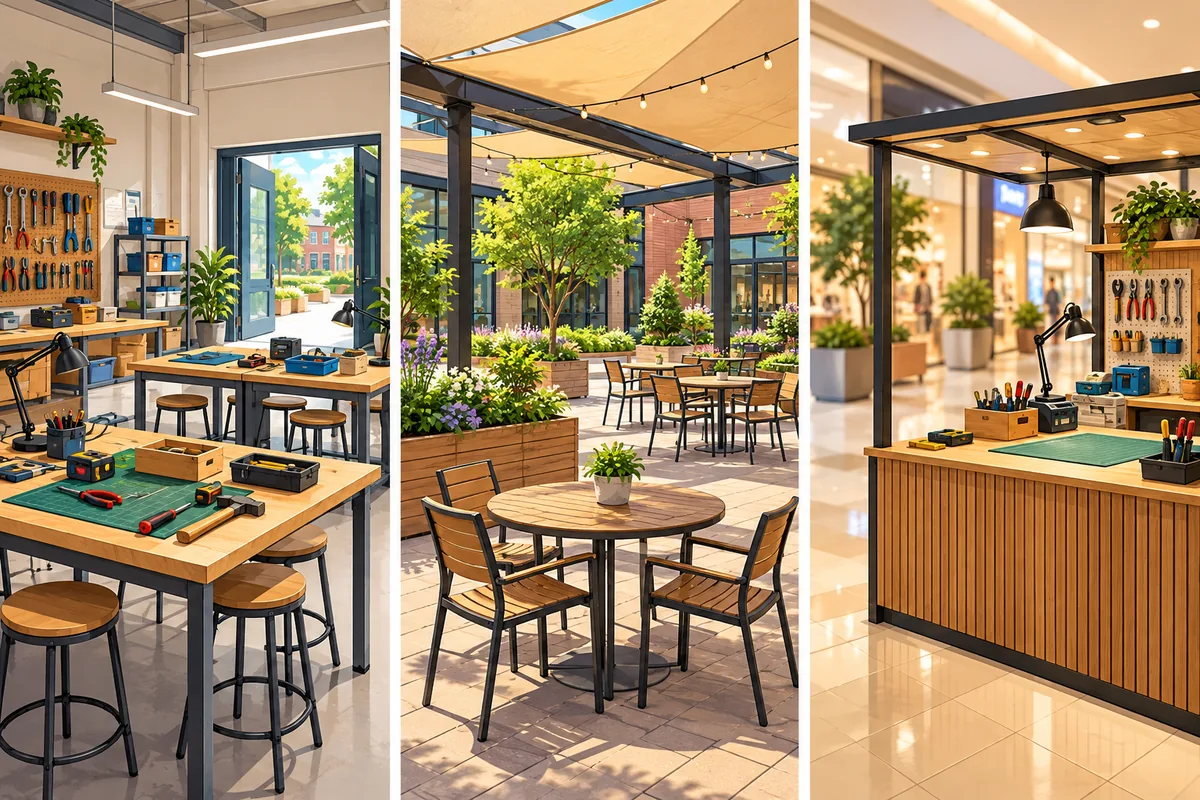
Illustrations suggest the settings; use the written cards for exact venue facts.
Optional recording stays in this tab. Timer-only practice is always available.
Show guide and sample responses
Plan your response
- Choose A or B in the silent comparison stage.
- Speak to your colleague and compare relevant card facts with C.
- State a priority, acknowledge a drawback, and make a practical recommendation.
I recommend … because… · Compared with the stall, this venue… · I recognize that … is a drawback, but…
The first 60 seconds are for silent choice between A and B. In the speaking stage, persuade a colleague who prefers C using only the stated facts and a clear trade-off.
Model 1 — Choose A over C
I see why you like the shopping-centre stall: at $120, it is our cheapest option, and shoppers might notice the event. However, we expect 16 people, and the stall only holds 12. I recommend the school workshop, which accommodates 24. Its work tables and sinks suit a repair session, and it has a step-free entrance and accessible washroom. The $220 price is $100 higher, so we should check our budget before booking. We would also need to register everyone because casual drop-ins are not allowed. The earlier nine-to-one schedule may require an earlier start for volunteers. Even with those drawbacks, having enough space for our whole group makes the school the more practical choice. What do you think?
Why it works: This argument acknowledges C's lower cost and visibility, uses card facts accurately, and identifies A's cost and access-time drawback.
118 words · Practise within 60 seconds at a natural pace. Adapt this example to your own voice.
Listen after your own attempt. The MP3 is an example, not an official score benchmark.
Model 2 — Choose B over C
I agree that the shopping-centre stall offers useful visibility and the lowest price. Still, our group of 16 would exceed its 12-person capacity. The covered courtyard holds 18, so everyone could attend. At $160, it costs just $40 more than the stall and $60 less than the school workshop. It also provides power outlets and a roof, with a step-free paved route and an accessible washroom inside the centre. Its open sides could let in wind or cold, so we should check conditions before confirming the booking. Unlike the stall, it does not list a restriction keeping every repair at one small counter. For our group and budget, I think the courtyard deserves serious consideration. Would you be willing to check availability?
Why it works: The recommendation uses B's capacity, access, roof and outlets while openly noting the price and weather limitations.
122 words · Practise within 60 seconds at a natural pace. Adapt this example to your own voice.
Listen after your own attempt. The MP3 is an example, not an official score benchmark.
Check your response
- Make a clear A or B recommendation.
- Address the colleague's preference for C directly.
- Use accurate price, capacity, access, time or extra details.
- Acknowledge a real disadvantage of your choice.
Task 6: Dealing with a Difficult Situation
A scheduling conflict has appeared in the Community Repair Weekend plan: the tool-safety briefing and the volunteer check-in are both scheduled for 10:00 a.m. Speak directly to one person below, negotiate a respectful solution, and confirm the next step. Jordan, the organizer, requires the safety briefing before repairs begin and has the room booked until 1:00 p.m. Riley, the volunteer lead, needs time to welcome volunteers and assign tasks. The earliest permitted room access has not yet been confirmed.
Optional recording stays in this tab. Timer-only practice is always available.
Show guide and sample responses
Plan your response
- Recognize the other person's need before proposing a change.
- Offer a specific schedule adjustment and invite their view.
- End by confirming who will update volunteers or the schedule.
I see why … matters to you. · Could we try…? · Would that work if…? · To confirm, I will…
A respectful negotiation identifies the shared scheduling problem, proposes a workable adjustment, and confirms a follow-up rather than blaming either person.
Model response — Speak to Jordan
Hi Jordan, the safety briefing and volunteer check-in are both scheduled for ten. I understand that everyone needs the briefing before starting repairs. Could we ask whether the room can open at nine forty-five, so Riley can check volunteers in first? If early access is unavailable, we could keep check-in at ten and move the briefing to ten fifteen. Repairs would begin afterwards in either case. We would still finish before the one o'clock booking ends, although the repair session would be slightly shorter. I would confirm the change with Riley before sending anything out. Which arrangement would work better for you? Once we agree, I can update the volunteer message and add instructions for late arrivals to receive a briefing before helping.
Why it works: The response protects Jordan's safety requirement, proposes a concrete sequence, and confirms the booking and follow-up.
123 words · Practise within 60 seconds at a natural pace. Adapt this example to your own voice.
Listen after your own attempt. The MP3 is an example, not an official score benchmark.
Model response — Speak to Riley
Hi Riley, I noticed that your check-in and Jordan's safety briefing both start at ten. I know you need time to welcome volunteers and assign roles. Could we check whether the room is available fifteen minutes earlier? Then you could handle arrivals before the briefing. If early entry is not possible, perhaps we could check people in at ten, hold the briefing at ten fifteen, and open repair stations after that. We would have less repair time, but nobody would need to miss the instructions. I would ask Jordan to approve either arrangement before changing the schedule. Would fifteen minutes give you enough time? If so, I can contact Jordan today and send both of you the confirmed plan before we notify volunteers.
Why it works: This version centers Riley's check-in needs, proposes a feasible order, and checks before treating a schedule change as settled.
123 words · Practise within 60 seconds at a natural pace. Adapt this example to your own voice.
Listen after your own attempt. The MP3 is an example, not an official score benchmark.
Check your response
- Address the named person directly.
- Acknowledge their stated responsibility.
- Propose a specific change that avoids the overlap.
- Invite agreement and confirm a communication step.
Task 7: Expressing Opinions
Some people think towns should actively support repair programmes so residents can fix and reuse household items. Others believe it is more practical to replace broken items. What is your opinion? Give reasons and examples.
Optional recording stays in this tab. Timer-only practice is always available.
Show guide and sample responses
Plan your response
- State your position clearly.
- Develop reasons with practical examples and recognize a reasonable limitation.
In my view… · One practical reason is… · That said, there are cases when…
A developed opinion gives a clear position, supports it with reasons and examples, and recognizes that repair may not suit every situation.
Model 1
In my view, towns should support repair programmes, as long as they are affordable and run safely. A community repair event can help residents learn basic skills instead of depending on a new purchase for every small problem. For example, someone might learn to replace a loose button, tighten a chair joint, or understand whether an appliance needs professional service. These events can also connect neighbours who have different skills. There is a waste benefit as well: an item that can be repaired may stay out of the landfill for longer. However, repair is not always the right choice. Some electrical or structural problems need a qualified technician, and a very old item may cost more to repair than to replace. Towns could offer clear safety rules and referrals to professionals. With those safeguards, repair programmes give people a useful option without suggesting every item must be saved. It can also help residents feel more confident handling small household problems on their own. That is a sensible starting point.
Why it works: The opinion is clear, supported with examples and a waste-related reason, and balanced by safety and cost limits.
169 words · Practise within 90 seconds at a natural pace. Adapt this example to your own voice.
Listen after your own attempt. The MP3 is an example, not an official score benchmark.
Model 2
I believe towns should help residents repair and reuse household items, but the programmes should complement normal services rather than replace them. A monthly repair weekend at a library or community centre could make small fixes more accessible, especially for people who cannot afford to replace useful equipment. Visitors could also learn how to maintain items, which may prevent simple problems from getting worse. These events create opportunities for people to share knowledge across generations. For instance, an experienced volunteer might show a newcomer how to patch fabric or safely check a bicycle tyre. At the same time, organizers should be honest about what they cannot repair. A damaged electrical appliance may need a certified technician, and a repair attempt should never put a volunteer at risk. A town could set up referral information for those cases. This balanced approach would encourage less waste while keeping safety and professional expertise in view. The town could start with a modest monthly event and expand it only if residents and volunteers find it useful.
Why it works: This alternative focuses on access and learning, while clearly distinguishing community help from professional repair.
172 words · Practise within 90 seconds at a natural pace. Adapt this example to your own voice.
Listen after your own attempt. The MP3 is an example, not an official score benchmark.
Check your response
- State your opinion.
- Give at least two supporting reasons or examples.
- Acknowledge one limitation or opposing consideration.
- End with a clear conclusion.
Task 8: Describing an Unusual Situation
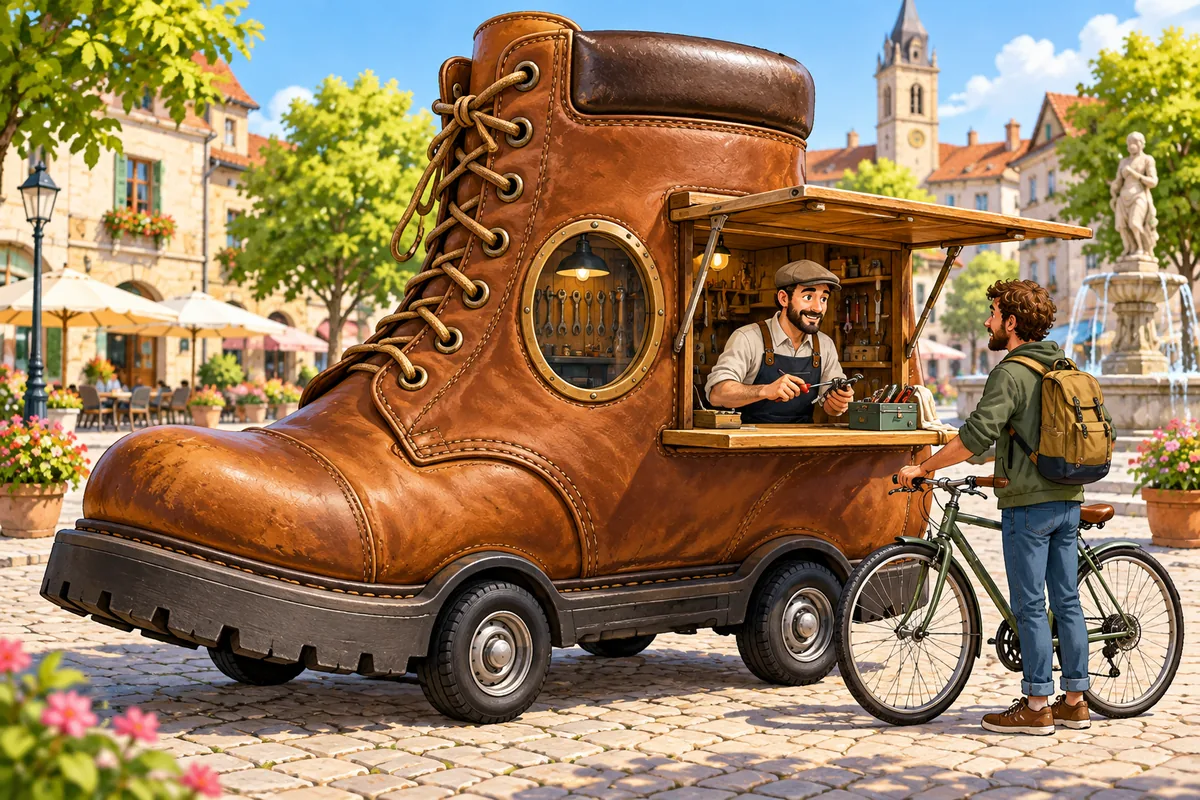
You are calling a friend to describe a surprising sight: a giant boot-shaped mobile repair kiosk has arrived in your neighbourhood. Describe what it looks like and what seems unusual about it, then explain what you might do next.
Optional recording stays in this tab. Timer-only practice is always available.
Show guide and sample responses
Plan your response
- Give a clear visual description before explaining your reaction.
- Separate the unusual design details from what you are unsure about.
You would not believe what I just saw… · The most unusual part is… · I am not sure whether…, but…
An effective phone description gives enough visual detail for a listener to imagine the unusual kiosk and includes a natural next step without inventing text or claims shown in the picture.
Model 1
Hi, you should see the unusual repair kiosk in the town square. It is shaped like an enormous brown leather boot, complete with laces and a thick sole. Small wheels underneath make the whole thing look like a vehicle. On the side, a raised hatch forms a roof over a serving counter. A repair worker is standing behind it with tools, and a customer with a bicycle is talking to him. There is also a round window with more tools visible inside. I cannot tell exactly which repairs they offer, but the design certainly catches your attention. I might ask whether they can look at my loose bag handle. Would you like me to find out when they will be here again?
Why it works: The call describes the kiosk's visible features and avoids claiming services or signage that are not shown.
122 words · Practise within 60 seconds at a natural pace. Adapt this example to your own voice.
Listen after your own attempt. The MP3 is an example, not an official score benchmark.
Model 2
Hey, there is a giant boot parked by the fountain, and someone is using it as a repair kiosk. I mean a whole building shaped like a brown lace-up boot, with little wheels along the bottom. Its side hatch is lifted up above a wooden counter, where a smiling worker is holding tools. A man with a backpack has stopped beside it with his bicycle. The circular window shows a row of tools inside, which makes it look like a tiny workshop. I have no idea how the boot was built or how often it moves around. I am going to ask what services are available. If they repair bags, perhaps I could bring mine here rather than buy a new one.
Why it works: This version gives a phone-friendly description, notes the uncertainty, and suggests a plausible next step.
122 words · Practise within 60 seconds at a natural pace. Adapt this example to your own voice.
Listen after your own attempt. The MP3 is an example, not an official score benchmark.
Check your response
- Address the friend naturally on the phone.
- Describe the boot shape and visible kiosk features.
- Say what seems surprising and what you might do next.
Finish speaking, then review your attempts and self-assessment.