
CELPIP Speaking · Set 10 · Practice Test 1 · Original practice
A Neighbourhood Seed Library
One warm-up and eight speaking tasks. Plan, speak aloud, then review your response. Keep your own examples and viewpoint.
Follow the preparation and response times shown. Task 5 has an additional silent choosing stage. This practice does not calculate an official score.
0 of 8 practice tasks attempted
Optional microphone recording requires browser permission and a supported secure context. Your recordings are not uploaded. Recordings, notes and ratings are kept only in this tab and disappear on reset, reload or closing; download recordings you want to keep. Without a microphone, use the timer and speak aloud. Sample responses use approved AEn4U British voices and are available inside the guides after your own attempt.
Practice: Warm-up
Describe a small item you keep or reuse for gardening, cooking, or another hobby. Say what it is, where you got it, and why you find it useful. This warm-up is outside the eight-task practice count and is not scored.
Optional recording stays in this tab. Timer-only practice is always available.
Show guide and sample responses
Plan your response
- Choose an item you can describe from memory.
- Move from its appearance to how you use it.
- Give one specific reason it is useful.
One item I find useful is… · I got it from… · It helps me because…
This short warm-up helps you begin speaking with a clear object, source, and personal reason. It is unscored and separate from the eight practice tasks.
One possible response
I keep a small glass jar in a cool kitchen cupboard and use it to collect herb seeds at the end of summer. It once held pasta sauce, so reusing it saved me buying another container. I wash it, let it dry completely, and label the lid with the plant name and date. Its wide opening helps me pour seeds out without spilling many. I keep the jar away from sunlight and moisture, and only put fully dried seeds inside. My aunt gave me the idea after seeing several loose envelopes on my shelf. It is an ordinary object, but it helps me stay organized and reminds me to use things I already have.
Listen to this sample after your own attempt
Why it works: The answer describes a familiar reused object and connects its features to a specific purpose.
One possible response (114 words). Practise aloud within 60 seconds and adapt the details to your voice. No official score or level is implied.
Check your response
- Name and describe the item.
- Explain where it came from or where you keep it.
- Give a practical reason you value it.
Task 1: Giving Advice
Your neighbour Lina wants to start a small seed library in the lobby of her apartment building. Residents could take seeds and leave some for others, but Lina is unsure how to make the system clear and welcoming. Give her practical advice about organizing the seeds, explaining how the exchange works, and encouraging residents to participate.
Optional recording stays in this tab. Timer-only practice is always available.
Show guide and sample responses
Plan your response
- Start with a simple, manageable setup.
- Explain how residents can take and contribute seeds.
- Suggest a way to keep information useful and participation welcoming.
I would begin by… · To make the exchange clear… · You could invite residents to…
Helpful advice turns a broad idea into a few manageable steps and considers both clear instructions and ongoing participation.
Set up a simple exchange
Lina, I think your seed library could work well if the first version is easy to understand. Begin with one sturdy box on a lobby shelf, divided into vegetables, herbs, and flowers. Ask a few residents to contribute seeds they have stored properly, and label each packet with the plant name and collection date. A short instruction card could explain that people may take a few packets and are welcome to contribute, although they do not need to bring seeds before taking any. That keeps the exchange friendly for beginners. Include a notebook where residents can share growing tips or request a variety. You could invite neighbours to a short launch session and show them how the sections work. Arrange for two volunteers to check the box regularly, so maintaining it does not become your responsibility alone. After a month, ask whether the labels and instructions make sense. Start small, learn from the feedback, and expand only when you have enough help.
Listen to this sample after your own attempt
Why it works: This response gives a modest launch plan and makes participation welcoming for people who have no seeds to contribute yet.
One possible response (162 words). Practise aloud within 90 seconds and adapt the details to your voice. No official score or level is implied.
Build participation gradually
Lina, I would test the idea with a small group before filling the lobby with packets. Ask a few neighbours which plants they would like to grow, then prepare clearly labelled envelopes for those seeds. Include the plant name, variety if known, and collection date. Put a simple sign beside the box explaining that residents can take seeds even if they have nothing to contribute. Beginners should feel welcome too. You could organize a short courtyard gathering where experienced gardeners answer questions and show people how to use the library. Give residents a way to leave suggestions, perhaps in a notebook beside the collection. For maintenance, check regularly for damaged or unidentified packets and set uncertain ones aside for checking. Share that job with another volunteer. After several weeks, ask what worked and what was confusing. That feedback will help you improve the instructions and decide whether more sections are needed. A small, reliable exchange will encourage people to return and recommend it to their neighbours.
Listen to this sample after your own attempt
Why it works: This alternative emphasizes a trial, inclusive borrowing, and feedback before the collection grows.
One possible response (166 words). Practise aloud within 90 seconds and adapt the details to your voice. No official score or level is implied.
Check your response
- Offer practical first steps for setting up the library.
- Explain how to label or organize seed packets.
- Suggest a welcoming way to invite participation or handle questions.
Task 2: Talking about a Personal Experience
Talk about a time you learned something from growing a plant, helping in a garden, or caring for something over time. Explain what you did, what surprised or challenged you, and what you learned from the experience.
Optional recording stays in this tab. Timer-only practice is always available.
Show guide and sample responses
Plan your response
- Choose one experience with a clear beginning and outcome.
- Include a challenge or discovery that made it memorable.
- Finish with what you learned or would do differently.
I remember when… · At first, I thought… · That experience taught me…
A focused personal story is easy to follow when it connects an initial plan, a turning point, and a lesson.
A lesson from balcony gardening
A few years ago, I tried growing basil on my balcony. I watered it every evening because I assumed that would help it grow faster. After a week, some leaves began to droop and turn yellow. My aunt suggested checking the soil first. The pot was still damp after rain, so I had been adding water unnecessarily. I moved it under a small overhang and waited until the soil needed watering again. It gradually recovered and produced leaves for several meals. What surprised me was that doing less could be more helpful. I learned to observe the plant and its surroundings instead of following a fixed schedule. Now I check conditions before deciding what care is needed.
Listen to this sample after your own attempt
Why it works: Uses a clear sequence of relevant details. For picture tasks, observed actions are distinct from predictions; other well-supported responses are possible.
One possible response (117 words). Practise aloud within 60 seconds and adapt the details to your voice. No official score or level is implied.
A shared community plot
Last spring, I spent a morning helping at a community garden. I expected to plant vegetables, but our first job was sorting seed packets. Several labels had faded, so nobody could confidently identify their contents. An experienced volunteer showed us the garden's record book, and we matched some packets with reliable notes. Anything still uncertain stayed separate. Later, I helped sow beans in a marked row. I enjoyed that practical work, but the sorting made the strongest impression on me. I realized that careful records matter as much as digging or watering. Since then, I label containers at home immediately. It takes very little time and prevents the frustration of finding something useful without knowing exactly what it is.
Listen to this sample after your own attempt
Why it works: Uses a clear sequence of relevant details. For picture tasks, observed actions are distinct from predictions; other well-supported responses are possible.
One possible response (119 words). Practise aloud within 60 seconds and adapt the details to your voice. No official score or level is implied.
Check your response
- Set the scene and explain what you were doing.
- Describe a specific difficulty or discovery.
- End with a lesson or change in your approach.
Task 3: Describing a Scene
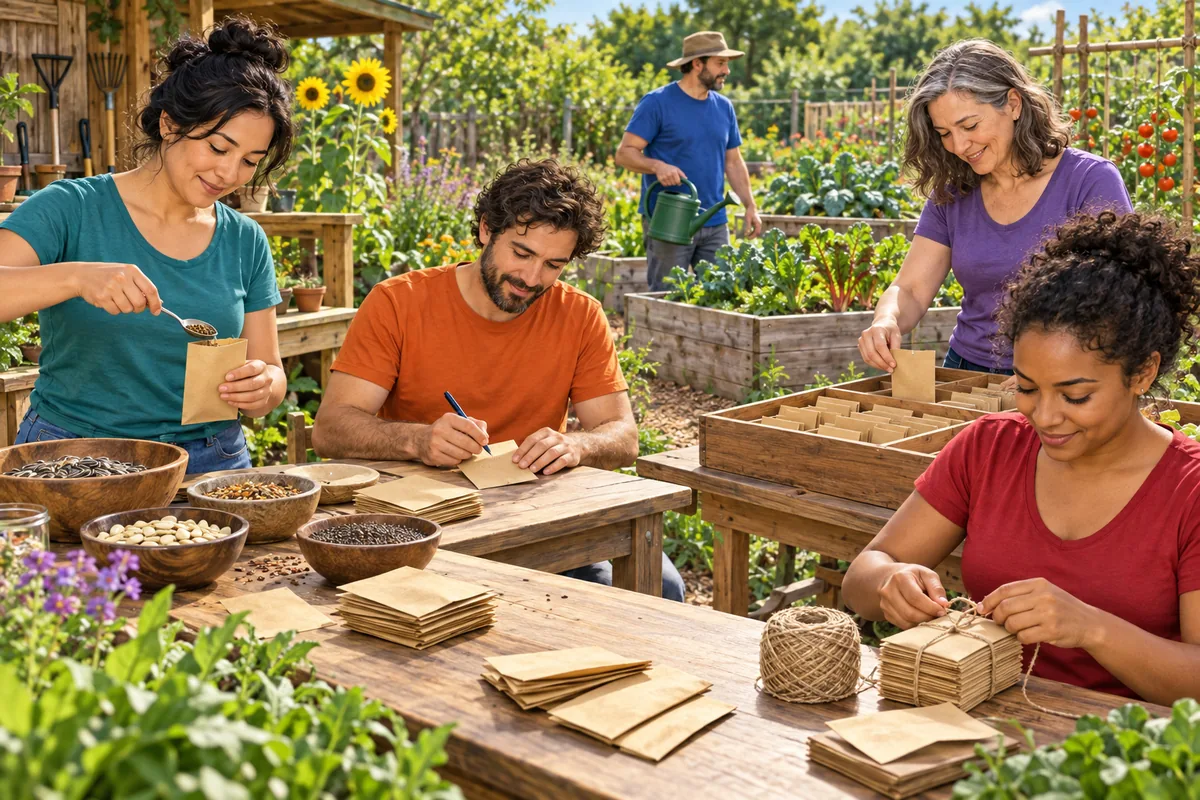
Describe the community garden seed-packing picture to a person who cannot see it. Explain where the people and objects are and what each person is visibly doing. Keep your description to observable details.
Optional recording stays in this tab. Timer-only practice is always available.
Show guide and sample responses
Plan your response
- Begin with the garden and seed-packing activity.
- Describe the five adults by position and clothing so the listener can distinguish them.
- Use only visible actions and objects; do not invent names, motives, or event details.
On the left… · In the centre… · In the foreground…
An effective picture description gives the listener a map of the scene, then adds visible actions and objects without turning guesses into facts.
Describe by position
The picture shows five adults working with seeds in a sunny garden. On the left, a woman in teal holds a spoon of seeds above a paper packet. Beside her, a seated man in orange is writing on another packet. On the right, a woman in purple is putting a packet into a wooden tray divided into sections. In the foreground, a woman in red is tying string around a bundle of brown packets. Behind the tables, a man in blue carries a green watering can beside a raised bed. There are bowls of different seeds on the tables, with plants and sunflowers around the work area. The people appear to be preparing and organizing packets together.
Listen to this sample after your own attempt
Why it works: Uses a clear sequence of relevant details. For picture tasks, observed actions are distinct from predictions; other well-supported responses are possible.
One possible response (117 words). Practise aloud within 60 seconds and adapt the details to your voice. No official score or level is implied.
Group the details
There is a seed-packing activity taking place outdoors among garden beds. Five adults are visible. Closest to us on the right, a woman wearing red ties a bundle of paper packets with string. Farther left, a woman in teal is holding a spoon above an open packet. The orange-shirted man next to her sits at a wooden table and writes on a packet. Across from them, a woman in purple places one into a divided wooden tray. A blue-shirted man stands farther back with a green watering can. Bowls of seeds, loose packets, and a ball of string cover parts of the tables. Plants surround the group, including tall yellow sunflowers behind the woman on the left.
Listen to this sample after your own attempt
Why it works: Uses a clear sequence of relevant details. For picture tasks, observed actions are distinct from predictions; other well-supported responses are possible.
One possible response (117 words). Practise aloud within 60 seconds and adapt the details to your voice. No official score or level is implied.
Check your response
- Mention the community garden setting and all five adults.
- Match each person's location, shirt colour, action, and relevant object to the picture.
- Avoid claims about identities, feelings, or unseen event details.
Task 4: Making Predictions
Look at the community garden seed-packing picture. What do you think might happen next? Make a few reasonable predictions based on visible clues, and use tentative language to show that these are possibilities rather than facts.
Optional recording stays in this tab. Timer-only practice is always available.
Show guide and sample responses
Plan your response
- Choose visible clues such as packets, the tray, or the raised bed.
- Make predictions that follow from those clues.
- Use language such as might, could, or perhaps; do not claim to know what happens next.
Perhaps they will… · The packets might… · It is possible that…
Predictions should be plausible interpretations of the scene. Tentative wording makes clear that the future actions are not visible facts.
Predict from the packets
I think the group may soon have more packets ready to organize. The woman with the spoon could finish filling her packet and pass it to someone for labelling. The man writing at the table might add it to a completed pile once he finishes his own packet. The divided tray suggests that the woman in purple may sort the packets into separate groups. In front, the woman tying string could finish her bundle and set it aside for carrying. The man with the watering can might water one of the nearby beds. After these jobs, the adults may compare what they have prepared. Those predictions come from the visible objects and actions; we cannot know their exact next steps.
Listen to this sample after your own attempt
Why it works: Uses a clear sequence of relevant details. For picture tasks, observed actions are distinct from predictions; other well-supported responses are possible.
One possible response (120 words). Practise aloud within 60 seconds and adapt the details to your voice. No official score or level is implied.
Imagine the next stage
Perhaps these adults will prepare the packets for a seed exchange. The bundle in the foreground looks nearly tied, so the woman in red might move it to a storage area. The woman on the left could fill another envelope from one of the bowls. Since the man in orange is writing, he may be recording information that will help somebody identify the seeds later. The wooden tray could keep finished packets separate until they are needed. Meanwhile, the man with the watering can might turn to caring for the nearby plants. I would expect some tidying when the packing is finished, because supplies cover several tables. That is only a possibility, though; the picture does not show their schedule.
Listen to this sample after your own attempt
Why it works: Uses a clear sequence of relevant details. For picture tasks, observed actions are distinct from predictions; other well-supported responses are possible.
One possible response (120 words). Practise aloud within 60 seconds and adapt the details to your voice. No official score or level is implied.
Check your response
- Refer to at least two visible clues.
- Make plausible predictions about a next step.
- Mark each prediction as uncertain rather than certain.
Task 5: Comparing and Persuading
You and your neighbour Priya are organizing a seed-library event this Saturday with 60 seed packets. First choose one display option, A or B. You will then compare your choice with a different suggestion.
Choose A or B for this Saturday. You have 60 packets in total. Consider display capacity, cost and weather. You do not need to speak during this 60-second choosing stage.
A – Folding display table
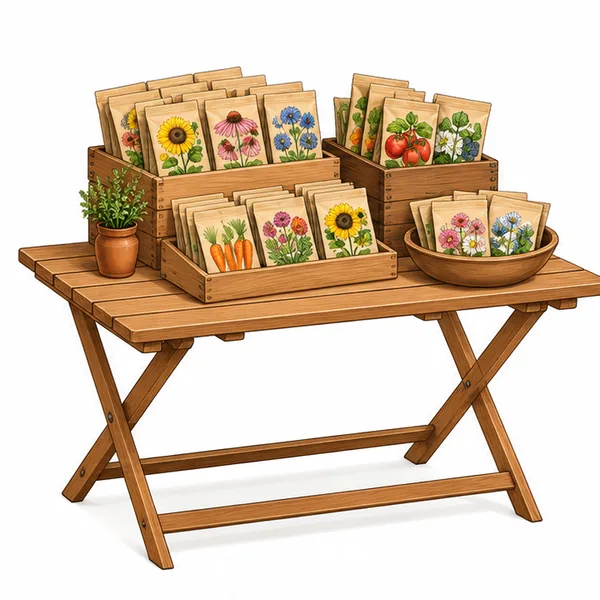
- $45 for one day
- Capacity: 40 packets
- Outdoors
- Needs dry weather
B – Indoor wall rack
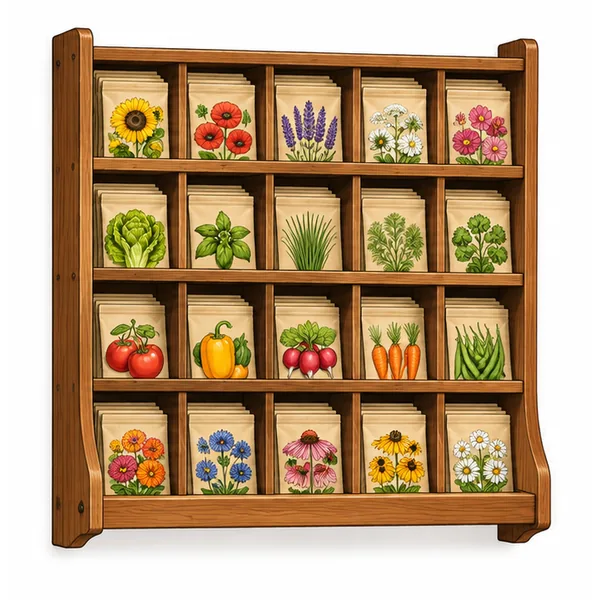
- $95 for one day
- Capacity: 80 packets
- Sheltered indoors
- Permission already granted
If you have not selected an option when the choosing timer ends, A is selected. No speaking is needed during this stage.
Priya prefers option C, the delivery display booth shown below. Speak directly to Priya and persuade her that your selected option, A or B, is more suitable for this Saturday. Explain any extra arrangements your choice needs.
A – Folding display table
- $45 for one day
- Capacity: 40 packets
- Outdoors
- Needs dry weather
B – Indoor wall rack
- $95 for one day
- Capacity: 80 packets
- Sheltered indoors
- Permission already granted
C – Delivery display booth
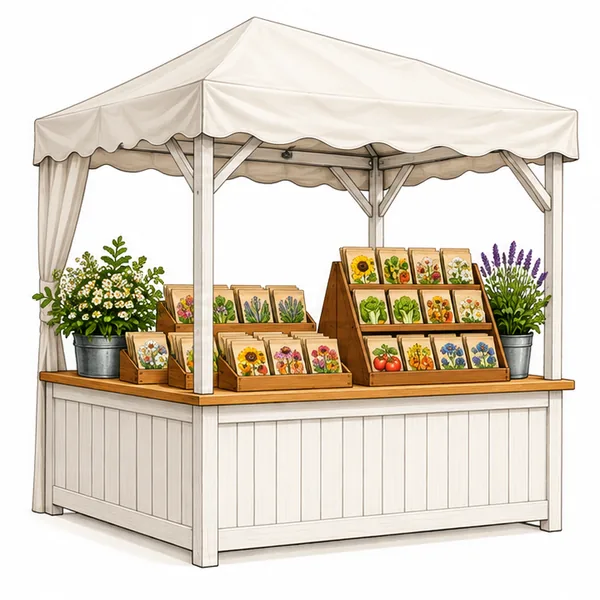
- $180 for one day
- Capacity: 120 packets
- Outdoors
- Supplier unavailable until next weekend
Optional recording stays in this tab. Timer-only practice is always available.
Show guide and sample responses
Plan your response
- Notice that 60 packets exceed A's capacity but fit B's capacity.
- Compare cost, capacity, shelter, and the Saturday timing accurately.
- Acknowledge why Priya likes C, then explain why your choice is more suitable this Saturday.
I understand why C appeals to you… · For this Saturday, I would choose… · Although it costs more than A…
A strong comparison uses the stated facts, respects the other person's preference, and connects the recommendation to the event's actual needs and timing. Option A alone cannot hold all 60 packets. Option B can hold them and is sheltered, with permission already granted. Option C offers the greatest capacity, but the supplier is unavailable until after the event.
Recommend B over C
Priya, I understand why you like the booth: it holds 120 packets and gives us plenty of space. However, its supplier cannot deliver until next weekend, and our event is this Saturday. I would choose the indoor rack. Its 80-packet capacity is enough for all 60 packets, with room left over. It costs $95, which is $85 less than the booth. It is sheltered indoors, and we already have permission to use the space. The rack does cost more than the folding table, but that table cannot display everything at once and needs dry weather. The rack meets our immediate needs without those extra arrangements. Could we book it for Saturday and consider the booth for a future event?
Listen to this sample after your own attempt
Why it works: This model respects Priya's preference, compares B and C, and explains why B meets the Saturday capacity and shelter needs.
One possible response (119 words). Practise aloud within 60 seconds and adapt the details to your voice. No official score or level is implied.
Choose A with a smaller display plan
Priya, the booth offers more space, but it will arrive too late for Saturday. I would choose the $45 folding table if we agree on a smaller display. It holds 40 packets, so we would keep the other 20 in labelled boxes and replenish the table as visitors take packets. That saves $135 compared with the booth and $50 compared with the indoor rack. We must also check the forecast because the table requires dry weather. If rain is expected, I would switch to the sheltered rack. I know this plan needs more organizing, but it keeps costs low when conditions are suitable. Would you accept that approach, provided we arrange the spare boxes and confirm dry weather first?
Listen to this sample after your own attempt
Why it works: This choice acknowledges A's capacity and weather limits and proposes a practical way to manage them rather than hiding the trade-off.
One possible response (119 words). Practise aloud within 60 seconds and adapt the details to your voice. No official score or level is implied.
Check your response
- Choose either A or B and compare it with C.
- Accurately state price, capacity, location or shelter, and availability.
- Acknowledge Priya's preference and give a courteous reason to choose your option for this Saturday.
Task 6: Dealing with a Difficult Situation
You are opening a seed library shortly. Alex wants every donated packet displayed immediately. Sam says several labels are unclear and wants to delay opening until all are checked. Choose ONE: speak directly to Alex and explain why some packets should stay off display; OR speak directly to Sam and explain why the clearly labelled packets can be offered while the others are checked. Give a respectful practical plan.
Optional recording stays in this tab. Timer-only practice is always available.
Show guide and sample responses
Plan your response
- Choose one audience before preparing.
- Acknowledge that person's concern and address them directly.
- Explain a workable plan for opening and handling uncertain packets.
I understand the time pressure… · For any packet we cannot identify… · Could you help by…
Either audience is valid. The first response persuades Alex to withhold uncertain packets; the second persuades Sam that checking can continue while known packets are offered. No automatic speaking score is assigned.
Speaking to Alex
Alex, I understand that you want every packet ready before we open. You have worked hard, and it would be frustrating to leave some off the display. However, we cannot confidently identify several packets, and I do not want visitors taking seeds with unreliable information. Let us put out the clearly labelled ones first and keep the uncertain packets separate. Could you arrange the known varieties while Sam checks the donation notes? If a label still cannot be confirmed, that packet can stay unavailable today. We can explain the smaller selection honestly and add verified packets later. This way, we can open on time without guessing. Would you help me prepare the reliable packets while the checking continues?
Listen to this sample after your own attempt
Why it works: Addresses the selected person directly, recognizes the competing concern, and offers a concrete division of work.
One possible response (118 words). Practise aloud within 60 seconds and adapt the details to your voice. No official score or level is implied.
Speaking to Sam
Sam, thank you for noticing the unclear labels before visitors arrive. I agree that we should avoid guessing what those seeds are. We are close to opening, though, so I suggest separating the uncertain packets while we prepare the clearly labelled ones. Could you check the donation notes or contact the people who brought the questionable packets? Alex and I can organize the known varieties in the meantime. If you cannot confirm a packet today, leave it off the public display and we will review it later. We can still offer a useful exchange with a smaller reliable selection. You do not need to solve every label before we open. Would that division of work give you enough space to check carefully?
Listen to this sample after your own attempt
Why it works: Addresses the selected person directly, recognizes the competing concern, and offers a concrete division of work.
One possible response (122 words). Practise aloud within 60 seconds and adapt the details to your voice. No official score or level is implied.
Check your response
- Speak directly to the selected person.
- Recognize their concern respectfully.
- Offer known packets and keep uncertain ones separate until verified.
Task 7: Expressing Opinions
Some neighbourhoods are considering shared seed libraries where residents can exchange seeds and growing advice. Do you think communities should support these libraries? Give your opinion, support it with reasons or examples, and acknowledge a concern or limitation.
Optional recording stays in this tab. Timer-only practice is always available.
Show guide and sample responses
Plan your response
- State your position directly.
- Develop reasons connected to access, learning, community, or resource use.
- Acknowledge a realistic concern and suggest a reasonable safeguard.
I believe communities should… · One benefit is… · A practical concern is…
A developed opinion combines a clear position with relevant support and a realistic response to a limitation.
Support community seed libraries
I believe neighbourhoods should support seed libraries, especially when they are organized with clear information and modest expectations. Seeds can be expensive for someone who wants to try only a few plants, and a shared collection lets residents experiment without buying a large packet each time. The library can also help people exchange practical advice. A new gardener might learn when to sow a particular herb from someone who has grown it locally. These conversations can make gardening feel less intimidating and create connections among neighbours who might not otherwise meet. There are concerns to manage. Seeds need to be stored appropriately, and packets should be labelled clearly so people are not relying on guesses. A volunteer team could check dates and separate anything uncertain. The library should also be accessible to residents who cannot attend a particular event. Starting with a small collection and gathering feedback would help the organizers improve it. With careful stewardship, a seed library can make learning and sharing easier for the whole community.
Listen to this sample after your own attempt
Why it works: The model gives reasons about affordability and learning, then addresses storage and reliable labelling.
One possible response (169 words). Practise aloud within 90 seconds and adapt the details to your voice. No official score or level is implied.
Support only where residents want it
I would support a seed library when residents show interest and someone is willing to maintain it. A shared collection can reduce the cost of trying new plants, and it gives experienced gardeners a way to pass on useful local knowledge. It could be as simple as a small cabinet at a community centre with labelled packets and a notebook for comments. However, a library will not automatically be useful to everyone. Some people have no space to grow plants, and others may not be able to visit the location during its opening hours. Seeds can also become difficult to identify if packets are poorly labelled or left for a long time. I would recommend beginning with a short trial and asking residents what would make it accessible. Organizers could offer an occasional exchange table or keep a small set of instructions online. If participation remains low, the group could adjust the format rather than keep expanding the collection. The idea works when it responds to local needs and has a maintenance plan.
Listen to this sample after your own attempt
Why it works: This qualified view considers who can access the library and makes ongoing community interest part of the decision.
One possible response (173 words). Practise aloud within 90 seconds and adapt the details to your voice. No official score or level is implied.
Check your response
- Give a clear position on community seed libraries.
- Support it with reasons or a concrete example.
- Address a concern such as storage, identification, access, or maintenance.
Task 8: Describing an Unusual Situation
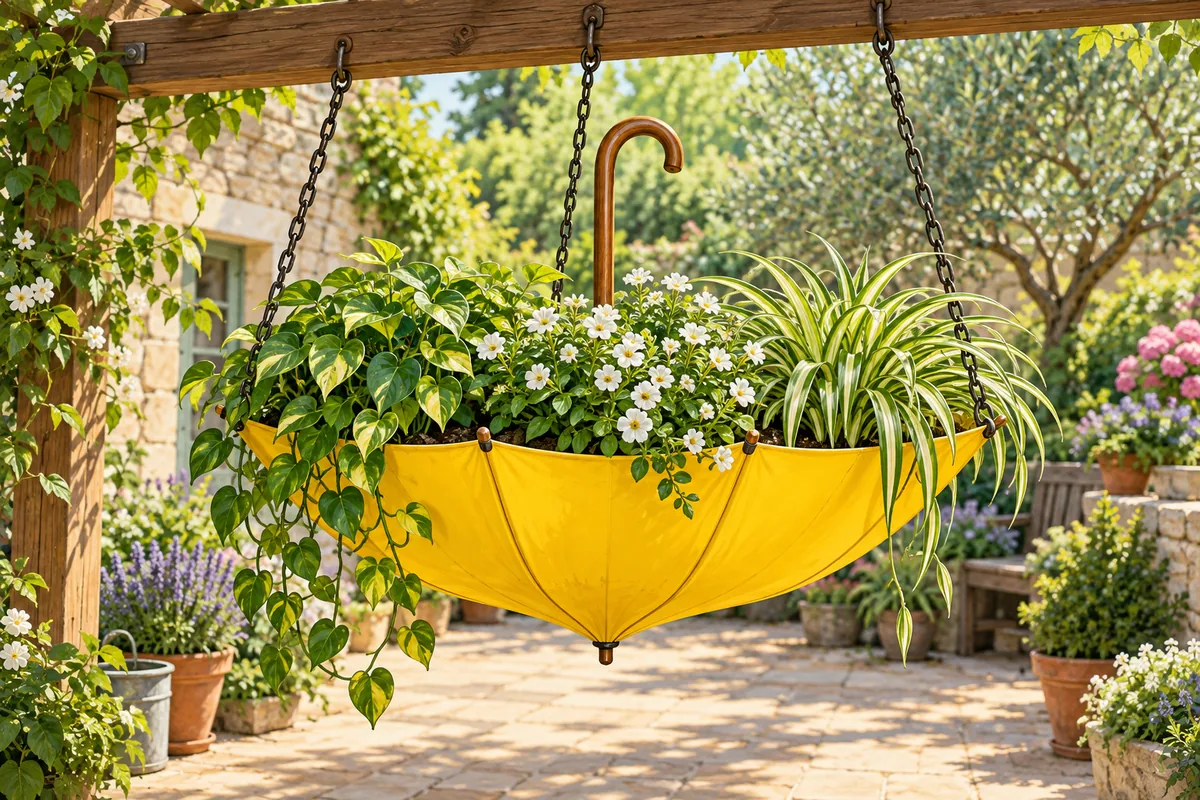
You are in the courtyard of a garden centre. Your friend Omar is inside browsing. Call him, describe the unusual object in the picture so he can imagine it, and invite him to meet you at the courtyard entrance.
Optional recording stays in this tab. Timer-only practice is always available.
Show guide and sample responses
Plan your response
- Start with the overall object and setting.
- Describe visible features in a logical order.
- Give Omar a clear meeting point; avoid unsupported construction claims.
Omar, I noticed something unusual… · What I can see is… · Could you meet me…?
Help Omar picture the visible object and give a clear invitation. Its weight capacity and drainage cannot be determined from this image.
Give Omar a visual picture
Omar, I am in the garden centre courtyard, and you should see the unusual planter hanging over the patio. It looks like a large yellow umbrella turned upside down to make a bowl. Leafy plants grow inside the open canopy, while its curved handle points upward through the middle. Chains run from the edge to a wooden beam above it. The bright yellow shape makes it stand out against the greenery. I cannot tell how the planter drains or what weight it can support, so we would need to ask about that. Could you join me and take a look? Meet me at the courtyard entrance when you finish browsing, and I will show you where it is.
Listen to this sample after your own attempt
Why it works: Describes the visible umbrella, greenery and support arrangement, leaves technical properties uncertain, and invites Omar to a precise meeting point.
One possible response (118 words). Practise aloud within 60 seconds and adapt the details to your voice. No official score or level is implied.
Describe it from top to bottom
Omar, there is an interesting object in the garden centre courtyard. A yellow umbrella is hanging from a wooden beam above the patio, but its canopy has been turned into a bowl for plants. The curved central handle sticks upward, and chains connect the outside edge to the beam. Green leaves spread out of the yellow canopy. It is a striking way to reuse something usually carried in the rain. I do not know whether it has drainage holes or how the supports were installed, so I would ask a member of staff before copying the idea. Could you come to the courtyard entrance? I will wait there and we can look at the planter together.
Listen to this sample after your own attempt
Why it works: Describes the visible umbrella, greenery and support arrangement, leaves technical properties uncertain, and invites Omar to a precise meeting point.
One possible response (116 words). Practise aloud within 60 seconds and adapt the details to your voice. No official score or level is implied.
Check your response
- Describe the yellow umbrella-shaped bowl and upward hooked handle.
- Mention the visible plants, chains and beam.
- Invite Omar to the courtyard entrance; distinguish observations from guesses.
Finish speaking, then review your attempts and self-assessment.