

Movers 4 – Test 3 Listening
100% Original Practice Test
A Week at Willow Glasshouse 100% Original Practice Test with new pictures and audio. Listen to five parts and answer 25 questions. Hear each part twice, take notes and check your answers. This A1 listening practice has 5 parts and 25 questions.
Learning guide
Level: A1.
Topic: A Week at Willow Glasshouse
Learning objectives
- Identify people by combining clues about appearance, actions and positions.
- Listen for spelling, numbers and missing details in a short conversation.
- Match the activities or objects described in conversations to the correct person or day.
- Compare three pictures and choose the detail finally confirmed by the speakers.
- Follow colour and position instructions to locate the correct objects in a scene.
Before you start: Understand familiar everyday vocabulary, simple descriptions, numbers, names and position words.
Teacher tip: Let learners study the pictures and headings before each part. After their first attempt, discuss the clues and use the transcript and answer explanations for review.
Listening strategy: Look at the picture or form first. Listen for the final confirmed detail, spelling and position words. Check each answer against what the speakers actually say.
Listen and draw lines
Listen and match the names to the children. Leo is the example. One name is not used.
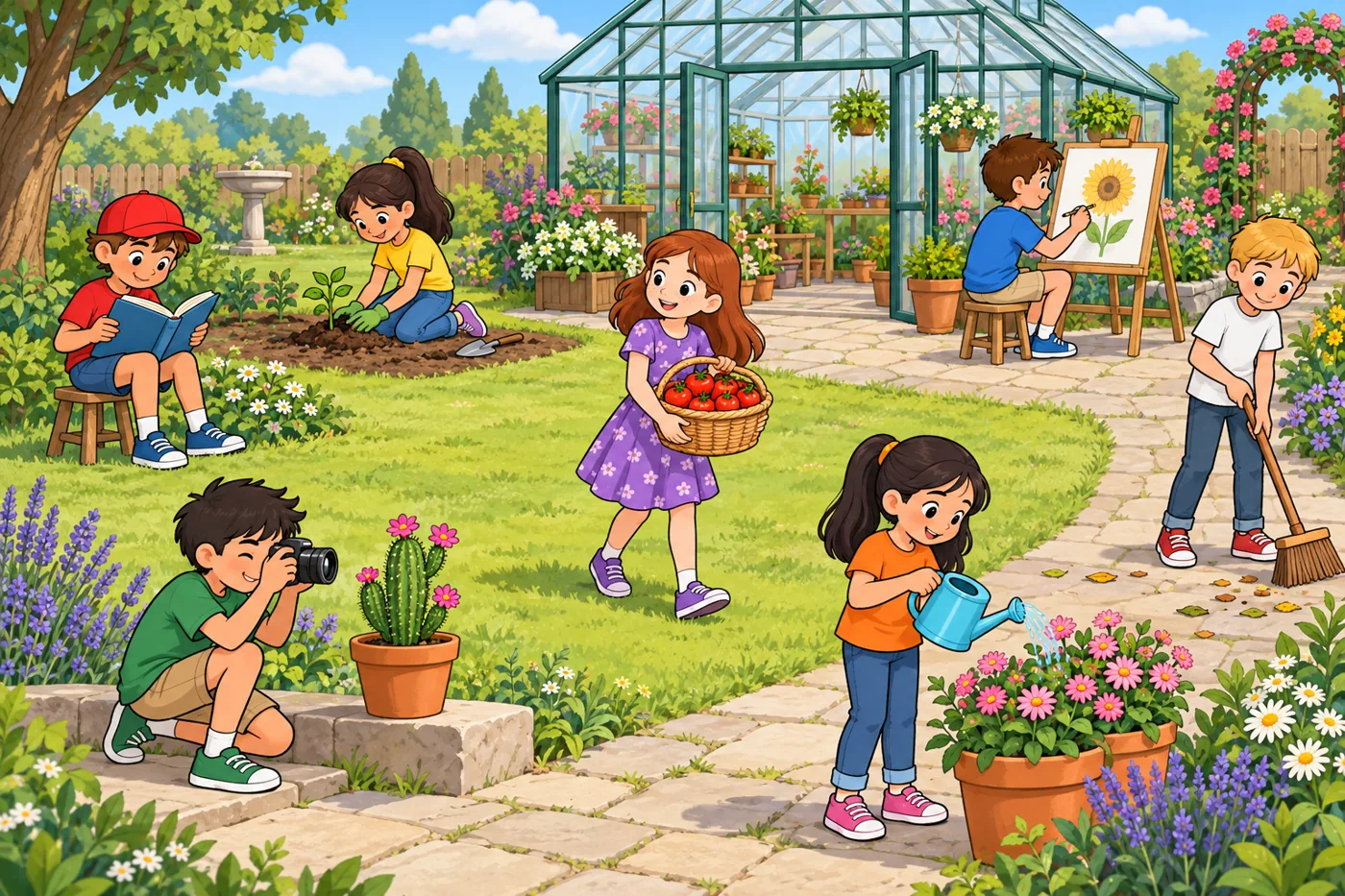
Choose a name, then choose the matching child in the picture. Leo is the example. One name is not used.
Example
Examiner: Look at all the children in this garden. Can you find Leo?
Woman: Is he the boy with a red cap, sitting on a little stool?
Examiner: Yes. He has an open book in his hands.
Woman: I can see him on the left. Leo is reading.
Question 1
Examiner: Who is the girl near the top left? She is wearing a yellow shirt.
Woman: That is Mia. She is putting a little plant into the ground.
Examiner: Has she finished planting it?
Woman: Not yet. Mia is kneeling beside it, with her hands in the soil.
Question 2
Examiner: There is a boy sitting in front of a picture on the right.
Woman: The boy in the blue shirt? His name is Owen.
Examiner: Is he drawing the glasshouse?
Woman: No. Look at the large yellow flower on his paper. Owen is drawing a sunflower.
Question 3
Examiner: Who is the girl in the middle, with the purple dress?
Woman: That is Ruby. She has just been inside the glasshouse.
Examiner: Her basket looks heavy. Are those apples?
Woman: They are tomatoes. Ruby is carrying the basket with both hands.
Question 4
Examiner: Can you find Max? He is down on the left.
Woman: Is he the boy in the green shirt, near that cactus?
Examiner: Yes. What is he holding in front of his face?
Woman: A camera. Max is taking a photograph of the cactus and its flowers.
Question 5
Examiner: What is the name of the girl in the orange shirt?
Woman: That is Ella. She is beside the path, at the bottom right.
Examiner: Is she carrying that blue watering can away?
Woman: No. Look at the water coming out. Ella is watering the flowers in the pot.
Listen and write
Listen and write a word or number. There is one example.
Willow Glasshouse – Garden club
Example: First name: Sophie · Age: 9
Example
Examiner: Welcome to the garden club, Sophie. How old are you?
Child Girl: I was eight when I came here last year.
Examiner: And how old are you now?
Child Girl: Nine. My birthday was in the spring, so please write nine on the form.
Question 6
Examiner: What is your family name, Sophie? I need it for our list.
Child Girl: Green. I can spell it: G-R-E-E-N.
Examiner: Are there two letter Es in the middle?
Child Girl: Yes, two Es. My name is Sophie Green.
Question 7
Examiner: Which street do you live in?
Child Girl: Willow Street. It is near the little library.
Examiner: Can you spell the street name for me?
Child Girl: Yes. W-I-L-L-O-W. Willow Street. There are lots of trees along our road.
Question 8
Examiner: What is the number of your house?
Child Girl: Fourteen. It is the house with a red front door.
Examiner: Did you say forty?
Child Girl: No, fourteen. One, then four. Our house is opposite the library, on the other side of the road.
Question 9
Examiner: Do you know which day our garden club meets?
Child Girl: I thought it was Thursday. Is that right?
Examiner: We meet on Wednesday now. The room is free that afternoon.
Child Girl: Wednesday. Good. My music lesson is on Thursday, so I can come.
Question 10
Examiner: The club starts at half past four. Can you get here then?
Child Girl: Yes. School finishes at three, so I have plenty of time.
Examiner: Good. Write the starting time in this box.
Child Girl: Four thirty. I will put four thirty on the form.
What did Sophie do last week?
Listen and match each day to the correct activity picture. Sunday is the example. Use each day once; one day is not used.
Choose a day, then choose a picture. Use each day once. Sunday is the example; one day is not used.
Example
Examiner: Tell me about Sunday, Sophie. Did you help in the garden?
Child Girl: No. Before breakfast, I fed the goldfish in our fish bowl.
Examiner: Did your dad give them the food?
Child Girl: I did it. Dad showed me how much to give them.
Question 11
Examiner: When did your class plant the little apple tree?
Child Girl: On Thursday. We all went into the school garden after lunch.
Examiner: Did you put seeds in pots?
Child Girl: No. We dug a hole for one small tree. I helped put soil around it.
Question 12
Examiner: That wooden garden sign looks new. When did you paint it?
Child Girl: On Monday, after school. It was brown before.
Examiner: Did you paint some flowers on it?
Child Girl: No. I used blue paint all over the sign. Now we can put it by the gate.
Question 13
Examiner: What did you make at the club on Friday?
Child Girl: We built a little bird house from pieces of wood.
Examiner: Did you work on your own?
Child Girl: My dad helped me. We made a small round entrance, and put the house near the trees.
Question 14
Examiner: What did you do on Tuesday? It rained all afternoon.
Child Girl: I stayed inside and made a paper flower.
Examiner: Did you paint a real flower?
Child Girl: No. I cut some coloured paper and folded it into petals. Then I put my paper flower on the table.
Question 15
Examiner: And Wednesday? Did you visit the glasshouse then?
Child Girl: No. I went to the park and played badminton with my cousin.
Examiner: Was it too windy for your game?
Child Girl: It was fine. We took two rackets and a shuttlecock, and played on the grass.
Listen and tick the box
Listen and choose the correct picture. There is one example.
Example
Woman: You have new boots for the garden, Sophie. Did you choose green ones?
Child Girl: I liked the green boots, but they were too small.
Woman: Were the red ones the right size?
Child Girl: They were, but I chose the yellow boots. They are much easier to find!
Question 16
Woman: Which tool did you use to dig the hole for your plant?
Child Girl: The little spade. It was just the right size.
Woman: I saw you carrying a rake too.
Child Girl: That was for the leaves afterwards. I used the spade to dig, then watered the plant.
Question 17
Woman: What did you draw on the little label beside your plant?
Child Girl: A sunflower, with yellow petals and a brown middle.
Woman: I thought you were going to draw a red rose.
Child Girl: I changed my mind. The sunflower was easier. I have put the label in the soil.
Question 18
Woman: Did you see any animals near the glasshouse today?
Child Girl: There was a rabbit beside the gate. It was eating grass.
Woman: Was your cat with you?
Child Girl: No, our cat stayed at home. I watched the rabbit for a minute, then went inside.
Question 19
Woman: What did you have for your snack at the garden club?
Child Girl: I took an apple, but it fell out of my bag.
Woman: Did the teacher give you a biscuit?
Child Girl: No. She had a pear in her lunch bag, and gave me that. It was lovely.
Question 20
Woman: Where are your gardening gloves, Sophie? Are they on the chair?
Child Girl: I think I put them in my bag.
Woman: I have looked in your bag. They are not there.
Child Girl: Oh, now I remember. I left them under the table. I will get them.
Listen and colour
Listen and colour the picture. There is one example.
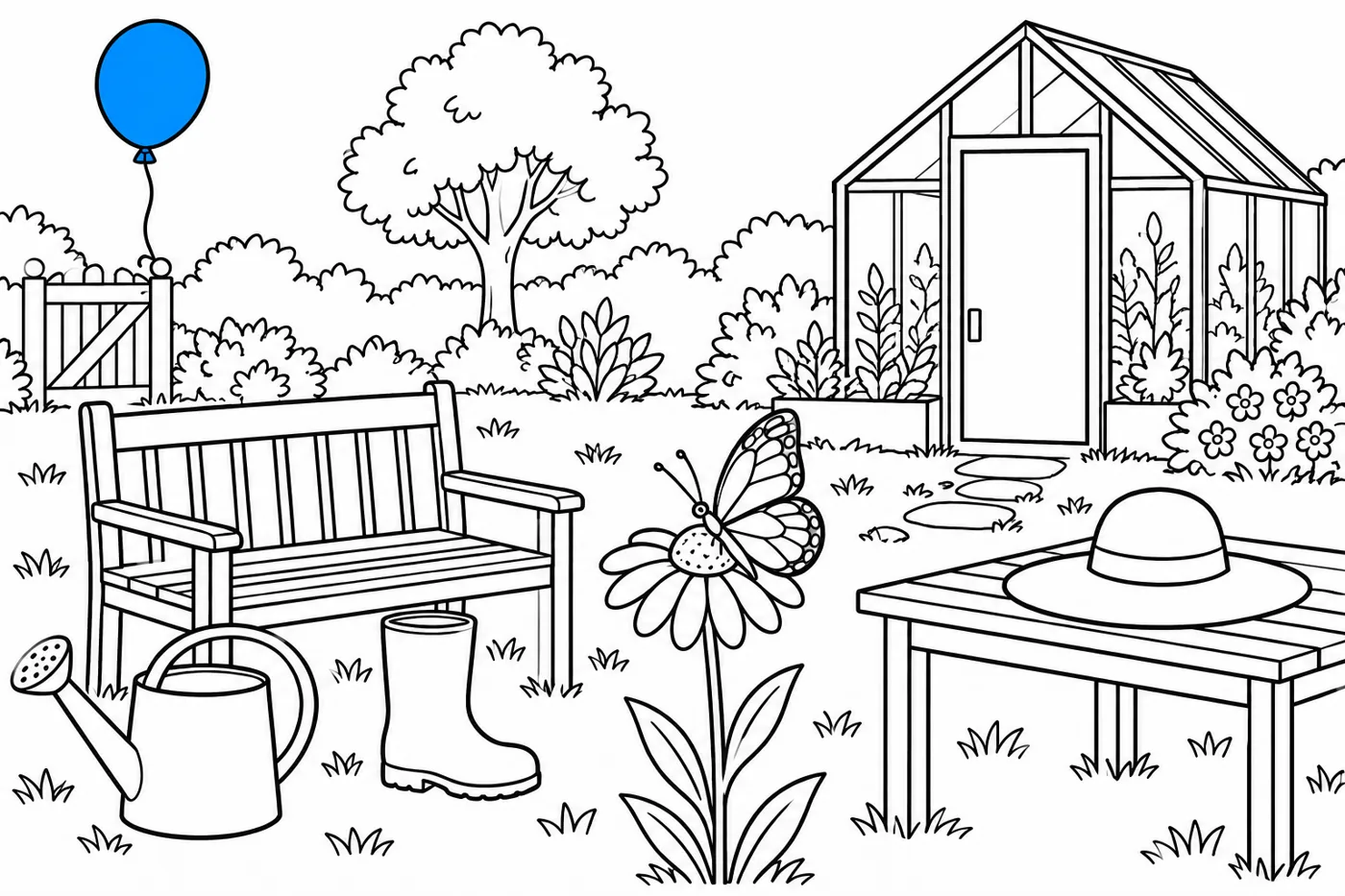
Example: the balloon tied to the gate is blue. Choose a colour, then choose an area in the picture. Follow the colours in each instruction.
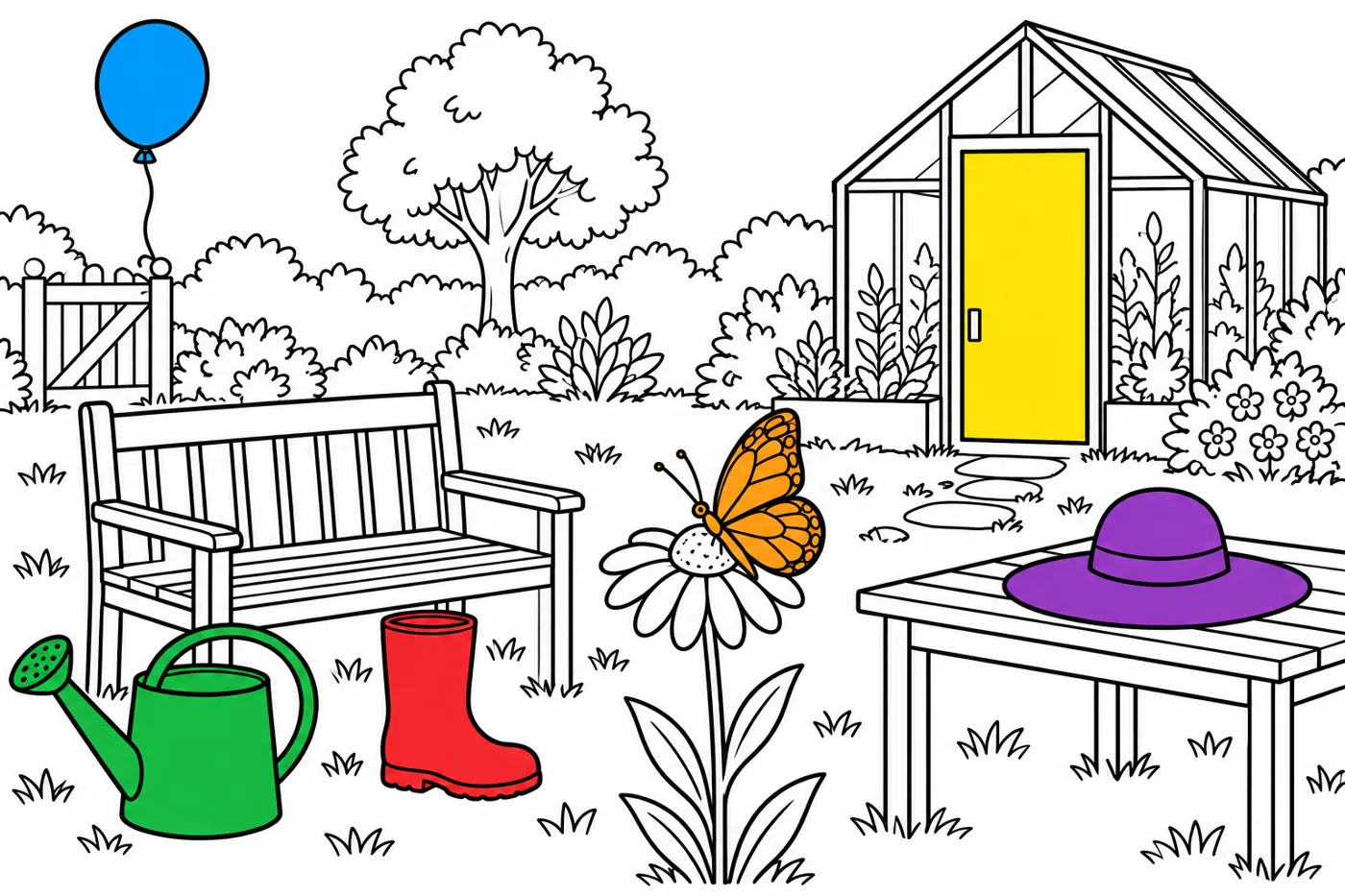
Completed picture – colour answer key
Example
Examiner: Here is the garden picture. Find the balloon tied to the gate.
Woman: I can see its long string. Is that our example?
Examiner: Yes. The balloon is already blue. Leave it blue.
Woman: All right. The blue balloon is beside the garden gate.
Question 21
Examiner: Look beside the wooden bench. Can you find the large watering can?
Woman: Yes. It is on the ground, beside the bench.
Examiner: Colour the watering can green, please.
Woman: Green for the large watering can. I will leave the bench white.
Question 22
Examiner: Now look in front of the bench. There is a boot there.
Woman: I can see it in front of the wooden seat.
Examiner: Good. Colour that boot red.
Woman: Red for the boot in front of the bench. I have found the right one.
Question 23
Examiner: Can you see the butterfly resting on the flower?
Woman: Yes. Its wings are open, just above the petals.
Examiner: Colour the butterfly orange. Leave the flower white.
Woman: Only the butterfly is orange. I will be careful with its wings.
Question 24
Examiner: Look at the garden table. What can you see on top?
Woman: There is a gardener's hat lying on it.
Examiner: That is right. Colour the hat purple.
Woman: Purple for the hat on the table. The table stays white.
Question 25
Examiner: There is one last thing to colour. Find the glasshouse door.
Woman: The large door at the front? I can see it.
Examiner: Colour that door yellow, please.
Woman: Yellow for the door. I will leave the other parts of the glasshouse white.
🎯 Finished all 25 questions?
Submit to grade your whole test, OR use 👁 Show Answer per part / per question.
All 25 questions are automatically graded, including all five colouring questions.
Learning review – listen for the important details
Look at each child’s action before matching a name. In Sophie’s form, listen for spelling, corrected numbers and the club starting time. For Sophie’s week, Sunday is the goldfish example; match five other days and leave Saturday unused. In the picture questions, listen to the end: the final choice can differ from the first suggestion. For colouring, find the correct object and then select its colour. Each question gives one mark for its own region.
Show Answer and transcripts help you study; they do not fill your answers or award marks. You can change an answer and submit again. For colouring questions, choose a colour and click the matching object in the picture. Each instruction states the required colour.