
KET 4 Practice Test 2
Reading & Writing
Willowford Night Market and young community helpers. Original A2 practice in this page’s classic nine-part format: 55 auto-graded questions and a separate short writing task.
Notices at Willowford Night Market
Which notice (A-H) matches each statement (1-5)? Use each letter once at most. Notice H is the example.
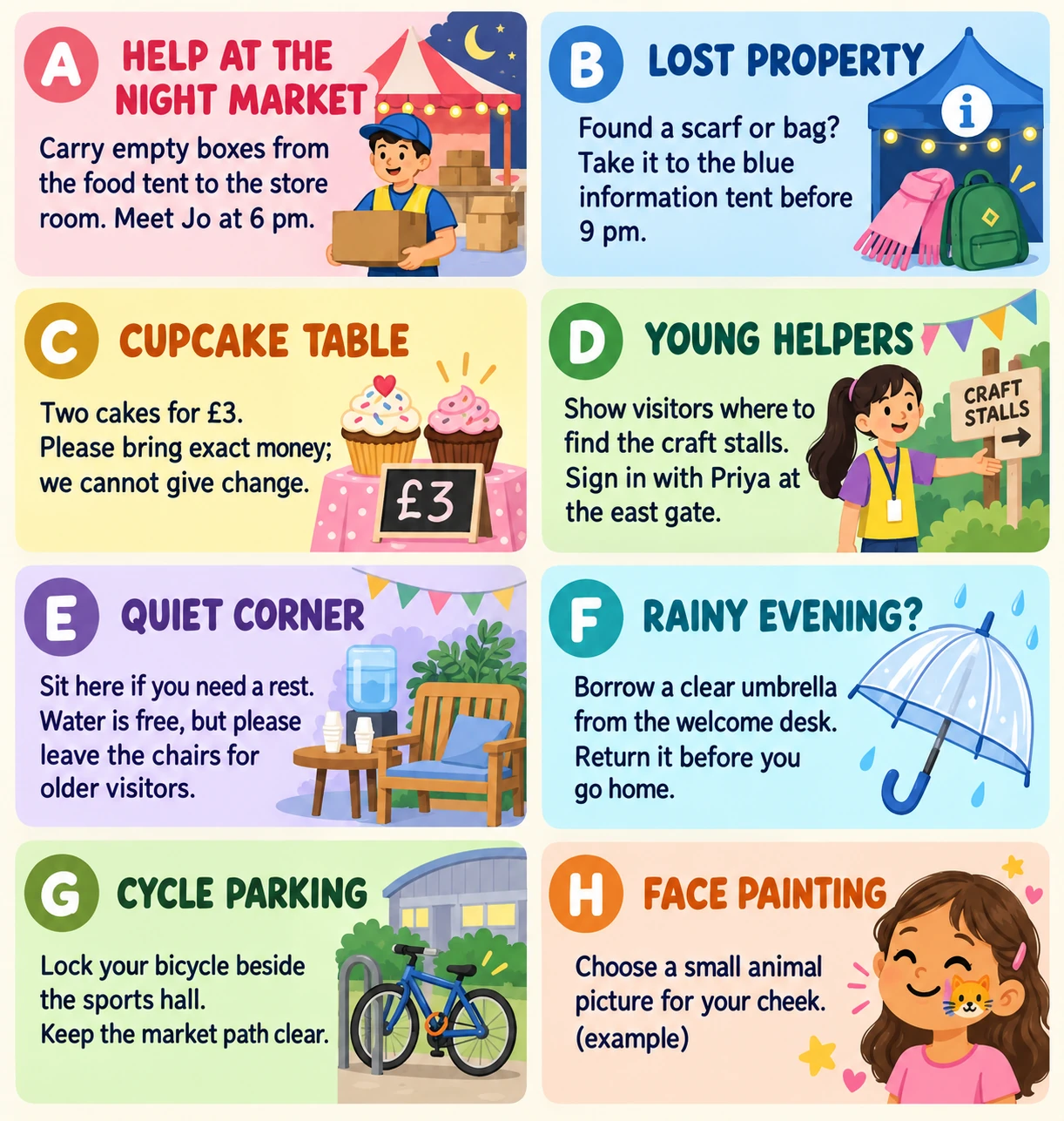
Read notices A–H as text
1. Answer: E. Notice E says that water is free in the quiet corner, so no payment is needed.
2. Answer: B. Notice B asks people to take lost scarves or bags to the blue information tent.
3. Answer: F. Notice F lets visitors borrow an umbrella and asks them to return it before leaving.
4. Answer: D. Notice D asks young helpers to show visitors where to find the craft stalls.
5. Answer: A. Notice A asks volunteers to carry empty boxes and meet Jo at 6 pm.
Helping at a food stall
Choose the best word (A, B or C) to complete each sentence.
6. Answer: B. A stall is a place where people sell food or other goods at a market.
7. Answer: A. Visitors tell Isla what they want to eat, and she writes down their orders.
8. Answer: C. A tray has a flat surface that can hold several bowls and carry them together.
9. Answer: B. Brought means carried something to this place; the baker brought bread from a shop.
10. Answer: A. The verb enjoy is followed by an -ing form, so meeting is grammatically correct.
Making plans for the market
Making plans — short conversations
Choose the best reply (A, B or C) for each short conversation.
11. Answer: B. Across from the fountain gives the place Maya asks about.
12. Answer: A. Yes, please is a suitable reply to an offer of a drink.
13. Answer: C. At half past seven directly answers Nina’s question about time.
14. Answer: B. Asking at the information tent is a useful response to losing a badge.
15. Answer: A. No problem is a natural response to thanks, and the next sentence is friendly.
At the market — Riya and Sam
Complete the conversation. Choose A–G for questions 16–20. H is the example.
Riya: Are you free after school?
Sam: I am free after school. (Example: H)
Riya: We are helping at the Willowford market on Friday. Would you like to join us?
Sam: 16.
Riya: We need fruit drinks and direction signs. Meet at the east gate at six. Is that OK?
Sam: 17.
Riya: Will you be coming by bus?
Sam: 18.
Riya: Yes, it stops by the park entrance every twenty minutes. Would you like a biscuit when you arrive?
Sam: 19.
Riya: Which job would you prefer: making drinks or putting up signs?
Sam: 20.
Riya: Great. I will bring the tape.
16. Answer: D. Sam accepts the invitation and asks what he can help to prepare.
17. Answer: A. Sam agrees to the meeting place and time Riya has just suggested.
18. Answer: F. Sam asks whether the number 8 bus stops near the park; Riya confirms that it does.
19. Answer: C. Riya offers a biscuit, and Sam thanks her because he has forgotten to bring a snack.
20. Answer: G. Riya asks which of two jobs Sam prefers, and he chooses putting up the direction signs.
A night market for the school garden
Read the article. For questions 21-27 choose A (Right), B (Wrong) or C (Doesn’t say).
An evening in Willowford
Last year, pupils at Willowford School suggested a night market to raise money for a new garden. Their teacher, Mr Bell, helped them ask the town council for permission. The council agreed to close Bridge Street to traffic for one evening in June.
This year, the market will take place on Friday 18 July, from six until nine. Local families will run food stalls, while pupils will sell plants and handmade cards. The young helpers have practised giving directions and keeping paths clear.
Mina, who is fourteen, is organising the music. She asked a local band to play, and they agreed to perform for free. Mina will also sing one song with her cousin. There will also be a table where visitors can exchange old books.
Money from this event will pay for soil, seeds and a wooden bench for the school garden. Last year, all the money from the market was spent on tools. If it rains, the food stalls and band will move into the sports hall.
21. Answer: A. The article says the council agreed to close Bridge Street to traffic for one evening.
22. Answer: A. The second paragraph directly says pupils will sell plants and handmade cards.
23. Answer: C. The article does not say whether Mina performed with the band at the previous event.
24. Answer: B. The article states that the local band agreed to perform for free, contradicting this statement.
25. Answer: A. The article says Mina will sing one song with her cousin.
26. Answer: C. The article gives no expected visitor number, so we cannot decide whether more than one hundred people are expected.
27. Answer: B. The article says last year’s money bought tools, not soil; the new event will pay for soil.
Getting ready for the market
Read the passage. Choose the correct word (A, B or C) for each space.
Getting ready for the market
Helpers will reach the hall [28] climbing the back stairs. There will be [29] small lights along the wall. We are bringing lanterns [30] it will be dark outside. Jo will [31] a list of jobs on a blank sheet of paper. Volunteers must carry the jars [32] so they do not break. Wash each jar [33] filling it with lemonade. The entrance will look bright [34] that visitors can find the stalls easily. There is [35] space for a table.
28. Answer: C. By followed by an -ing form explains how helpers reach the hall: by climbing the stairs.
29. Answer: B. Many is used with the plural countable noun lights, while much is used with uncountable nouns.
30. Answer: A. Because introduces the reason for bringing lanterns: it will be dark outside.
31. Answer: A. Make a list means write down several items; Jo writes the jobs on a blank sheet.
32. Answer: A. An adverb is required to describe how volunteers carry the glass jars.
33. Answer: A. The jars have to be clean before they are filled with lemonade.
34. Answer: A. So that introduces the purpose of lighting the entrance: helping visitors find the stalls.
35. Answer: A. Enough space means the amount of room needed to put a table there.
Words for a community event
Read each description and write the whole word. The first letter is given. Include it in your answer. Example (not scored): A person who sells goods. (t_____) → trader.
36. Answer: volunteer. A volunteer gives help without payment; the answer has nine letters and begins with v.
37. Answer: market. A market has stalls where people buy and sell; the six-letter answer begins with m.
38. Answer: visitor. A visitor is someone who comes to a place; the seven-letter answer begins with v.
39. Answer: lantern. A lantern is a light in a portable case, often with a handle; lantern has seven letters.
40. Answer: pavement. In British English, a pavement is the path for people walking beside a road; it has eight letters.
Complete the messages
Read the two messages. Write ONE word in each space.
41. Answer: for. Thank you for is the standard expression used to thank someone for a message.
42. Answer: like / love. Would you like to and would you love to both form a grammatical invitation here.
43. Answer: are. There are agrees with the plural phrase six places in the present-time context.
44. Answer: at. At is used before a precise clock time: at ten o’clock.
45. Answer: not. Do not need expresses that bringing a camera is unnecessary because one is available to borrow.
46. Answer: have. I have never been uses the present perfect to talk about experience up to now.
47. Answer: than. Than connects the two things being compared after the comparative adjective smaller.
48. Answer: how. How much asks about the amount of money needed for the bus journey.
49. Answer: in / with / using / by. In cash is the standard expression; with cash, using cash and by cash are also accepted ways to state the payment method here.
50. Answer: to. Looking forward to is followed by a noun or an -ing form, here seeing you.
Choose a market helper session
Read the notice and Mia’s message. Complete Zoe’s notes with short answers.
Message from Mia to Zoe
Hi Zoe, I booked us into the afternoon session on 12 September. You said you wanted to try face painting, so I chose that session. Please meet me by the west gate at 1:30 pm and we can go to the welcome desk together. Remember to bring a water bottle. See you there! Mia.
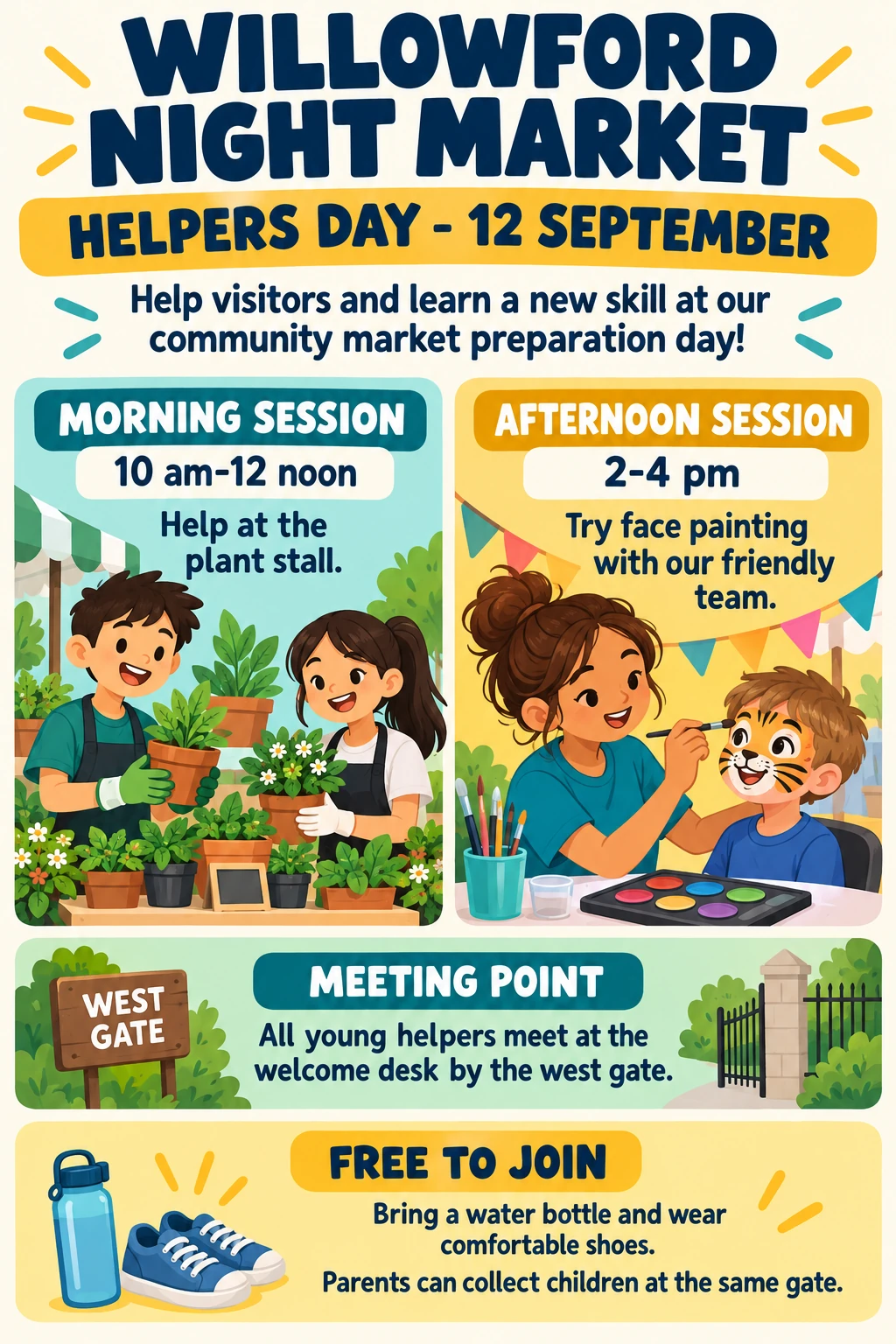
Read text version
Help visitors and learn a new skill at our community market preparation day! Morning session: 10 am-12 noon, help at the plant stall. Afternoon session: 2-4 pm, try face painting with our friendly team. All young helpers meet at the welcome desk by the west gate. Free to join. Bring a water bottle and wear comfortable shoes. Parents can collect children at the same gate.
ZOE’S NOTES
51. Answer: 12 September / September 12 / 12th September / September 12th / 12 Sep / Sep 12 / 12/09. Mia books the afternoon session for 12 September, the date Zoe will attend.
52. Answer: face painting / painting faces. Mia says Zoe wanted to try face painting, which the notice offers as a helper job.
53. Answer: west gate / the west gate. Mia asks Zoe to meet by the west gate before they go to the welcome desk.
54. Answer: 1:30 pm / 1.30 pm / 1:30 / 1.30 / 13:30 / 13.30 / half past one. Mia asks Zoe to meet at 1:30 pm, which is half past one in the afternoon.
55. Answer: water bottle / a water bottle / bottle of water. The notice asks every young helper to bring a water bottle to the session.
Writing — message to Ruby
This task is self-checked separately from the score out of 55. Write your message, then compare the sample answers.
- Say what you want to do at the market.
- Say when you will meet.
- Say what Ruby should bring.
Sample answers — self-check examples
Hi Ruby, Meet me at the library at five on Friday. I want to paint signs for the night market. Please bring blue pens so we can finish them. See you soon, Ava.
Hi Ruby, I want paint signs at the night market. We can meets at five on Friday outside the library. Please bring blue pens. I am happy you can help. Ava.
Hi Ruby, I want to paint signs for the night market with you. Let’s meet outside the library at five on Friday. We will have a good time. Ava.
In B, use “want to paint” and “can meet”. In C, add what Ruby should bring. These are learning examples, not official examiner marks.
Ready to check your work?
Submit to grade your whole test, OR use 👁 Show Answer per part / per question.
Learning review & writing checklist
Read each notice for its purpose. Link dialogue replies to the turns before and after each gap. In Part 4, distinguish explicit agreement, contradiction and missing information. Use both source documents for the notes in Part 8.
For grammar gaps, read the whole sentence, choose the correct form, and read it again. For open gaps, type one word only. Check the first letter and spelling in Part 6.
Your writing should answer all three points in 25–35 words. Compare your message with the sample after you finish. The writing sample does not add points to the automatic score.
Show Answer reveals the answer and explanation without filling your response or awarding a mark. After editing a graded answer, submit again for an updated score.