
Flyers 9 – Test 3 Reading & Writing
100% Original Practice Test
Join a family evening at a community observatory, help find a missing Moon model and read about the stars above us. This original A2 Flyers practice test has seven parts and 50 questions. This A2 reading & writing practice has 7 parts and 50 questions. Complete each part, then submit to grade your work or use Show Answer to review.
Learning guide
Level: A2.
Topic: An Evening at the Observatory
Learning objectives
- Read short texts and stories for detail and meaning.
- Use context and grammar to complete sentences and passages.
- Write clear, short answers using familiar vocabulary.
Before you start: Learners should be comfortable reading short A2-level stories, choosing words from a bank and writing familiar one-word answers.
Teacher tip: Invite learners to underline clues around each gap before they choose or write an answer. In the story tasks, ask them to explain which detail supports each answer.
Reading & Writing strategy: Read the instructions and example first. Use picture details and nearby words as clues, reread the whole sentence, and check spelling before submitting.
Part 1 · 10 questions
Read the sentences and choose the words
Choose the correct word from the box for each sentence. There is one example. Four words are not needed.
Example: You look through this long instrument to see things that are far away. → telescope
1. This is the part of the day after the afternoon and before the night.
2. If you speak in this way, you make very little noise.
3. People stand in this line while they wait for their turn.
4. This list tells you the times when planned activities will happen.
5. This is a small copy of a real object, such as a boat or a building.
6. This is the outside or top layer of an object.
7. This piece of furniture has a flat top and legs. You can put your meals on it.
8. This container usually has straight sides and a lid. You can pack toys inside it.
9. This small sheet of paper gives information about a place or an event.
10. This person comes to a place to look around or spend time there.
Part 2 · 7 questions
Look at the picture and read the sentences
Look carefully at the observatory scene. Write Yes if the sentence matches the picture or No if it does not. There are two examples.
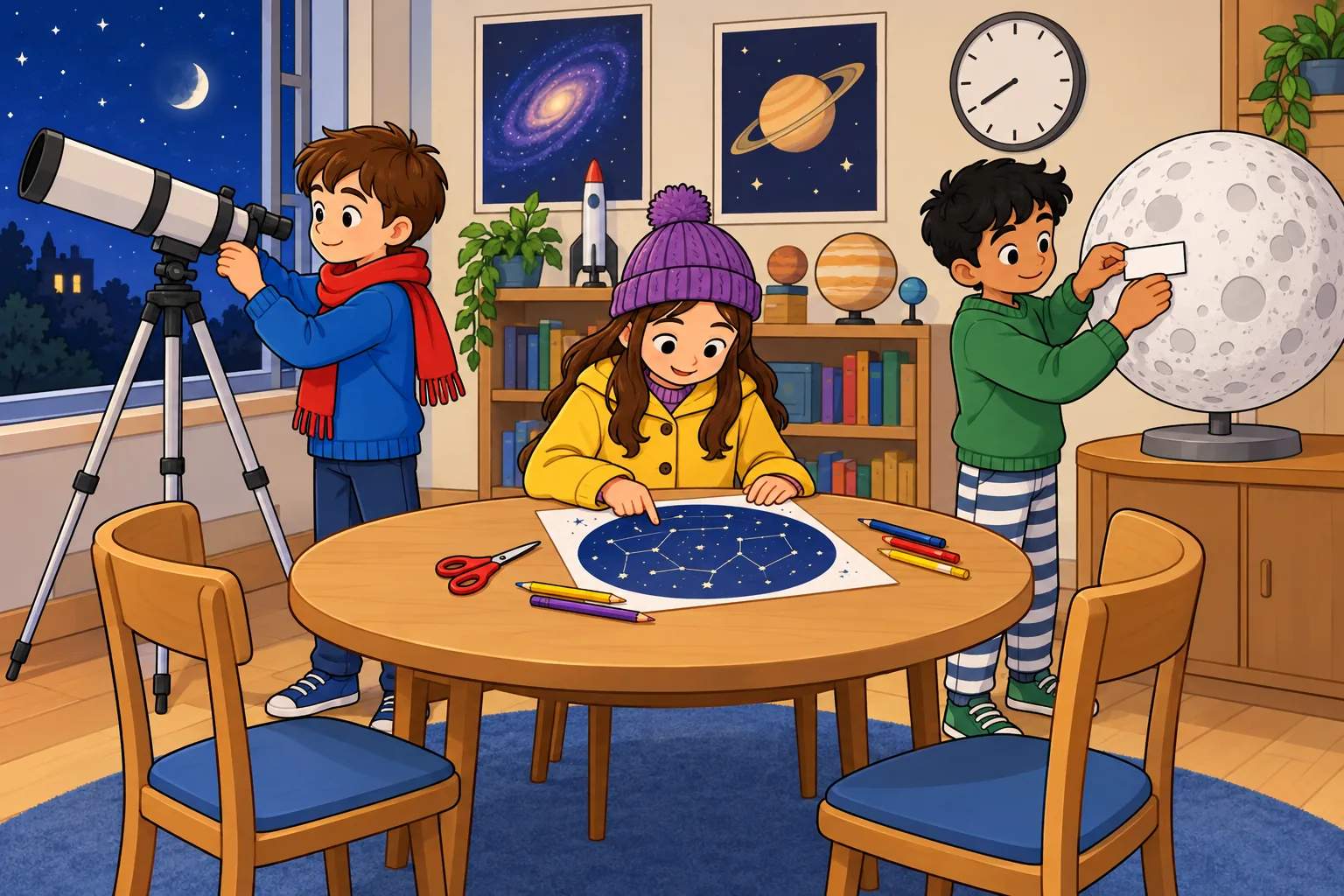
Clothing recognition key: Ben wears a blue jumper and red scarf; Lily wears a yellow coat and purple hat; Omar wears a green jumper and striped trousers.
Example 1: There are three people in the room. → Yes
Example 2: Lily is wearing a green jumper. → No
11. Ben is adjusting the telescope.
12. Lily is reading a star chart.
13. Omar is putting a label on the Moon model.
14. Ben is sitting on a chair and drawing a picture.
15. Lily is holding a telescope above her head.
16. Omar is painting a real rocket.
17. The three people are doing different activities.
Part 3 · 5 questions
Choose the best reply
Read what Maya says. Choose the best reply from A–H for each question. There is one example. Two replies are not needed.
Maya and her dad are talking at home before they go to the family evening at the community observatory.
Choose a reply
- Good idea. I will wait by the gate.
- Please hold it carefully with both hands.
- It starts at half past six.
- No, the kitchen is closed on Mondays.
- They can draw the Moon in the activity room.
- Yes, please. It looks bright tonight.
- There are hooks beside the entrance.
- I left my red scarf on the bus.
Example: Maya: Would you like to look at the Moon? → Yes, please. It looks bright tonight.
18. Maya: What time does the talk begin?
19. Maya: Where should we leave our coats?
20. Maya: Can I carry the cardboard model?
21. Maya: What will the children do after the talk?
22. Maya: Shall we walk home together after the evening visit?
Part 4 · 6 questions
Read the story and choose the missing words
Choose the correct word from the box for each gap in the story. There is one example. Four words are not needed. Then choose the best title for the story.
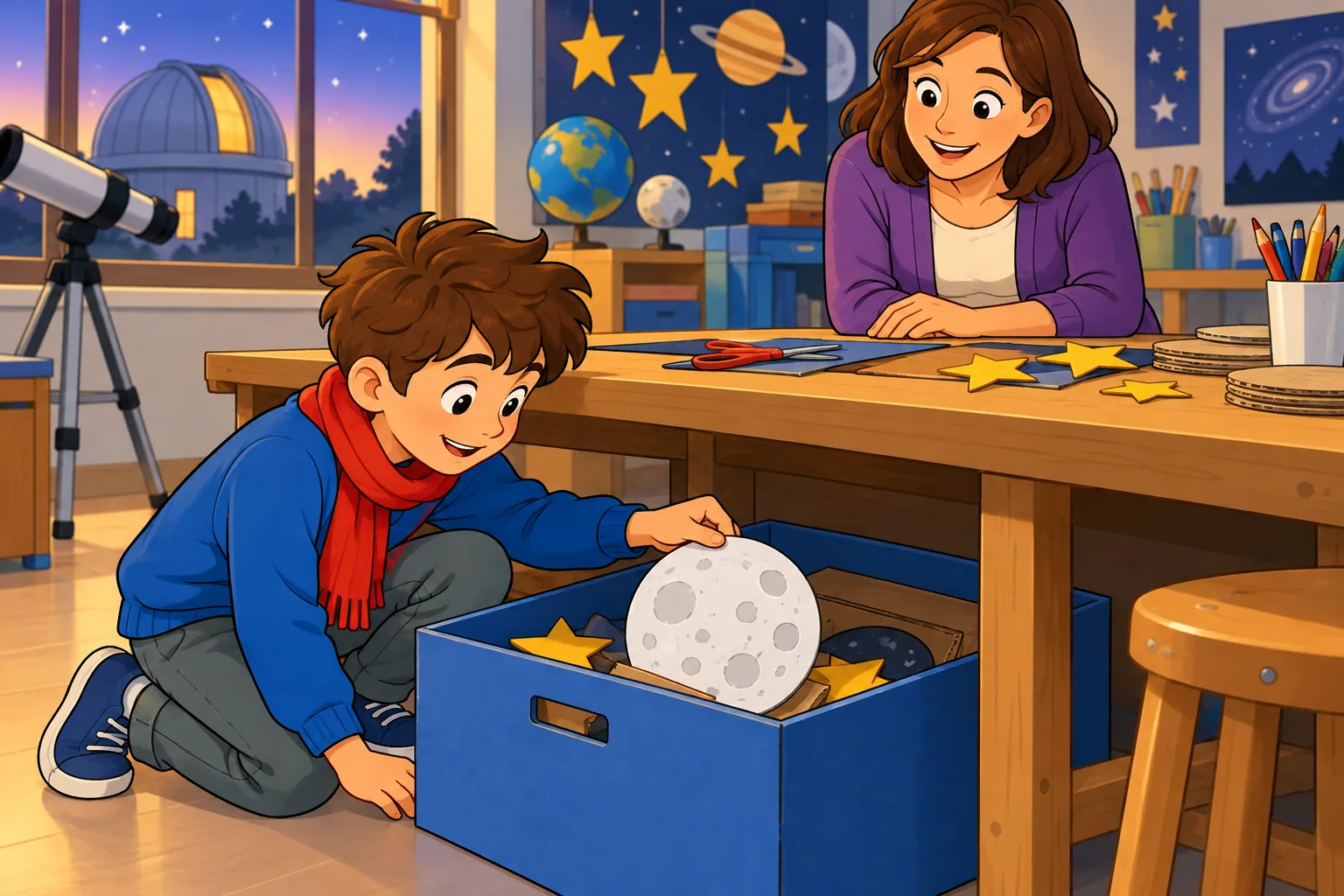
A family evening at the community observatory
The community observatory held a family evening last Friday (example). Before the star talk, the children made a round [23] Moon. They covered it with shiny paper. Ben [24] the little model to the display table before everyone went to see the telescope. When they returned, the little Moon was missing. Ava looked behind the chairs, while Omar checked beside the door. Then Ben looked inside a blue box [25] the craft table. The little Moon was there! Everyone felt [26] because their worries were over. The helper put the model back on the display and said, "The sky is clear tonight. There are no [27] to hide the stars!"
Example: The observatory held a family evening last ___. → Friday
28. Choose the best title for the story.
Part 5 · 7 questions
Complete the sentences about the story
Read the story. Complete each sentence with one to four words. The answer must be supported by the story.
A Star for the School Window
On Thursday, Nia and her cousin Sam went to the community observatory with their aunt. The family evening was busy, but the guide spoke slowly and made everyone feel welcome. Nia liked the telescope best because she could see a bright dot in the sky. Sam enjoyed the craft table. He cut a paper star and wrote the name of their school on its back.
Before they left, the guide asked the children to help tidy the room. Nia put the pencils in a jar, and Sam stacked the empty paper plates. Their aunt found a small Moon model beneath the table, so the children placed it beside the large display. Then the guide gave each child a simple star chart to take home.
At school the next morning, Nia showed her chart to her class. Sam taped his paper star inside the classroom window. Their teacher smiled and asked them to tell the class about the observatory. Nia and Sam decided to make a poster together for the next family evening.
Example: The guide spoke ___. → slowly
29. The family evening took place on ___.
30. Nia liked using the ___ best.
31. Sam wrote the name of their ___ on the paper star.
32. Nia put the pencils in a ___.
33. The small Moon model was ___ the table.
34. The guide gave each child a ___ to take home.
35. Nia and Sam decided to make a ___ for the next family evening.
Part 6 · 10 questions
Read the passage and choose the correct words
Choose A, B or C for each gap. Read the whole sentence to help you.
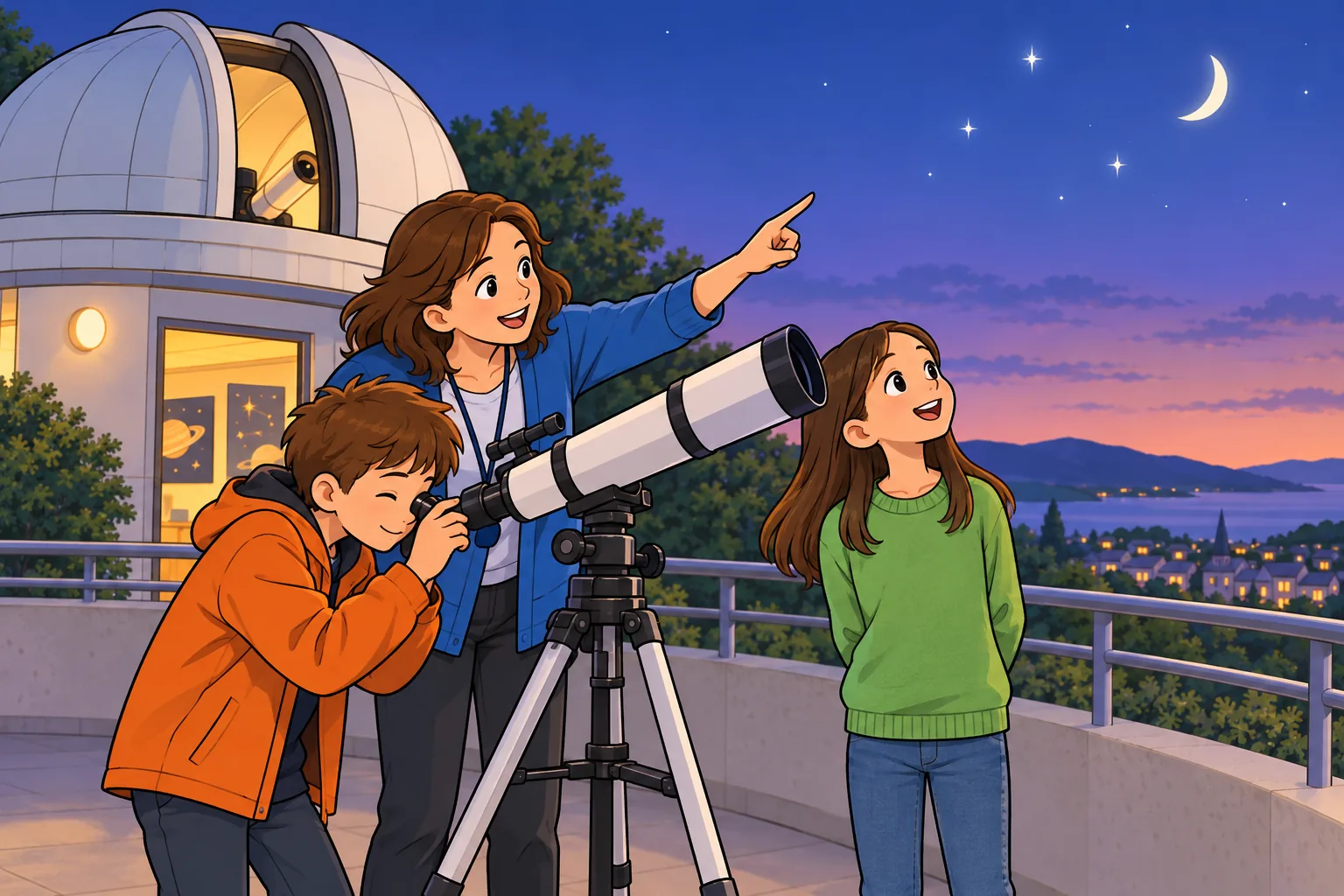
At our observatory, evening visits are (example) popular with families. Our guide [36] every group at the door. Each visitor receives [37] small star chart. Children can [38] pictures at the activity table. Before the talk begins, please put your bags [39] a chair, where they will be out of the way. Tonight the sky is clearer [40] it was last Saturday. Mrs Hill is the guide [41] will lead our group. Please speak [42] during the talk so that everyone can hear her. We have only five chairs but seven visitors, so we need two [43] chairs. At the moment, Mrs Hill [44] us round the building. After the talk, everyone walks outside [45] look at the stars.
Example: Evening visits ___ popular with families. → are
Part 7 · 5 questions
Complete the email
Read the email and write one word in each gap.
Hi (example) Nia,
Would you like to come [46] me to the community observatory? The family evening is [47] 27 June. You will be able [48] look through the telescope with a guide. My class made a Moon model [49] has shiny paper on its surface. We can meet at the main gate at a quarter [50] six (5:45 pm).
See you soon, Maya
Example: ___ Nia, → Hi
Ready to check your answers?
Submit to grade your whole test, OR use 👁 Show Answer per part / per question.
Learn from your answers
Answer reasons
- evening — Evening is the time between afternoon and night.
- quietly — Quietly means with little sound.
- queue — A queue is a line of people waiting to do something.
- schedule — A schedule lists activities and the times arranged for them.
- model — A model represents an object in a smaller form.
- surface — The surface is an outer or upper layer.
- table — A table has a flat top supported by legs.
- box — A box is a container for storing or carrying things.
- leaflet — A leaflet is a printed sheet containing information.
- visitor — A visitor is someone who comes to a place for a visit.
- Yes — Ben is shown beside the window with his hands on the telescope.
- Yes — Lily is looking down at the star chart on the table.
- Yes — Omar is attaching a label to the cardboard Moon model.
- No — Ben is standing by the telescope, not sitting and drawing.
- No — Lily is studying a star chart; Ben is the person beside the telescope.
- No — Omar is labelling a cardboard Moon model, not painting a rocket.
- Yes — Ben adjusts the telescope, Lily reads a chart and Omar labels the model.
- It starts at half past six. — The reply gives the starting time of the talk.
- There are hooks beside the entrance. — The reply tells Maya where the coats can be left.
- Please hold it carefully with both hands. — The reply answers the request and gives a safe way to carry the model.
- They can draw the Moon in the activity room. — The reply describes an activity for the children after the talk.
- Good idea. I will wait by the gate. — The reply accepts the suggestion and says where to meet.
- cardboard — Cardboard tells us what material the Moon model was made from.
- carried — Carried is the past-tense verb describing how Ben moved the model.
- underneath — Underneath describes the position of the box below the table.
- relieved — Relieved means no longer worried after the missing model was found.
- clouds — Clouds can cover the stars; none were in the clear sky in this story.
- Finding the Little Moon — The story is about the search for the missing small Moon model and its discovery.
- Thursday — The opening sentence gives the day of the visit.
- telescope — The story says Nia liked the telescope best.
- school — Sam wrote their school's name on the back of the star.
- jar — Nia helped tidy by putting the pencils in a jar.
- beneath / under / underneath / below — The aunt found the model beneath the table. Under, underneath and below also describe that position.
- star chart / simple star chart / chart / a star chart / a simple star chart — The guide gave every child a simple star chart.
- poster — The final sentence says they planned to make a poster together.
- welcomes — Guide is singular, so the present-simple verb ends in -s.
- a — A is the singular indefinite article before the consonant sound in small.
- draw — After can, use the base form draw.
- under — Under describes the position below a chair.
- than — Use than after the comparative clearer.
- who — Who introduces a relative clause about a person.
- quietly — Quietly is the adverb describing how to speak.
- more — More means additional chairs; two more make seven altogether.
- is showing — At the moment signals an action happening now; Mrs Hill takes is showing.
- to — To plus the base verb expresses the purpose of walking outside.
- with — With me means joining Maya on the visit.
- on — Use on before a calendar date.
- to — The phrase is be able to followed by a base verb.
- that / which — That or which introduces a relative clause describing the model.
- to — A quarter to six means fifteen minutes before six, or 5:45 pm.
Teacher tip
Invite learners to underline clues around each gap before they choose or write an answer. In the story tasks, ask them to explain which detail supports each answer.