
Flyers 7 – Test 1 Reading & Writing
100% Original Practice Test
Prepare a school theatre for a shadow-puppet evening, then read an original story, an information text and a friendly email in this seven-part A2 practice test. This A2 reading & writing practice has 7 parts and 50 questions. Complete each part, then submit to grade your work or use Show Answer to review.
Learning guide
Level: A2.
Topic: A Shadow-Puppet Evening
Learning objectives
- Understand familiar A2 words from clear definitions and story context.
- Compare sentences with details shown in a picture.
- Choose suitable replies and complete short connected texts.
- Use common past and present forms, pronouns, articles and prepositions in context.
Before you start: Learners should know familiar A2 vocabulary, common past and present forms, simple future, pronouns, prepositions, comparatives and short connected texts.
Teacher tip: Read the whole sentence or passage first. Use the surrounding words to decide what fits, and check picture questions against details that can be seen clearly.
Reading & Writing strategy: Read the instructions and example first. Use picture details and nearby words as clues, reread the whole sentence, and check spelling before submitting.
Part 1 · 10 questions
Read the definitions and write the words
Choose words from the box. There is one example. Four words are not needed.
Example: You wear this over your clothes to keep them clean while you cook. → apron
1. The people who sit and watch a play or a show.
2. The place where people go into a building or room.
3. Special clothes an actor wears to look like a character in a play.
4. To do an activity several times so that you can become better at it.
5. A small piece of paper that lets you enter a show after you pay for it.
6. The large piece of cloth that can cover the front of a stage.
7. A person who plays a part in a film or a play.
8. To speak very quietly so that only someone near you can hear.
9. To go and get things from different places and bring them together.
10. When a lamp is bright, it can do this in a dark room.
Part 2 · 7 questions
Look at the picture and read the sentences
Write Yes or No. There are two examples.
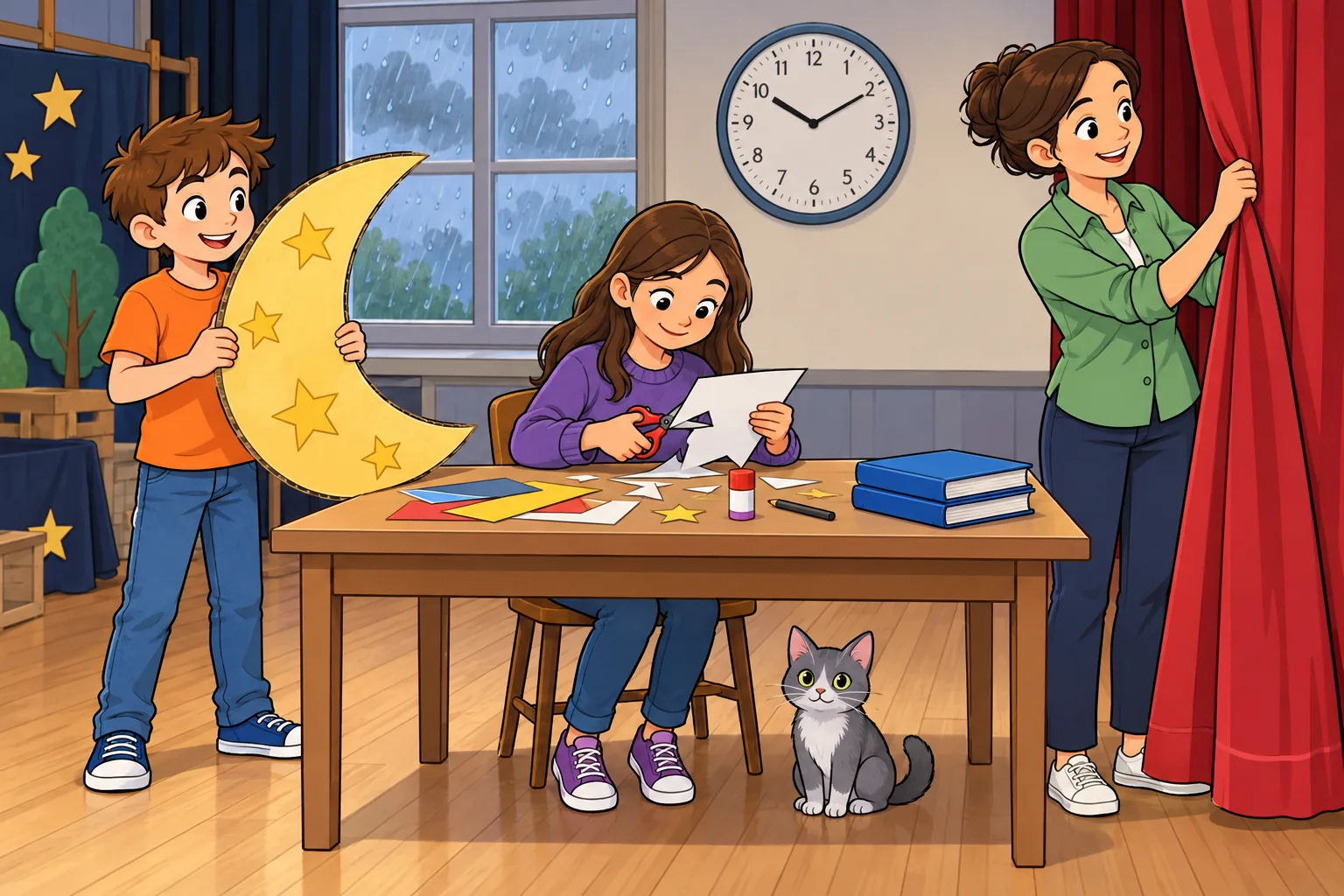
Example 1: The boy in orange is standing on the left. → Yes
Example 2: The cat under the table is asleep. → No
11. The boy is holding a large, flat cardboard moon.
12. The girl in the purple jumper is sitting on a chair.
13. The woman in green is holding a long red curtain.
14. There are three closed blue books on the table.
15. The small grey cat is sitting on the table.
16. A large round clock is hanging on the back wall.
17. The window is open and the weather outside is sunny.
Part 3 · 5 questions
Choose the best reply
Choose a reply from A-H. There is one example. Two replies are not needed.
Mia and Ben are getting their school shadow-puppet show ready. Mia asks the questions, and Ben answers. Choose Ben's replies to complete their conversation.
Choose a reply
- At half past six. The doors open at six.
- Yes, I can carry the box of paper for you.
- We made it from a flat piece of cardboard.
- I think the rabbit should stand behind the moon.
- No, thank you. I have already had a glass of water.
- My sister is bringing them in her blue bag.
- They can sit in the first row near the stage.
- Because it lets the people see the shadows clearly.
Example: Mia: What did we make the moon from? → We made it from a flat piece of cardboard.
18. Mia: When does the show begin?
19. Mia: Could you help me take these things to the hall?
20. Mia: Where should my grandparents sit?
21. Mia: Why are we using a white screen?
22. Mia: Would you like some water before we practise?
Part 4 · 6 questions
Read the story and choose the missing words
Choose words from the box. There is one example. Four words are not needed. Then choose the best title.
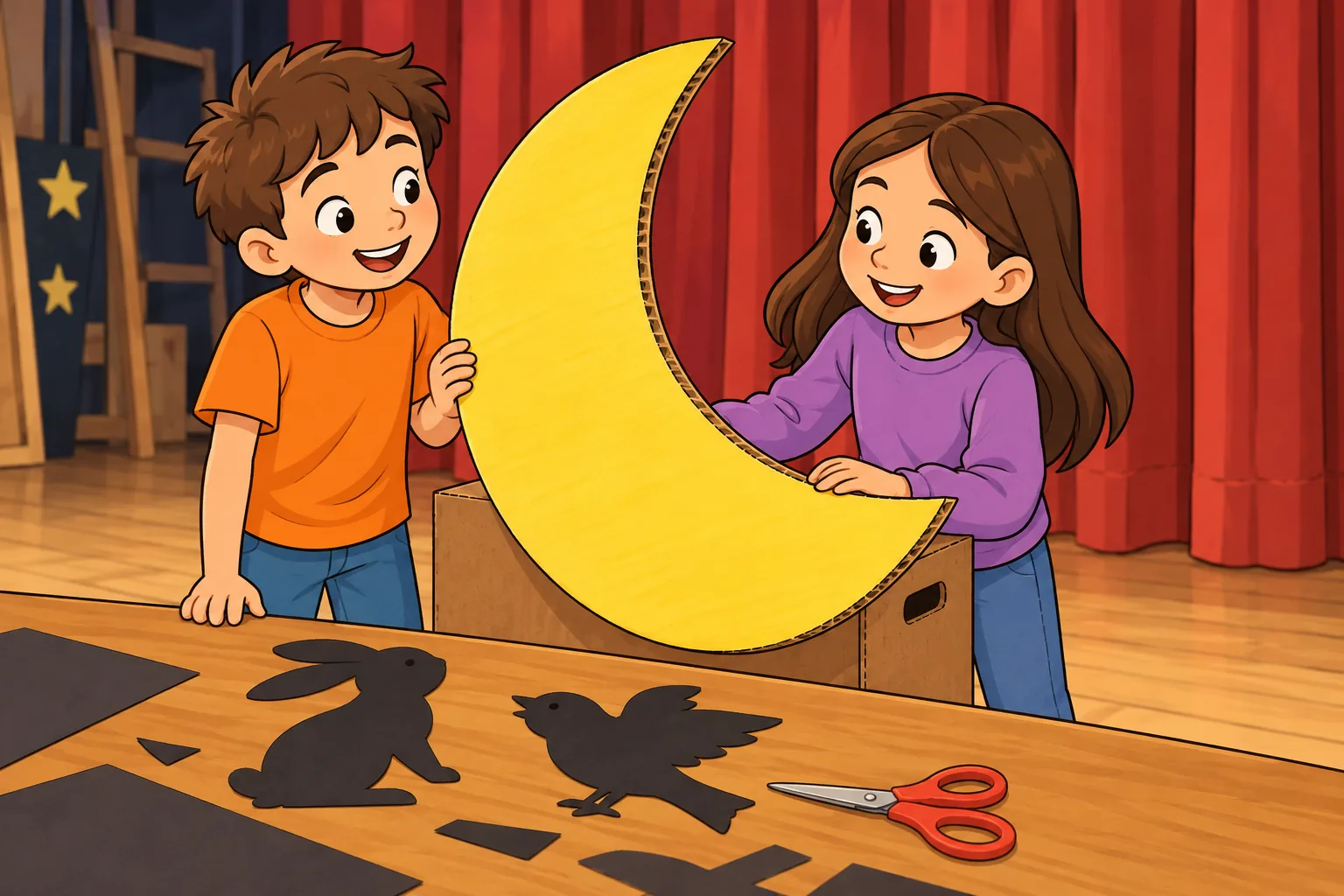
Ben and Mia were helping Class Five prepare an evening show. They cut a large, flat shape from yellow cardboard (example). It looked like a moon for the night sky in their story. On Thursday, this [23] had disappeared. Mia found it standing against a brown [24], behind a pile of coats. They carried it back carefully and placed it near the red [25]. Then Mia cut a little white star from a sheet of [26] and fixed it to the moon. When their teacher saw the finished scene, she gave them a warm [27]. The class felt ready to welcome the audience.
Example: They cut a large, flat shape from yellow ___. → cardboard
28. Choose the best title for the story.
Part 5 · 7 questions
Read the story and complete the sentences
Complete each sentence with one to four words from the story. There is one example.
A Cake for the Garden Sale
On Saturday morning, Amira helped her uncle bake a lemon cake for the school garden sale. They wanted to make the cake before the shops opened, so they began at seven o'clock. Her uncle measured the flour into a large bowl, and Amira added two eggs and some sugar. She stirred the mixture with a wooden spoon until it looked smooth. Then they poured it into a round tin. The cake needed forty minutes in the oven. While they waited, Amira washed the bowls and wiped the kitchen table. When the cake was cool, her uncle put lemon icing on top. Amira cut it into eight pieces and placed them in a clean paper box. At the sale, a family bought four pieces first. A little later, Amira's neighbour bought two more. The money from the cakes went into a green tin beside the garden gate. The class planned to use it to buy new seeds. Amira was pleased that their baking could help the school garden grow.
Example: Amira helped her uncle bake a ___ cake. → lemon
29. They began baking at ___.
30. Amira stirred the mixture with a wooden ___.
31. The cake needed forty minutes in the ___.
32. While they waited, Amira wiped the kitchen ___.
33. Amira's uncle put lemon icing on top when the cake was ___.
34. Amira put the cake pieces in a clean paper ___.
35. The class planned to spend the money on new ___.
Part 6 · 10 questions
Read the text and choose the correct word
Choose the correct word for each space. There is one example.
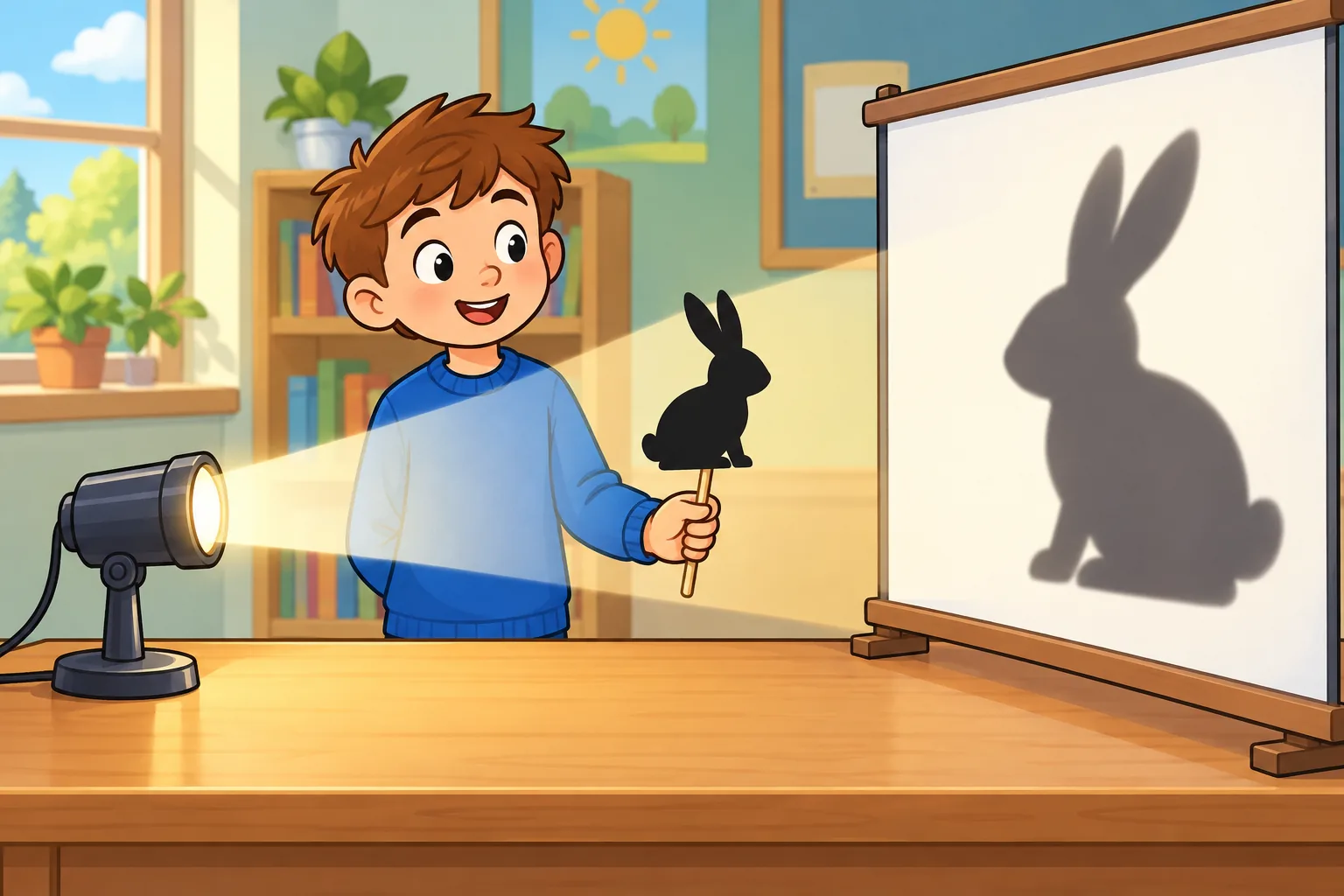
Our class made (example) a shadow puppet show last week. I [36] a rabbit from black card, and my friend tied it to a thin stick. We placed the puppet [37] a lamp and a white screen. When I [38] the rabbit closer to the lamp, its shadow grew bigger. Our teacher asked us [39] move the puppet slowly. The white screen was [40] than a small sheet of paper, so the whole class could see it. One pupil held the screen while [41] read the short story aloud. We practised [42] the end of lunch. On Friday, the children watched the screen very [43] as the first shadow appeared. The rabbit in our story had [44] long ears and a small round tail. Everyone enjoyed the show and wanted to watch [45] again.
Example: Our class ___ a shadow puppet show last week. → made
Part 7 · 5 questions
Complete the email
Write one word in each space. There is one example.
Hi Ruby,
We walked along (example) the river path after school yesterday. My cousin wanted [46] join us, so the three of us went together. We took apples for a snack. When we sat on a bench, we each ate one [47] the apples. Later, we saw a wooden bridge [48] went over the water. I tried to take a photo of two ducks, but one flew away before I was able [49] press the button. I will tell you all [50] the walk when I see you on Monday.
See you soon, Ellie
Example: We walked ___ the river path after school. → along
Ready to check your answers?
Submit to grade your whole test, OR use 👁 Show Answer per part / per question.
Learn from your answers
Answer reasons
- audience — An audience is the group of people watching a performance.
- entrance — An entrance is a place where people enter.
- costume — A costume is clothing worn for a performance to show who a character is.
- practise — You practise an activity by doing it repeatedly to improve your skills.
- ticket — A ticket is proof that someone may enter a show or event.
- curtain — A curtain can be pulled across a stage to hide it from the audience.
- actor — An actor performs as a character in a play or film.
- whisper — When you whisper, you use a very quiet voice.
- collect — To collect things is to gather them together.
- shine — A bright lamp shines and gives light.
- Yes — The boy on the left is holding the large flat cardboard moon.
- Yes — The girl in the centre is sitting on a chair at the table.
- Yes — The woman on the right is holding the long red curtain.
- No — There are exactly two closed blue books on the table.
- No — The grey cat is sitting under the table.
- Yes — The picture shows a large round clock on the back wall.
- No — The window is closed, and raindrops can be seen outside.
- At half past six. The doors open at six. — The question asks for a time, and the reply gives half past six.
- Yes, I can carry the box of paper for you. — The reply agrees to help and says what the speaker can carry.
- They can sit in the first row near the stage. — The question asks where the grandparents should sit, and the reply gives them a place.
- Because it lets the people see the shadows clearly. — The reply explains why a white screen is useful for the show.
- No, thank you. I have already had a glass of water. — The reply politely refuses the offer and gives a reason.
- moon — The previous sentence identifies the cardboard shape as a moon; the children find the missing moon next.
- box — The story says the moon was standing against a brown box.
- curtain — The moon was placed near the red curtain.
- paper — The star was cut from a sheet of paper.
- smile — The teacher gave the children a warm smile.
- The Missing Cardboard Moon — The children find the cardboard moon that had disappeared while they prepared their show.
- seven o'clock / 7 o'clock / seven / 7 — They began at seven o'clock, before the shops opened.
- spoon — The story says she used a wooden spoon to stir the mixture.
- oven — The cake baked in the oven for forty minutes.
- table — Amira cleaned the bowls and wiped the kitchen table while the cake baked.
- cool — The uncle added the icing after the cake was cool.
- box — The cut pieces were placed in a clean paper box.
- seeds — The final lines say the class planned to use the money to buy new seeds.
- cut — The passage describes last week's show, and cut is the past form of cut.
- between — Between describes the puppet's position with the lamp on one side and the screen on the other.
- moved — Moved is the past-tense verb that fits the account of what happened.
- to — Use ask someone to do something: asked us to move.
- larger — Than introduces a comparison, so the comparative adjective larger is needed.
- I — I is the subject pronoun before the verb read; me is an object pronoun, and my needs a noun after it.
- until — Until means they continued practising up to the end of lunch.
- carefully — Carefully is the adverb that describes how the children watched.
- two — Two counts the rabbit's ears. Twice describes frequency, and second gives a position in order.
- it — It is the object pronoun referring to the show after watch.
- to — Wanted to join uses to before the base form of the verb.
- of — One of the apples means a single apple from the group.
- that / which — That and which can introduce the clause describing the bridge.
- to — Use be able to followed by a verb: was able to press.
- about — Tell you all about the walk means describe what happened during it.
Teacher tip
Read the whole sentence or passage first. Use the surrounding words to decide what fits, and check picture questions against details that can be seen clearly.