
Flyers 6 – Test 3 Reading & Writing
100% Original Practice Test
Explore a museum clock workshop through original picture tasks, conversations, stories and messages in this seven-part A2 practice test. This A2 reading & writing practice has 7 parts and 50 questions. Complete each part, then submit to grade your work or use Show Answer to review.
Learning guide
Level: A2.
Topic: The Museum Clock Workshop
Learning objectives
- Understand familiar A2 words through clear, contextual definitions.
- Read visible details in a picture and decide whether statements are true or false.
- Choose suitable spoken replies and follow connected stories.
- Use common A2 grammar and vocabulary in short texts.
Before you start: Learners should know familiar A2 vocabulary, common past and present forms, simple future, pronouns, prepositions, comparatives and short connected texts.
Teacher tip: Read the full sentence or passage before answering. Use the words around each gap, and rely on details stated in the text or clearly visible in the picture.
Reading & Writing strategy: Read the instructions and example first. Use picture details and nearby words as clues, reread the whole sentence, and check spelling before submitting.
Part 1 · 10 questions
Read the definitions and write the words
Choose words from the box. There is one example. Four words are not needed.
Example: You open this above your head when rain starts during a walk. → umbrella
1. In this room, a group learns to make wooden toys using small tools.
2. This person has come to see the museum today but does not work there.
3. To mend a broken toy so that a child can use it again.
4. This small piece of paper beside a museum object gives its name.
5. Several model clocks arranged together for everyone to look at.
6. To take out an old battery and put a new one in its place.
7. A flat board on a wall where you can put books or a small clock.
8. This describes a child who waits calmly while a friend finishes a model.
9. This tool has a handle and many hairs that you use to put paint on a model.
10. A small part of your coat where you can keep a key or a folded ticket.
Part 2 · 7 questions
Look at the picture and read the sentences
Write Yes or No. There are two examples.
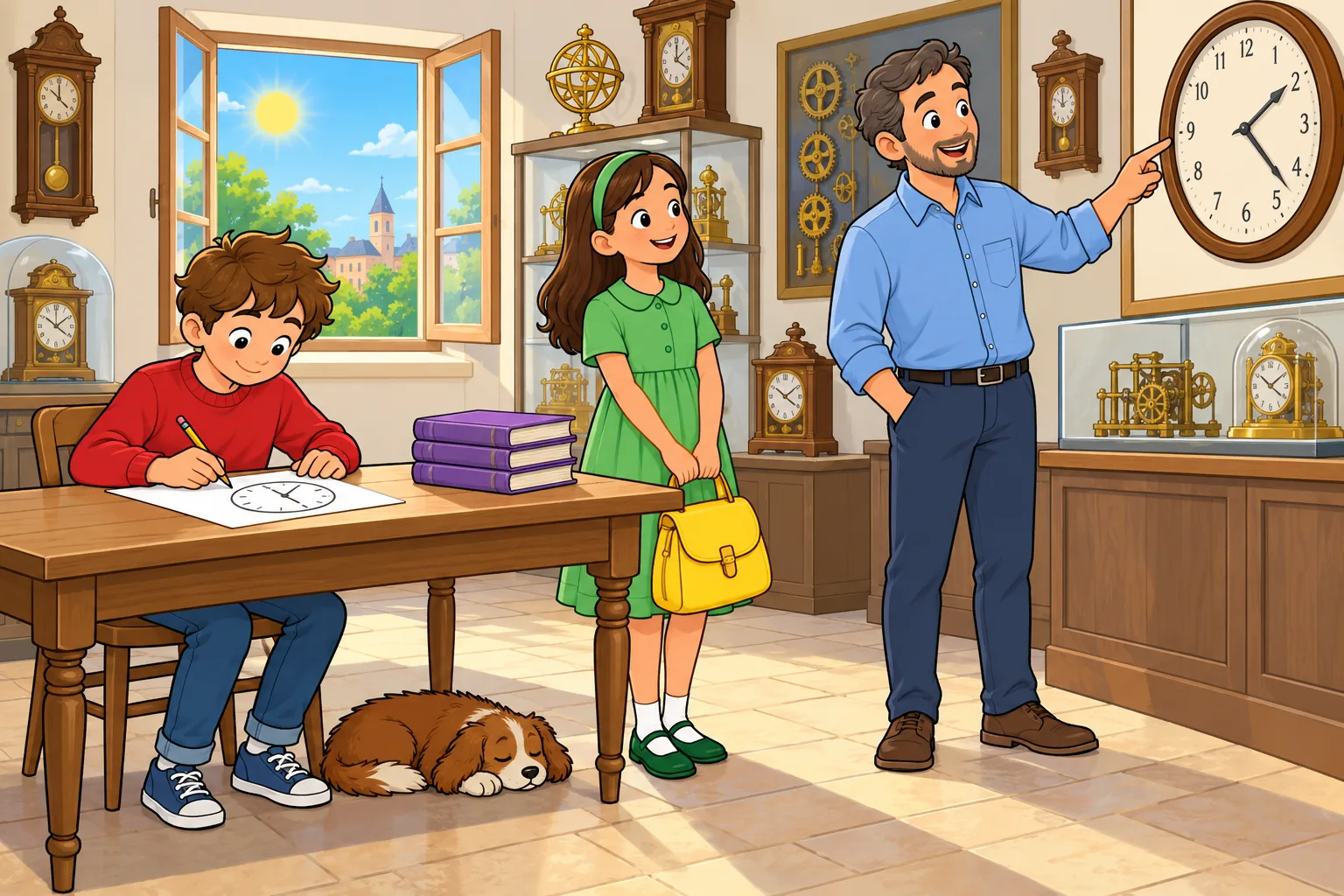
Example 1: The small brown dog is asleep under the table. → Yes
Example 2: The girl's bag is blue. → No
11. The boy in the red jumper is sitting down to draw a round clock.
12. The girl in the green dress is standing beside the table.
13. The adult in the blue shirt is standing on the left of the picture.
14. There are three closed purple books stacked on the table.
15. The boy who is drawing is wearing a black jumper.
16. The adult is pointing to a large round wall clock.
17. The window at the back is closed.
Part 3 · 5 questions
Choose the best reply
Choose a reply from A–H. There is one example. Two replies are not needed.
Read these short exchanges between Owen, Mia and a museum guide. Choose the reply that best fits each speaker. Two replies are not needed.
Choose a reply
- Sorry, I left my camera at home.
- Yes, I'll wait for you there when the talk ends.
- Yes, I'll take the heavier ones.
- Only on Sunday mornings.
- I'm glad you like it; we made it from cardboard.
- It's just past the front desk, beside the blue door.
- I think the smaller clock looks best here.
- I came with my cousin after lunch.
Example: Mia: Where can I find the clock labels? → It's just past the front desk, beside the blue door.
18. Owen: Can you help me carry these books?
19. Guide: Who did you come to the museum with?
20. Mia: Your clock looks lovely!
21. Owen: Let's meet by the map after the talk. Does that sound good?
22. Guide: Which clock would you put in the window?
Part 4 · 6 questions
Read the story and choose the correct words
Choose words from the box to complete the story. There is one example. Four words are not needed.
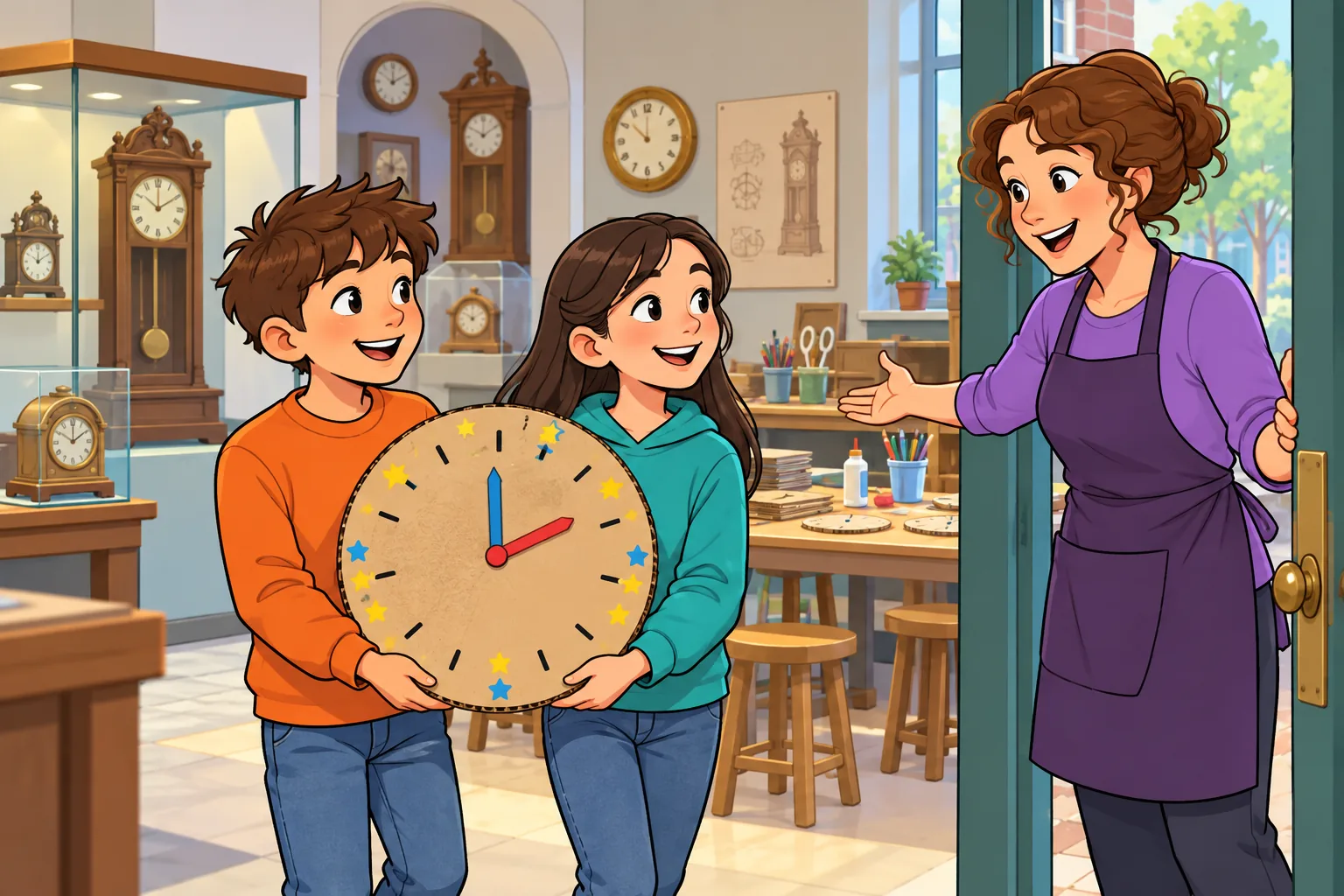
Owen and his friend Mia visited a museum time workshop (example) on Saturday. They had made a cardboard clock together. It was [23] with yellow and blue paper stars. They carried it in a box, then lifted it out to show the guide. Other children's models were on [24] inside the room, so everyone could look at them. Owen filled in a small [25] with his name and the model's title. A young visitor asked whether its hands could move. Owen gently [26] the paper hands to show her. Later, Mia took a [27] of their clock beside the other models. They smiled when they saw their model among the other clocks.
Example: Owen and Mia visited a museum time ___ on Saturday. → workshop
28. Choose the best title for the story.
Part 5 · 7 questions
Read the story and complete the sentences
Complete each sentence with one to four words from the story. There is one example.
The Hall Clock's New Home
Nia liked helping her grandfather in his little repair room behind their house. One wet Wednesday, he brought out a tall wooden clock that had belonged to Nia's aunt. It had stopped, and its glass door was dusty. Grandfather said they would clean the outside and take it to the town museum on Friday, where it could be shown in a new room about family objects. Nia used a soft cloth to wipe the wooden case while Grandfather checked the paper label. It said that Aunt Rose had kept the clock in her hall for many years. Nia wanted to learn more, so she asked her mother to telephone Rose. Aunt Rose remembered the clock well. She said it had stood near the stairs and made a ringing sound every afternoon. She also told Nia that she had painted the small blue flowers on its door herself. On Friday morning, Nia and Grandfather wrapped the clock in a thick blanket and carried it carefully to the museum in their car. A museum helper showed them a safe place beside a photograph of Rose's old house. Nia placed a new card under the clock with its history. Before leaving, she promised to visit it with Aunt Rose the following week. Nia felt proud because her family's story would now be shared with other visitors.
Example: Nia helped her grandfather in a repair room behind their ___. → house
29. The old clock had belonged to Nia's ___.
30. Nia and her grandfather planned to take the clock to the museum on ___.
31. Aunt Rose had kept the clock in her ___.
32. The clock made a ringing sound every ___.
33. Rose painted small blue ___ on the clock door.
34. They wrapped the clock in a thick ___.
35. The new card told visitors about the clock's ___.
Part 6 · 10 questions
Read the text and choose the correct word
Choose the correct word for each space. There is one example.
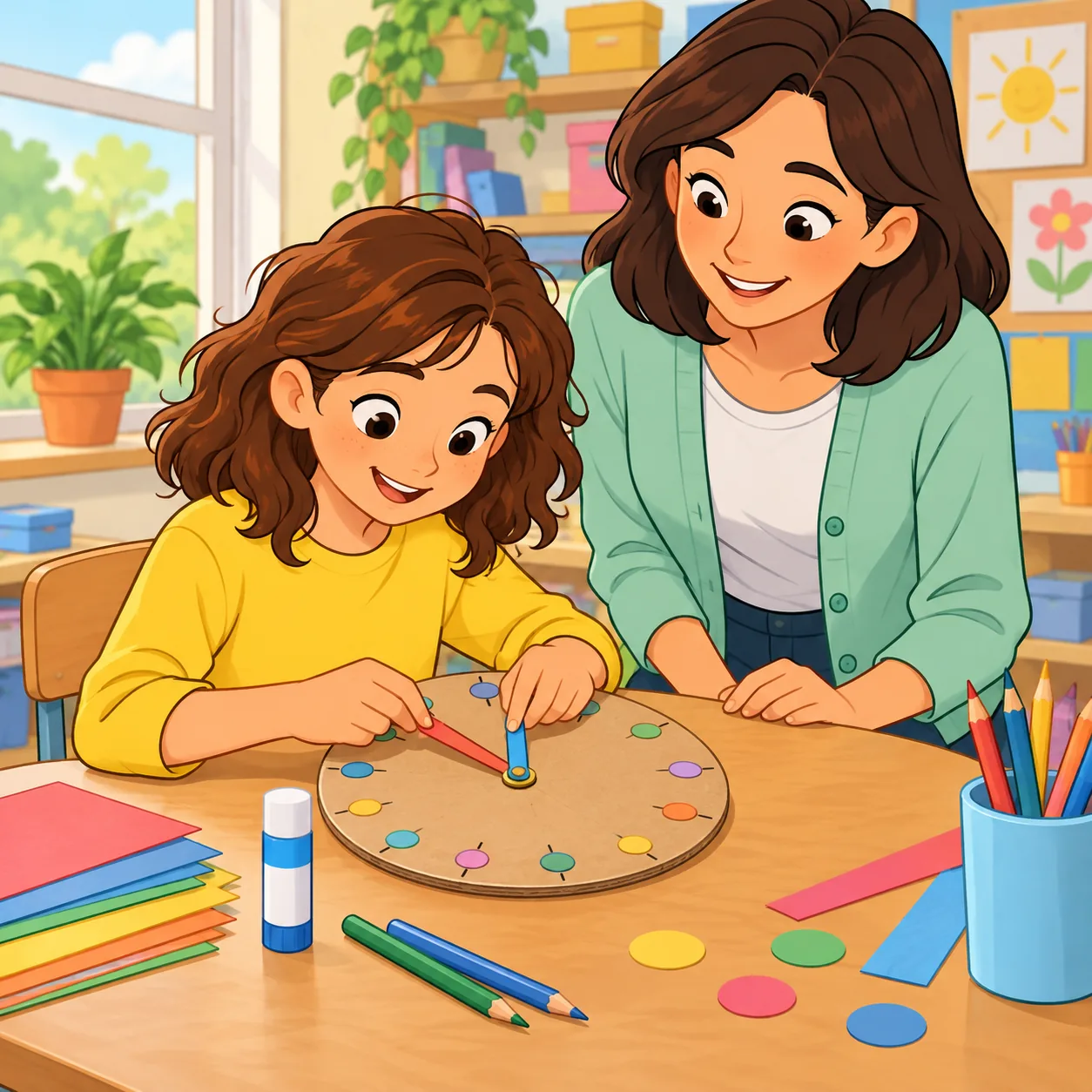
Our class made (example) a clock from card last week. First, each pupil [36] a large circle on coloured card. The teacher [37] us to draw the face before cutting it out. Two paper hands [38] attached with a small paper fastener. We waited [39] the glue was dry before moving the hands. I wrote numbers [40] the clock face with a felt-tip pen. My friend used blue card, but [41] used yellow card. We worked [42] so the circles had smooth edges. If a hand came loose, we [43] it carefully. The finished clocks [44] on the classroom wall now. Everyone [45] pleased with the bright display.
Example: Our class ___ a clock from card last week. → made
Part 7 · 5 questions
Complete the email
Write one word in each space. There is one example.
Dear Sam,
I went to (example) the museum workshop on Friday. It took us half [46] hour to get there. I put my yellow bag down and took a pencil out [47] it. The guide asked us [48] draw a clock before we visited the next room. I liked the wooden clock [49] had a painted flower on its door. We made a small clock from card, and I am going to tell you [50] it tomorrow.
See you soon, Nia
Example: I went ___ the museum workshop on Friday. → to
Ready to check your answers?
Submit to grade your whole test, OR use 👁 Show Answer per part / per question.
Learn from your answers
Answer reasons
- workshop — A workshop is a room used for making or repairing things; the tools and wooden toys give the clues.
- visitor — A visitor comes to see a place. The sentence says this person is visiting the museum rather than working there.
- repair — To repair the toy means to fix what is broken and make it usable again.
- label — A label gives short information about the object beside it, such as its name.
- display — The clocks form a display: a collection arranged so people can see it.
- replace — Replacing a battery means removing the old one and putting another one in its place.
- shelf — A shelf is a flat board used to support things such as books and clocks.
- patient — A patient child can wait calmly without getting annoyed.
- brush — A paint brush has a handle and hairs for spreading paint over a surface.
- pocket — A pocket is a small section of clothing used for carrying things.
- Yes — The boy on the left is seated at the table and is drawing a round clock.
- Yes — The girl in green is standing next to the wooden table.
- No — The adult in blue is on the right side of the picture.
- Yes — The picture shows a stack of three closed purple books on the table.
- No — The seated boy is wearing a red jumper.
- Yes — The adult on the right points toward the large round clock on the wall.
- No — The window at the back is open.
- Yes, I'll take the heavier ones. — The reply agrees to help and offers to carry the heavier books.
- I came with my cousin after lunch. — The question asks who came with the child. The reply names the cousin.
- I'm glad you like it; we made it from cardboard. — The reply responds to the compliment and explains that the clock is made from cardboard.
- Yes, I'll wait for you there when the talk ends. — The reply agrees to the suggested meeting place and time.
- I think the smaller clock looks best here. — The reply chooses the smaller clock for the window display.
- decorated — The yellow and blue paper stars make the clock look attractive; it was decorated with them.
- display — On display is the phrase for objects arranged so that people can look at them.
- label — The label identifies who made the model and what its title is. You fill in these details on a label.
- turned — He turned the paper hands so the visitor could see them move.
- photograph — A photograph is a picture taken with a camera.
- Owen and Mia's Museum Clock — The story follows Owen and Mia taking their handmade clock to the museum and showing it to visitors.
- aunt / aunt Rose — The story says the wooden clock belonged to Nia's aunt, Rose.
- Friday — They planned to take it to the museum on Friday.
- hall — The paper label says Rose kept the clock in her hall for many years.
- afternoon — Rose remembered that the clock made its ringing sound every afternoon.
- flowers — Rose said she had painted the small blue flowers herself.
- blanket — Nia and her grandfather wrapped it in a thick blanket for the trip.
- history / story — Nia placed a card with the clock's history under it so visitors could learn about it.
- drew — Drew is the past form used in the account of last week.
- told — The passage describes what happened last week, so told is the past form.
- were — Two paper hands is plural, so were completes the past passive construction.
- until — Until shows that the pupils waited up to the time when the glue was dry.
- on — On describes writing on the surface of the clock face.
- I — I is a subject pronoun before the verb used. Me is an object pronoun, and my must go before a noun.
- carefully — Carefully is the adverb that describes how the pupils worked.
- fixed — The if-clause describes a past activity, so fixed matches the past-tense account.
- are — Clocks is plural, so are is the correct present form.
- is — Everyone takes a singular verb, so is is correct.
- an — Use an before hour because its first sound is a vowel. Half an hour means thirty minutes.
- of — Out of is the fixed phrase for removing something from inside a bag.
- to — Use ask someone to do something: asked us to draw.
- that / which — That and which can introduce the clause describing this clock.
- about — Tell someone about something means to give them information about it.
Teacher tip
Read the full sentence or passage before answering. Use the words around each gap, and rely on details stated in the text or clearly visible in the picture.