
Flyers 5 – Test 3 Reading & Writing
100% Original Practice Test
Visit a mountain weather station, follow a wind-report story, and practise vocabulary, conversations, reading and grammar in this original A2 test. This A2 reading & writing practice has 7 parts and 50 questions. Complete each part, then submit to grade your work or use Show Answer to review.
Learning guide
Level: A2.
Topic: A Visit to the Mountain Weather Station
Learning objectives
- identify words from clear definitions
- read for specific facts and sequence
- use common A2 grammar in context
- complete a short informal letter
Before you start: A2 vocabulary for weather, travel, places and everyday activities; present and past simple forms.
Teacher tip: Invite learners to use picture details as evidence, then underline the exact words that support each reading answer.
Reading & Writing strategy: Read the instructions and example first. Use picture details and nearby words as clues, reread the whole sentence, and check spelling before submitting.
Part 1 · 10 questions
Words at the Weather Station
Read the definitions and write the correct words from the box. There is one example. Four words are not needed.
Example: This very high area of land often has snow at the top, even when the villages below are warm. → mountain
1. When you meet a new English word, this book can tell you its meaning and spelling.
2. You carry this small light in your hand to see the path when you walk after dark.
3. In this book, you can write about what happened to you on Monday, Tuesday and the other days.
4. You can walk along this to get from one side of a river to the other without going into the water.
5. This number tells you how hot or cold the air is, and you can read it on a thermometer.
6. This raised area of land is lower than a mountain, but you can still walk up to its top.
7. Water in a river drops from a high rock into a pool below to make this.
8. This bag rests against your back when you put its two straps over your shoulders.
9. You can open this above your head to keep raindrops off your face, then close it when the rain stops.
10. A white or grey shape above you which can cover the sun as it moves across the sky.
Part 2 · 7 questions
Look at the Mountain Weather Station
Look at the picture and read the sentences. Choose Yes if a sentence is correct, or No if it is incorrect.
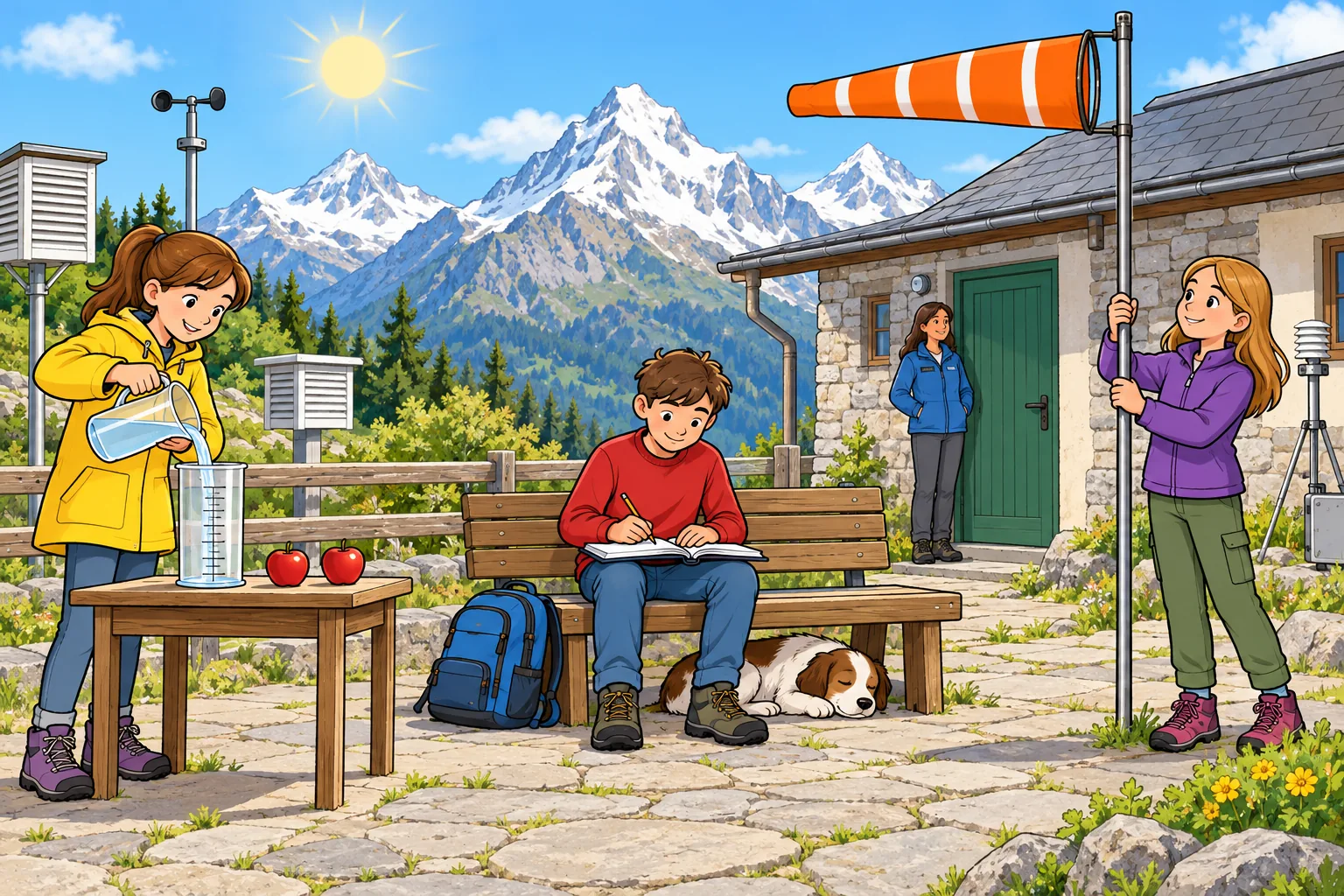
A cylinder is a tall container with a round top and bottom. A windsock is a cloth tube that moves in the wind.
Example 1: The girl on the right is wearing a purple jacket. → Yes
Example 2: The woman beside the green door is sitting down. → No
11. The girl on the left is pouring water into a clear cylinder.
12. The boy in the red jumper is standing and writing.
13. The orange windsock extends to the left.
14. The woman in the blue jacket is beside an open green door.
15. There are two red apples on the wooden table.
16. The blue backpack is on the bench.
17. The white-and-brown dog is asleep under the bench.
Part 3 · 5 questions
A Conversation with the Station Keeper
Read Nina's questions to Mr Cole. Choose the best reply from A-H. Use each reply once. Two replies are not needed.
Nina is visiting the mountain weather station. She asks Mr Cole, the station keeper, these questions.
Choose a reply
- You can read it on the small screen inside.
- Yes, but please put them back on this shelf afterwards.
- It measures how much rain falls.
- The tickets cost three pounds each.
- You can put your coats on the hooks by the door.
- It opens at nine in the morning.
- No, the path is closed after heavy snow.
- No, they are made from light metal.
Example: Nina: What time does the station open? → F. It opens at nine in the morning.
18. Nina: May we borrow the pencils to draw our chart?
19. Nina: What does this rain gauge measure?
20. Nina: Where can we see the air temperature?
21. Nina: Where should we leave our coats?
22. Nina: Are these wind-measuring cups made of heavy wood?
Part 4 · 6 questions
A Busy Morning on the Mountain
Choose words from the box to complete the story. There is one example. Four words are not needed. Then choose the best title for question 28.
At six o'clock the station was still quiet (example). Two hours later, a school group [23] at the door. The children put on their walking [24] before going into the courtyard. The wind grew [25] than it had been earlier, so Mr Cole asked them to stay close to the building. Nina checked the rain gauge [26], making sure she read the right number. Dark [27] were moving across the valley. The group returned indoors and finished a report about the changing weather.
Example: Before the visitors came, the station was ___. → quiet
28. Choose the best title for the story.
Part 5 · 7 questions
The Wind Report
Read the story. Complete each sentence with one to four words from the story.
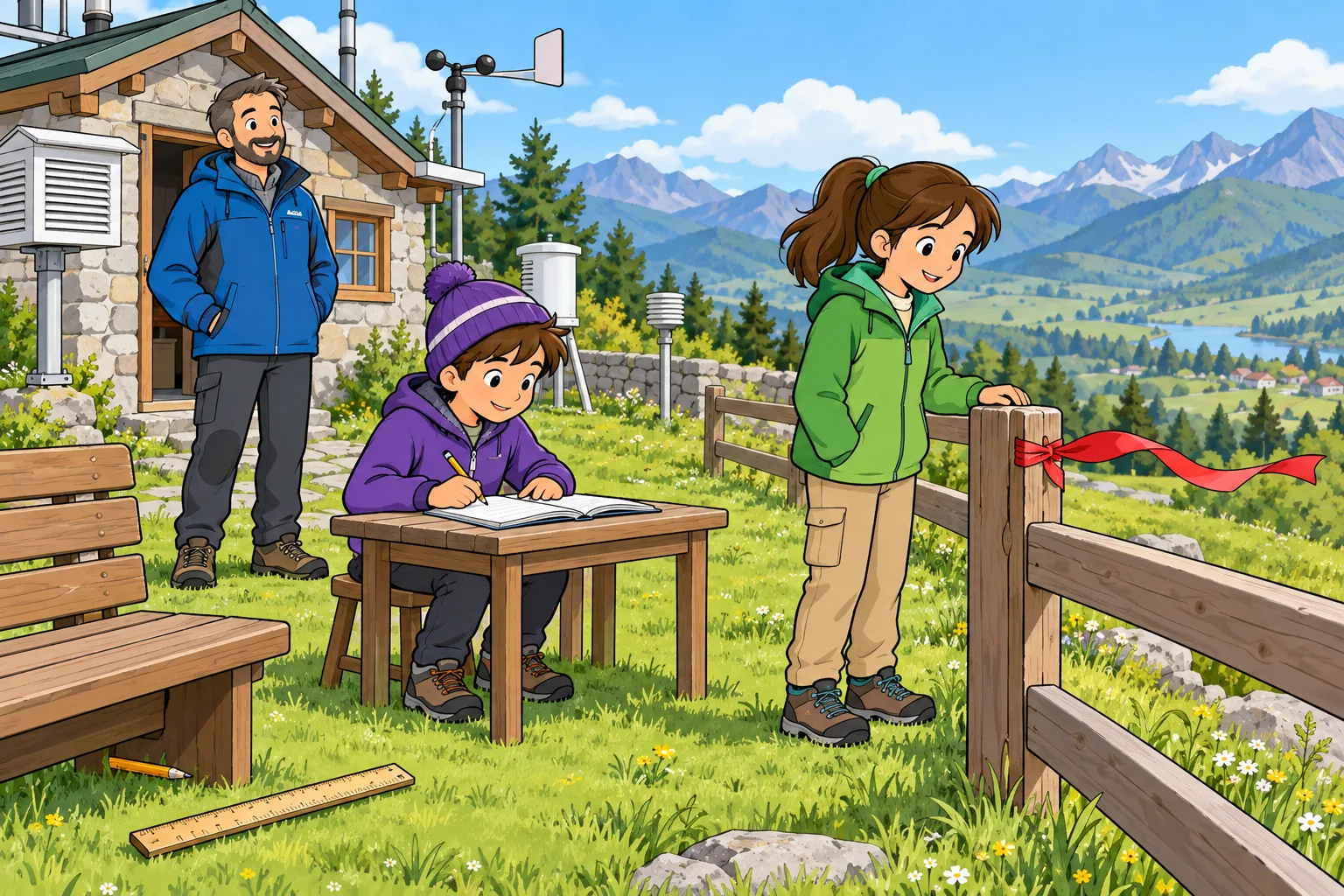
The Wind Report
Maya and Leo visited the mountain station with their science club on Saturday. Their minibus reached the station at half past nine. Mr Cole showed everyone how to watch the wind. He gave the children a red ribbon, and Leo tied it to a wooden fence. Maya watched the ribbon for ten minutes while Leo wrote notes in his notebook.
Just as Leo finished the last note, a gust of wind knocked his pencil off the table. It rolled under a bench. Leo could see it, but his hand could not reach it. Mr Cole brought a long ruler from the station. Leo used the ruler to pull the pencil towards him. Maya held his notebook so that the pages would not blow away.
After lunch, the two friends used their notes to make a wind report with pictures and arrows. On Monday, their teacher put it on the classroom wall. The other children liked the drawings and asked about the ribbon. Maya was pleased that a simple piece of cloth had helped them learn something new.
Example: Maya and Leo went to the mountain station with their ___. → science club
29. The minibus arrived at the station at ___.
30. Mr Cole gave the children ___ to help them watch the wind.
31. Leo tied the ribbon to ___.
32. Maya watched the ribbon for ___.
33. When the pencil fell, it rolled ___.
34. Leo pulled the pencil towards him using ___.
35. On Monday, the wind report was put on ___.
Part 6 · 10 questions
Watching the Weather
Read the text and choose the correct word for each gap. There is one example.
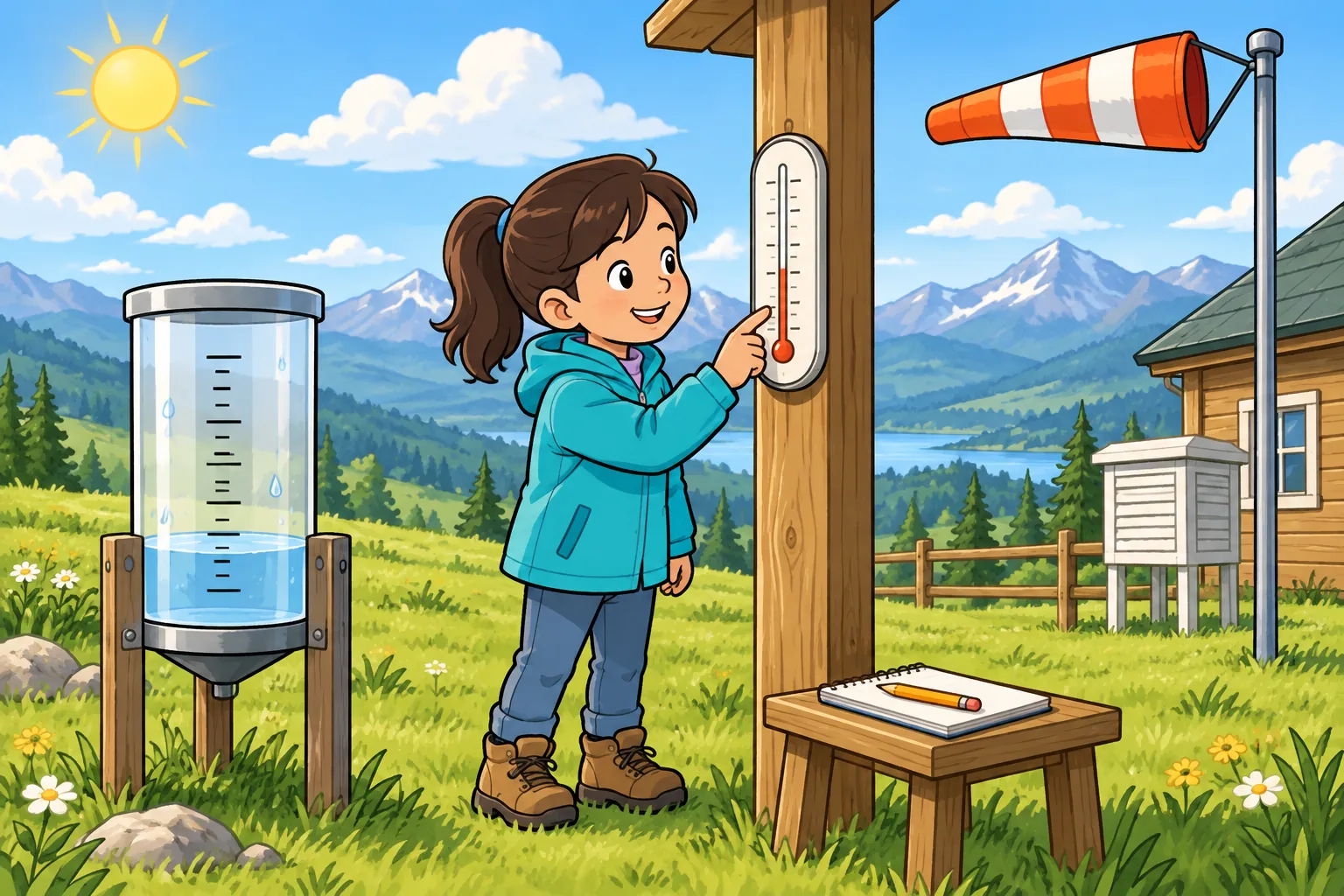
The weather can change from one day to (example) the next. At a weather station, people use tools to find out [36] warm or cold the air is. One of these tools is called [37] thermometer. It tells them the temperature [38] the air.
People also collect rain in a special container. When the rain stops, they look at [39] water inside. The marks on the container show how [40] rain has fallen. Our school has a rain container too. Yesterday it [41] empty because no rain had fallen.
A windsock is a cloth tube on a pole. When the wind blows, the sock [42]. The children watch [43] and draw an arrow on their chart. In a strong wind, the sock is usually [44] than it is in a light breeze. Our chart shows no wet days this week, [45] we have not needed our umbrellas.
Example: The weather can change from one day ___ the next. → to
Part 7 · 5 questions
A Message from the Mountain
Complete Sam's email. Write one word in each gap. There is one example.
Hi Ben,
I am writing about (example) our class visit to the weather station. It was one [46] the most interesting trips I have been on. The bus stopped [47] the bottom of the mountain, and we walked up together. I liked the rain container [48] it showed us how much rain had fallen. We had lunch [49] a warm room and then wrote our report. Both Leo [50] I enjoyed finding out about the weather.
See you soon, Sam
Example: I am writing ___ our class visit. → about
Ready to check your answers?
Submit to grade your whole test, OR use 👁 Show Answer per part / per question.
Learn from your answers
Answer reasons
- dictionary — A dictionary explains words and shows how to spell them.
- torch — A torch is a small light that you can hold and carry.
- diary — A diary is a book for writing about daily events.
- bridge — A bridge lets people cross over a river.
- temperature — Temperature tells us how hot or cold something is.
- hill — A hill is a raised area of land that is lower than a mountain.
- waterfall — A waterfall forms where water falls from a higher level to a lower one.
- rucksack — A rucksack is a bag that you carry on your back.
- umbrella — An umbrella opens above your head to protect you from rain.
- cloud — A cloud is a visible group of tiny water drops or ice crystals in the sky.
- Yes — The yellow-raincoat girl pours from a jug into the cylinder.
- No — He is seated on the bench while writing.
- Yes — The windsock visibly points left.
- No — The green door is closed.
- Yes — The table holds exactly two red apples.
- No — The backpack is on the ground beside the bench.
- Yes — The dog is sleeping underneath the bench.
- Yes, but please put them back on this shelf afterwards. — Mr Cole gives permission and asks Nina to return the pencils.
- It measures how much rain falls. — The reply explains that the gauge measures the amount of rain.
- You can read it on the small screen inside. — The reply directs Nina to the screen inside the station.
- You can put your coats on the hooks by the door. — The reply names the hooks where visitors can leave their coats.
- No, they are made from light metal. — Mr Cole says no and explains that the cups are made from light metal.
- arrived — The school group arrived at the station two hours later. 'Arrived at' describes reaching a place.
- boots — Walking boots are suitable footwear for the mountain path.
- stronger — 'Than it had been earlier' requires a comparative: the wind grew stronger.
- carefully — Carefully describes how Nina checked the number to avoid a mistake. No other bank word fits here as an adverb.
- clouds — Clouds can move across the valley and make the sky dark.
- A Class at the Weather Station — The passage follows a school group during its morning visit.
- half past nine — The minibus reached the station at half past nine.
- a red ribbon / red ribbon — Mr Cole gave them a red ribbon.
- a wooden fence / wooden fence — The ribbon was tied to a wooden fence.
- ten minutes / 10 minutes — The story gives ten minutes as the observation time.
- under a bench / under the bench — The pencil rolled under a bench.
- a long ruler / the long ruler / a ruler / the ruler / long ruler — Mr Cole brought a long ruler, which Leo used to reach the pencil.
- the classroom wall / classroom wall — Their teacher displayed it on the classroom wall.
- how — 'How warm or cold' asks about the temperature.
- a — We use a before the singular noun thermometer, which begins with a consonant sound.
- of — 'The temperature of the air' tells us what is being measured.
- the — The means the particular water collected in the container.
- much — Rain is uncountable, so we ask how much rain has fallen.
- was — Yesterday requires the past tense; the singular subject it takes was.
- moves — The singular subject the sock takes moves in this present simple sentence.
- it — The pronoun it refers to the singular windsock.
- straighter — Than requires the comparative straighter.
- so — So introduces the result of having no wet days.
- of — Use one of before a group: one of the most interesting trips.
- at — Use at in the phrase at the bottom of a mountain.
- because / as / since — Because, as and since can introduce the reason Sam liked the container.
- in / inside — In or inside says where the children ate their lunch.
- and — The pair both … and joins Leo and Sam.
Teacher tip
Invite learners to use picture details as evidence, then underline the exact words that support each reading answer.