
Flyers 4 – Test 3 Reading & Writing
100% Original Practice Test
An original seven-part A2 Flyers Reading & Writing practice test set around a school photo exhibition, with everyday vocabulary, a detailed picture task, a connected conversation, original stories and a general text about keeping photo albums. This A2 reading & writing practice has 7 parts and 50 questions. Complete each part, then submit to grade your work or use Show Answer to review.
Learning guide
Level: A2.
Topic: The School Photo Exhibition
Learning objectives
- Read familiar everyday words from clear definitions.
- Compare sentences with details in a carefully described picture.
- Choose suitable replies in a connected conversation about an exhibition.
- Complete narratives and an everyday informational text using A2 vocabulary and grammar.
- Use common one-word patterns in a friendly email.
Before you start: Learners should know everyday A2 vocabulary, present and past forms, common prepositions, conjunctions, simple relative clauses and short connected texts.
Teacher tip: Read each text once for meaning before filling a gap. In the picture task, check clothing, position and action carefully. Use surrounding words to decide which answer fits each text.
Reading & Writing strategy: Read the instructions and example first. Use picture details and nearby words as clues, reread the whole sentence, and check spelling before submitting.
Part 1 · 10 questions
Read the definitions and write the words
Choose words from the box to complete the definitions. There is one example. Four words are not needed.
Example: You show this small piece of paper to enter a cinema: a ___. → ticket
1. You use this to take a photograph: a ___.
2. This holds a photograph and can stand on a desk: a ___.
3. You can keep many photographs together in this book: an ___.
4. Someone who travels to a museum to look around it is a ___.
5. This is a large room inside a school: a ___.
6. You can hang a picture on this part of a room: a ___.
7. This is an image made with a camera: a ___.
8. You sit on this long seat: a ___.
9. You can look outside through this opening: a ___.
10. You can put cups or books on this piece of furniture: a ___.
Part 2 · 7 questions
Look at the picture and read the sentences
Look at the picture. Read each sentence and choose Yes or No. There is one example.
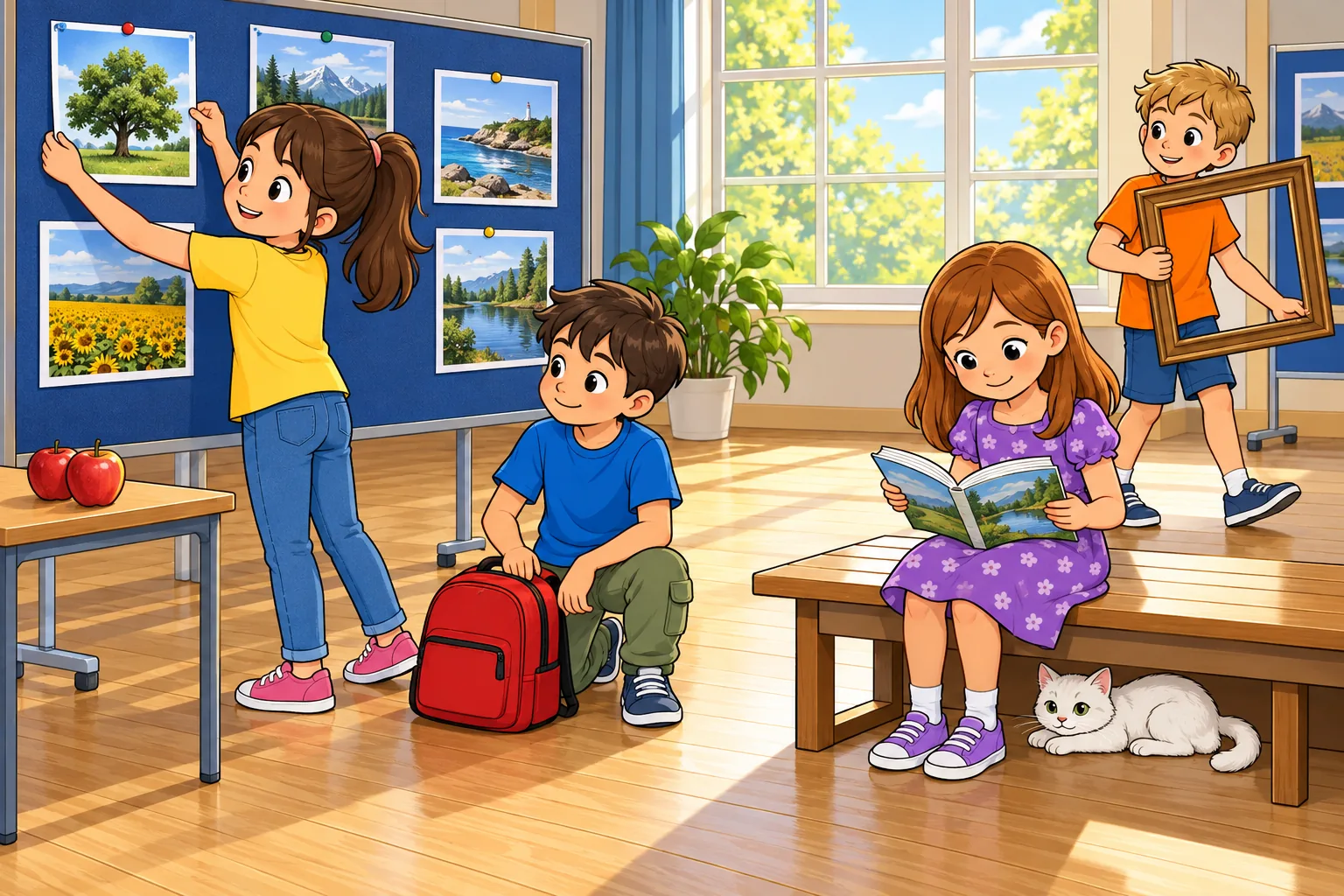
Mia is the girl in yellow on the left; Leo is the boy in blue in the centre; Grace is the girl in purple on the bench; Oscar is the boy in orange at the back right.
Example: Leo is kneeling beside a closed red backpack. → Yes
11. Mia is pinning a photograph of a tree to the board.
12. Grace is sitting on the bench and reading an open book.
13. Oscar is carrying an empty brown picture frame.
14. There are three apples on the small table.
15. The white cat is under the bench.
16. Mia is reading an open book on the bench.
17. The boy in the blue T-shirt is carrying the empty brown frame.
Part 3 · 5 questions
Choose the best reply
Read the conversation and choose the best reply for each question. There is one example. Two replies are not needed.
Ella and Noah are planning their school photo exhibition and talking about Noah's favourite photograph.
Choose a reply
- We can put them in the tall box by the door.
- It was taken beside the lake last spring.
- Yes, I can bring my blue one tomorrow.
- I like the picture with the little brown dog.
- At three o'clock, after the last lesson.
- We chose it because the colours look warm.
- My sister helped me carry the chairs upstairs.
- Please ask Mr Hall; he has the spare keys.
Example: Ella: When will your class visit the exhibition? → At three o'clock, after the last lesson.
18. Ella: Which photograph is your favourite?
19. Ella: Where was that photograph taken?
20. Ella: Why did you choose it for the display?
21. Ella: Can you bring a frame for it?
22. Ella: Where shall we put the extra photographs?
Part 4 · 6 questions
Read and complete the text
Choose words from the box to complete the text. There is one example. Four words are not needed. Then choose the best title.
The art club planned a small photo exhibition for families. First, they wrote an invitation (example) for each family and placed it in a school bag. The children checked every picture [23] they put it on the display board. They wanted each photograph to look [24] under the hall lights. Ana [25] a picture of her dog in a pile on the classroom shelf. The club worked [26] so that another class could keep studying nearby. At last, the display was [27] for the visitors.
Example: First, they wrote an ___ for each family and placed it in a school bag. → invitation
28. Choose the best title for the text.
Part 5 · 7 questions
Read the story and complete the sentences
Read the story. Complete each sentence with one, two, three or four words. There is one example.
A Frame for the Tree
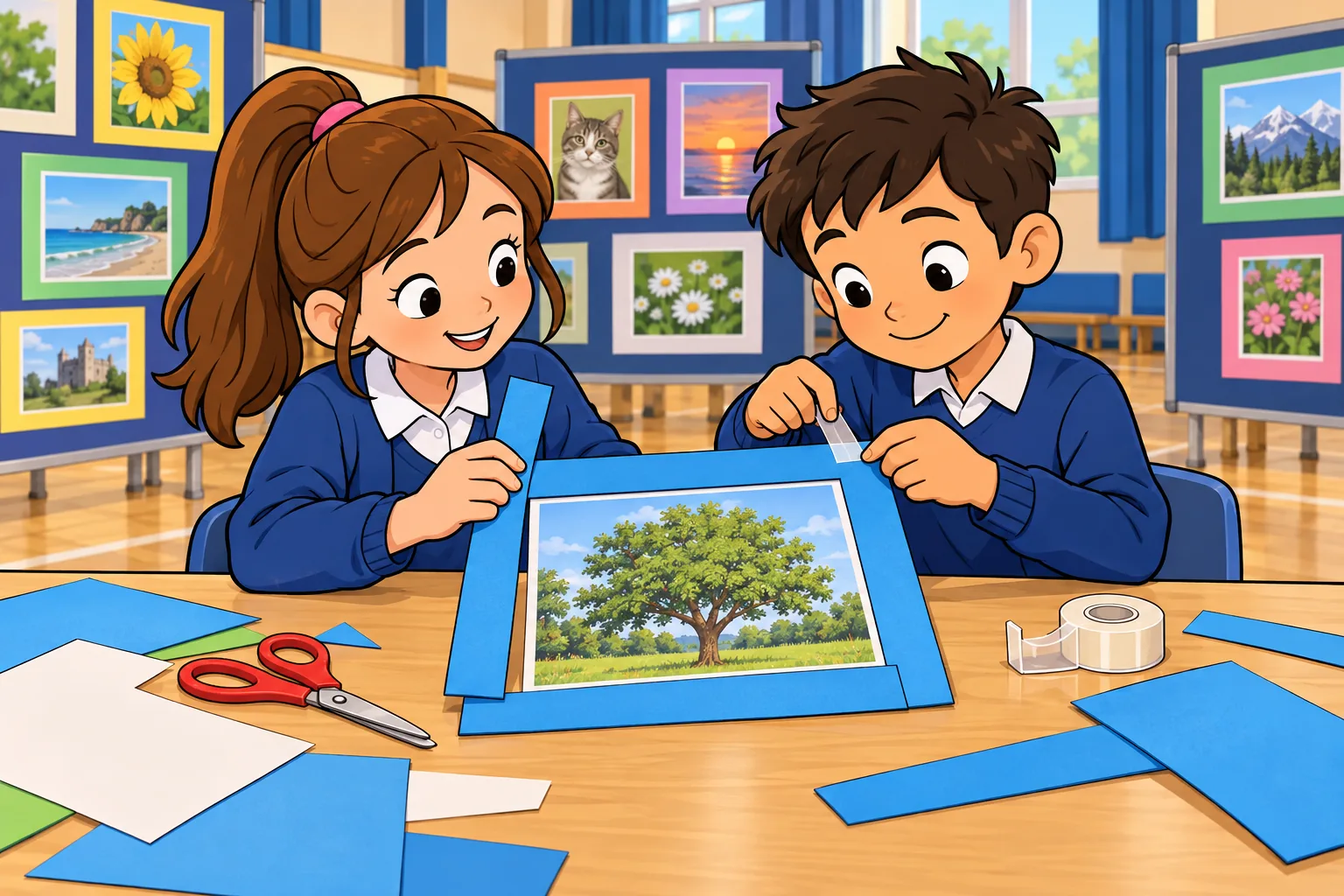
On Tuesday, Ben and Ava stayed after class to help prepare the school photo exhibition. Their teacher, Mrs Lane, gave them a table near the hall window. Ben had taken a photograph of a tall tree on a windy day. Ava liked its wide branches, so they decided to show it together. They wanted to make a frame that would stand on the table.
They cut a large blue sheet of card into a rectangle. Ava measured a space in the middle, and Ben carefully cut it out. The first opening was too small, so part of the tree was hidden. They tried again with a wider opening. This time the whole top of the tree could be seen. Ava put the photograph behind the blue card while Ben held both pieces still. They fixed the card with small strips of tape on the back.
When they lifted the frame, one corner began to bend. Ben folded a spare piece of card and taped it to the back as a support. That helped the frame stand on the table. Mrs Lane helped them place it on the table beside the other photographs. At the exhibition, several families stopped to look at the tree. Ben and Ava were pleased that their handmade frame had helped everyone see the picture clearly.
Example: Ben and Ava stayed after class on ___. → Tuesday
29. The children prepared for the school photo ___.
30. Ben had photographed a tall ___.
31. They cut a blue sheet of ___ into a rectangle.
32. The first opening was too ___ to show the whole tree.
33. They fixed the card with strips of ___.
34. Ben taped a folded piece of card to the ___ of the frame.
35. The frame helped everyone see the picture ___.
Part 6 · 10 questions
Choose the correct word
Read the text and choose the correct word for each space. There is one example.
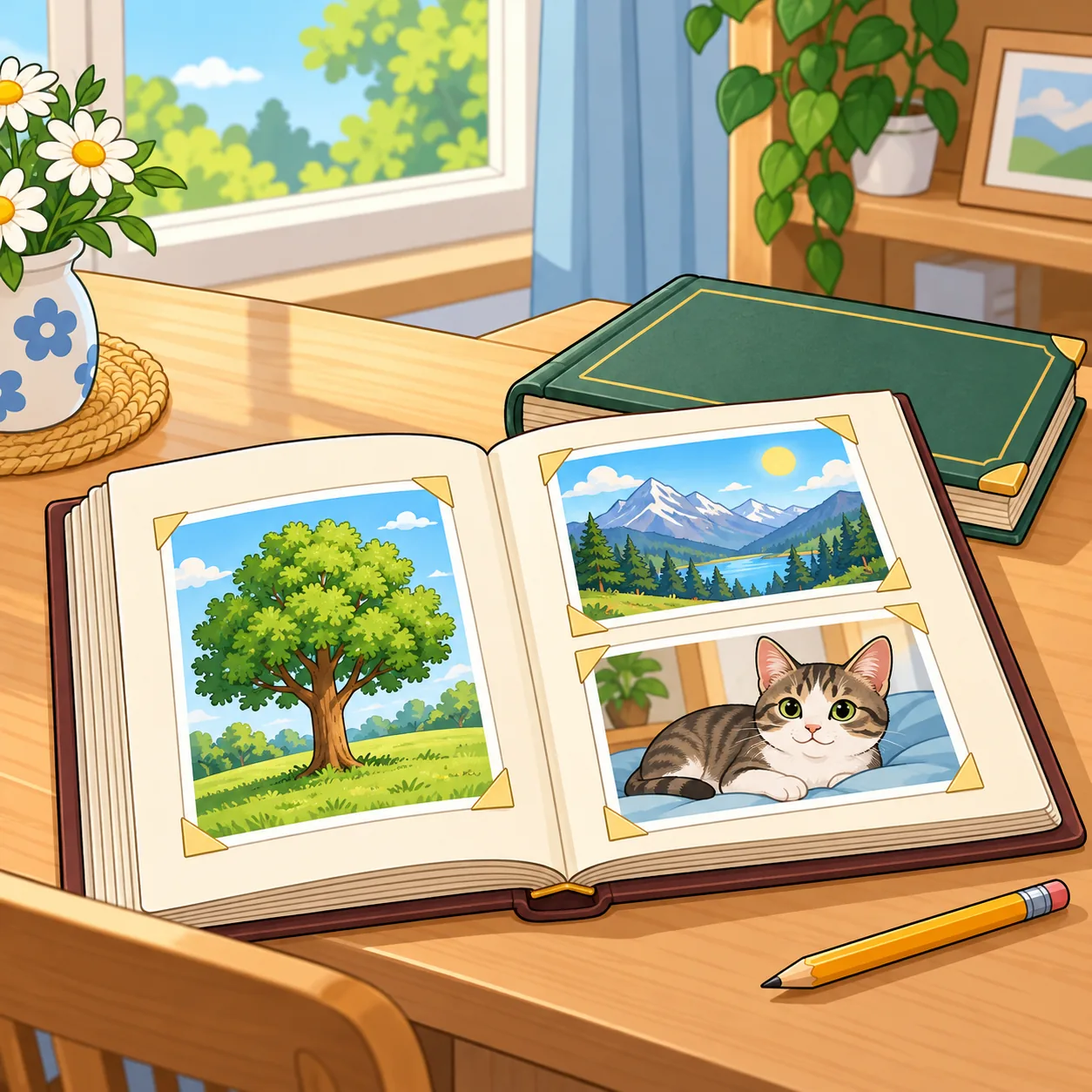
A photo album is a book which (example) has pages for keeping photographs. People put pictures [36] holidays, birthdays and days out inside it. Albums [37] easier to share than a pile of loose photographs. You can write names and dates beside the pictures. These notes help you remember each special day.
Last Sunday, my uncle [38] us his oldest album. We sat together [39] the kitchen table. We looked at [40] picture of his first pet, a small brown dog. The dog had [41] ears than our cat. He wrote the dog's name [42] a pencil on a card beside the photograph. Each page had space [43] a short note. His funny stories made us [44]. Looking at old albums is a lovely way [45] spend time together.
Example: A photo album is a book ___ has pages for keeping photographs. → which
Part 7 · 5 questions
Complete the email
Read the email and write one word in each space. There is one example.
Hi Lily,
Our school photo exhibition was wonderful. We arrived at (example) half past two and went into the hall with our class. I was especially interested [46] the pictures of wild animals. My favourite was a photo [47] showed a fox near a tree. It was one [48] the best pictures in the hall. I asked [49] I could make a copy, and the photographer said I could. She thanked us [50] coming to see the display.
Would you like to visit the next exhibition with me?
See you, Ella
Example: We arrived ___ half past two and went into the hall with our class. → at
Ready to check your answers?
Submit to grade your whole test, OR use 👁 Show Answer per part / per question.
Learn from your answers
Answer reasons
- camera — A camera is used to take photographs.
- frame — A frame holds and displays a photograph.
- album — An album is a book for keeping photographs.
- visitor — A visitor goes to a museum to see what is there.
- hall — A hall is a large room in a school.
- wall — A wall is a surface where a picture can be hung.
- picture — A picture is an image that someone can look at.
- bench — A bench is a long seat.
- window — A window lets people see outside.
- table — A table has a flat top for putting things on.
- Yes — Mia is the girl in a yellow T-shirt pinning the tree photograph on the left.
- Yes — Grace is wearing a purple dress and reading an open book while seated on the bench.
- Yes — Oscar wears an orange T-shirt and carries the empty brown frame at the back right.
- No — The small table on the left has exactly two apples.
- Yes — The scene places the white cat underneath the bench.
- No — Mia pins the tree photograph; Grace reads on the bench.
- No — Oscar, who wears an orange T-shirt, carries the empty brown frame; Leo wears blue and kneels by the backpack.
- I like the picture with the little brown dog. — The question asks which photograph the speaker likes.
- It was taken beside the lake last spring. — The reply identifies where and when it was taken.
- We chose it because the colours look warm. — The reply gives a reason for choosing the photograph.
- Yes, I can bring my blue one tomorrow. — The reply answers whether the speaker can bring a frame.
- We can put them in the tall box by the door. — The reply suggests where to put the extra photographs.
- before — Before shows that checking happened first.
- bright — Bright describes how the photograph should look.
- found — Found is the past-tense verb for discovering the picture.
- quietly — Quietly describes working without making much noise.
- ready — Ready means prepared for the visitors.
- Getting the Photo Exhibition Ready — The text describes preparing photographs and the hall for visitors.
- exhibition — They stayed to prepare for the school photo exhibition.
- tree — Ben's photograph showed a tall tree.
- card — The frame was made from a blue sheet of card.
- small / narrow — The opening was too small, so part of the tree was hidden. Narrow also describes the opening being too small from side to side.
- tape — Small strips of tape held the photograph and blue card together.
- back — He taped the folded card to the back to help the frame stand.
- clearly — The story says the frame helped people see the picture clearly.
- of — Of connects the pictures to what they show.
- are — The plural subject Albums takes are.
- showed — Last Sunday places the action in the past, so showed is needed.
- at — At the table describes where they sat.
- a — A is used before the singular noun picture, which begins with a consonant sound.
- longer — Than signals a comparison, so longer is needed.
- with — With tells us which tool he used to write.
- for — Space for a note means room to include a note.
- laugh — Made us is followed by the base form laugh.
- to — A way to do something takes to before the base verb.
- in — Interested in is the pattern used for something that attracts your attention.
- that / which — That and which can both introduce the relative clause describing the photo.
- of — One of the best pictures takes of after one.
- if / whether — If and whether can both introduce this indirect yes/no question.
- for — Thank someone for doing something is the correct construction.
Teacher tip
Read each text once for meaning before filling a gap. In the picture task, check clothing, position and action carefully. Use surrounding words to decide which answer fits each text.