
Flyers 3 – Test 3 Reading & Writing
100% Original Practice Test
An original seven-part A2 Flyers Reading & Writing practice test about a community school-garden open day, with garden vocabulary, conversations, stories and a factual text about growing seeds. This A2 reading & writing practice has 7 parts and 50 questions. Complete each part, then submit to grade your work or use Show Answer to review.
Learning guide
Level: A2.
Topic: The School Garden and Growing Seeds
Learning objectives
- Read familiar garden vocabulary in definitions.
- Compare short statements with a detailed picture and a story.
- Choose contextually suitable replies in a connected conversation.
- Complete short texts using A2 vocabulary, grammar and common one-word patterns.
Before you start: Learners should be familiar with everyday A2 vocabulary, present and past forms, common prepositions, conjunctions, comparatives and short connected texts.
Teacher tip: Read the whole passage before choosing a word. In the picture task, check each person's clothing, position and action against the sentence.
Reading & Writing strategy: Read the instructions and example first. Use picture details and nearby words as clues, reread the whole sentence, and check spelling before submitting.
Part 1 · 10 questions
Read the definitions and write the words
Choose words from the box to complete the definitions. There is one example. Four words are not needed.
Example: You put this in the ground, and a new plant can grow from it: a ___. → seed
1. You wear this on your hand to keep it clean while gardening: a ___.
2. You use this tool to dig a small hole in the ground: a ___.
3. This is the natural top layer of ground that plant roots grow in: ___.
4. This open container has a handle but no spout. You can carry water in it: a ___.
5. You write a plant's name on this and put it beside the plant: a ___.
6. This is a line of boards or wire around a garden: a ___.
7. You walk on this narrow strip through a garden: a ___.
8. You push this garden tool on one wheel to move leaves or soil: a ___.
9. This flat green part grows on a plant's stem or a tree's branch: a ___.
10. You use this tool to collect leaves with its long row of teeth: a ___.
Part 2 · 7 questions
Look and read
Look at the picture. Read the sentences and choose Yes or No. There is one example.
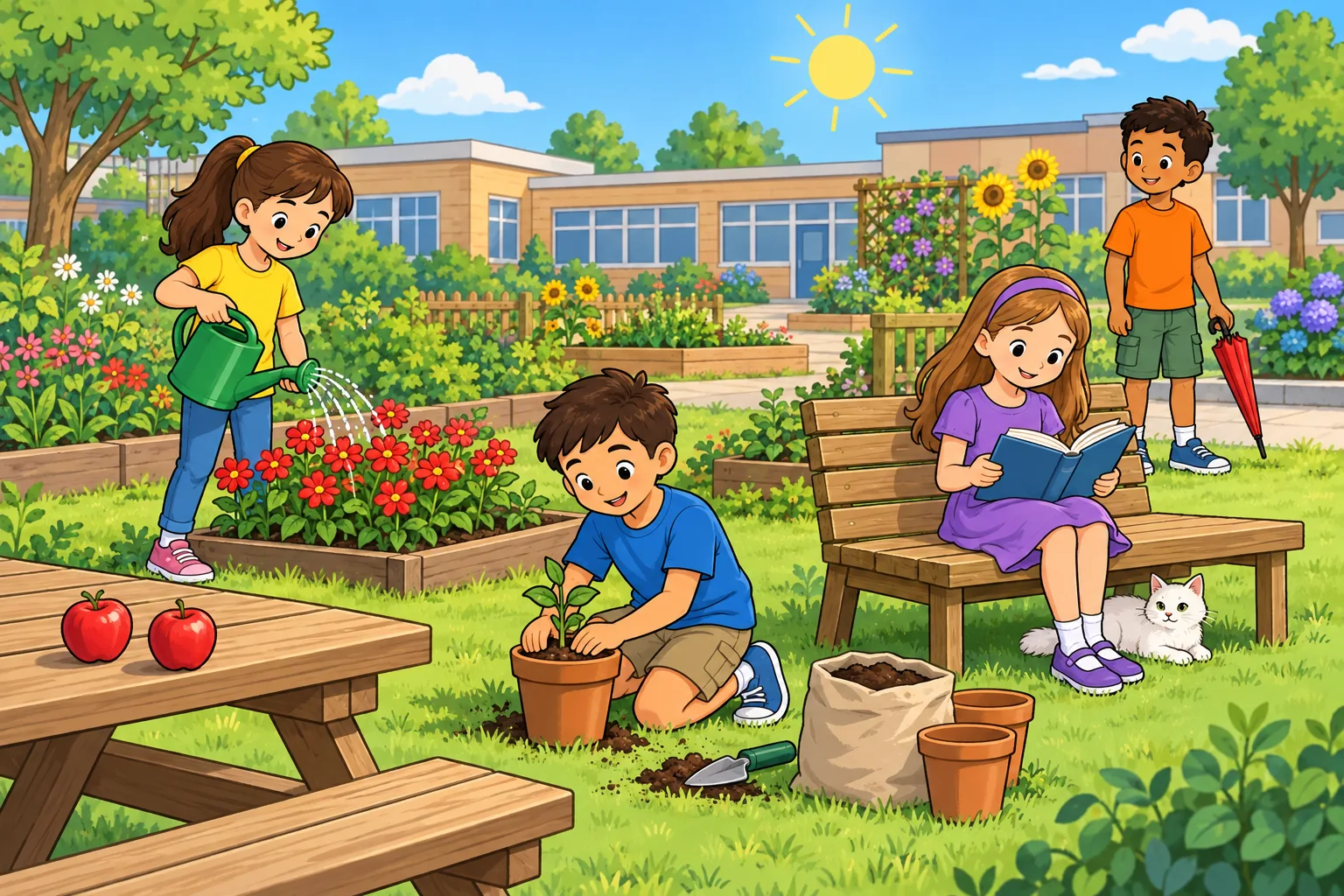
Ava is the girl in the yellow T-shirt on the left; Ben is the boy in the blue T-shirt in the centre; Lily is the girl in the purple dress on the bench at the right; Max is the boy in the orange T-shirt at the back right.
Example: Ben is kneeling and planting a seedling in a brown pot. → Yes
11. Ava is watering the red flowers with a green watering can.
12. Ben is standing beside a blue pot.
13. Lily is sitting on the bench and reading an open book.
14. Max is holding an open blue umbrella.
15. There are exactly two apples on the picnic table.
16. The white cat is sitting on the bench.
17. The sun is shining above the school garden.
Part 3 · 5 questions
Choose the best response
Read the conversation and choose the best response from the box. There is one example. Two responses are not needed.
Nora and Eli are helping at their school garden and talking about the open day.
Choose a reply
- I can ask Ms Green for another packet.
- It begins at half past ten by the garden gate.
- We planted them in the long bed beside the fence.
- Yes, I brought two clean jars from home.
- Let's carry the small tables out after lunch.
- My brother painted it green last week.
- A pair of red gloves would be useful.
- Because the wind blew the paper away.
Example: Nora: When and where does the open day begin? → It begins at half past ten by the garden gate.
18. Nora: Have you got any empty jars for the flower table?
19. Nora: Where did we plant the sunflowers?
20. Nora: What shall we do with the small tables?
21. Nora: Why is the picture missing from the noticeboard?
22. Nora: What should I wear while we move the pots?
Part 4 · 6 questions
Read and complete the story
Read the text and choose a word from the box for each space. There is one example. Four words are not needed. Then choose the best title.
On Friday, the garden club stayed after school to make signs for its open day. Maya picked up a small wooden label (example) and looked at a list of plant names. She checked the spelling [23] writing a name on the wood. Then she [24] the finished signs to the art table in a basket. At the table, the children painted a [25] yellow border around each sign. To avoid mistakes, they held their brushes and painted [26]. They put the signs on a shelf until the paint was dry. Next, they placed a sign beside each row of plants. The club leader smiled [27] visitors could now learn the plant names by reading the signs. The children were excited about showing their work to their families the next morning.
Example: Maya picked up a small wooden ___ and looked at a list of plant names. → label
28. Choose the best title for the text.
Part 5 · 7 questions
Read the story and complete the sentences
Read the story. Complete each sentence with one, two, three or four words. There is one example.
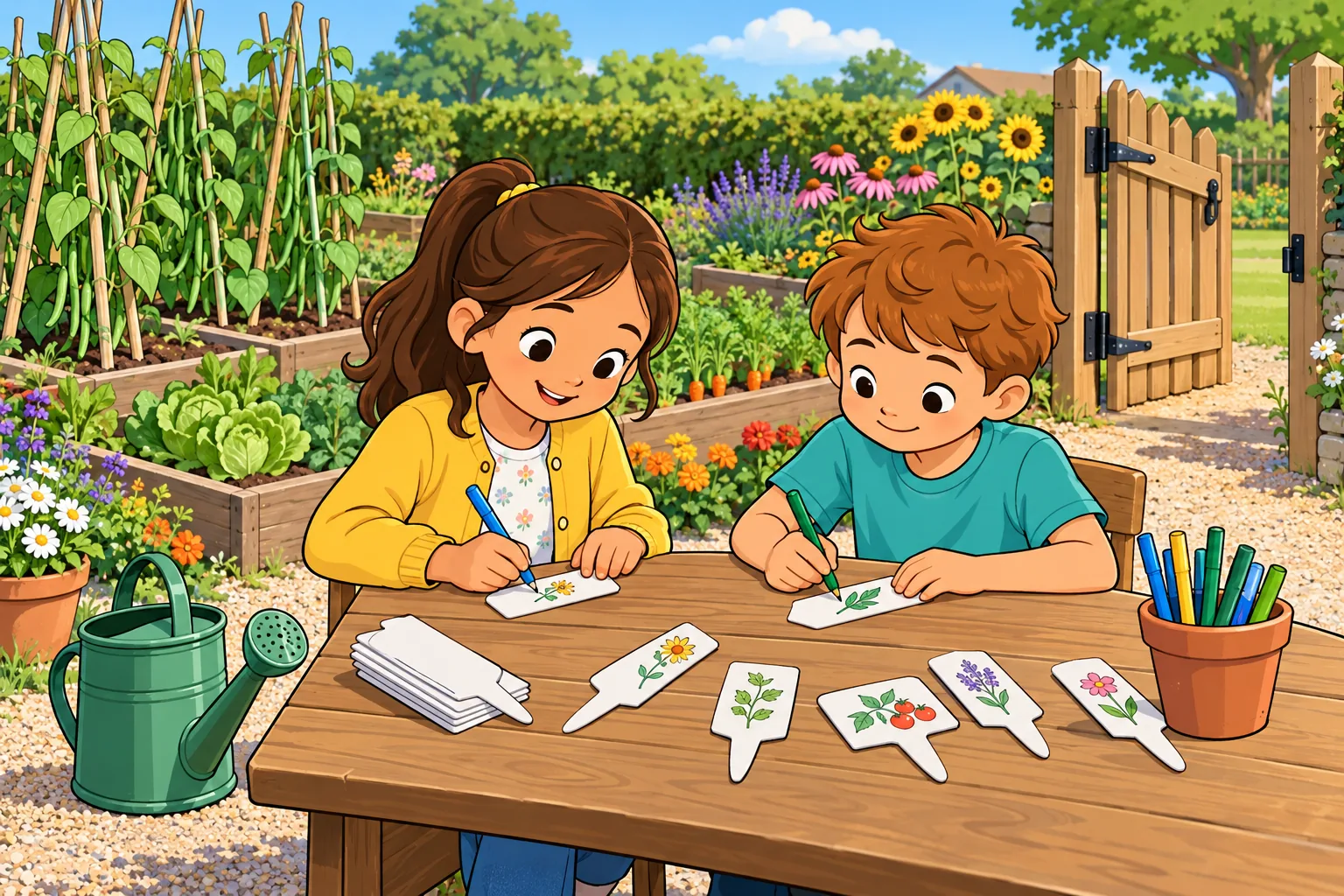
Labels for the Open Day
On Saturday morning, the school garden club met early to prepare for its open day. A light breeze moved the leaves, and the children could hear birds in the hedge. Their teacher, Ms Green, gave Nora and Eli a job near the garden gate. They had to make labels for the rows of plants so visitors would know what was growing. Nora wrote the plant names in large letters, while Eli drew a small picture beside each name. They used thick card and coloured pencils from a box on the table.
When the labels were finished, the children carried them to the long garden bed. Nora pushed a short stick into the soil beside each row, and Eli attached a label to every stick. One label fell face down in the grass. Eli found it and brushed off a little soil. Then they noticed that the label for the beans was missing. Nora looked under the table while Eli checked the basket. At last, Ms Green found it beside the watering can.
The club put the last label near the garden gate. Families began arriving, and Nora welcomed them. Eli showed a younger visitor how to read the plant names. By lunchtime, all the labels were in place, and the visitors could follow the rows without asking for help. The children felt proud of their careful work.
Example: The school garden club met early on ___. → Saturday
29. The children prepared for the garden's ___.
30. Ms Green gave Nora and Eli a job near the ___.
31. Nora wrote the plant names, and Eli drew a small ___.
32. They made the labels from thick ___.
33. Eli brushed a little ___ off the fallen label.
34. Ms Green found the missing beans label beside the ___.
35. Eli showed a younger visitor how to read the plant ___.
Part 6 · 10 questions
Choose the correct word
Read the text and choose the correct word for each space. There is one example.
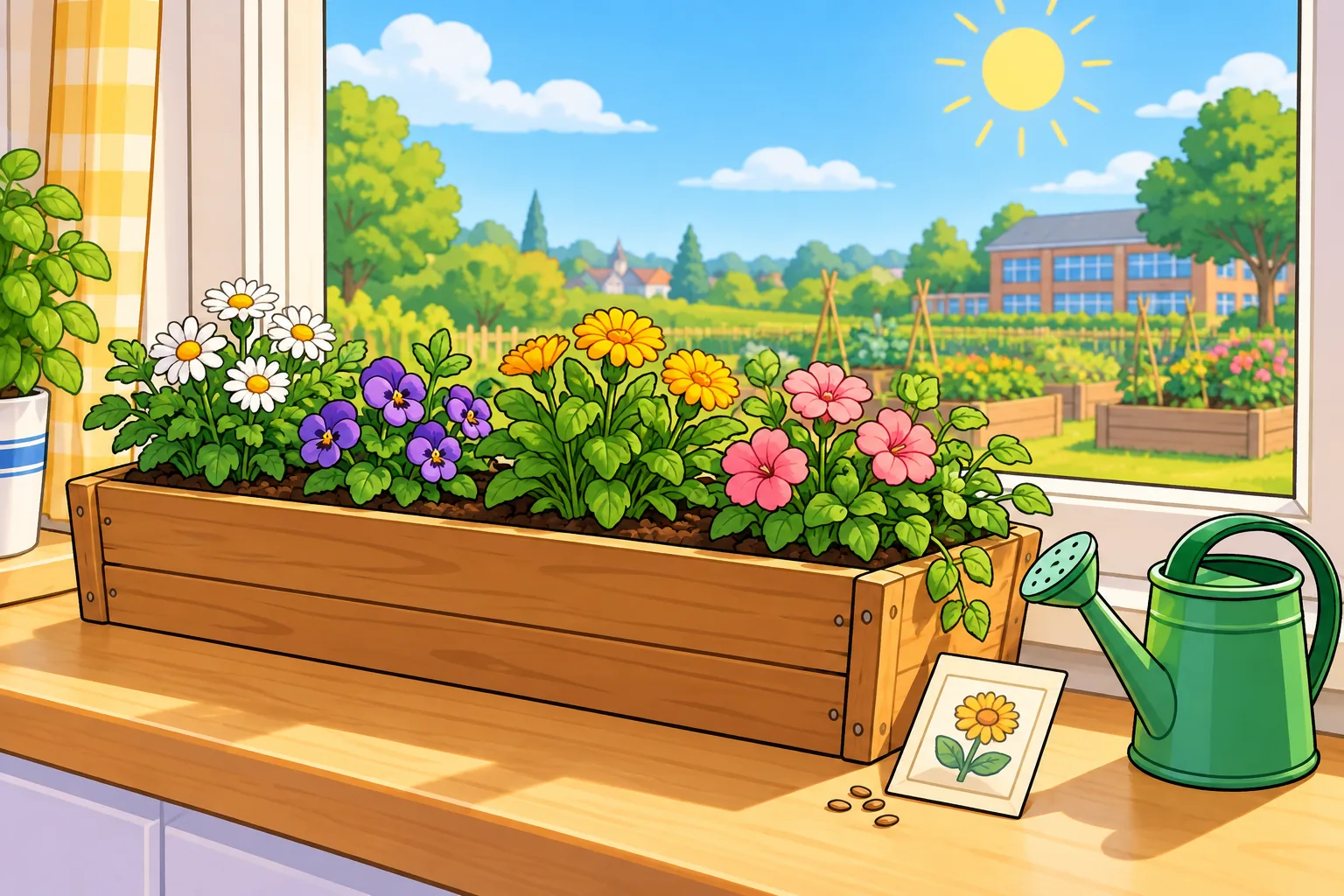
You do not need a large garden to grow plants. A window box can be a good place to start. Choose a box with (example) holes in the bottom so extra water can leave it. Fill it with compost for growing seeds. Follow the instructions on the seed packet. Put the seeds in the compost, leaving a gap [36] one seed and the next. Some seeds need a light covering of compost. Water gently: the compost should feel damp, but it should not [37] full of water.
Leave the box in a warm place. Look at [38] box every day and add water when the compost starts to dry. Some plants appear [39] a week, but other seeds take longer. When green shoots appear, put them somewhere bright. Turn the box [40] to help the plants grow towards the light. Plants [41] roots need more room can be moved to larger pots with an adult's help.
Keep your tools [42] after you use them. With care, the plants become [43] than before. Children can learn [44] plants change by watching them. Looking after a window box is a chance [45] enjoy gardening at home.
Example: First, choose a container ___ holes in its bottom. → with
Part 7 · 5 questions
Complete the text
Read the text and write one word in each space. There is one example.
Hi Mum,
We arrived at the school garden at (example) nine o'clock this morning. It was full [46] families enjoying the open day. A girl [47] knew all the plant names showed us around. She pointed to a row of purple flowers and told us how to grow them. Dad asked me [48] wait by the gate while he paid for some seeds. He bought a bag of seeds as [49] as a small plant for our kitchen window. We thanked the garden club [50] a lovely morning. I can't wait to put the seeds in a pot when we get home!
Love, Sam
Example: We arrived at the school garden ___ nine o'clock this morning. → at
Ready to check your answers?
Submit to grade your whole test, OR use 👁 Show Answer per part / per question.
Learn from your answers
Answer reasons
- glove — A glove covers and protects your hand.
- spade — A spade is a tool for digging.
- soil — Soil is the top layer of ground where plant roots grow.
- bucket — A bucket is an open container with a handle. A watering can has a spout.
- label — A label tells people the plant's name.
- fence — A fence forms a boundary around an area.
- path — A path is a route for walking.
- wheelbarrow — A wheelbarrow is pushed and carries garden materials.
- leaf — A leaf is a flat part of a plant or tree and is usually green.
- rake — A rake has teeth for gathering leaves.
- Yes — Ava stands on the left and uses a green watering can on the red flowers.
- No — Ben is kneeling and planting in a brown pot.
- Yes — Lily is seated on the right bench with an open book.
- No — Max holds a closed red umbrella.
- Yes — The picture shows two apples on the table.
- No — The cat is under the bench.
- Yes — The sun is visible in the clear blue sky.
- Yes, I brought two clean jars from home. — Eli answers the question about having jars and says how many he brought.
- We planted them in the long bed beside the fence. — The answer says where the sunflowers were planted.
- Let's carry the small tables out after lunch. — This is a suggestion about what to do with the tables.
- Because the wind blew the paper away. — The reply gives a reason for the missing picture.
- A pair of red gloves would be useful. — The reply recommends something to wear for moving pots.
- before — Before writing means she checked the spelling first and wrote the name afterwards.
- carried — Carried means she took the signs to the table in the basket.
- bright — Bright describes the vivid yellow border.
- carefully — Carefully describes painting with attention so they do not make mistakes.
- because — Because introduces the reason for her smile.
- The Garden Club's Plant Signs — The whole story follows the children making and placing plant signs.
- open day — The first paragraph says they met to prepare for its open day.
- garden gate / gate — Their task was given near the garden gate.
- picture — Eli drew a small picture beside each name.
- card — The story says they used thick card.
- soil — The fallen label had soil on it, which Eli brushed off.
- watering can — The story says she found it beside the watering can.
- names — He showed the visitor how to read the plant names.
- between — Between links the two separate seeds and describes the gap.
- be — Use the base form be after should not.
- this — This matches the singular noun box. These and those need plural nouns.
- in — In a week describes how long it takes for some plants to appear.
- regularly — The verb turn needs the adverb regularly.
- whose — Whose connects the plants with their roots.
- clean — Use the adjective clean after keep your tools.
- healthier — Than signals the comparative form healthier.
- how — How introduces the way plants change.
- to — Use a chance to followed by the base form of a verb.
- of — Full of is the pattern used to describe what fills a place.
- who / that — Who or that refers to the girl who knew the plant names.
- to — Use ask someone to do something: asked me to wait.
- well — As well as means in addition to.
- for — Use thank someone for something.
Teacher tip
Read the whole passage before choosing a word. In the picture task, check each person's clothing, position and action against the sentence.