
Flyers 3 – Test 2 Reading & Writing
100% Original Practice Test
An original seven-part A2 Flyers Reading & Writing practice test set at a community garden open day. This A2 reading & writing practice has 7 parts and 50 questions. Complete each part, then submit to grade your work or use Show Answer to review.
Learning guide
Level: A2.
Topic: The Community Garden Open Day
Learning objectives
- Read everyday A2 definitions and identify familiar words from context.
- Compare sentences with visible picture details and a short story.
- Choose suitable replies and complete short texts with words and phrases.
- Use A2 vocabulary, common grammar and one-word cloze language in context.
Before you start: Learners should know everyday A2 vocabulary, simple past and present forms, common prepositions, pronouns, comparatives and short connected texts.
Teacher tip: Read each full sentence before answering. In the picture task, point to visible details that support each Yes or No choice.
Reading & Writing strategy: Read the instructions and example first. Use picture details and nearby words as clues, reread the whole sentence, and check spelling before submitting.
Part 1 · 10 questions
Read the definitions and write the words
Choose words from the box to complete the definitions. There is one example. Four words are not needed.
Example: Your aunt's or uncle's child is your ___. → cousin
1. You keep money and cards in this small case: a ___.
2. When the sky is full of grey clouds, the weather is ___.
3. You can borrow books and read them in this place: a ___.
4. If you need a drink, you are ___.
5. You climb this to reach a high place: a ___.
6. A shop gives you this paper after you pay: a ___.
7. You look at your face in this: a ___.
8. If you use your friend's book for a short time and then give it back, you ___ it.
9. You put a letter inside this before you post it: an ___.
10. A small place in the countryside, with houses and streets, can be a ___.
Part 2 · 7 questions
Look and read
Look at the picture. Read the sentences and choose Yes or No. There is one example.
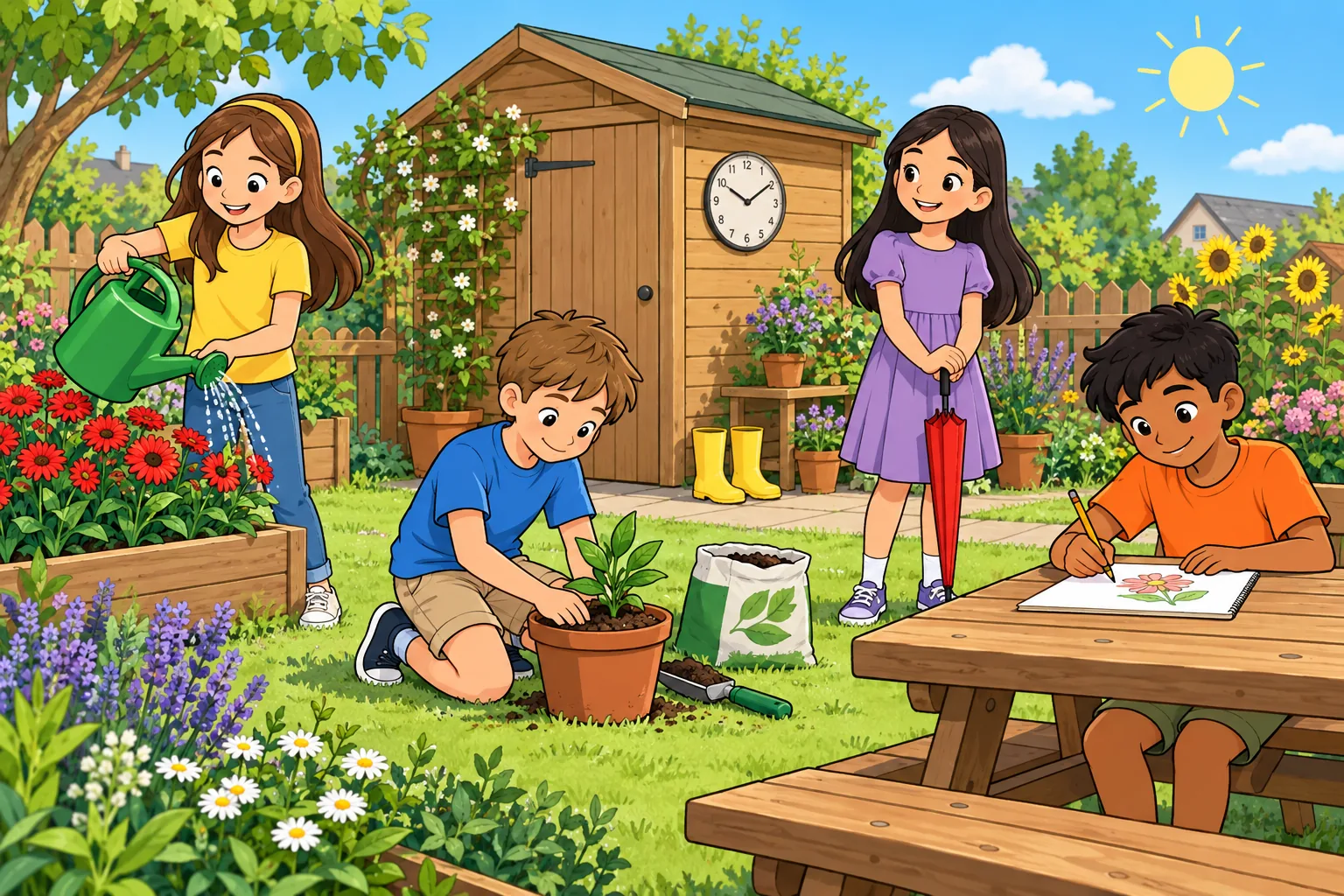
Lila is the girl in a yellow T-shirt on the left; Owen is the boy in a blue T-shirt in the centre; Ruth is the girl in a purple dress on the right; Amir is the boy in an orange T-shirt at the front right.
Example: Owen is the boy in the blue T-shirt in the centre. → Yes
11. Amir is sitting at the wooden table and drawing on white paper.
12. Lila waters red flowers with a green watering can.
13. Owen plants a green plant in a square blue pot.
14. Ruth sits at the picnic table and draws on white paper.
15. Ruth holds a closed red umbrella.
16. There are three yellow boots beside the shed.
17. A round clock hangs on the wall of the garden shed.
Part 3 · 5 questions
Choose the best response
Read the conversations and choose the best response from the box. There is one example. Two responses are not needed.
Two friends talk about their jobs and plans at a community garden open day.
Choose a reply
- We can put the extra chairs under the big tree.
- It starts at half past ten.
- Yes, I brought my own gloves.
- We planted them beside the fence yesterday.
- A glass of apple juice, please.
- The number 6 bus stops outside the library.
- Because the ground was very dry.
- Let's take the seed packets to the welcome table.
Example: Nora: Where should I put these seed packets? → Let's take the seed packets to the welcome table.
18. Nora: What time does the garden talk begin?
19. Nora: Did you remember to bring gloves?
20. Nora: Where can people sit while they eat?
21. Nora: Why did you water the garden early?
22. Nora: What would you like to drink?
Part 4 · 6 questions
Read and complete the story
Read the text and choose a word from the box for each space. There is one example. Four words are not needed. Then choose the best title.
Maya and her brother arrived early (example) at the garden open day, before most visitors came. A volunteer [23] them to help prepare the welcome table. First, Maya placed small packets of [24] in a neat row. The visitors could take these home to grow their own flowers. Her brother filled a [25] with clean apples for the children to eat. They worked [26], moving slowly so they did not knock any cups off the crowded table. Soon the first families arrived, and the garden became lively. At the end, everyone had finished their drinks. Maya helped collect the [27] cups and put them into a box for recycling. She felt pleased because the volunteers thanked her for helping.
Example: Maya and her brother arrived ___ at the garden open day. → early
28. Choose the best title for the text.
Part 5 · 7 questions
Read the story and complete the sentences
Read the story. Complete each sentence with one, two, three or four words. There is one example.
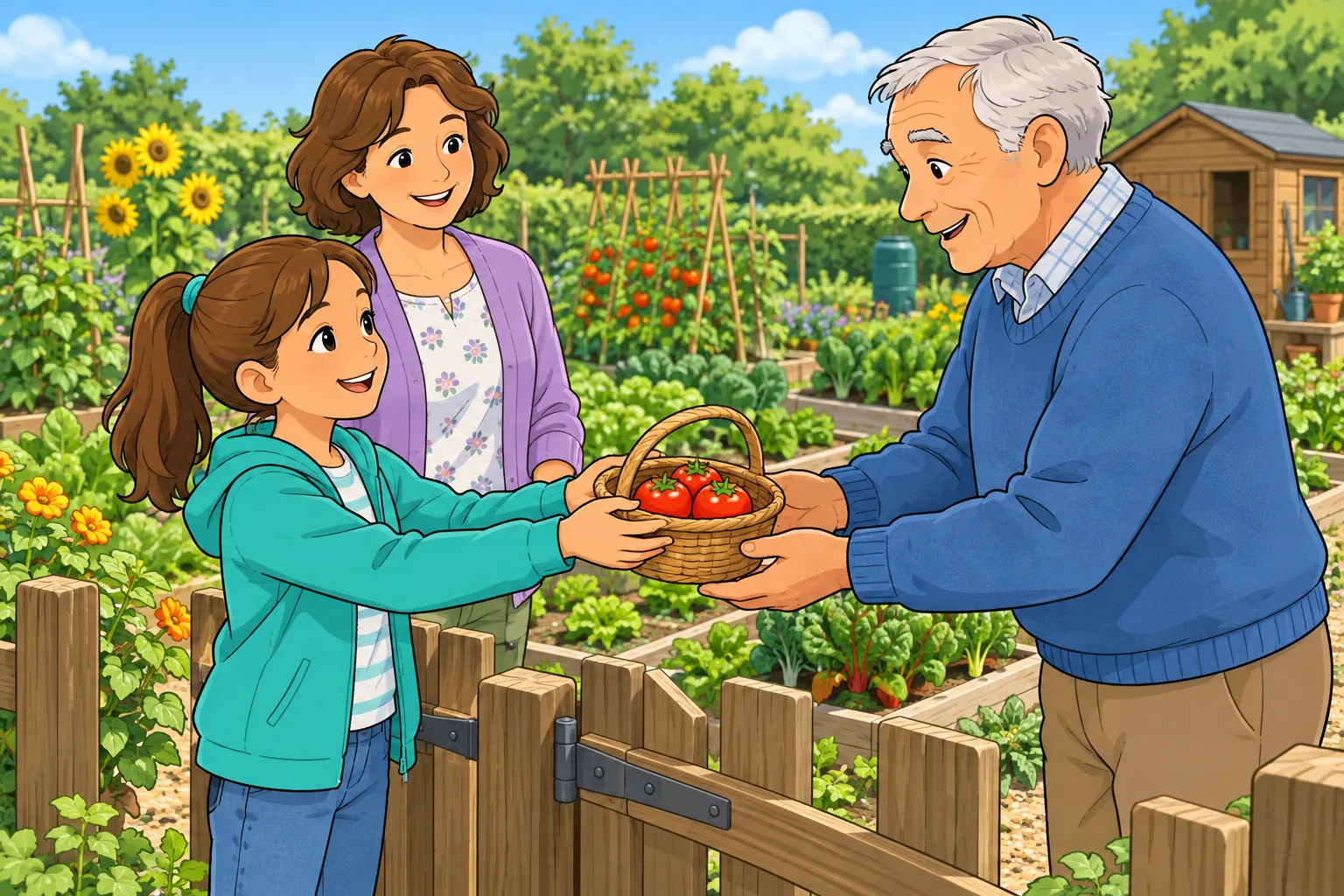
Beth's Garden Gift
Beth went to the community garden with her grandfather on Saturday morning. The air was cool, so she put on her jacket. Near the gate, a gardener called Mrs Green was preparing small baskets of ripe tomatoes for visitors. She wore a lavender cardigan and welcomed Beth with a smile. Beth wanted to choose the largest tomatoes, but Mrs Green explained that small ones could taste sweet too.
Before choosing her gift, Beth followed the gardener along the vegetable beds. The soil beside one plant looked dry. Mrs Green showed Beth a water tank where the volunteers stored rainwater. Beth filled a watering can and watered the dry soil. She was surprised that the volunteers could use rain from the roof instead of water from a tap.
When they returned to the gate, Beth chose three red tomatoes and put them in a small basket. She carried it slowly so that the tomatoes would not fall out. Her grandfather was waiting in his blue jumper. At the garden gate, Beth handed him the basket. He smiled and said he would make soup for lunch. Beth asked if she could help him cook it. Before they left, Mrs Green invited Beth to come back the following Saturday. Beth agreed because she wanted to help water the plants again.
Example: Beth visited the community garden with her ___. → grandfather
29. Beth went to the garden on ___.
30. The volunteers stored rainwater in a ___.
31. Beth picked ___ red tomatoes.
32. The gardener was called ___.
33. Beth carried the basket slowly so the tomatoes would not ___.
34. Beth handed the basket to her grandfather at the ___.
35. Her grandfather planned to make ___ for lunch.
Part 6 · 10 questions
Choose the correct word
Read the text and choose the correct word for each space. There is one example.
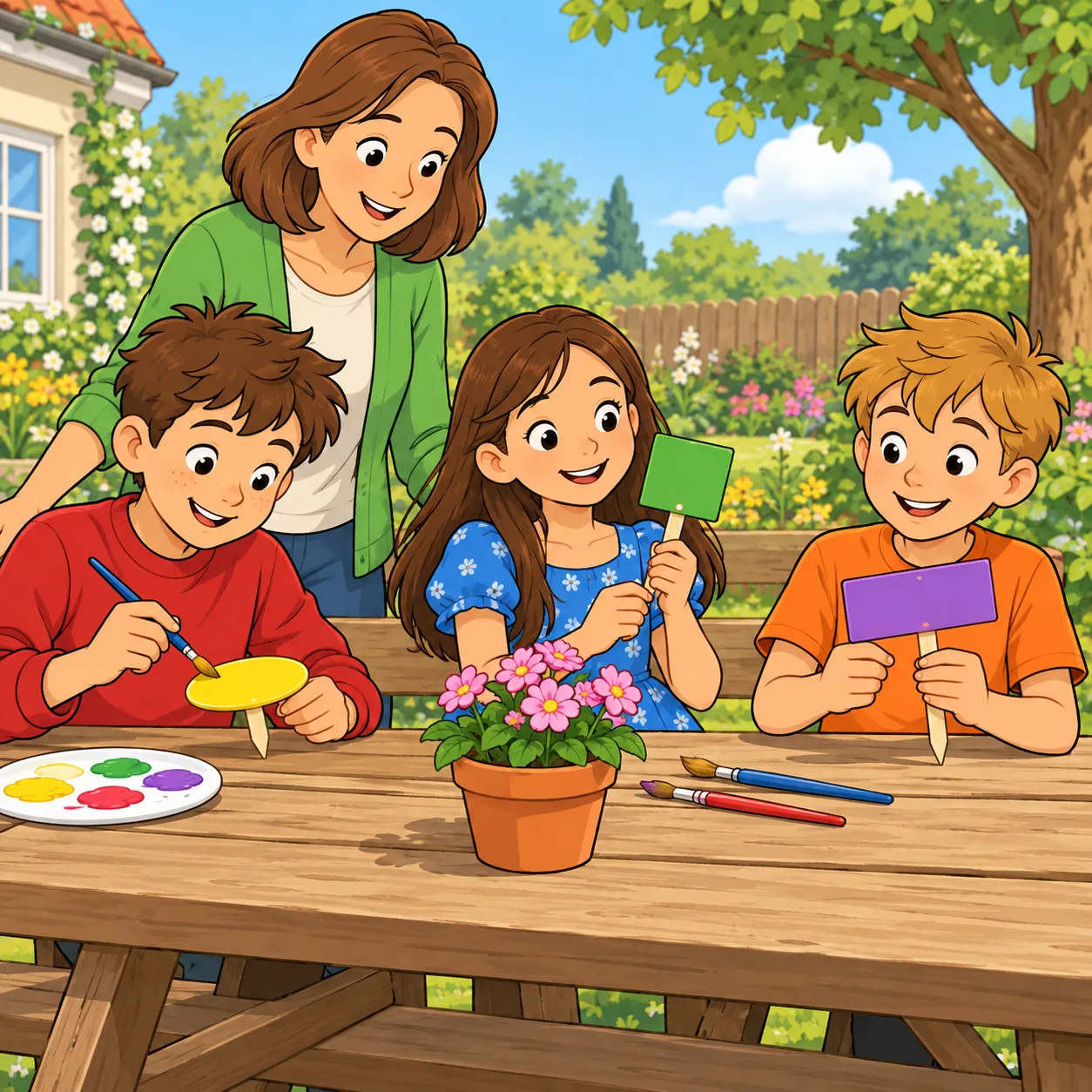
Last Saturday, the children made (example) garden labels at an outdoor picnic table. Before they began, they [36] the paint and brushes from the garden room. The boy in the red jumper [37] a yellow oval label. His sister, [38] was wearing a blue dress, held a green square one. The children wrote [39] own names on the backs of the labels. The purple label was [40] than the yellow one and had enough space for two plant names. The woman asked them to paint [41] so the colours would stay inside the shapes. A small pot of pink flowers [42] on the table beside them. After they finished, the children [43] the labels near the vegetable beds. The teacher thanked them [44] helping her tidy the table. Next Saturday, the group [45] add labels to the herb garden.
Example: Last Saturday, the children ___ garden labels at an outdoor picnic table. → made
Part 7 · 5 questions
Complete the text
Read the text and write one word in each space. There is one example.
We arrived at (example) nine o'clock to help at the garden open day. My brother had saved a small job [46] me at the welcome table. There were more visitors [47] we had expected, so we needed extra pots for the planting activity. Each small pot was made [48] plastic, and the gardener showed us how to plant a bean seed inside it. We wrote the date on the labels to remember when we had planted the seeds. At lunch, we sat under a tree and shared sandwiches. All of us were interested [49] learning more about growing vegetables. Before going home, we cleaned the tools and put them in their box. We were already looking forward [50] visiting the garden again the following week.
Example: We arrived ___ nine o'clock. → at
Ready to check your answers?
Submit to grade your whole test, OR use 👁 Show Answer per part / per question.
Learn from your answers
Answer reasons
- wallet — A wallet is a small case for carrying money and cards.
- cloudy — Cloudy describes a sky covered with clouds.
- library — A library is a place where people can read or borrow books.
- thirsty — Thirsty describes someone who wants a drink.
- ladder — A ladder has steps that help people climb.
- receipt — A receipt records what you bought and paid for.
- mirror — A mirror shows the person or things in front of it.
- borrow — Borrow means to use something and return it later.
- envelope — An envelope is a paper cover for a letter.
- village — A village is a small community, often in the countryside.
- Yes — Amir is seated at the picnic table with a pencil and white paper.
- Yes — The picture shows Lila using a green can on red flowers.
- No — His pot is round and brown.
- No — Amir draws at the table; Ruth stands on the right.
- Yes — Ruth's umbrella is red and closed.
- No — There are exactly two yellow boots beside the shed.
- Yes — The clock on the shed wall has a round face.
- It starts at half past ten. — The reply gives the start time.
- Yes, I brought my own gloves. — The reply answers the question about gloves.
- We can put the extra chairs under the big tree. — The reply suggests a place for visitors to sit.
- Because the ground was very dry. — The reply gives a reason for watering.
- A glass of apple juice, please. — The reply politely names a drink.
- invited — Invited means the volunteer asked them to help.
- seeds — The packets contained seeds.
- basket — A basket is a container for the apples.
- carefully — Carefully describes the attention they used to avoid knocking things off the crowded table.
- empty — The cups had no drink left in them, so they were empty.
- Two Helpers at the Garden Open Day — The story follows Maya and her brother as they prepare the welcome table and help clear up at the garden open day.
- Saturday morning / Saturday — The opening sentence says they visited on Saturday morning; Saturday also completes the sentence correctly.
- water tank / tank — Mrs Green showed Beth the water tank used to store rainwater.
- three / 3 — Beth chose three red tomatoes for the basket.
- Mrs Green / Mrs. Green — The story names her Mrs Green.
- fall out / fall — She moved slowly to keep the tomatoes from falling out of the basket.
- gate / garden gate — She gave him the basket at the garden gate.
- soup / tomato soup — Her grandfather said he would make soup for lunch using the tomatoes.
- borrowed — Yesterday requires the past form borrowed.
- painted — The whole activity happened last Saturday; painted is the past form needed here.
- who — Who introduces extra information about his sister, who is a person.
- their — Their is the possessive determiner before own names.
- longer — Than compares the two labels, so the comparative longer is needed.
- carefully — Carefully is an adverb describing the way the children painted.
- was — The subject is one pot and the description is in the past, so was is correct.
- placed — The children placed the labels after finishing the past activity.
- for — Thank someone for doing something uses for before the -ing form.
- will — Next Saturday refers to the future.
- for — Save a job for someone means keep it for that person.
- than — More … than compares the number of visitors with the number expected.
- of / from — Both made of plastic and made from plastic naturally describe the material of the pots.
- in — Interested in is followed by a noun or an -ing form.
- to — Look forward to is followed by an -ing form such as visiting.
Teacher tip
Read each full sentence before answering. In the picture task, point to visible details that support each Yes or No choice.