
Flyers 3 – Test 1 Reading & Writing
100% Original Practice Test
An original seven-part A2 Flyers Reading & Writing practice test set around a visit to a railway museum, with activities for children, a missing sketchbook story and a model railway project. This A2 reading & writing practice has 7 parts and 50 questions. Complete each part, then submit to grade your work or use Show Answer to review.
Learning guide
Level: A2.
Topic: A Visit to the Railway Museum
Learning objectives
- Read short definitions and identify familiar people, places and objects.
- Read statements against a detailed picture and a short story.
- Choose suitable replies in a conversation and complete short texts with words or phrases.
- Use A2 vocabulary, common grammar patterns and one-word cloze language in context.
Before you start: Learners should be familiar with everyday A2 vocabulary, simple past and present forms, comparatives, pronouns, prepositions and short connected texts.
Teacher tip: Ask learners to read the whole text before choosing an answer. In the picture task, have them point to visible details before deciding whether each statement is true.
Reading & Writing strategy: Read the instructions and example first. Use picture details and nearby words as clues, reread the whole sentence, and check spelling before submitting.
Part 1 · 10 questions
Read the definitions and write the words
Choose words from the box to complete the definitions. There is one example. Four words are not needed.
Example: A book with blank pages that you can use for drawing is a ___. → sketchbook
1. A person who travels on a train without driving it is a ___.
2. You pack clothes in this large case before a holiday: a ___.
3. The part of a train that provides the power to pull its carriages is the ___.
4. A place where you can see old objects and learn about the past is a ___.
5. A person who leads visitors around a place and explains what they see is a ___.
6. The place where two walls of a room meet is a ___.
7. You buy this paper or card to travel on a train: a ___.
8. A card with a picture on one side and space for an address on the other is a ___.
9. The door or opening that you use to go into a building is the ___.
10. Travelling from one place to another is making a ___.
Part 2 · 7 questions
Look and read
Look at the picture. Read the sentences and choose Yes or No. There is one example.
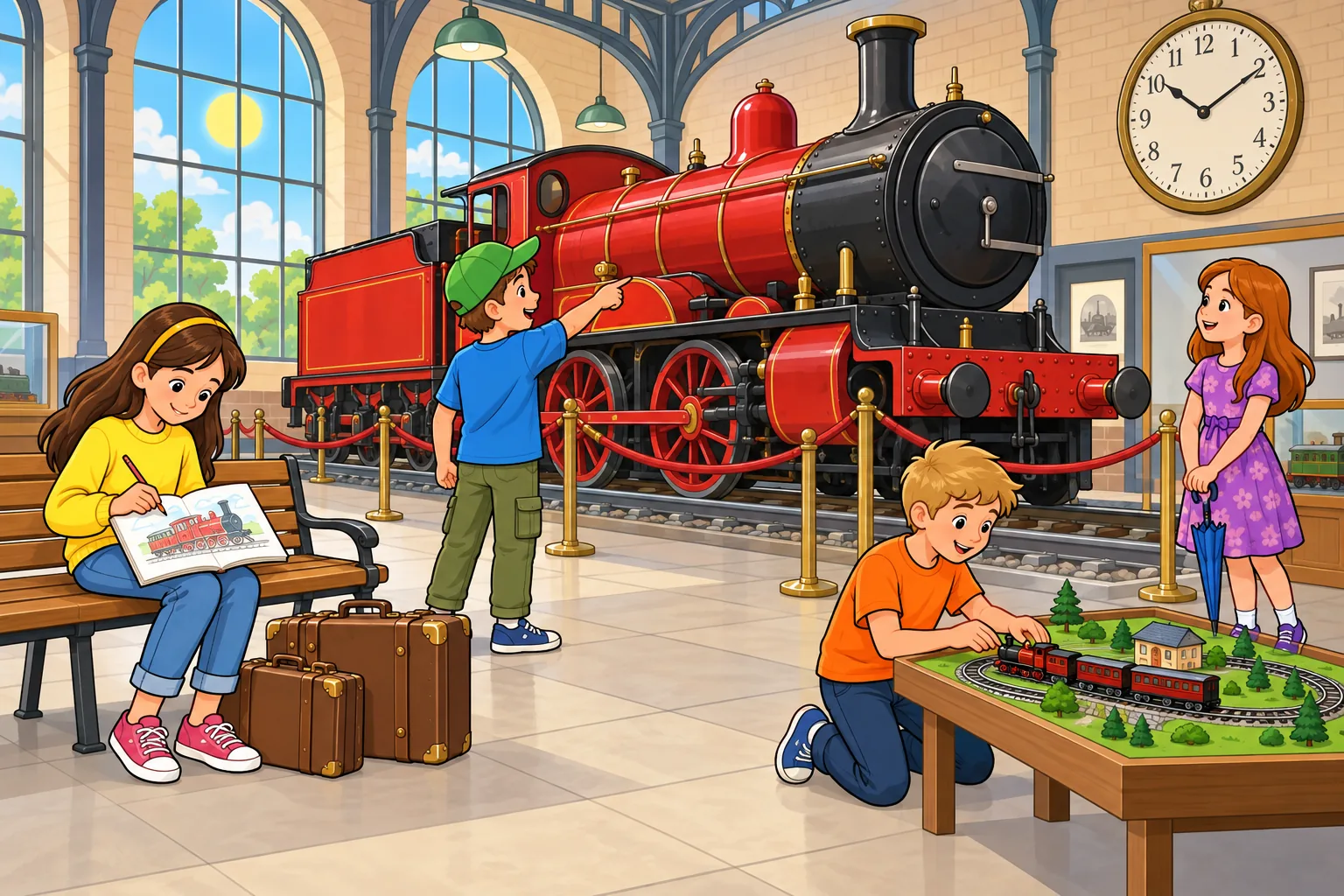
Eva wears a yellow jumper; Noah wears a green cap and blue shirt; Zoe wears a purple dress; Max wears an orange shirt.
Example: The red engine is behind a safety rope. → Yes
11. Eva is sitting on the bench and drawing in an open sketchbook.
12. Noah is standing in the centre and pointing at the engine.
13. Zoe is holding an open blue umbrella.
14. Max is kneeling beside the small model train table.
15. The large clock above the engine is square.
16. There are exactly two brown suitcases beside the bench.
17. The window shows a rainy sky outside.
Part 3 · 5 questions
Choose the best response
Read the conversation and choose the best response from the box. Each response is used once. There is one example. Two responses are not needed.
Mia and Leo are visiting the railway museum together. Choose Leo's reply to each question. Reply C is used in the example.
Choose a reply
- Let's sit at the cafe near the garden.
- The guide will meet our group at the main door.
- You can hang it on the pegs beside the entrance.
- A small postcard for my sister.
- I came here by bus.
- The room upstairs has them.
- It runs every twenty minutes.
- Yes, there are pencils by the window.
Example: Mia: Where can I leave my coat? → You can hang it on the pegs beside the entrance.
18. Mia: How often does the model train run?
19. Mia: Where can we see the old photographs?
20. Mia: Is it all right if I draw the engine?
21. Mia: What did you get in the museum shop?
22. Mia: Shall we have something to eat now?
Part 4 · 6 questions
Read and complete the story
Read the text and choose a word from the box for each space. There is one example. Four words are not needed. Then choose the best title.
On Saturday, the Patel family arrived (example) at the railway museum just after ten o'clock. They left their coats in a locker and followed a blue line [23] the floor to the main hall. A volunteer gave them a map and explained where the children's activities were. First, they looked at a collection of [24] signs from old stations. All the signs were made from pieces of wood, and each had a different shape and colour. Then they [25] that a small brass bell was missing from the display case, so they told the volunteer. She checked her list and found that it was being cleaned in another room. After lunch, the children used pencils to label their own drawings. They worked [26], checking the spelling and size of every word, because they wanted their letters to fit neatly underneath each picture. Before going home, they bought two [27] for the afternoon model-train ride and thanked the volunteer for helping them.
Example: On Saturday, the Patel family ___ at the railway museum just after ten o'clock. → arrived
28. Choose the best title for the text.
Part 5 · 7 questions
Read the story and complete the sentences
Read the story. Complete each sentence with one, two, three or four words. There is one example.
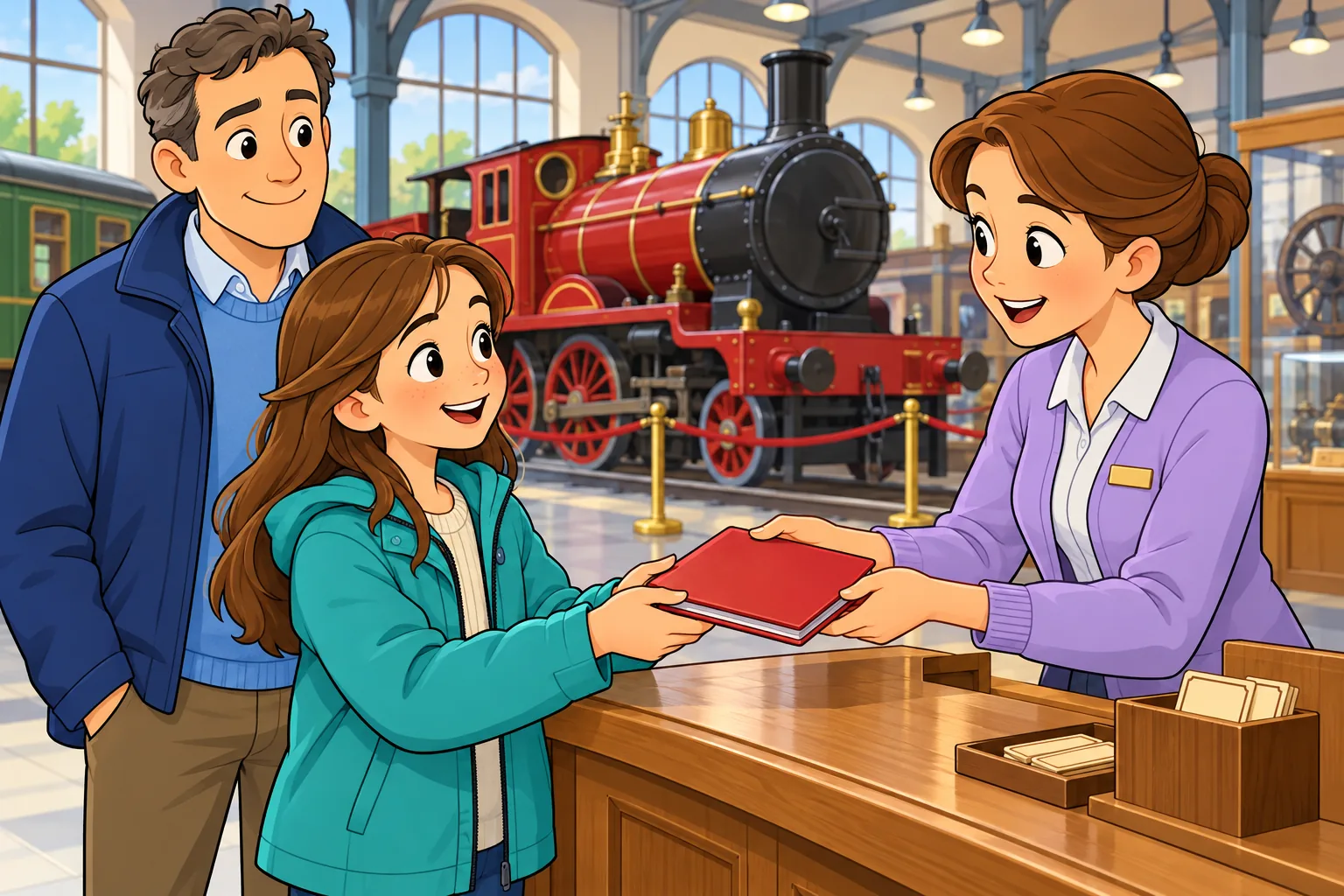
Lucy Finds Her Sketchbook
Lucy visited the railway museum with her uncle on Sunday. She carried a red sketchbook because she wanted to draw the old trains. In the first hall, she sat near a large window and sketched the wheels of a blue carriage. Her uncle suggested that they visit the model railway room next. Lucy put her sketchbook on a bench while she packed away her pencils. Then she followed her uncle to the next room, where a tiny blue train was moving around a track.
After watching it travel around the track, they went upstairs to see photographs of the museum. Lucy took out her camera, but she could not find her sketchbook in her bag. She remembered leaving it on the bench downstairs. Her uncle went to ask at the information desk while Lucy waited by the wooden ticket desk. A few minutes later, a woman guide came over with the red book in her hands. Another visitor had found it and given it to her. Lucy thanked the guide and checked that her drawing was safe. Before leaving, she added a picture of the model train to the last page. She was pleased that someone had returned her sketchbook.
Example: Lucy went to the railway museum with her ___. → uncle
29. Lucy carried a red ___ because she wanted to draw the trains.
30. In the first hall, Lucy drew the wheels of a blue ___.
31. Lucy left her sketchbook on a ___.
32. Lucy could not find her sketchbook in her ___.
33. Lucy waited by the wooden ___.
34. Another visitor had found the book and given it to the ___.
35. Before leaving, Lucy added a picture of the model ___.
Part 6 · 10 questions
Choose the correct word
Read the text and choose the correct word for each space. There is one example.
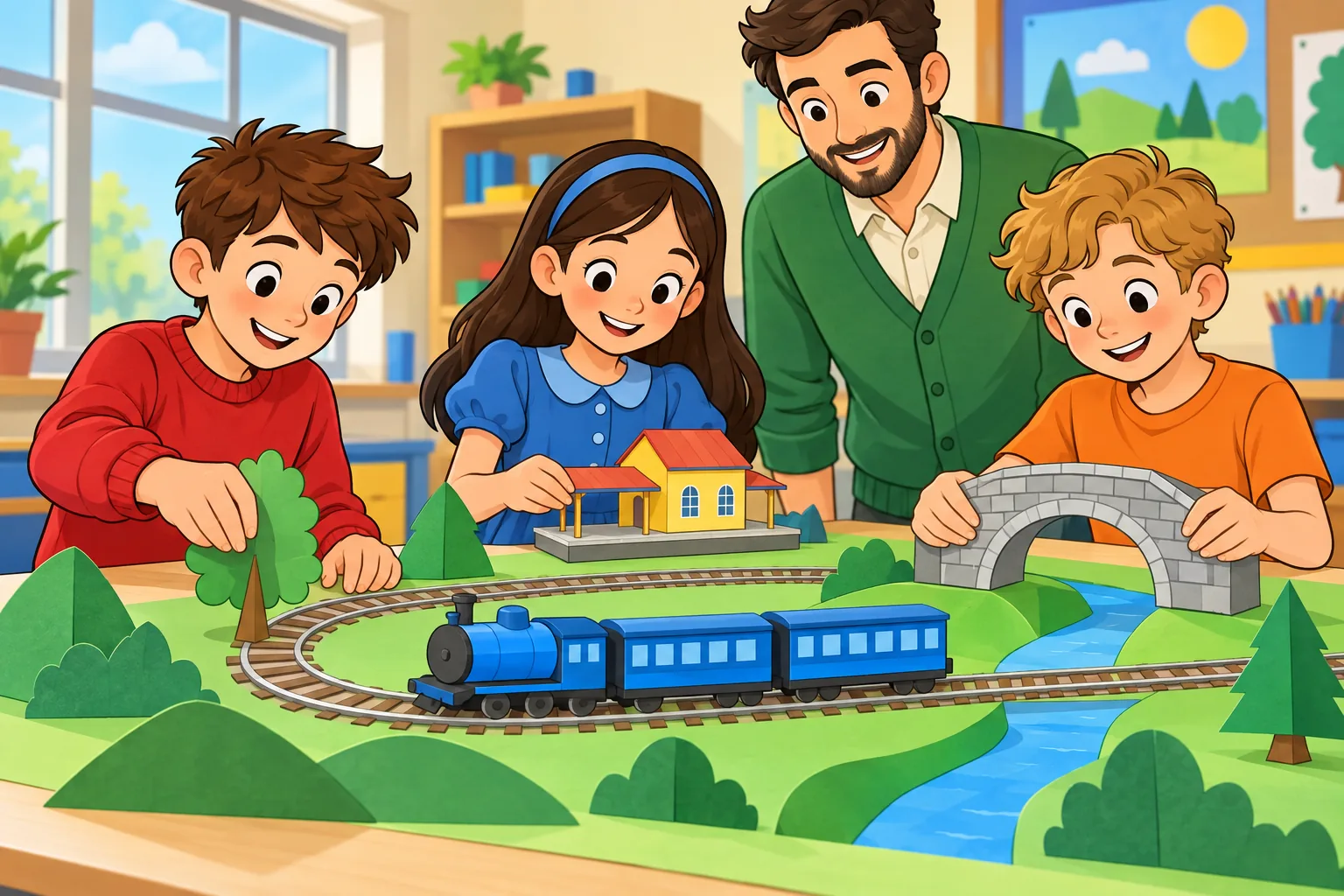
For their museum visit, the children made a railway scene on (example) a table. They [36] their project after lunch yesterday. Sam, [37] was wearing a red jumper, placed a paper tree beside the track. There [38] a yellow station near the bridge, and Mia held it carefully. The children brought [39] own coloured paper from home. Leo chose [40] grey sheet for the bridge because it looked like stone. Their teacher asked them to work [41] so that the pieces would not fall over. Mia's station was [42] than the one in their first drawing, with enough room for two extra doors. When the model was ready, the children [43] a blue train along the track. They were proud [44] the finished landscape and showed it to another class. Next week, they [45] make a small paper tunnel for the train. Everyone has an idea for a new part, so the group is looking forward to meeting again.
Example: For their museum visit, the children made a railway scene ___ a table. → on
Part 7 · 5 questions
Complete the text
Read the text and write one word in each space. There is one example.
We went to (example) the railway museum on Sunday. My cousin and I were both interested [46] trains, so our aunt planned the visit as a surprise. We stopped beside a red engine which was bigger [47] the blue one near the entrance. A guide showed us its wheels and answered our questions. I used my pencil [48] draw the engine in a notebook. There were lots [49] interesting maps on the wall of the next room. My cousin found the name of our town on one of them. We thanked our aunt [50] bringing us to such an exciting place. Before leaving, we sat in the cafe and shared a cheese sandwich. My cousin chose a postcard to take home. I showed my drawing to the guide, who smiled and said that I had remembered all the wheels. We would like to return with our friends during the next school holiday.
Example: We went ___ the railway museum on Sunday. → to
Ready to check your answers?
Submit to grade your whole test, OR use 👁 Show Answer per part / per question.
Learn from your answers
Answer reasons
- passenger — A passenger travels in a vehicle without driving it.
- suitcase — A suitcase is a case for carrying clothes when travelling.
- engine — The engine provides the power that moves the train.
- museum — A museum displays objects that people can study and learn about.
- guide — A guide shows visitors around and gives information.
- corner — A corner is the place where two walls meet.
- ticket — A ticket gives permission to make the journey.
- postcard — A postcard has a picture and can be sent through the post.
- entrance — An entrance is the way into a building.
- journey — A journey is a trip from one place to another.
- Yes — Eva is seated on the bench with her open sketchbook and is drawing.
- Yes — Noah stands in the centre and points towards the red engine.
- No — Zoe holds a closed blue umbrella.
- Yes — Max is kneeling next to the model train table at the front right.
- No — The clock above the engine is round.
- Yes — The picture shows two brown suitcases beside the bench.
- No — The window shows a sunny sky.
- It runs every twenty minutes. — The question asks how frequently the train runs, and this response gives an interval.
- The room upstairs has them. — The response identifies the room where the photographs can be seen.
- Yes, there are pencils by the window. — It answers Mia's request positively and tells her where to find pencils.
- A small postcard for my sister. — This response names an item bought at the shop and says who it is for.
- Let's sit at the cafe near the garden. — The reply agrees and suggests a place to eat.
- across — A line that goes from one part of the floor towards another can run across it.
- wooden — The next sentence says the signs were made from pieces of wood, so wooden describes their material.
- noticed — They became aware that the bell was not in the display case.
- carefully — The children check the spelling and size of every word, so they work carefully. Noisy and empty are adjectives, not suitable adverbs here.
- tickets — Tickets are what the family bought to take the ride.
- A Saturday at the Railway Museum — The text describes the family's activities during their Saturday visit to the railway museum.
- sketchbook — She brought the red sketchbook to draw the old trains.
- carriage — The first drawing was of the wheels of a blue carriage.
- bench — She put it on a bench while she packed her pencils away.
- bag — Upstairs, she noticed the sketchbook was not in her bag.
- ticket desk — She waited beside the wooden ticket desk while her uncle asked for help.
- guide / woman guide — The story says another visitor found the sketchbook and gave it to the woman guide.
- train — She drew the model train on the last page before leaving.
- started — Yesterday indicates past time, so the past form started is needed.
- who — Who refers to Sam, a person.
- was — The passage describes yesterday, and the station is singular, so was is correct.
- their — Their is the possessive determiner needed before own coloured paper.
- a — Grey begins with a consonant sound and sheet is a singular countable noun, so a is correct.
- carefully — Carefully is the adverb describing how the children should work.
- bigger — Than introduces a comparison between two stations, so use the comparative bigger.
- moved — The completed activity happened when the model was ready, so the past form moved fits.
- of — The standard expression is proud of something.
- will — Next week refers to the future, so will make is correct.
- in — The expression is interested in something.
- than — Use than after a comparative such as bigger.
- to — The infinitive to draw explains what the pencil was used for.
- of — The quantity expression is lots of.
- for — Thank someone for doing something uses for before the gerund.
Teacher tip
Ask learners to read the whole text before choosing an answer. In the picture task, have them point to visible details before deciding whether each statement is true.