
Flyers 2 – Test 2 Reading & Writing
100% Original Practice Test
An original A2 reading and writing practice test about children preparing handmade models for a miniature-town exhibition. This A2 reading & writing practice has 7 parts and 50 questions. Complete each part, then submit to grade your work or use Show Answer to review.
Learning guide
Level: A2.
Topic: Making Models for a Miniature Town
Learning objectives
- Understand everyday words about making, displaying and visiting handmade models.
- Read details in an illustrated miniature-town workshop scene.
- Choose suitable replies in a conversation about an exhibition.
- Use context to complete short descriptions, stories and messages.
- Recognise common A2 grammar in a text about preparing exhibition tickets.
Before you start: Learners can read familiar A2 vocabulary, follow short conversations and stories, and use common present and past forms, pronouns, comparatives and prepositions.
Teacher tip: Read each full sentence before choosing an answer. In the picture task, check the named clothing and visible action, then locate the stated object or position.
Reading & Writing strategy: Read the instructions and example first. Use picture details and nearby words as clues, reread the whole sentence, and check spelling before submitting.
Part 1 · 10 questions
Choose the right word
Read each definition and choose a word from the box. There is one example. Four words are not needed.
Example: A paper that lets you enter a show is a ___. → ticket
1. A person who comes to see a place or event is a ___.
2. To make a house, bridge or tower by joining pieces together is to ___ it.
3. The place where people go in is the ___.
4. If you make a plan for how something will look, you ___ it.
5. To fix something that is broken is to ___ it.
6. A large group of people standing together is a ___.
7. If you feel happy about what you have done, you feel ___.
8. A chair made from wood can be described as ___.
9. To take something for a short time and give it back later is to ___ it.
10. In a way that is not noisy means ___.
Part 2 · 7 questions
Look and read
Look at the picture. Read the sentences and choose Yes or No. There are two examples.
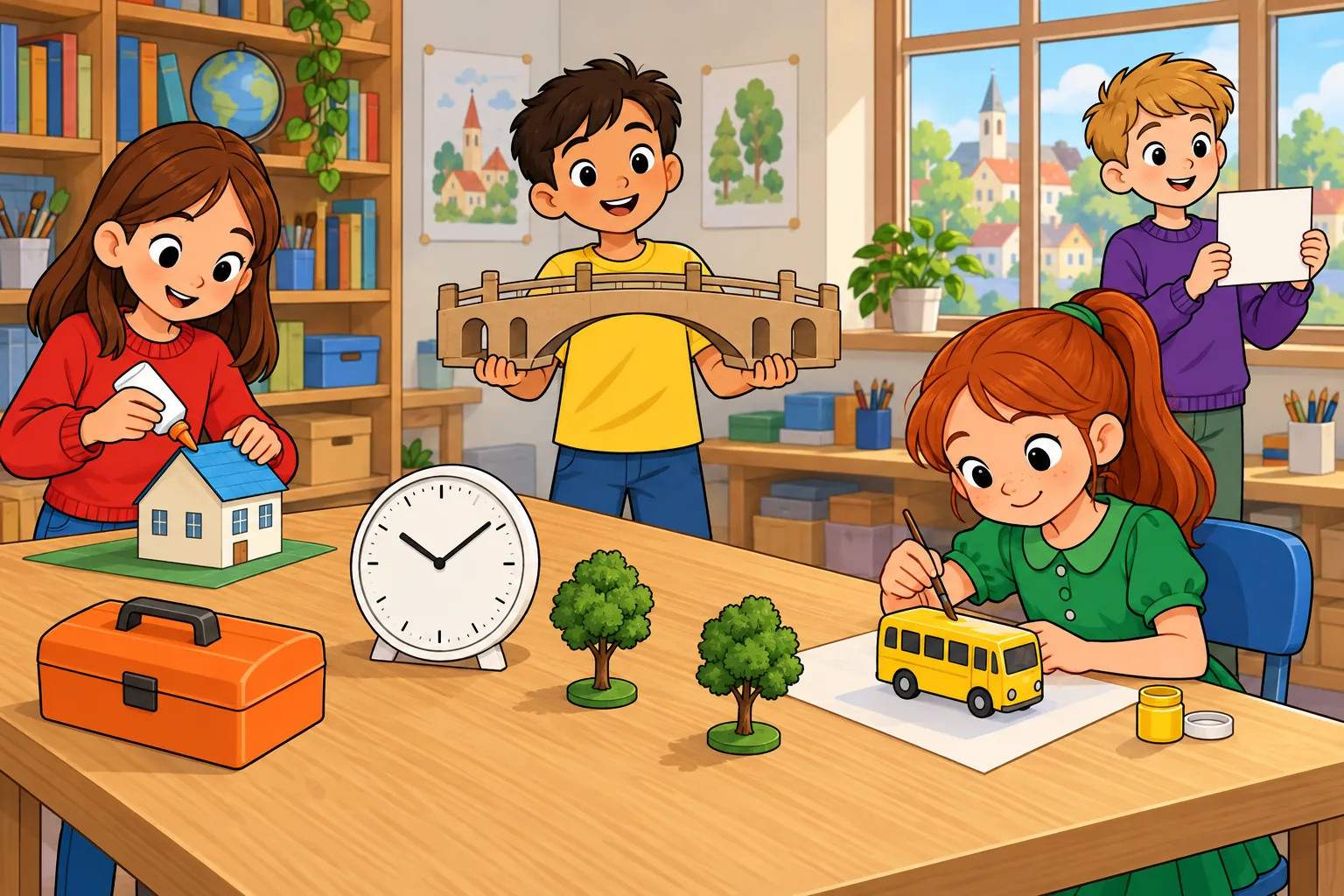
Names: Ada wears the red sweater; Leo wears the yellow T-shirt; Mina wears the green dress; Toby wears the purple sweater.
Example 1: Ada is wearing a red sweater. → Yes
Example 2: Leo is holding the bridge vertically. → No
11. Ada is using a bottle of glue beside a model house.
12. Leo is holding the cardboard bridge with one hand.
13. Mina is sitting on a blue chair while she paints.
14. Toby is holding a white card with both hands.
15. The orange toolbox is open.
16. Two small model trees are standing on the table.
17. The tall bookshelf is beside the window on the right.
Part 3 · 5 questions
Choose the best reply
Read the conversation. Choose the best reply from the box for each question. There is one example. Two replies are not needed.
Nora and Ben visit a miniature-town exhibition. Nora asks about the models and activities. Choose Ben's reply. Each reply is used once. The opening-time reply is used in the example; two replies are not needed.
Choose a reply
- I came with my aunt this morning.
- We can build a little house after lunch.
- The one with the red roof is my favourite.
- It opened at ten o'clock today.
- You can buy a ticket near the front door.
- I like making things from cardboard.
- The model river goes under the stone bridge.
- We are leaving when the exhibition closes.
Example: Nora: What time did the exhibition open? → It opened at ten o'clock today.
18. Nora: Which model do you like best?
19. Nora: Where can I get a ticket?
20. Nora: What material do you enjoy using?
21. Nora: What will we do in the workshop?
22. Nora: Where does the model river go?
Part 4 · 6 questions
Read and complete the story
Read the text and choose a word from the box for each space. There is one example. Four words are not needed. Then choose the best title.
The children were careful (example) as they carried their models into the hall. Ella had [23] a blue cloth from her neighbour to cover the display table. Ella promised to return it after the show. It was long enough to reach the floor on both sides. Max put a small wooden house in the middle. He had [24] its front door bright green the night before. Their teacher checked the house, but one little window was [25], so Max used a new piece of clear plastic. The class [26] their families to come and see the town on Saturday. On the morning of the show, the hall was still [27], with no sound except soft footsteps, and the children had time to put up the signs. Soon the first visitors arrived. Ella showed them the tiny houses, while Max explained how the bridge was made. At the end of the day, the children packed their work into boxes and thanked everyone who had come.
Example: The children were ___ as they carried the models. → careful
28. Choose the best title for the text.
Part 5 · 7 questions
Read the story and complete the sentences
Read the story. Complete each sentence with one, two, three or four words. There are two examples.
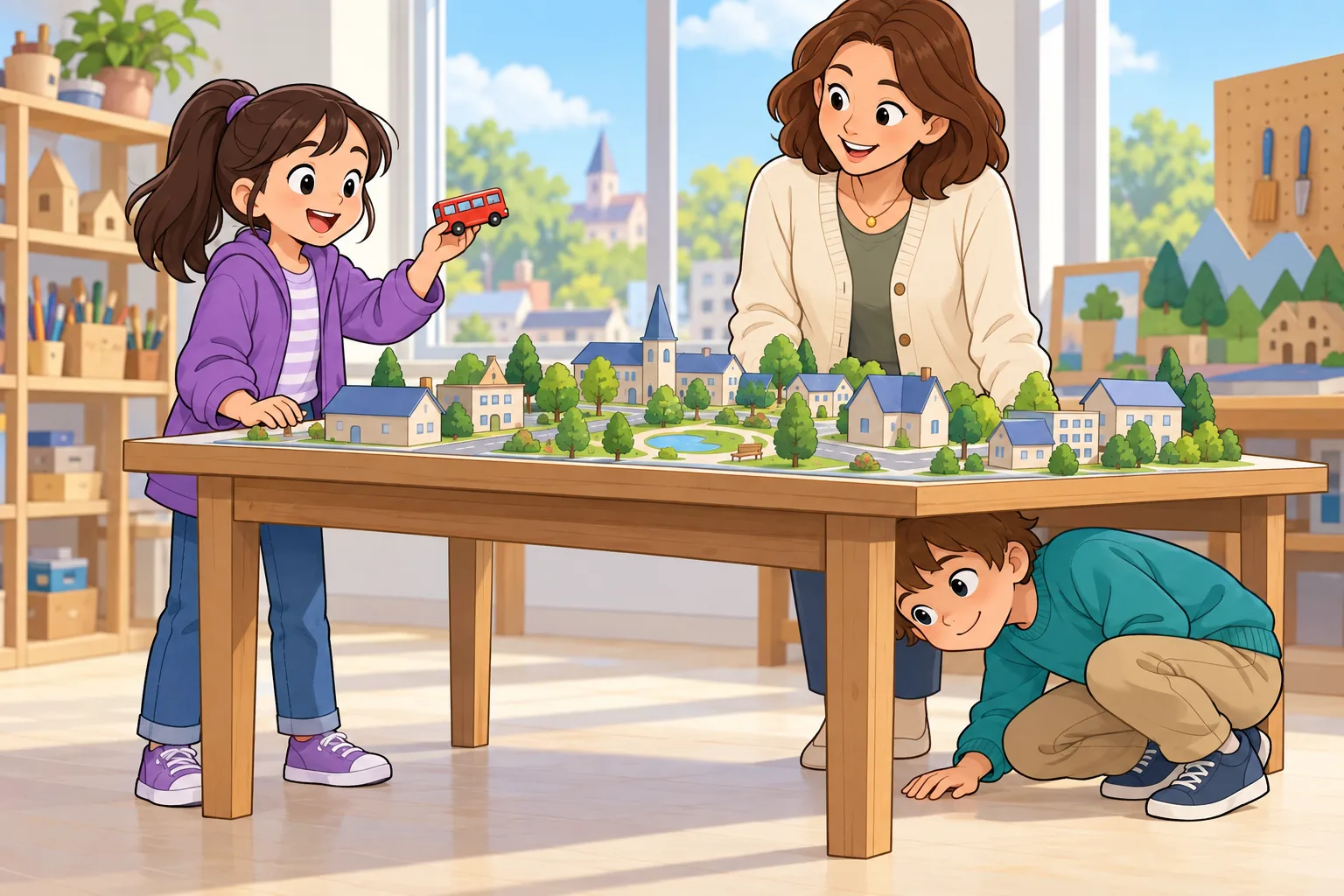
The Little Red Bus
On Friday afternoon, Mia and her friends stayed after school to finish their miniature town. Their teacher, Mrs Green, had asked them to make a model for the spring exhibition. Mia made a tiny red bus from a small cardboard box. She painted it carefully and added four black wheels. The bus was the last thing she put beside the model town before the bell rang.
The next morning, Mia returned to the workshop with her brother Sam. The cardboard town was still on the table, with blue-roofed houses around a green park. But the little bus had disappeared. Mia looked behind the houses and inside the box of spare paper. Sam checked the shelf near the door. They could not see it anywhere.
Mrs Green came in carrying a roll of green paper. She asked the children to look calmly before they moved anything. Sam crouched down and looked under the table. At first he saw only a bag and a pair of old shoes. Then he noticed a small red corner behind one table leg. He reached carefully and pulled out the model bus.
"It must have rolled off the table yesterday," Mia said. She was pleased that it was safe. Mrs Green smiled and helped her make a low cardboard barrier for the edge of the display. Mia put the bus back beside the park. On Monday, visitors could see it parked on the little road through town.
Example 1: Mia made the bus from a small cardboard ___. → box
Example 2: The bus had four black ___. → wheels
29. Mia and her friends stayed after school on ___.
30. The exhibition was going to be in ___.
31. Mia painted the little bus ___.
32. Sam looked on the shelf near the ___.
33. Mrs Green was carrying a roll of ___ paper.
34. Sam found the bus behind ___.
35. Mrs Green helped Mia make a ___ for the edge of the display.
Part 6 · 10 questions
Choose the correct word
Read the text and choose the correct word for each space. There is one example.
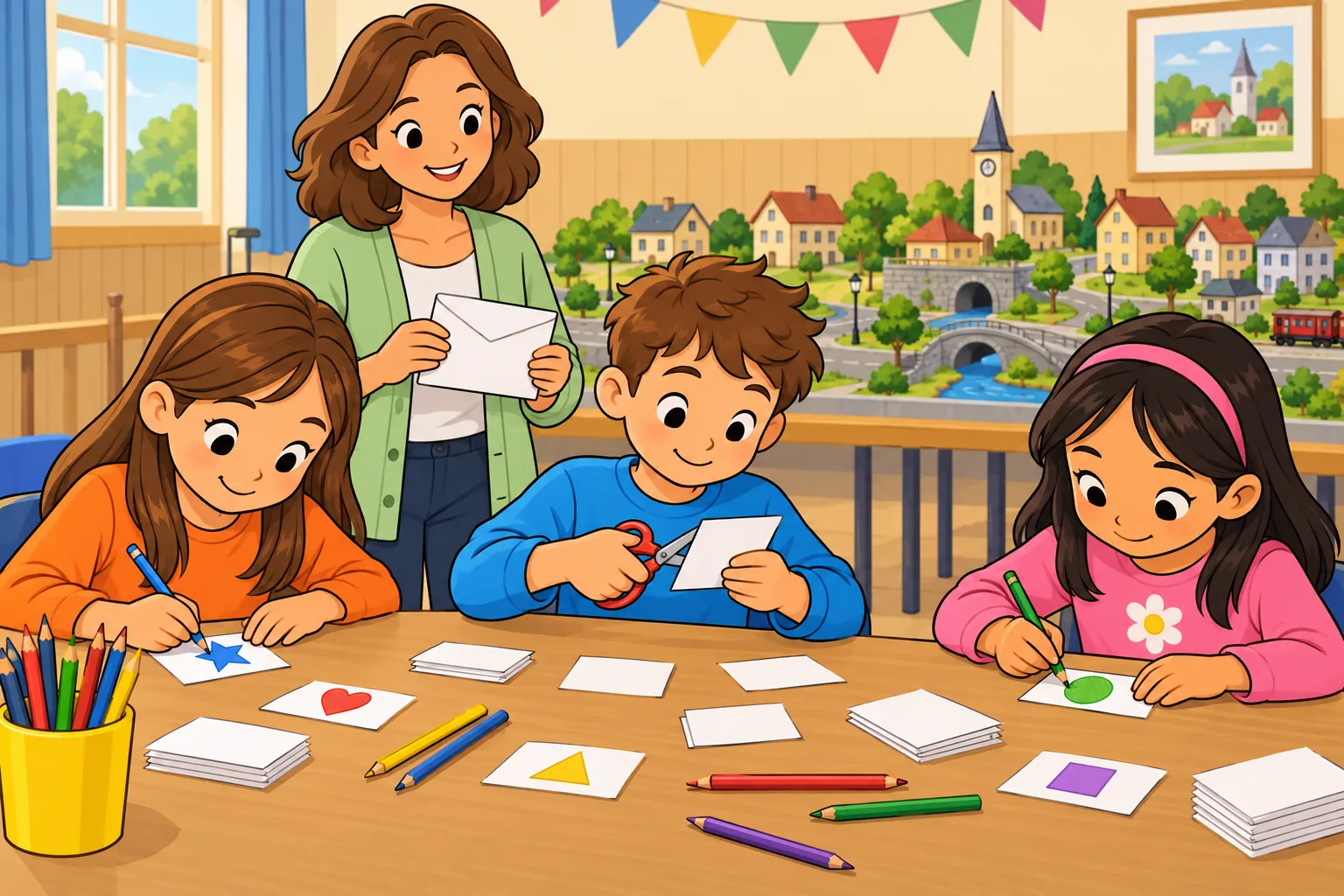
We are making tickets for (example) the exhibition this week. Yesterday our class [36] the paper into small rectangles. I chose a blue pencil because its colour [37] easy to see on the white card. My friend Jo, [38] sits beside me, drew a tiny house on her ticket. We [39] already finished the first box of tickets, but there are more to make. Each visitor [40] one ticket at the door. Our teacher asked us to work [41] so that the pictures would not smudge. The new tickets look [42] than the first ones we made. We have some spare paper, [43] we can make a few extra tickets. I will [44] the finished cards in a clean envelope. On Saturday, the doors [45] at ten o'clock, and the families can come in. We will count every ticket before the doors open, then leave the spare cards in a box near the entrance for the helpers to use.
Example: We are making tickets ___ the exhibition. → for
Part 7 · 5 questions
Complete the text
Read the text and write one word in each space. There is one example.
Dear Lily,
We are ready for (example) the exhibition now. Dad and I are both helping at the hall. I went there [46] him this morning to set up our display. There [47] two tiny buses parked beside the green park. We made a small river, [48] is crossed by a cardboard bridge. I am very happy [49] our model town has won a prize. I made a paper sign, but I forgot [50] bring the blue pens, so Dad went back to get them. We have put chairs by the door for visitors. I hope you can come after lunch. My class will show everyone how we made the models, and then we can look around together. Let us meet beside the front desk before we see the other displays.
See you soon, Alex
Example: Dear Lily, We are ready ___ the exhibition. → for
Ready to check your answers?
Submit to grade your whole test, OR use 👁 Show Answer per part / per question.
Learn from your answers
Answer reasons
- visitor — A visitor is someone who comes to a place, often to look around.
- build — Build means to make a structure by putting pieces or materials together.
- entrance — An entrance is a way into a building or area.
- design — To design something is to plan its look or shape.
- repair — Repair means to mend or fix something.
- crowd — A crowd is a large group of people in one place.
- proud — Proud describes the happy feeling you have about an achievement.
- wooden — Wooden is the adjective that means made of wood.
- borrow — Borrow means to use something for a while and return it.
- quietly — Quietly means with little or no noise.
- Yes — Ada holds the glue bottle beside the little house with the blue roof.
- No — Leo holds the large bridge with both hands.
- Yes — Mina is seated on the blue chair and painting the model bus.
- Yes — The boy in the purple sweater stands by the window holding a plain white card with both hands.
- No — The single orange toolbox on the table is closed.
- Yes — Two small green model trees are visible on the tabletop.
- No — The bookshelf is on the left; the window is on the right wall.
- The one with the red roof is my favourite. — Ben names the model he likes best.
- You can buy a ticket near the front door. — This reply tells Nora where tickets are sold.
- I like making things from cardboard. — Ben says which material he enjoys using.
- We can build a little house after lunch. — Ben explains an activity they can do in the workshop.
- The model river goes under the stone bridge. — Ben tells Nora where the river passes.
- borrowed — Ella got the cloth from her neighbour and promised to return it, so she borrowed it.
- painted — Painting changes the colour of the door, and the sentence gives a finished past action.
- broken — The damaged window needed replacing, so broken fits.
- invited — To invite people is to ask them to come to an event.
- quiet — Only soft footsteps can be heard, so quiet describes the hall.
- The Class Miniature Town Show — The passage follows the children as they prepare and present their miniature town.
- Friday afternoon / Friday — The opening sentence gives Friday afternoon; Friday also correctly identifies the day.
- spring — Mrs Green asked them to make a model for the spring exhibition.
- carefully — The story says she painted it carefully.
- door — Sam checked the shelf near the door.
- green — She entered carrying a roll of green paper.
- one table leg / a table leg / the table leg — Sam noticed a red corner behind one table leg and pulled the bus out from there.
- low cardboard barrier / cardboard barrier / low barrier / barrier — They made a low cardboard barrier along the edge; each accepted phrase identifies that barrier correctly.
- cut — Yesterday signals past time; cut is the past form of cut.
- is — Its colour is a singular subject, so use is before easy to see.
- who — Who is the relative pronoun used for a person.
- have — Have finished is the present perfect form with we.
- gets — Each visitor is singular, so the present simple verb takes -s.
- carefully — Carefully is an adverb describing how the children should work.
- neater — Than signals a comparison; neater is the comparative form of neat.
- so — So introduces the result of having spare paper.
- put — Will is followed by the base form put.
- open — A timetable can use present simple; plural doors take open.
- with — Dad and Alex go together to help, so with shows who accompanies Alex.
- are — The letter describes the display now. Two buses is plural, so use there are.
- which — Which introduces extra information about the river after a comma; that is not used in this kind of clause.
- because / that / as / since — Because, as and since give the reason for being happy; that also introduces the fact that makes Alex happy.
- to — Forget to do something means not remember to do it.
Teacher tip
Read each full sentence before choosing an answer. In the picture task, check the named clothing and visible action, then locate the stated object or position.