

Cambridge Flyers 2 Test 2 Listening
100% Original Practice Test
The Riverside Inventors' Fair · A2 listening practice with five Parts and 25 questions. Listen to each Part twice, match names, write details, choose picture answers and colour five kites. Submit to grade your attempt; use Show Answer and the transcripts to review.
Learning guide
Level: A2 Flyers · ages 9–12
Topic: The Riverside Inventors' Fair: children, workshop bookings and simple projects
Learning objectives
- Identify people in a busy scene from names, clothes and actions
- Record spelled names and practical booking details
- Match children to the things they made or activities they chose
- Follow short conversations in which a speaker changes a plan
- Follow colour and position instructions and identify five outlined kites.
Before you start: Look at all five Parts before playing the recording. Read the names, form labels and picture options. Each Part is played twice. Choose colours only after you have identified the correct kite.
Teacher tip: Ask learners to explain the action or position clue after their first attempt. Replay one conversation and compare the first suggestion with the final choice. Encourage learners to check a spoken spelling before submitting.
Listening strategy
Names and details
Use clothing and action together in Part 1. In the booking form, listen for the spelled surname, number of places, final start time, day and room.
Matching and picture choices
Match each child to the project they finished. Listen to the whole conversation in Part 4: the first idea may change. Check the final choice before selecting A, B or C.
Colour and review
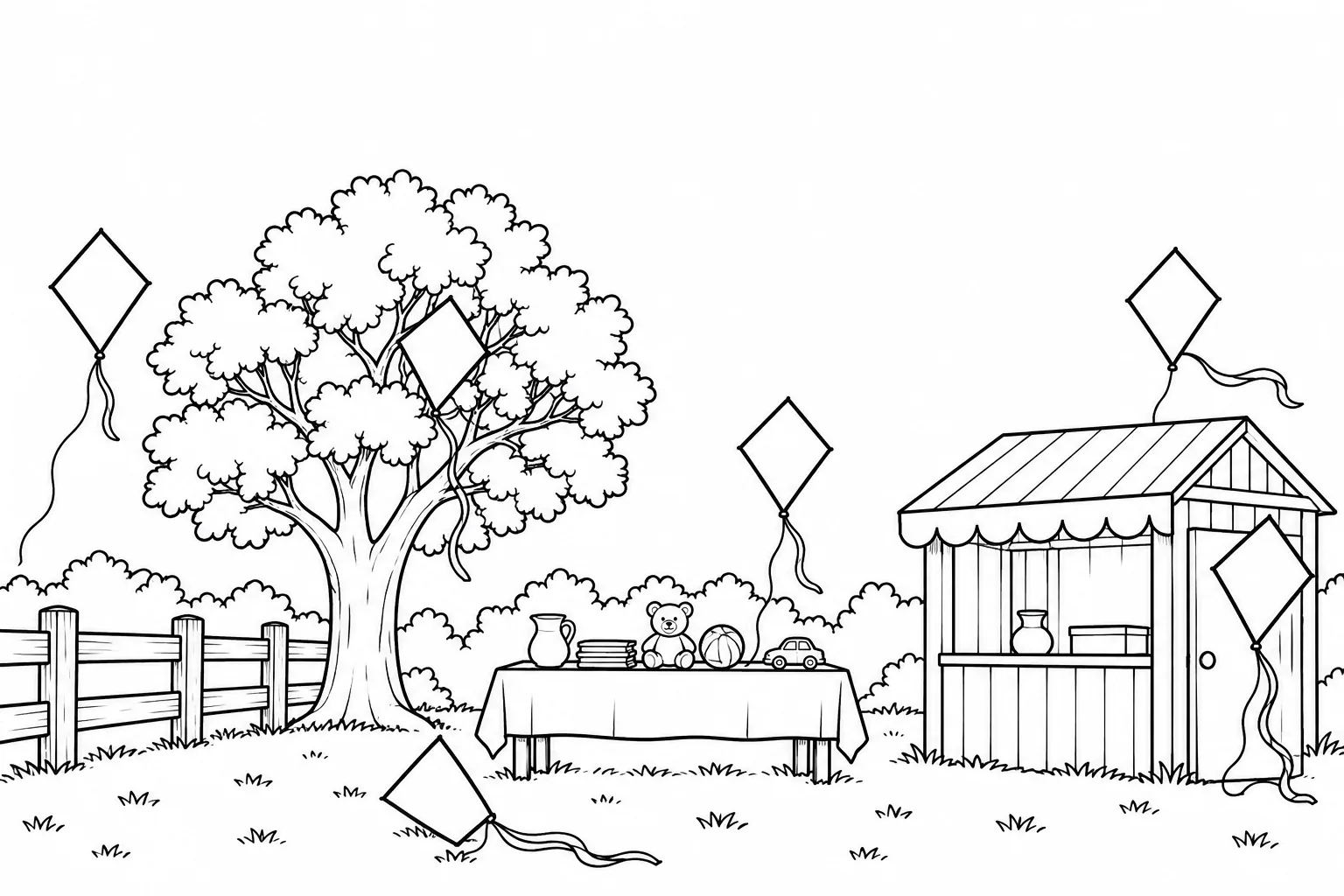
Locate the fence, tree, table, roof, ground and door before choosing a kite. The blue kite is the example. Colour the other five kites as instructed. Show Answer displays the completed key without filling your work or giving marks.
🎧 Audio – Flyers 2 Test 2 Listening
Listen and draw lines
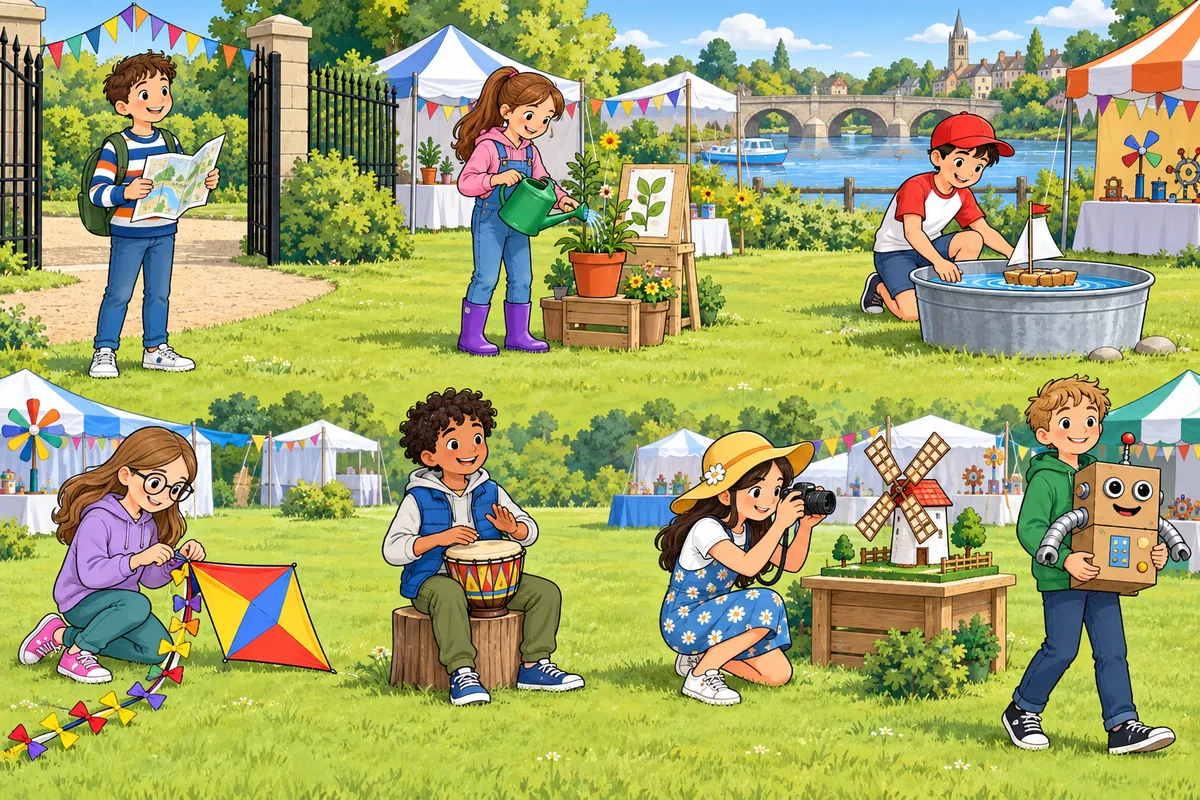
Listen and draw lines between the names and the children at the riverside fair. There is one example.
Narrator: Part One. Look at the picture. Listen and draw lines. There is one example.
Woman: Alex is at the entrance on the left. He is wearing a striped jumper and holding the fair map.
Narrator: Can you see the line? This is an example. Now you listen and draw lines.
Woman: Find Holly near the top middle. She is wearing purple wellington boots and watering a small plant.
Child Girl: I can see the water coming from her little can.
Woman: William is at the top right. He has a red cap and is testing a small toy boat in a tub.
Child Boy: It is a very small boat.
Woman: Look at Katy at the bottom left. She is wearing glasses and tying a long tail onto a kite.
Child Girl: The kite is ready to fly when she finishes.
Woman: Robert has curly hair and a blue waistcoat. He is playing a hand drum near the bottom middle.
Child Boy: I can hear the drum from here.
Woman: Emma is at the bottom right middle. She has a yellow hat and is photographing the windmill model.
Narrator: That is the end of Part 1.
Listen and write a word or a number
Complete the workshop booking form with the details you hear. There is one example.
📝 Listen and write
Narrator: Part Two. Listen and write. There is one example.
Child Girl: Hello. I'd like to book places at the paper-boat workshop. My first name is Ellie.
Narrator: Can you see the answer? Now you listen and write.
Woman: Could you spell your surname, please?
Child Girl: Yes. Parker. P-A-R-K-E-R.
Woman: How many places would you like?
Child Girl: Four, please. That's one for me, my brother and my two friends.
Woman: There are two workshops: one starts at ten thirty, and the other starts at quarter to eleven. Which would you like?
Child Girl: The first one is too early for us. Please book the quarter-to-eleven workshop.
Woman: Of course. Ten forty-five. Which day are you coming?
Child Girl: Sunday, please. My dad is free then.
Woman: The paper boats are made in the Big Hall.
Child Girl: I saw that on last year's leaflet. The new fair map says Riverside Room. Is that the right place this year?
Woman: Yes, it is. The Riverside Room is beside the little bridge.
Child Girl: Great. Thank you.
Narrator: That is the end of Part 2.
Match each child to a project
Which project did each child make? Look at pictures A–H and choose a letter. There is one example.
Narrator: Part Three. Listen and write a letter in each box. There is one example.
Woman: Daisy, what did you make at the fair?
Child Girl: A pinwheel. I folded the green and pink paper and put it on a stick.
Narrator: The answer is F. Now you listen and write.
Woman: Daniel, which thing did you make?
Child Boy: I tried making a wooden spoon, but I didn't finish it. My cardboard boat is ready. I folded a paper sail for it.
Woman: Helen, what did you put on your table?
Child Girl: A clear jar. I added blue lines, so we can see how much rain it catches. It's my rain gauge.
Woman: Michael, I can see a little boat beside your bridge. Which one is yours?
Child Boy: The boat belongs to my sister. My project is the bridge. I used two small boxes and a strip of card.
Woman: Vicky, did you make a birdhouse?
Child Girl: No, Oliver made that. I made a wooden spoon, and I painted its handle red.
Woman: Oliver, tell me about your invention.
Child Boy: This is my blue birdhouse. It has a round hole at the front for small birds.
Narrator: That is the end of Part 3.
Listen and tick (✓) the box
Listen to people making plans for the fair. Look at each set of pictures and tick the correct box. There is one example.
Narrator: Part Four. Listen and tick the box. There is one example.
Child Girl: Which kite are you taking, Finn? The yellow one with a long tail?
Child Boy: I thought I would take that one, but its red tail is too long. I'll take the yellow kite with the blue tail.
Child Girl: It will be easier to carry.
Narrator: The answer is B. Now you listen and tick the box.
Woman: Ruby, which kite will you fly today?
Child Girl: I wanted my red kite with the green tail, but the wind is strong. I might take my blue kite instead.
Woman: Do you mean the blue kite with the white tail, or the blue one with the yellow tail?
Child Girl: Yes. I will fly the kite with the yellow tail. I will see it easily above the river.
Woman: Good. Keep both hands on the string near the tent.
Woman: Sam, what are you bringing to sit on?
Child Boy: I packed my folding blue chair, but it is quite heavy. I could take the picnic blanket, though the grass is damp.
Woman: There is also your small wooden stool by the door.
Child Boy: That's true. It is light, and I can carry it easily. I'll bring the stool instead of the chair.
Woman: It will be useful beside the table.
Child Girl: Shall we meet at the bridge gate before we go in?
Child Boy: I thought so, but the gate is busy and lots of families are waiting there.
Child Girl: We could wait by the fair tent, then.
Child Boy: Let's meet at the boat shed. It is blue, and it stands across from the tent.
Child Girl: All right. I'll wait by its door.
Woman: Emma, what will you draw on your windmill?
Child Girl: I planned to cut out a red flower, but I found some yellow paper.
Woman: Would a blue fish look nice? You have blue card too.
Child Girl: It would, but I have enough yellow paper for a sun. I'll draw a yellow sun with short rays around it.
Woman: That will show clearly when the windmill turns.
Woman: Charlie, what will you carry your tools in?
Child Boy: My little green box is too small for everything. I also have a red basket, but the lid won't stay on.
Woman: What about the blue bag you used last week?
Child Boy: It has two pockets, so I'll use that. I can put the small tools in one pocket and the long ones in the other.
Woman: Then you can find them quickly.
Narrator: That is the end of Part 4.
Listen and colour
Listen and colour five kites. Choose a colour, then choose the matching kite. The kite above the left fence is the blue example.
Completed picture – colour answer key
Narrator: Part Five. Look at the fair picture. Listen and colour. There is one example.
Woman: Can you see the kite above the fence on the left? Colour that kite blue.
Child Girl: The kite above the fence?
Woman: Yes. Colour that one blue.
Narrator: That is the example. Now listen and colour.
Woman: Find the kite caught in the tree. Colour that kite red.
Child Boy: The one among the branches?
Woman: Yes, the kite in the tree. Make it red.
Woman: Now look at the display table. There is a kite beside it. Colour that kite green.
Child Girl: The kite floating beside the table, with its string near the toy car?
Woman: That is right. Colour it green.
Woman: Can you see the kite above the booth roof? Colour that one orange.
Child Boy: Above the roof, not beside the door?
Woman: Exactly. Make the kite above the roof orange.
Woman: There is another kite lying on the ground below the tree. Colour it purple.
Child Girl: I can see it on the grass. Purple for that one.
Woman: Finally, find the kite beside the booth door. Colour that kite yellow.
Child Boy: The one next to the door, lower than the roof?
Woman: Yes. Colour that kite yellow.
Narrator: That is the end of Part Five.
🎯 Finished all 25 questions?
Submit to grade your whole test, OR use 👁 Show Answer per part / per question.