
Flyers 2 – Test 1 Reading & Writing
100% Original Practice Test
An original A2 practice test about a seaside town model railway exhibition. This A2 reading & writing practice has 7 parts and 50 questions. Complete each part, then submit to grade your work or use Show Answer to review.
Learning guide
Level: A2.
Topic: The Seaside Model Railway Exhibition
Learning objectives
- Use everyday A2 vocabulary.
- Read picture details and short conversations.
- Complete contextual stories and texts.
Before you start: Learners can read familiar A2 words and use common past and present forms.
Teacher tip: Read the full context and match answers to stated facts.
Reading & Writing strategy: Read the instructions and example first. Use picture details and nearby words as clues, reread the whole sentence, and check spelling before submitting.
Part 1 · 10 questions
Choose the right word
Read the definitions. Write the correct word from the box in each answer space. There is one example. Four words are not needed.
Example: A small copy of a real thing is a ___. → model
1. This is the raised area beside a railway track where passengers wait for a train.
2. You buy this small piece of paper to show that you have paid for a train ride.
3. Travelling from one place to another, for example by train, is a ___.
4. Trains can go across this structure to get over a river or a road.
5. This is the machine at the front of a train that pulls the carriages.
6. The land along the edge of the sea is called the ___.
7. This is a place with platforms where passengers can get on or off trains.
8. A group of objects arranged for people to look at is a ___.
9. This person comes to see a place but does not live or work there.
10. This list shows the times when trains leave and arrive.
Part 2 · 7 questions
Look and read
Look carefully at the picture. Read each sentence and choose Yes or No. There are two examples.
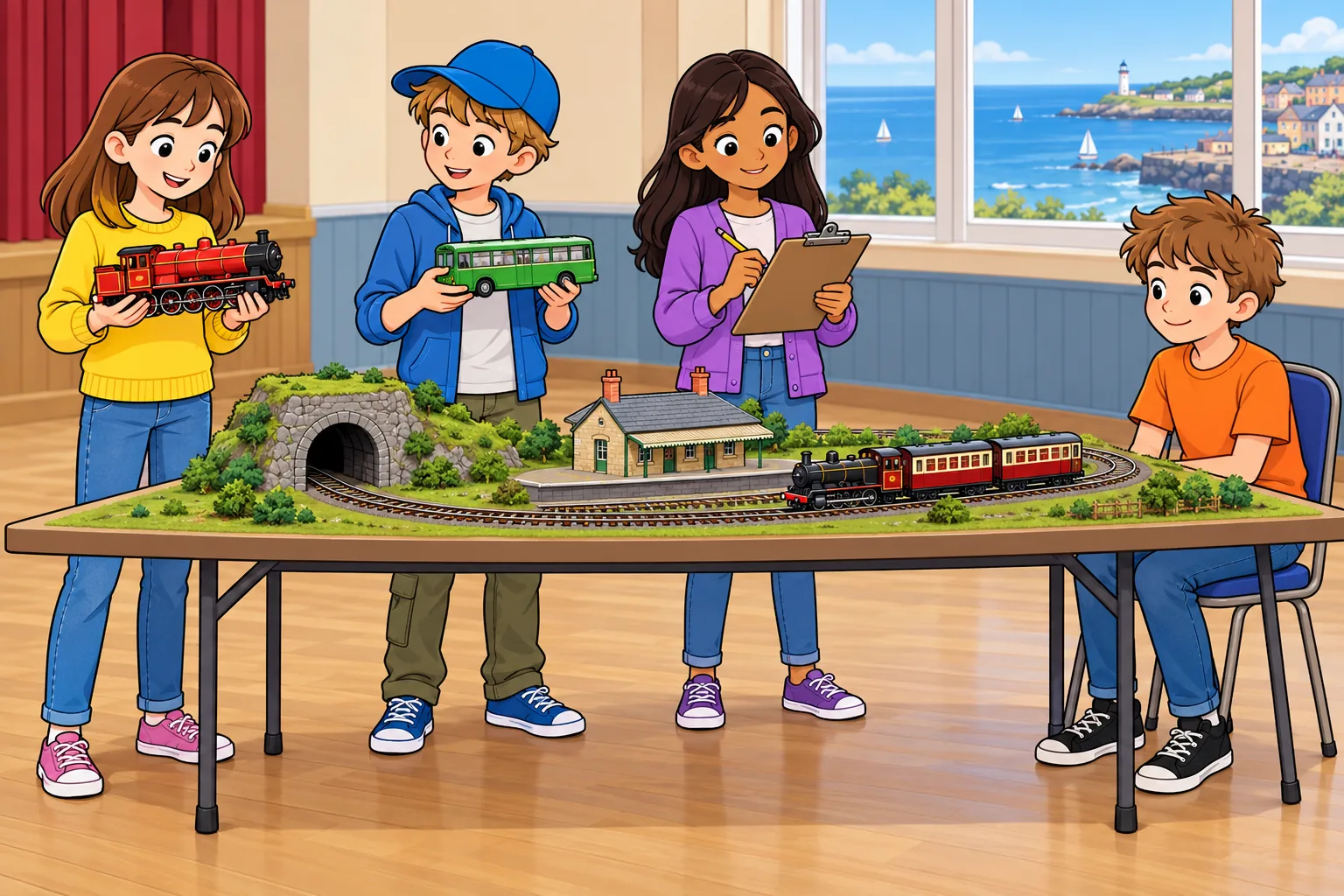
Names: Nora wears the yellow jumper; Leo wears the blue cap; Isha wears the purple cardigan; Max wears the orange shirt.
Example 1: Nora holds a red locomotive. → Yes
Example 2: Leo holds a yellow bus. → No
11. Isha is writing on a clipboard.
12. Max is standing beside the table.
13. There are two tunnels on the model railway.
14. The model station stands on the table.
15. Nora is wearing a red jumper.
16. There is a train on the track beside the station.
17. Leo is wearing a green cap.
Part 3 · 5 questions
Choose the best reply
Read the conversation. Choose Ben’s best reply from A–H for each question. There is one example. Two replies are not needed.
Mia is asking Ben about a model railway exhibition he has visited. Each reply is used once. Reply B is used in the example; two other replies are not needed.
Choose a reply
- We travelled there by bus.
- It is called the Seaview Model Railway Show.
- I bought a sandwich for lunch.
- There are small trains and bridges.
- It closes at five o’clock.
- The blue one is my favourite.
- It is in the old harbour hall.
- I went with my aunt on Saturday.
Example: Mia: What is the exhibition called? → It is called the Seaview Model Railway Show.
18. Mia: Where is it?
19. Mia: Who went with you?
20. Mia: What can we see there?
21. Mia: How did you travel?
22. Mia: When does it close?
Part 4 · 6 questions
Read and complete the story
Read the story. Choose a word from the box for each gap. There is one example. Four words are not needed. Then choose the best title for the story.
On Sunday morning, Ella and her brother arrived (example) early at the harbour hall. They wanted to see an exhibition about the town’s old railway. A volunteer showed them a [23] model of the coast. All its buildings were made from small pieces of wood. There was a station, a pier and some tiny boats. A road went [24] a short tunnel, from its entrance to its other end. Ella stood [25] the display table so she could see the little benches on the platform. Her brother read the map [26], checking every path and turning before they chose where to go. Then the volunteer pressed a button. A little red train moved round the model village and stopped beside the station. The children smiled and said they had [27] the show. Before leaving, they looked at the harbour through the windows. Outside, they compared the model buildings with the real ones across the water.
Example: Ella and her brother ___ early. → arrived
28. Choose the best title.
Part 5 · 7 questions
Read the story and complete the sentences
Read the story and complete each sentence with one, two, three or four words. There are two examples.
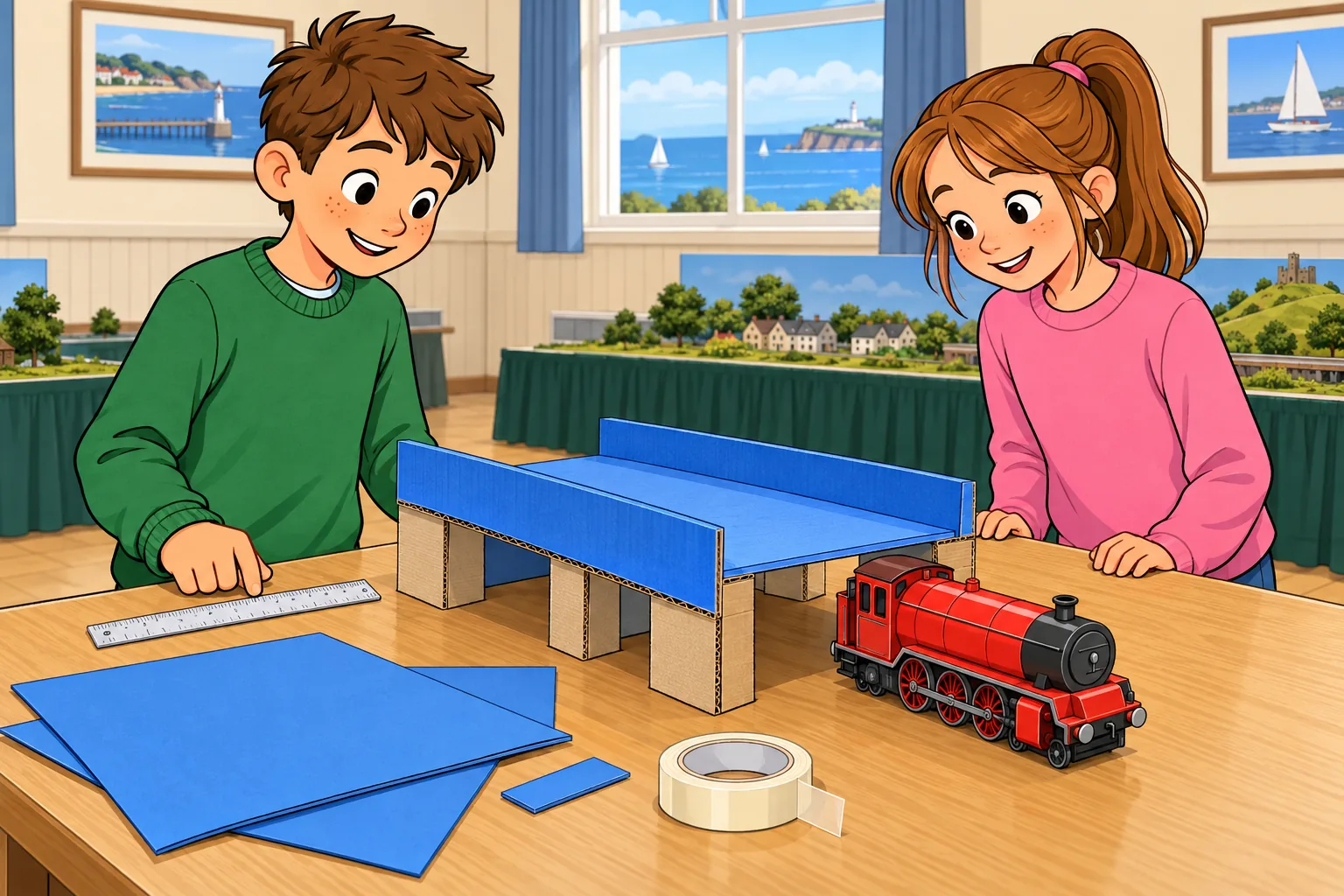
Theo and Poppy’s Blue Bridge
Theo had recently moved to Seaview, a small town beside the sea. He was shy in his new class, but he liked making cardboard models at home. On Friday, his class visited the town’s model railway exhibition. Poppy, who enjoyed building things too, invited him to look at her blue bridge. A red model locomotive stood beside it on the table.
Poppy wanted the locomotive to travel across the top of her bridge. The first blue piece of card was too narrow, so the train could not stay safely on it. Theo suggested using a wider piece of blue card. Their teacher found a ruler and some tape. Poppy measured the new piece, and the teacher cut it for her. They added low blue walls along the sides to help keep the train in place.
The bridge rested on brown cardboard supports. Poppy put the wider piece on top, and Theo checked that it was straight. Then they slowly pushed the red locomotive across the bridge. It reached the other side without falling. Poppy smiled and said she wanted to add a little station at the end of the track.
Theo drew a simple station in his notebook. Poppy liked his idea, and they agreed to work on it together after school. They wrote down the pieces they would need and put the ruler and tape back in the box. Their teacher thanked them for making space for the next group.
On the bus back to school, Theo told Poppy that he had enjoyed the visit. He was glad she had spoken to him, and he now had a friend in his new class. They planned to finish the station model the following week.
Example 1: Theo moved to ___. → Seaview
Example 2: Theo liked making ___ at home. → cardboard models
29. Theo’s class visited the model railway exhibition on ___.
30. The train could not stay safely on the first piece of card because it was ___.
31. Theo suggested using a ___ of blue card.
32. They added ___ along the sides to keep the train in place.
33. They pushed the locomotive across the ___ of the bridge.
34. Theo drew a simple station in ___.
35. They planned to finish the station model ___.
Part 6 · 10 questions
Choose the correct word
Read the text. Choose the correct option for each gap. There is one example.
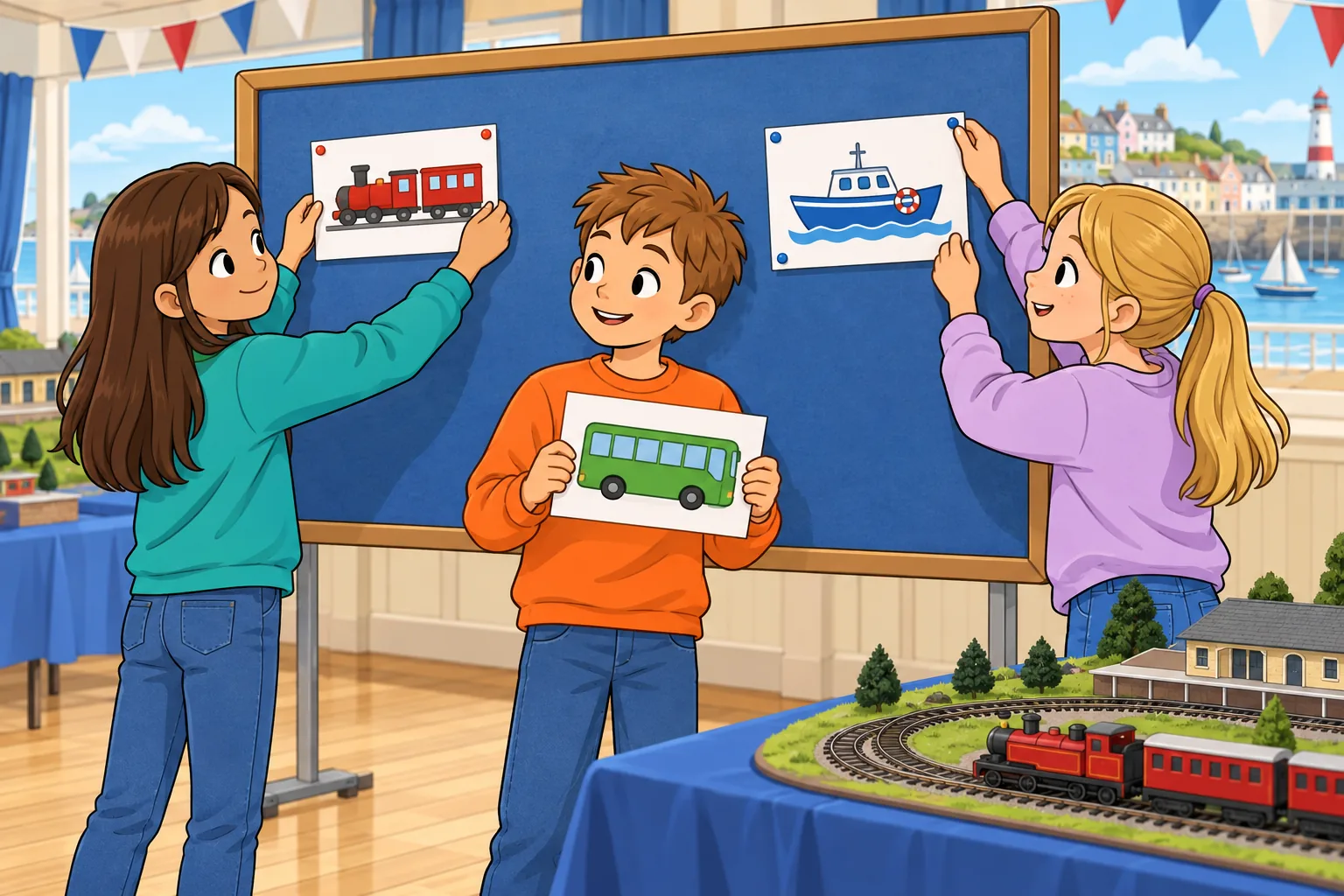
Our class arrived at (example) the exhibition at ten o’clock. We [36] the harbour hall before the doors opened. A guide, [37] name was Mrs Green, welcomed us and gave each group a map. She showed us a display that [38] a little train beside a model boat. There [39] three transport picture cards for the noticeboard. Ruby put the train card [40] the boat card, while Sam held a bus picture. The guide spoke [41] because the room was quiet, so everyone could hear her. I had [42] visited the exhibition before, so this was my first visit. The model engines were [43] than our classroom ones. We took turns [44] the cards on the board. At lunch, we sat [45] a long table near the window and talked about our favourite models. We drew one idea in our notebooks before leaving. Our teacher checked that all the cards were in place. We enjoyed the visit and hope to return with our families next month.
Example: We arrived ___ the exhibition. → at
Part 7 · 5 questions
Complete the text
Read the message and write one word in each gap. There is one example.
Dear Theo,
We went to (example) the exhibition on Saturday. The entrance was [46] front of the old harbour hall. My brother and I arrived [47] bus before eleven. The room was [48] busy that we had to wait outside for a few minutes. Once we were inside, I liked the bridge [49] crossed the little river best. A volunteer showed us how the tiny lights worked. We stayed from eleven [50] lunchtime and then went outside to see the boats. Mum bought us a small guide to take home. I want to build a cardboard station this week, and my brother will help me paint it. I will show you the pictures at school next Monday.
Your friend, Ella
Example: We went ___ the show. → to
Ready to check your answers?
Submit to grade your whole test, OR use 👁 Show Answer per part / per question.
Learn from your answers
Answer reasons
- platform — A platform is the area beside the track where passengers wait and get on a train.
- ticket — A ticket shows that you have paid to travel.
- journey — A journey is the act of travelling between places.
- bridge — A bridge carries a route over a river, road or other gap.
- engine — The engine at the front provides the power to pull the carriages.
- coast — The coast is the land beside the sea.
- station — A railway station has platforms where trains stop for passengers.
- display — A display is a group of objects arranged so that people can see them.
- visitor — A visitor comes to see a place rather than living or working there.
- timetable — A timetable lists the arrival and departure times of trains.
- Yes — Isha holds a clipboard and has a pencil touching it.
- No — Max is sitting on the blue chair to the right of the table.
- No — The model railway has one stone tunnel, on the left of the table.
- Yes — The small station is in the centre of the model railway on the table.
- No — Nora holds a red train, but her jumper is yellow.
- Yes — A separate train is on the railway track to the right of the station.
- No — Leo holds a green bus, but his cap is blue.
- It is in the old harbour hall. — Mia asks where the exhibition is. Ben gives its location: the old harbour hall.
- I went with my aunt on Saturday. — Mia asks who went with Ben. He says that he went with his aunt.
- There are small trains and bridges. — Mia asks what visitors can see. Ben names the small trains and bridges.
- We travelled there by bus. — Mia asks how Ben travelled. He says that he travelled by bus.
- It closes at five o’clock. — Mia asks for the closing time. Ben says five o’clock.
- wooden — The next sentence says the buildings were made from pieces of wood. Wooden describes their material.
- through — Going through a tunnel means entering it and passing inside to its other end.
- near — Near places Ella close enough to the table to see the small details; the other bank words do not fit this position.
- carefully — Checking every path and turning shows that he read the map carefully.
- enjoyed — The children smiled about the show, so enjoyed describes their positive experience.
- A Morning at the Harbour Hall — The whole story describes Ella and her brother’s morning visit to the exhibition at the harbour hall.
- Friday — The first paragraph says the class visited the exhibition on Friday.
- too narrow / narrow — The first piece of blue card was too narrow for the train to stay on it safely.
- wider piece — Theo suggested using a wider piece of blue card. The word of after the gap is already supplied.
- low blue walls / blue walls / low walls / walls — The second paragraph says they added low blue walls along the sides of the bridge.
- top — Poppy wanted the locomotive to travel across the top of the bridge, and their wider card made this possible.
- his notebook / a notebook — The fourth paragraph says Theo drew a simple station in his notebook.
- the following week / the next week / next week — The final sentence says they planned to finish the station model the following week; the next week has the same meaning.
- reached — The visit happened in the past, so the completed action uses reached.
- whose — Whose links the guide to her name: a guide whose name was Mrs Green.
- had — The account is in the past, so had describes what was in the display.
- were — Three picture cards is plural and the account is in the past, so use there were.
- next to — Next to means beside another card. Between requires two things, and during refers to time. The picture also shows the cards side by side.
- softly — Softly is an adverb that describes how the guide spoke. Soft is an adjective; softness is a noun.
- never — This was the writer’s first visit, so never correctly describes the earlier period.
- smaller — Than introduces a comparison between the model engines and the classroom ones. Use the comparative smaller.
- putting — After took turns, use the -ing form: took turns putting the cards on the board.
- at — Use at when people sit around a table for a meal: sat at a table.
- in — The fixed expression in front of describes the entrance’s position.
- by — Use by with a form of transport when no article is used: by bus.
- so — So + adjective + that describes a degree that produces a result: so busy that they had to wait.
- that / which — That and which can both introduce a defining relative clause about a thing: the bridge that/which crossed the river.
- until / till / to — Until, till and to can all mark the end of the time period beginning at eleven.
Teacher tip
Read the full context and match answers to stated facts.