
Flyers 1 – Test 3 Reading & Writing
100% Original Practice Test
An original A2 Reading & Writing practice test about a seaside lighthouse visitor day and a children's beach nature club. This A2 reading & writing practice has 7 parts and 50 questions. Complete each part, then submit to grade your work or use Show Answer to review.
Learning guide
Level: A2.
Topic: A Lighthouse Visit and Beach Nature Club
Learning objectives
- Match everyday A2 definitions to suitable vocabulary.
- Read a simple illustrated seaside scene and identify visible facts.
- Choose natural replies in a conversation about a lighthouse visit.
- Complete a short story with words from a bank and choose its best title.
- Read a narrative and complete sentences with details from the story.
- Use common A2 grammar forms in a coastal clean-up text.
- Complete a short text with one suitable functional word in each gap.
Before you start: Learners can read everyday A2 vocabulary and short narratives, recognise common past and present forms, and use basic pronouns, prepositions and conjunctions.
Teacher tip: Ask learners to read the full sentence or paragraph before choosing an answer. In the picture task, remind them to check where each person is and what is clearly visible.
Reading & Writing strategy: Read the instructions and example first. Use picture details and nearby words as clues, reread the whole sentence, and check spelling before submitting.
Part 1 · 10 questions
Choose the correct word
Read each definition and copy the correct word from the box. There is one example. Four words are not needed.
Example: A small light that you can carry is a ___. → lantern
1. The land beside the sea is the ___.
2. A person who comes to a place for a short time is a ___.
3. If you find something you did not know about before, you ___ it.
4. A path with very little space from side to side is ___.
5. If you use something for a short time and give it back, you ___ it.
6. A trip from one place to another is a ___.
7. When you do something without danger, you do it ___.
8. A short piece of information written for people to read is a ___.
9. If something is broken and you make it work again, you ___ it.
10. To get to a place, especially at the end of a trip, is to ___.
Part 2 · 7 questions
Look and read
Look at the picture. Read the sentences and choose Yes or No. There are two examples.
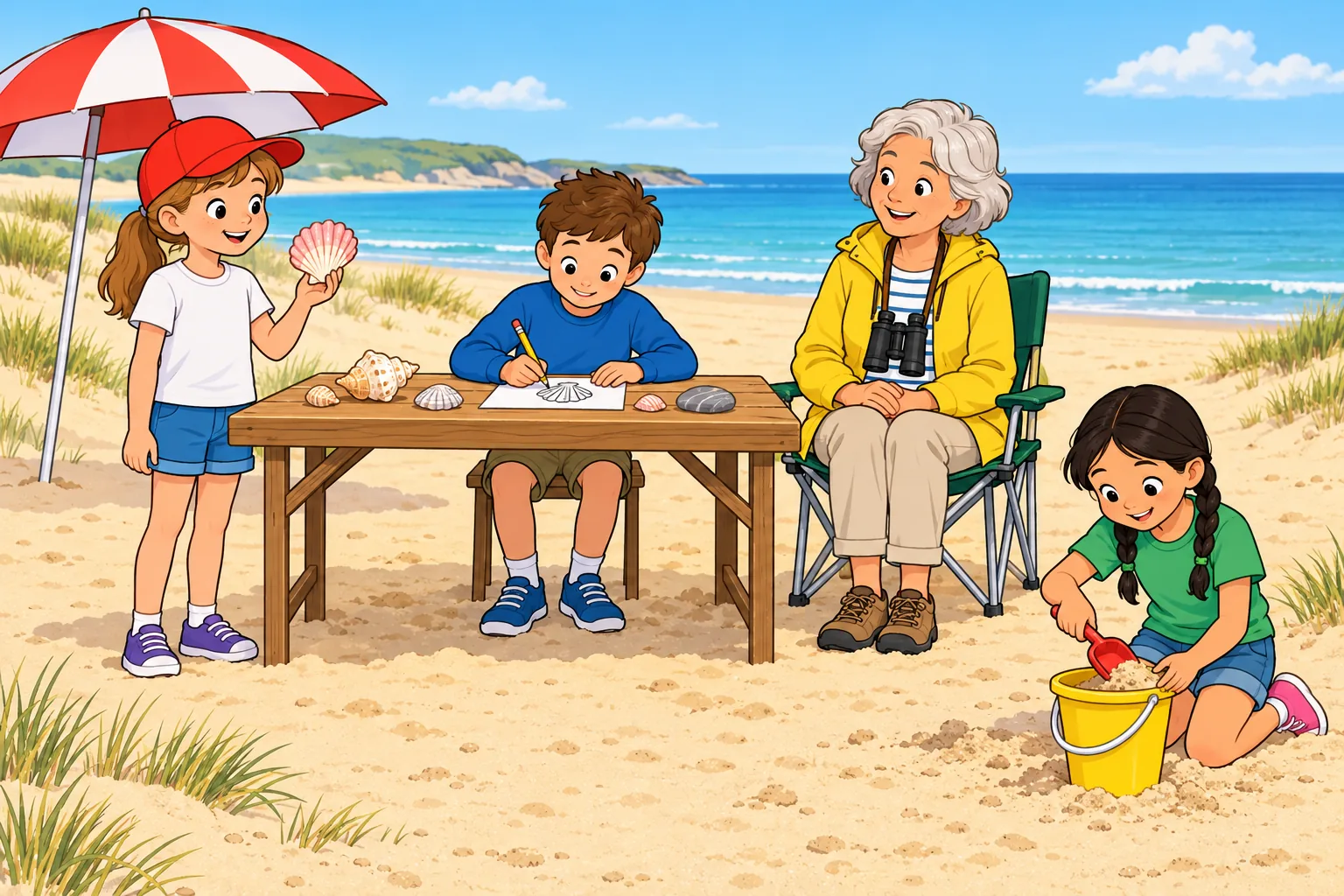
Names: Ruby wears the red cap; Ben wears the blue sweatshirt; Ms Lane wears the yellow jacket; Ella wears the green top.
Example 1: The sea is in the background. → yes
Example 2: The girl in the red cap is holding a book. → no
11. The boy in the blue sweatshirt is drawing on a piece of paper.
12. The adult in the yellow jacket is standing beside the table.
13. The girl in the green top is filling a yellow bucket with sand.
14. The girl in the red cap is to the right of the boy in the picture.
15. The adult has binoculars around their neck.
16. The girl in the green top is holding a book.
17. The beach umbrella is red and white.
Part 3 · 5 questions
Choose the best response
Read Nina and Tom's conversation. Choose a reply from A–H for each question. There is one example. Two replies are not needed.
Nina and Tom are waiting near the entrance to a lighthouse museum before their class tour. Nina asks the questions and Tom replies. Reply B is used in the example; each reply is used once.
Choose a reply
- Yes, the guide said we can climb to the top.
- At half past ten, near the front gate.
- I'll bring my notebook and a pencil.
- No, it belongs to the lighthouse museum.
- We can see the whole bay from there.
- My sister went there last summer.
- Because the steps are quite steep.
- I think the small one is more comfortable.
Example: Nina: What time does our group arrive? → At half past ten, near the front gate.
18. Nina: Can visitors climb all the way to the top?
19. Nina: Why should we walk slowly on the stairs?
20. Nina: What can we see from the top?
21. Nina: What will you take to write down the things we learn?
22. Nina: Is the old lamp in that glass case yours?
Part 4 · 6 questions
Choose the correct word
Read the text. Choose a word from the box for each gap. There is one example and four words are not needed. Then choose the best title.
Last Saturday (example), Isla visited the lighthouse with her aunt. At the entrance, a guide showed them an old brass key. Isla read the small [23] beside the display to learn who had used it. Then she and her aunt walked [24] up the spiral stairs, holding the handrail all the way. At the top, Isla found a smooth white stone in her coat [25]. She had picked it up on the beach that morning. Isla wanted to draw the view, but she had left her pencil at home. She [26] a pencil from the guide and promised to give it back. When Isla had finished her drawing, her aunt [27] the pencil to the guide, who thanked her and put it in a box. Isla put her drawing in her bag before they left.
Example: Last ___, Isla visited the lighthouse with her aunt. → Saturday
28. Choose the best title for the text.
Part 5 · 7 questions
Read the story and complete the sentences
Read the story. Complete each sentence with one, two, three or four words. There are two examples.
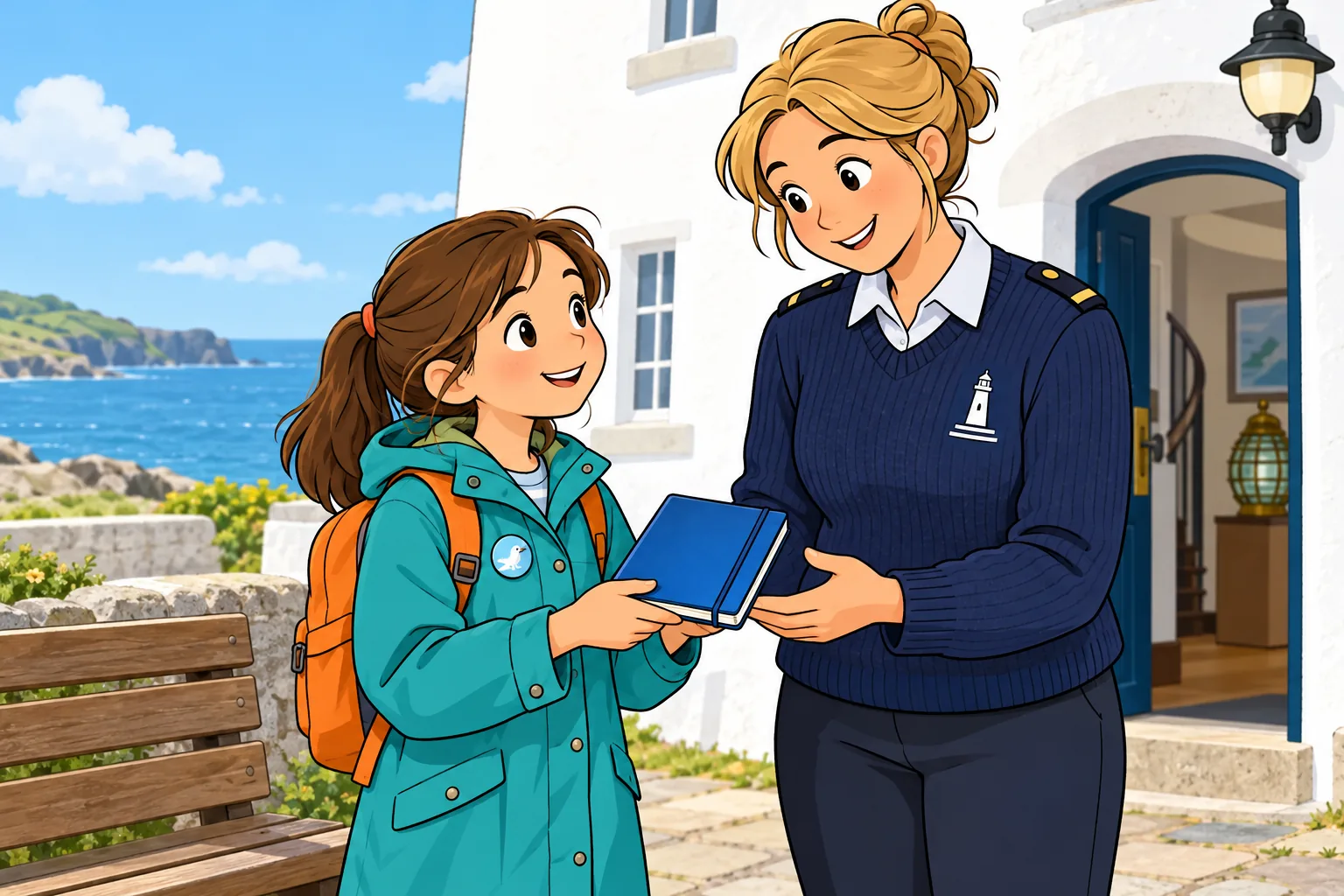
Pippa and the Lost Notebook
Pippa went to the old lighthouse with her class on a windy Wednesday. At the entrance, the guide gave each child a round visitor badge to wear. Pippa pinned hers to her teal raincoat, then followed her group up the stairs. The guide explained how the light helped boats find the harbour. Before lunch, the class went outside to look at the rocks below the lighthouse. Pippa sat on a wooden bench to eat her apple. When she stood up, she saw a blue notebook under the bench. One corner was damp, but the pages were still together.
Pippa opened the cover and found a small card inside. It said, 'Please return this notebook to Sam at the lighthouse office.' She closed the notebook without reading the other pages and took it to the guide. The guide looked at the card and remembered Sam. He was a young visitor who had come with his family that morning. They were going to return for an afternoon tour, so the guide put the notebook safely in the office.
A short time later, Sam and his father came back early to look for the notebook. Sam was relieved when the guide brought it out. He said that it contained drawings of all the places his family had visited that week. He thanked Pippa for finding it and for keeping the pages safe. Before Pippa's class left, the guide gave her a lighthouse postcard to thank her. Pippa put it in her backpack and waved goodbye to Sam. On the bus home, she told her teacher that returning the notebook was the best part of her day.
Example 1: Pippa visited the lighthouse on a windy ___. → Wednesday
Example 2: The guide gave each child a visitor ___. → badge
29. Pippa pinned her badge to her teal ___.
30. The class went outside to look at the rocks below the ___.
31. Pippa found a blue notebook under the ___.
32. A card inside the notebook asked people to return it to Sam at the lighthouse ___.
33. Pippa found a small ___ inside the notebook's cover.
34. Sam came back with his ___.
35. The guide gave Pippa a lighthouse ___ to thank her.
Part 6 · 10 questions
Choose the correct word
Read the text and choose the correct word for each space. There is one example.
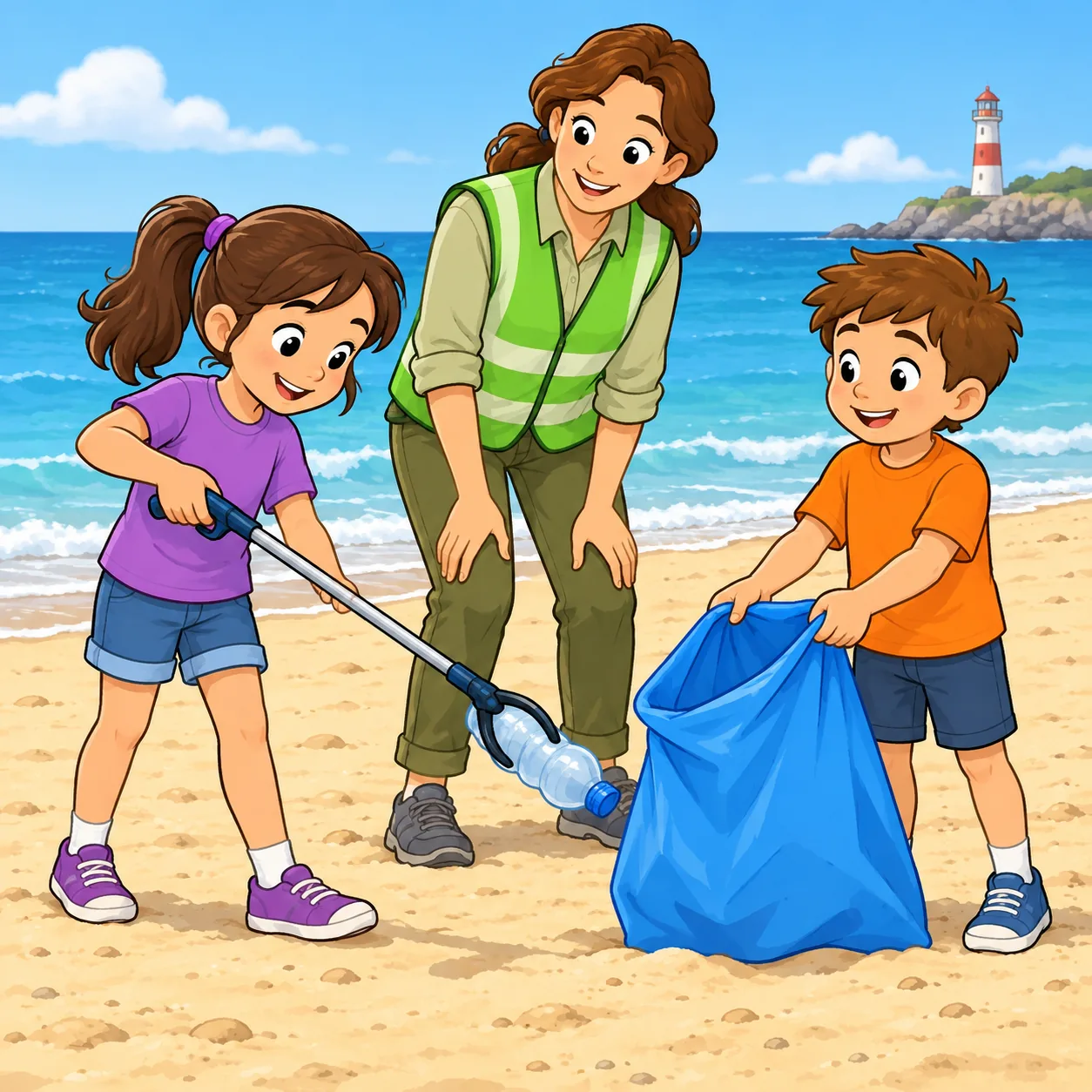
Last Friday, our beach club organised (example) a short clean-up. The weather [36] sunny, so we met beside the old harbour wall. Our leader, [37] works at the nature centre, gave us rubbish pickers. Each child brought [38] own water bottle. Our walk took [39] than usual because we were carrying full bags. Near the path, we saw [40] unusual shell, but we left it where it was. The younger children [41] excited when they found a smooth pebble. We put the rubbish [42] a large sack and carried it to the bins. Afterwards, our shoes were [43] than before because they were covered in wet sand. We cleaned them [44] we got on the bus. The leader thanked everyone for helping to keep the beach [45].
Example: Last Friday, our beach club ___ a short clean-up. → organised
Part 7 · 5 questions
Complete the text
Read the text and write one word in each space. There is one example.
Our nature club meets on (example) Fridays. We gather [46] half past eight beside the harbour gate. Before we set off, the leader says, 'Don't forget [47] bring a hat!' Each child also brings a bottle of water. The club leader is the person [48] teaches us about the birds. We are not allowed to walk off the marked path. We walk slowly and stay [49] it all the way to the harbour. We watch the birds from a distance and carry all our rubbish home. Taking care [50] the beach is everyone's job.
Example: Our nature club meets ___ Fridays. → on
Ready to check your answers?
Submit to grade your whole test, OR use 👁 Show Answer per part / per question.
Learn from your answers
Answer reasons
- coast — The coast is the part of the land next to the sea.
- visitor — A visitor comes to see or spend time at a place.
- discover — To discover something is to find or learn about it for the first time.
- narrow — Narrow describes something that is not wide.
- borrow — To borrow something is to use it and return it later.
- journey — A journey is travel between places.
- safely — Safely means in a way that avoids danger.
- notice — A notice gives people information, often in a public place.
- repair — To repair something is to fix it.
- arrive — Arrive means to reach a place.
- yes — The boy seated behind the centre of the table is drawing a shell on white paper.
- no — The adult is seated, not standing.
- yes — At the far right, she is kneeling and using a red spade to put sand into a yellow bucket.
- no — The girl in the red cap is on the left side of the picture; the boy is nearer the centre.
- yes — The binoculars hang around the seated adult's neck.
- no — She is holding a red spade and a yellow bucket, with no book in her hands.
- yes — The large umbrella on the left has alternating red and white panels.
- Yes, the guide said we can climb to the top. — This directly answers the question about whether visitors may climb to the top.
- Because the steps are quite steep. — This gives a sensible reason to move carefully on the stairs.
- We can see the whole bay from there. — The response names the view from the top of the lighthouse.
- I'll bring my notebook and a pencil. — The notebook and pencil are things Tom can use to write notes.
- No, it belongs to the lighthouse museum. — Tom says that the lamp belongs to the museum, answering the question about ownership.
- notice — The written information beside an exhibit is a notice.
- carefully — Carefully is an adverb describing how they climbed while holding the handrail.
- pocket — A pocket is a part of clothing where a small object can be kept.
- borrowed — Using the guide's pencil temporarily and promising to give it back means she borrowed it.
- returned — The aunt gave the borrowed pencil back to its owner, so returned is correct.
- A Visit to the Lighthouse — The text describes Isla's visit to the lighthouse, including its display, stairs and view.
- raincoat — She pinned the badge to the teal raincoat she was wearing.
- lighthouse — The story says the rocks were below the lighthouse.
- bench / wooden bench — She saw the notebook under the wooden bench after eating her apple.
- office — The card said to return the notebook to Sam at the lighthouse office.
- card — Inside the cover, Pippa found the card giving Sam's name and the lighthouse office address.
- father — Sam returned to look for the notebook with his father.
- postcard — The guide thanked Pippa with a lighthouse postcard.
- was — Weather is treated as singular, and the event took place in the past.
- who — Who refers to the person, our leader, and introduces information about them.
- their — Their is the possessive determiner before own water bottle. It can refer to each child without specifying a boy or girl.
- longer — Longer compares the time taken for this walk with the time it usually takes. Than introduces the comparison.
- an — Unusual starts with a vowel sound, so use an before this singular countable noun.
- were — Children is plural and this event happened last Friday, so were is correct.
- into — Into describes rubbish being placed inside the sack.
- dirtier — Than signals a comparison. The wet sand made the shoes dirtier.
- before — Before links the two actions in time: cleaning the shoes came first. During and between cannot introduce the clause we got on the bus.
- clean — Keep the beach clean uses an adjective to describe the beach. Cleanly is an adverb and cleaning is a verb form.
- at — Use at before a specific clock time, including half past eight.
- to — Forget followed by an action to remember uses to plus the base verb: forget to bring.
- who / that — Who or that can introduce this defining relative clause about a person.
- on — It refers to the marked path. The previous sentence says not to walk off it, so stay on it is correct.
- of — Taking care of is the fixed expression meaning looking after something.
Teacher tip
Ask learners to read the full sentence or paragraph before choosing an answer. In the picture task, remind them to check where each person is and what is clearly visible.