
CELPIP Speaking · Set 9 · Practice Test 2 · Original practice
A Neighbourhood Welcome Day
One warm-up and eight speaking tasks. Plan, speak aloud, then review your response. Keep your own examples and viewpoint.
Follow the preparation and response times shown. Task 5 has an additional silent choosing stage. This practice does not calculate an official score.
Original speaking practice with optional UK model recordings.
0 of 8 practice tasks attempted
Optional microphone recording requires browser permission and a supported secure context. Nothing is uploaded. Recordings, notes and ratings are kept only in this tab and disappear on reset, reload or closing; download recordings you want to keep. Without a microphone, use the timer and speak aloud.
Practice: Warm-up
Talk about a welcome that helped you feel comfortable in an unfamiliar place. Who welcomed you, what did they do, and why do you remember it?
Optional recording stays in this tab. Timer-only practice is always available.
Show guide and sample responses
Plan your response
- Name the place and explain why it was unfamiliar.
- Describe two concrete welcoming actions.
- Finish with how you felt or what changed.
When I first arrived … · A small gesture that helped was … · By the end of the day …
Tell one brief personal story in time order. Your own experience can be ordinary; specific details make the response clear.
Illustrative model: a first workday
On my first day at a small office, I arrived early and stood near the lift because I did not know which door to use. A colleague called Priya noticed me and introduced herself. Instead of pointing down the corridor, she walked with me to our room and showed me where to leave my coat. She had also drawn a simple map of the kitchen and meeting rooms. At lunchtime, she invited me to sit with two other new staff members. We talked about our journeys to work, so I did not feel under pressure to say something impressive. I remember that welcome because it turned a confusing morning into a manageable day. Now, when a new colleague arrives, I try to offer the same practical help.
Why it works: Follows one morning from uncertainty to inclusion, using concrete actions and a personal consequence.
127 words for this response. Practise at a comfortable pace with pauses; shorten a detail if necessary.
Check your response
- Identify the unfamiliar setting.
- Explain what someone did to welcome you.
- Describe the effect on you.
Task 1: Giving Advice
Your friend is coordinating volunteers for a neighbourhood welcome day at the community centre. They are worried about finding enough helpers and keeping everyone organised. Give your friend practical advice about recruiting helpers, assigning roles and managing the day.
Optional recording stays in this tab. Timer-only practice is always available.
Show guide and sample responses
Plan your response
- Address your friend directly and acknowledge the concern.
- Offer specific recruiting and scheduling steps with reasons.
- Include a plan for delays and a manageable first action.
I would start with … · That way, each helper … · If someone cannot come …
Advice should be usable. Explain who does each job and how your friend can adjust when plans change. Two developed steps can be stronger than a long unexplained list.
Illustrative model: build a clear rota
I can see why you are worried, but you do not need to organise everything at once. First, list the essential jobs: greeting visitors, giving directions, serving drinks and clearing the room. Estimate how many helpers each job needs, then advertise specific shifts instead of simply asking for volunteers. Someone who cannot spare a whole day might happily cover forty minutes. Next, ask people about their interests and any tasks they would prefer to avoid. Match them to roles and send one clear rota with arrival times, a meeting point and your contact number. That should reduce last-minute questions. On the day, hold a short briefing before visitors arrive. Show everyone the exits, the water station and where to direct questions they cannot answer. Keep one person free to cover a delayed helper, if you have enough volunteers. Finally, thank people individually and ask what would make the next event easier. Your first step could be a simple message listing three jobs and the available shifts. It gives neighbours a clear way to help without making a commitment they cannot keep.
Why it works: Connects recruitment, role matching, briefing and backup cover to practical reasons.
181 words for this response. Practise at a comfortable pace with pauses; shorten a detail if necessary.
Illustrative model: organise around stations
I would make the event feel like a few small teams instead of one huge job. You could have a welcome desk, a refreshments station and a team helping people find activities. Ask a reliable person to lead each station, then recruit helpers for clearly defined periods. In your notice, explain what a volunteer will actually do and whether any experience is needed. That may encourage people who want to help but feel unsure. Before you publish the schedule, check availability with everyone. Give each person a short role description and pair a new helper with someone who knows the building. During the event, use one contact number for urgent questions so instructions do not arrive from several directions. If someone cancels, protect the essential jobs first. You could temporarily close an optional display while its helper covers the entrance, provided the helpers agree. Afterward, send a thank-you message and ask each team for one improvement. I would begin today by drawing the stations on a page and deciding which jobs must stay staffed. Then you can recruit for real needs rather than guessing.
Why it works: Offers an alternative station-based structure, checks consent and prioritises essential coverage.
184 words for this response. Practise at a comfortable pace with pauses; shorten a detail if necessary.
Check your response
- Give relevant recruitment advice.
- Explain roles, times and communication.
- Address a possible event-day problem.
- End with a practical next step.
Task 2: Talking about a Personal Experience
Describe a time you learned how to use a local service. What did you need, how did you learn, and how did the experience help you?
Optional recording stays in this tab. Timer-only practice is always available.
Show guide and sample responses
Plan your response
- Choose one service and a clear need.
- Explain a difficulty and the steps you took.
- Use past tense for the story, then describe its result.
At first, I was unsure … · The person showed me … · After that experience …
Use one experience rather than listing services. A helpful story includes a problem, an action and a specific change.
Illustrative model: finding an evening bus
When I moved across town, I needed to use a different bus to reach my evening class. Several routes stopped near my flat, and I was unsure where to change. I checked the route map, but the transfer point still confused me. On a quiet afternoon, I asked a driver to explain the journey. She showed me which stop to use and reminded me to check the number on the arriving bus. I made a trial journey before the class began and wrote the return route in my notebook. The first trip took extra time, but after that I could travel without worrying about every stop. It also gave me confidence to ask a clear question when I needed help.
Why it works: Explains a concrete need, a learning process and an observable change in confidence.
120 words for this response. Practise at a comfortable pace with pauses; shorten a detail if necessary.
Illustrative model: using a library catalogue
I learned to use my local library when I needed a quiet place and some material for a course. I knew I could read books there, but I did not understand the catalogue. A librarian showed me how to search by topic and note the shelf number. Then she let me find a book myself while she stayed nearby in case I got stuck. I also learned to check the return date and where to look for renewal information. That afternoon I found two useful books and chose a desk near the window. The next week I returned on my own. What helped most was trying each step myself instead of only watching a demonstration. The building soon felt familiar, and I had somewhere dependable to study.
Why it works: Keeps the story chronological and shows the learner practising the service independently.
127 words for this response. Practise at a comfortable pace with pauses; shorten a detail if necessary.
Check your response
- Identify the service and need.
- Describe how you learned to use it.
- Explain a result or lesson.
Task 3: Describing a Scene
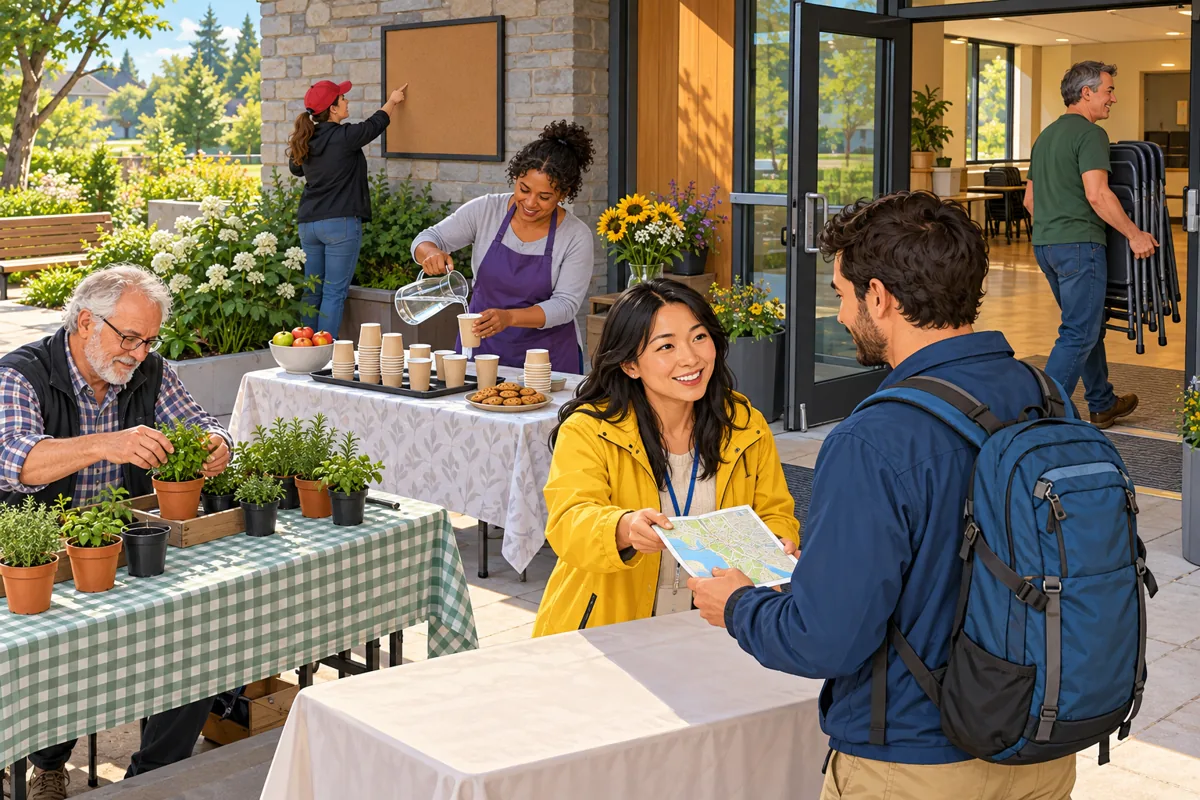
Describe the community-centre entrance in the picture. Tell a listener who cannot see it where people are and what they are doing.
Optional recording stays in this tab. Timer-only practice is always available.
Show guide and sample responses
Plan your response
- Give a brief overview before individual details.
- Use positions and clothing to distinguish the six adults.
- Describe visible actions without inventing names, speech or motives.
In the foreground … · On the left-hand side … · At the back, near …
Describe the picture as it is now. Present continuous forms and clear location words help the listener build an accurate picture.
Illustrative model: foreground to background
The picture shows six adults around a bright community-centre entrance. In the foreground, a woman wearing a yellow jacket is handing a folded map to a man with a blue backpack. On the left, an older man is sitting at a table and arranging small pots of herbs. Behind the woman in yellow, another woman is wearing a purple apron. She is pouring water from a clear jug into a paper cup, with more cups on the table. On the right, a man in a green shirt is carrying folded chairs through an open doorway. Further back, a woman in a red cap is pointing towards a blank noticeboard on the wall. The doors are open, and the tables give the entrance a welcoming appearance.
Why it works: Organises all six adults by position and uses only visible details.
125 words for this response. Practise at a comfortable pace with pauses; shorten a detail if necessary.
Illustrative model: move across the scene
This is an entrance area with tables outside and an open door into a community building. Starting on the left, an older man is seated behind several potted plants and is touching one of the herbs. Above him in the background, a woman in a red cap is pointing at an empty board. Near the middle, a woman in a purple apron is pouring a drink into a paper cup. Closer to us, a woman in a yellow jacket and a man carrying a blue backpack are holding opposite sides of a folded map. To their right, a man in green is carrying a stack of folding chairs into the building. There are flowers beside the doorway and extra chairs visible inside. Everyone is occupied with a different activity.
Why it works: Uses a left-to-right route and avoids presenting guesses about the event as facts.
129 words for this response. Practise at a comfortable pace with pauses; shorten a detail if necessary.
Check your response
- Identify the entrance setting.
- Describe the map handover and four other visible actions.
- Separate observation from inference.
Task 4: Making Predictions
Look at the same picture. What do you think may happen next? Make several predictions and explain the visible clues behind them.
Optional recording stays in this tab. Timer-only practice is always available.
Show guide and sample responses
Plan your response
- Predict actions that follow naturally from current actions.
- Link each prediction to something visible.
- Use probably, may or might when outcomes are uncertain.
Because she is holding … · He will probably … · Judging by the open door …
Move beyond a description of the current scene. A prediction needs a future action and a reason from the picture; several reasonable outcomes are possible.
Illustrative model: follow the current actions
The man with the blue backpack will probably take the map and look at it more closely because both he and the woman in yellow are already holding it. He might ask her where to go next. The man carrying folded chairs is likely to put them down inside, as he is walking through the open doorway. Perhaps he will return for more, although we cannot see another stack outside. The woman with the jug will probably finish filling the cup and place it with the others on her table. On the left, the older man may move another herb pot into position because he is arranging the plants. Finally, the woman pointing at the blank board might suggest where to put information. These small actions could help the group get the entrance ready for visitors.
Why it works: Makes future predictions tied to the map, chairs, jug, pots and blank board.
136 words for this response. Practise at a comfortable pace with pauses; shorten a detail if necessary.
Illustrative model: connect clues to possibilities
I think the area will become more organised over the next few minutes. The woman in the purple apron is pouring water, so she may soon put a full cup on the table for someone to collect. The man in green is carrying chairs towards the room, which suggests he will set up seating inside. The map handover could lead to a short conversation about directions, and the visitor may then enter the building. Meanwhile, the seated man might straighten the remaining herb pots to make them easier to see. The woman in the red cap may help prepare the noticeboard, since she is pointing to its empty surface. I cannot tell exactly what event is planned, but the visible preparations make a gathering seem possible.
Why it works: Keeps each inference tentative and distinguishes an unknown event from visible preparation.
126 words for this response. Practise at a comfortable pace with pauses; shorten a detail if necessary.
Check your response
- Make at least three plausible predictions.
- Give a visible clue for each.
- Use uncertain language where appropriate.
Task 5: Comparing and Persuading
Choose a venue for the welcome coffee, then compare your choice with Omar's suggestion. Follow the two stages below.
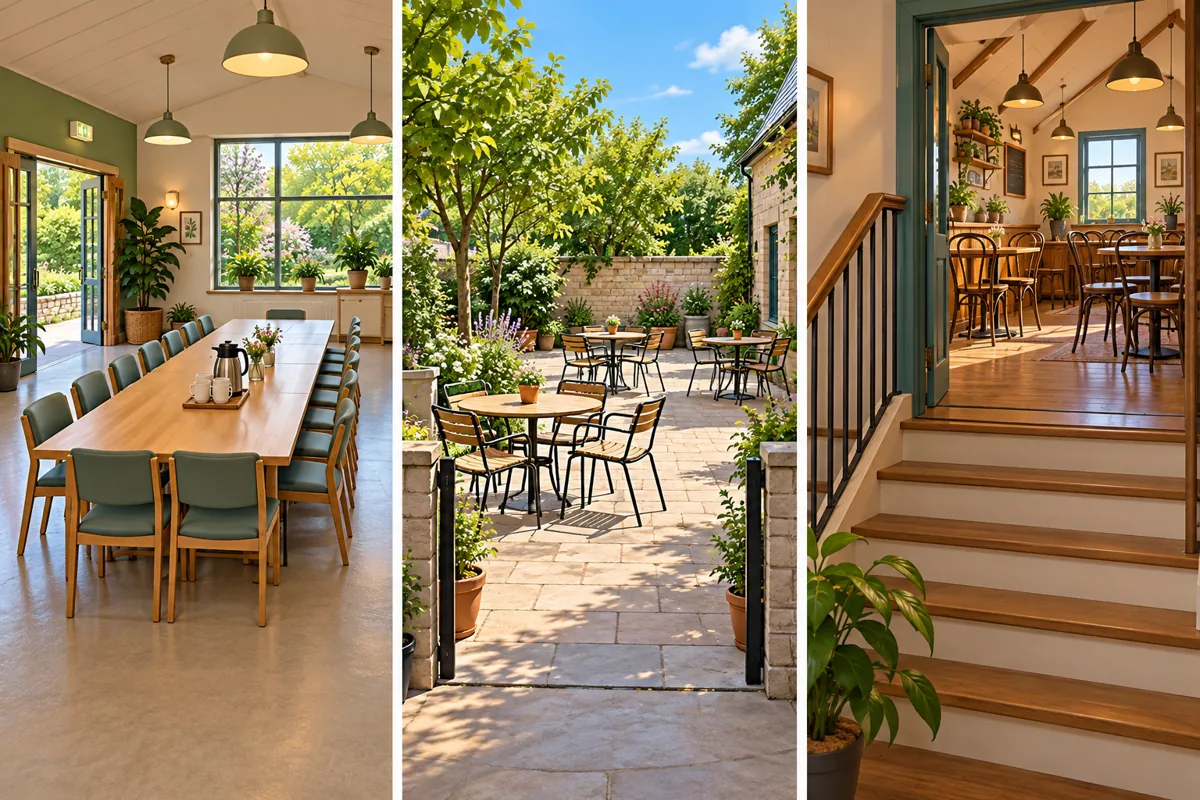
Use the written venue cards for exact prices, capacity, access and times. The picture illustrates the spaces.
You and Omar are organising a welcome coffee for 12 people on Saturday from 10 a.m. to noon. Step-free access is required, and the total budget is $180. Choose A or B. This choosing stage is silent.
If you have not selected an option when the choosing timer ends, A is selected. No speaking is needed during this stage.
Omar prefers C, Upstairs Cafe. Persuade him that your selected A or B venue is better for this group. Compare the written facts and acknowledge a trade-off.
Optional recording stays in this tab. Timer-only practice is always available.
Show guide and sample responses
Plan your response
- Choose A or B during the silent stage.
- Address Omar directly during the response.
- Compare your selected venue with C using access, time, price and seating.
- Acknowledge one trade-off and ask for agreement.
Omar, I see the appeal of … · Our group needs … · Compared with your suggestion … · Would you agree to …?
Both A and B meet the essential access and time requirements. C has enough seats but fails those two requirements. A uses the full budget and includes drinks; B leaves $60 before drink costs but depends on weather. Other relevant arguments are possible.
Choose A: prioritise access and time
Omar, I understand why you like the Upstairs Cafe, especially with drinks included. I would still choose the Garden Room because everyone needs step-free access. The cafe has stairs only, so it would exclude someone before our welcome event even began. Its booking also ends at eleven, while we need the space until noon. The Garden Room gives us the full two hours and sixteen seats for our twelve guests. It costs thirty dollars more than the cafe, but tea and coffee are included, and the total remains within our budget of one hundred and eighty dollars. We would use the whole budget, so we should avoid extra purchases. Would you agree to book the accessible room and keep the refreshments simple?
Why it works: Compares A directly with C, handles the $30 difference and acknowledges the full-budget limit.
122 words for this response. Practise at a comfortable pace with pauses; shorten a detail if necessary.
Choose B: explain the saving
Omar, the Upstairs Cafe sounds pleasant, but I think the Courtyard suits our group better. It is step-free and available from ten until noon. The cafe has stairs and gives us only one hour, so it misses two essential requirements. The Courtyard also has twenty seats, which is more than enough for twelve people, and its price is one hundred and twenty dollars. That leaves sixty dollars within our budget before we buy drinks. We would need to bring those ourselves, and the outdoor setting is weather-dependent. I suggest checking the forecast and the venue's cancellation terms before we commit. If those conditions are workable, could we choose the Courtyard so everyone can attend for the full meeting?
Why it works: Uses B versus C throughout, explains the $60 remainder accurately and checks the weather risk.
118 words for this response. Practise at a comfortable pace with pauses; shorten a detail if necessary.
Choose A: explain the complete arrangement
Omar, I like your idea of having drinks included, and the Garden Room offers that too. It includes tea and coffee for one hundred and eighty dollars. That is thirty more than your cafe, but it solves two problems: the room is step-free, and we can stay until noon. Your cafe is upstairs with stairs only, and its slot finishes at eleven. We cannot shorten our planned coffee or leave a guest unable to enter. Sixteen seats are sufficient for the twelve of us, so capacity works as well. The disadvantage is that the room uses our entire budget. I would keep the event to the included drinks and check the booking details. Could we choose it for a simpler, more inclusive welcome?
Why it works: Provides a distinct A argument around included refreshments and inclusive attendance without inventing facilities.
123 words for this response. Practise at a comfortable pace with pauses; shorten a detail if necessary.
Choose B: focus on the essential requirements
Omar, before we decide, let us compare what our guests actually need. All twelve must be able to enter, and we promised a meeting from ten to noon. The Upstairs Cafe seats fourteen and includes drinks, but the stairs-only entrance and eleven o'clock finish do not work. The Courtyard gives us step-free access, twenty seats and the complete time slot. It also costs thirty dollars less than the cafe. We must organise our own drinks, so the saving is not all spare money. Weather is another concern, and I would check our options if rain is forecast before confirming anything. Provided we can manage that risk, would you support the Courtyard? It meets the main requirements while leaving room in the budget for refreshments.
Why it works: Compares B and C accurately, distinguishes the $30 price difference from the $60 total-budget remainder and avoids assuming an indoor backup.
124 words for this response. Practise at a comfortable pace with pauses; shorten a detail if necessary.
Check your response
- Speak to Omar, not an examiner about Omar.
- Use your selected A or B consistently.
- Compare at least two accurate card facts with C.
- Mention a real limitation and end persuasively.
Task 6: Dealing with a Difficult Situation
You promised your neighbour Jo that you would help carry boxes on Saturday from 9 to 11 a.m. Your manager Leena now asks you to cover a shift from 9 a.m. to 1 p.m. Choose ONE person below and request a workable change. Neither person has agreed to a change yet.
Optional recording stays in this tab. Timer-only practice is always available.
Show guide and sample responses
Plan your response
- Choose one audience before starting.
- Acknowledge the existing promise and the overlapping times.
- Make a specific request and leave the other person room to refuse.
- Confirm arrangements before treating them as settled.
Could we discuss …? · I already promised … · Would a different time work …? · Please let me know before …
There is no single correct decision. A successful response addresses the selected person directly, explains the conflict honestly and proposes a change without announcing it as agreed.
To Jo: ask about Saturday afternoon
Hi Jo, could we talk about Saturday? I promised to help with your boxes from nine to eleven, and I know you may have planned around that. My manager has just asked whether I can cover a shift from nine until one. I have not confirmed it because I already made a commitment to you. Would moving the boxes later on Saturday be possible? I could check my travel time and suggest an afternoon start before we settle anything. If the morning is essential, please tell me. I do not want you waiting for help that never arrives. Let me know what you need, and I will answer my manager after we have discussed it. I am sorry to bring you this extra complication.
Why it works: Preserves the original promise, asks Jo rather than imposing a change and delays confirmation of the shift.
124 words for this response. Practise at a comfortable pace with pauses; shorten a detail if necessary.
To Leena: request a later shift
Hi Leena, thank you for asking about Saturday. I would like to help the team, but I already promised my neighbour that I would carry boxes from nine until eleven. Your proposed shift begins at nine and ends at one, so I cannot do both as arranged. Would a later shift be useful instead? I would need time to travel after finishing with my neighbour, so I cannot promise an eleven o'clock start. If the early hours are essential, I understand that you may need someone else. Please let me know whether there is another slot or a different day I could cover. I will not treat a change as confirmed until you approve it. I wanted to explain the conflict promptly so you have time to plan.
Why it works: Speaks directly to Leena, offers alternatives and accounts for travel rather than promising immediate availability.
128 words for this response. Practise at a comfortable pace with pauses; shorten a detail if necessary.
To Jo: explore another day
Jo, I wanted to check something with you before I answer my manager. I agreed to carry your boxes on Saturday from nine to eleven. Leena has now asked me to cover a nine-to-one shift, and I am trying to see whether there is an arrangement that works for everyone. Is Saturday morning fixed, or could we consider another day? I could come on Sunday if you are available, but I would need to confirm a time with you first. If the boxes must move on Saturday morning, I will tell my manager about my earlier promise. Please do not change your plans just because I asked. I value being dependable, and I would rather discuss the options now than disappoint you on the day.
Why it works: Offers another day as a proposal, gives Jo a clear refusal path and avoids promising unconfirmed help.
125 words for this response. Practise at a comfortable pace with pauses; shorten a detail if necessary.
To Leena: ask about a different day
Leena, I need to explain an existing commitment before I accept Saturday's shift. I promised Jo two hours of help with boxes, from nine until eleven that morning. Since your shift runs from nine to one, accepting it would mean breaking that promise. Could I cover a shift on another day instead? I am happy to discuss which hours would help, although I would need to check my calendar before agreeing. If you specifically need Saturday morning cover, I may have to decline this request. I understand that creates a scheduling problem, so I wanted to let you know early rather than leave it uncertain. Is there a different day you would like me to consider? We can confirm the details once we find a suitable option.
Why it works: Declines the conflict conditionally, offers a different day and keeps final scheduling subject to confirmation.
127 words for this response. Practise at a comfortable pace with pauses; shorten a detail if necessary.
Check your response
- Address only the selected person.
- Keep 9-11 and 9-1 commitments accurate.
- Offer a practical request.
- Respect consent and confirm the next step.
Task 7: Expressing Opinions
Should local libraries lend useful household equipment as well as books? Give your opinion and explain your reasons with examples.
Optional recording stays in this tab. Timer-only practice is always available.
Show guide and sample responses
Plan your response
- State a clear position at the start.
- Develop reasons with concrete examples.
- Acknowledge a practical limitation and explain how it affects your view.
- Avoid presenting invented statistics as evidence.
I would support … provided that … · For example, someone who … · A concern I would take seriously is …
An opinion needs reasons, not a supposedly correct side. You may support lending, oppose it or propose a limited trial if you explain the trade-offs clearly.
Illustrative model: support a small trial
I would support a small household-equipment collection at a local library, provided it is manageable for the staff. Some objects are useful only occasionally. A person who needs a basic tool kit to assemble a shelf might prefer borrowing one to buying equipment that will sit in a cupboard. A shared collection could also help a newcomer try an activity before deciding what to purchase. However, lending an object involves more than putting it on a shelf. Staff need storage, clear instructions and time to check its condition after each loan. I would avoid complex or potentially dangerous equipment at the beginning. Instead, the library could trial a few durable items, explain the borrowing period and show people how to report damage. The trial should have a clear limit, so staff can decide whether the extra work is worthwhile. Books and study space should still receive enough attention. Overall, I favour testing a modest collection because it could be useful, but I would expand it only after hearing from both borrowers and staff.
Why it works: States a conditional view, gives practical examples and develops the workload objection without invented research.
173 words for this response. Practise at a comfortable pace with pauses; shorten a detail if necessary.
Illustrative model: use a separate partner
I would prefer libraries to partner with a separate equipment-lending group instead of managing a large collection themselves. My main concern is the work involved. A returned book can be checked fairly quickly, while a sewing machine or tool kit may have missing parts or need a demonstration. Staff would also need space for bulky objects and a reliable way to arrange repairs. If those demands reduce time for reading support or study services, the change may not help the people who rely on the library most. That does not mean sharing equipment is a bad idea. A local workshop or community organisation might have people who understand the items and can maintain them. The library could display information and help residents find that service. I would be open to a tiny collection of simple items if staff had the capacity, but I would not make household lending a major responsibility without dedicated resources. For me, a partnership offers the benefit of access while keeping the practical work with people equipped to handle it.
Why it works: Develops a different position, weighs staff responsibilities and proposes a concrete partnership rather than rejecting access.
174 words for this response. Practise at a comfortable pace with pauses; shorten a detail if necessary.
Check your response
- Give a clear position.
- Develop at least two reasons or examples.
- Consider one reasonable objection.
- End with a conclusion consistent with your argument.
Task 8: Describing an Unusual Situation
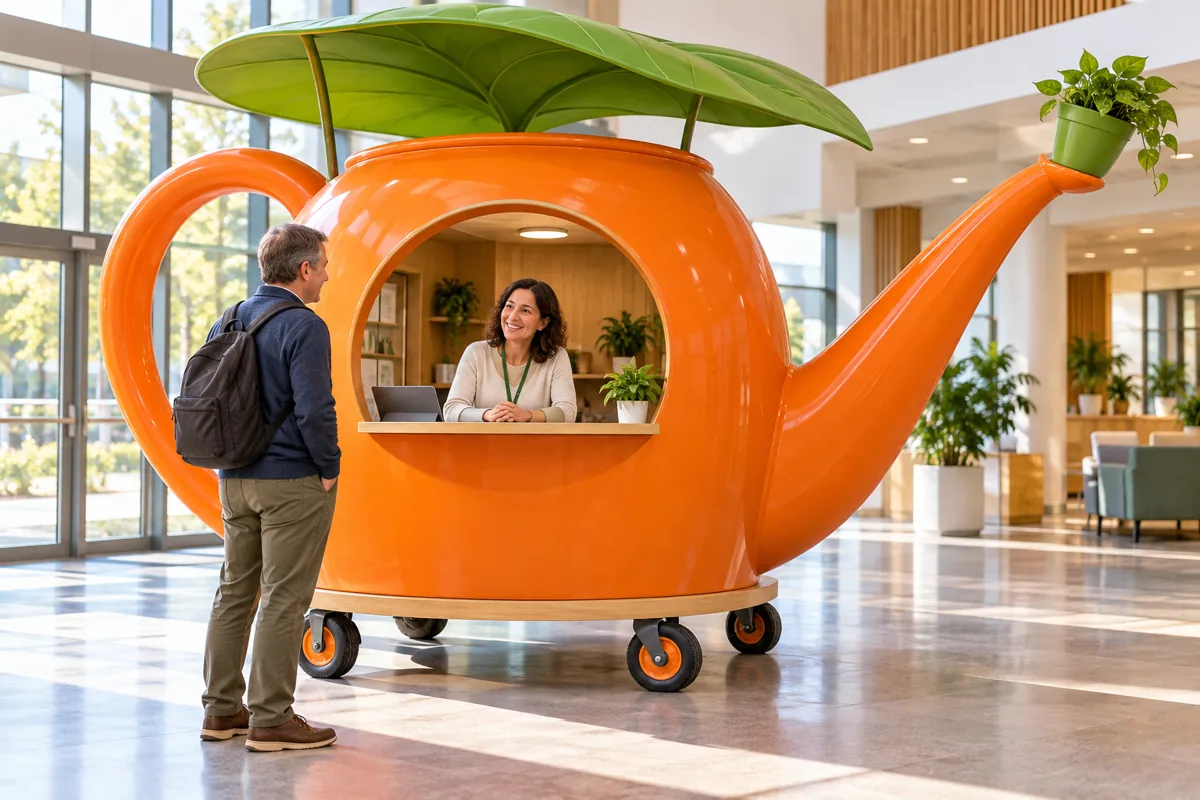
You are in the community-centre lobby and notice the unusual information booth in the picture. Call your friend Mina, describe it so she can imagine it, and invite her to join you as a volunteer at the welcome desk.
Optional recording stays in this tab. Timer-only practice is always available.
Show guide and sample responses
Plan your response
- Open as a phone call to Mina and say where you are.
- Describe the overall shape, colour and distinctive parts.
- End with the invitation in the prompt.
Mina, I am calling from … · Imagine a huge … · Would you like to join me …?
Your listener cannot see the object. Describe the watering-can shape before its window, canopy, spout and wheels. Keep the invitation directed to Mina rather than adding an unrelated request.
Illustrative model: describe the overall shape first
Hi Mina, I am in the community-centre lobby, and you should see the welcome desk. It looks like an enormous orange watering can. There is a round opening in the front where a volunteer is sitting, so visitors can speak to her through the body of the can. A large green leaf forms a canopy over the top. On the left is the curved handle, and on the right a long spout points upwards with a small plant pot at its end. The whole thing stands on a low platform with four little wheels. It is such a cheerful way to greet people. I am helping at the welcome desk, and I thought of you. Would you like to join me as a volunteer?
Why it works: Addresses Mina, builds a spatial picture from visible details and finishes with the requested invitation.
124 words for this response. Practise at a comfortable pace with pauses; shorten a detail if necessary.
Illustrative model: contrast ordinary purpose and unusual design
Mina, hello! I am calling from the community centre. Their information booth is an orange watering can, only large enough for a person to sit inside. The volunteer serves visitors through a circular window in its side, with a laptop on the counter. Above her is a canopy shaped like a broad green leaf. The handle curves around the left side, while the long orange spout reaches up to the right. There is even a little green pot with a plant at its tip. Four cart wheels support the base, and a visitor is standing in front of the window. I am going to help welcome people here. Would you be interested in volunteering with me? I can ask the coordinator how we would work together.
Why it works: Uses accurate picture details, maintains a phone-call audience and asks rather than assuming Mina will attend.
126 words for this response. Practise at a comfortable pace with pauses; shorten a detail if necessary.
Check your response
- Greet Mina and name the location.
- Describe the orange body and several visible parts.
- Invite her to volunteer with you.
Finish speaking, then review your attempts and self-assessment.