
CELPIP Speaking · Set 1 · Test 1 · Original practice
Small Choices, Shared Skills
This is an original practice set. You will have a short preparation period before each response. Speak naturally, organize your ideas, and use the full response time when useful. The sample responses are learning models only; they are not certified scores or guaranteed score outcomes.
One unscored warm-up and eight speaking practice tasks. Task 5 includes a separate 60-second choosing stage, then 60 seconds to prepare and 60 seconds to respond. Practice self-assessment is not an official CELPIP result.
0 of 8 practice tasks attempted
Microphone permission is optional. Browser recording requires a supported browser and a secure context. Timer-only practice is available if recording is unavailable. Nothing is uploaded.
Warm-up: Warm-up
Describe a small change that would make your usual weekday routine easier. Explain what you would change and why it would help.
Timer practice works without a microphone. Enabling the microphone asks your browser for permission. Recordings stay in this tab; download anything you want to keep.
Show guide and sample responses
Plan your response
- Name one everyday difficulty.
- Explain one change and its likely benefit.
- Try the controls before starting the eight practice tasks.
A small change I would like to make is… · It would help because…
Task 1: Giving Advice
Your neighbour has recently started working from home. They say their days feel unstructured and they often keep working late. Give your neighbour advice about creating a healthier and more organized workday.
Timer practice works without a microphone. Enabling the microphone asks your browser for permission. Recordings stay in this tab; download anything you want to keep.
Show guide and sample responses
Plan your response
- Address the neighbour directly and acknowledge the difficulty.
- Offer three practical steps in a sensible order.
- Explain how each step could help; avoid presenting advice as a guaranteed cure.
- End with one easy first step to try this week.
One change that may help is… · I would suggest setting… · That way, you can… · You could try it for a week and then…
Clear and developed model
Original model recording · 45 seconds · approved AEn4U UK voice.
I can understand why working from home might make the day feel open-ended. I would start by choosing a regular time to begin and finish, even if the hours are a little flexible. At the start of the day, write down the two or three most important things you need to complete. That makes it easier to see what can wait until tomorrow. I would also create a short lunch break away from the desk and take a few minutes to walk outside if possible. Finally, use a simple end-of-day routine: save your work, write down your next task, and close the laptop. You do not have to make the whole routine perfect immediately. Try these steps for one week and adjust the schedule to fit your energy and responsibilities.
Why this works: The response recognizes the problem, gives a sequence of specific and manageable actions, and explains their purpose. Its closing suggests a realistic trial rather than promising a result.
Text model only; adapt to your natural pace. Word count does not certify spoken timing or a score.
Alternative model
Original model recording · 46 seconds · approved AEn4U UK voice.
I would recommend making a clear boundary between work time and personal time. For example, choose a finish time and set an alarm fifteen minutes before it. When the alarm rings, use those minutes to check what is unfinished and decide whether it is genuinely urgent. Another helpful idea is to plan the day before opening email. Pick one main task and two smaller ones, so messages do not decide your priorities for you. It may also help to work in a particular place, even if that is just one corner of the home. When you take a break, leave that spot and stretch or get a drink. If your workload regularly cannot fit into the schedule, discuss priorities with your manager. Start with one boundary that feels realistic and build from there.
Why this works: This version develops the advice through examples and adds a sensible caveat about workload. It keeps a supportive tone and gives the listener a clear starting point.
Text model only; adapt to your natural pace. Word count does not certify spoken timing or a score.
Task 2: Talking about a Personal Experience
Talk about a time you had to change a plan at short notice. Describe what changed, how you responded, and what you learned from the experience.
Timer practice works without a microphone. Enabling the microphone asks your browser for permission. Recordings stay in this tab; download anything you want to keep.
Show guide and sample responses
Plan your response
- Choose one specific, ordinary event you can explain clearly.
- Set the scene quickly before describing the unexpected change.
- Use past-tense verbs consistently and make your actions easy to follow.
- Finish with a reflection connected to the event.
I remember one occasion when… · At first, I thought… · Instead of…, I decided to… · Looking back, I learned that…
Clear and developed model
Original model recording · 42 seconds · approved AEn4U UK voice.
Last autumn, I arranged to meet a colleague after work to prepare a presentation. An hour before our meeting, she called to say her bus was delayed. I was already at the community centre, so I suggested working by phone instead. We divided the presentation into sections and prepared our own notes that evening. The next morning, we met briefly and combined our ideas. Although our original plan changed, the important work still got done. I learned to agree on a backup way to communicate before a project becomes urgent. Now I usually set up shared notes at the beginning, so a change of location does not stop us working together.
Why this works: A single event is easy to follow: plan, disruption, response, and reflection. The details support the story without taking time away from the lesson learned.
Text model only; adapt to your natural pace. Word count does not certify spoken timing or a score.
Alternative model
Original model recording · 40 seconds · approved AEn4U UK voice.
A few months ago, I was helping a friend move into a new apartment. Heavy rain made the outdoor loading area difficult to use, so we paused rather than carrying slippery boxes. I checked the building rules while my friend called to reserve the indoor service entrance for the next morning. We spent the evening labelling boxes by room instead. That extra preparation made the move quicker the following day. I was disappointed at first, but the delay helped us organize everything better. The experience taught me to focus on what I can control. When a plan changes, clear communication and a practical backup can make the situation manageable.
Why this works: This model includes a clear reason for the change and shows practical cooperation. The reflection follows from the story instead of introducing an unrelated general claim.
Text model only; adapt to your natural pace. Word count does not certify spoken timing or a score.
Task 3: Describing a Scene
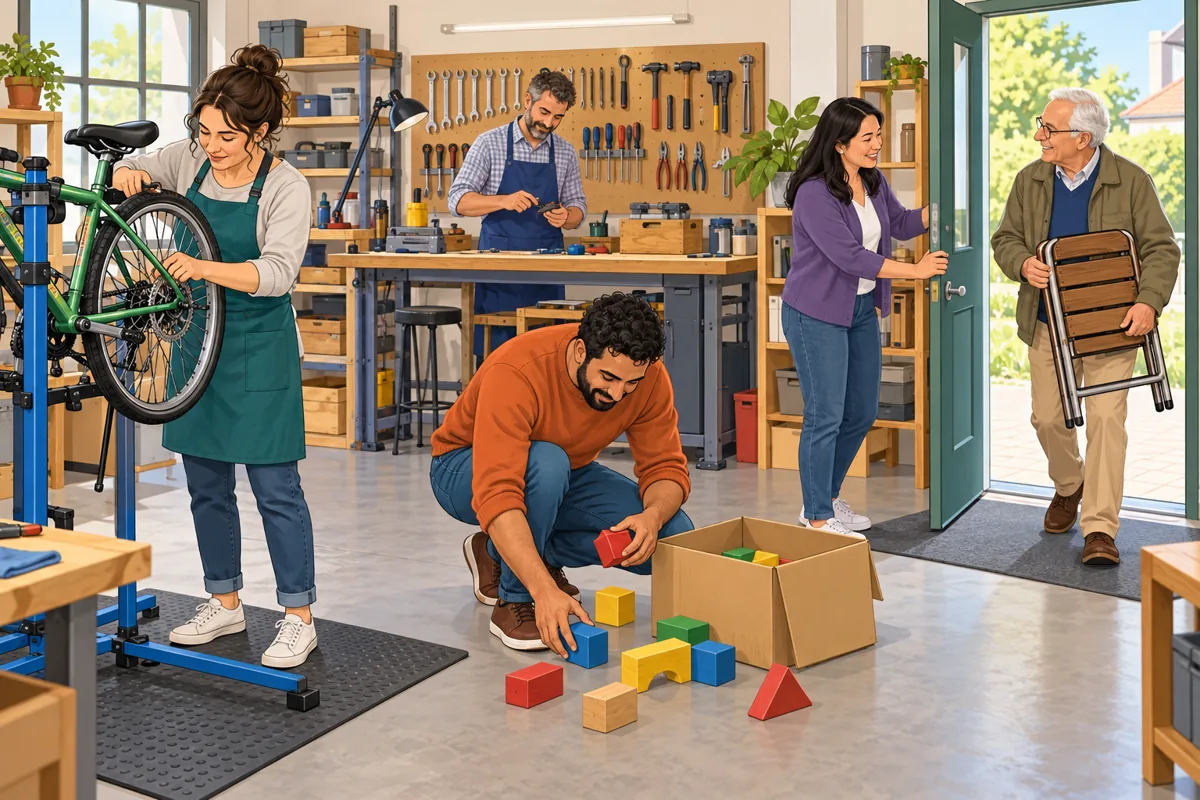
Describe the community repair workshop picture to a friend who cannot see it. Cover the people, their positions, what they are doing, and the general setting. Do not invent additional events beyond the visible details.
Timer practice works without a microphone. Enabling the microphone asks your browser for permission. Recordings stay in this tab; download anything you want to keep.
Show guide and sample responses
Plan your response
- Give an overall setting before listing the details.
- Organize people by position so the listener can picture the scene.
- Use present continuous for visible actions.
- Separate what is visible from guesses about people's identities or motives.
It looks like a community workshop… · On the left, I can see… · In the centre…, while on the right… · At the back of the scene…
Clear and developed model
Original model recording · 39 seconds · approved AEn4U UK voice.
The picture shows a community repair workshop. On the left, a woman in a teal apron is repairing a bicycle at a stand. In the middle, a man wearing an orange sweater is crouching beside an open cardboard box. He is gathering some large wooden blocks from the floor. On the right, a woman in purple is holding a door open for an older man carrying a folded chair. At the back, a man in a blue apron is standing at a tool bench. The tools and work areas give the room a practical feel. Several activities are happening at once, but each person appears to have a particular job.
Why this works: The description follows a left-centre-right-back route and covers every specified person and action. The final impression is cautious and grounded in the visible activities.
Text model only; adapt to your natural pace. Word count does not certify spoken timing or a score.
Alternative model
Original model recording · 36 seconds · approved AEn4U UK voice.
This looks like a shared workshop with several people working around the room. A woman wearing teal is busy with a bicycle on the left. Near the centre, a crouching man in orange is collecting wooden blocks beside a cardboard box. Over by the doorway, a woman in purple is letting an older man through. He has a folded chair in his arms. Another man, wearing a blue apron, is at a tool bench towards the back. There are tools and equipment around the workspaces. I cannot tell exactly what event is taking place, but the picture suggests a place where people repair things and help one another.
Why this works: This version varies the wording and explicitly avoids claiming to know the event's purpose. It describes location and action with clear reference points.
Text model only; adapt to your natural pace. Word count does not certify spoken timing or a score.
Task 4: Making Predictions
Using the same community repair workshop picture, describe what may happen next. Refer to visible details as clues, and make several reasonable predictions. Avoid stating uncertain events as facts.
Timer practice works without a microphone. Enabling the microphone asks your browser for permission. Recordings stay in this tab; download anything you want to keep.
Show guide and sample responses
Plan your response
- Make each prediction connect to a visible clue.
- Use cautious language such as may, might, or could.
- Give two or three related possibilities rather than many unsupported details.
- Finish with the most likely outcome while keeping it uncertain.
Since…, they may… · It looks as though… might… · Once he has…, he could… · I cannot know for sure, but…
Clear and developed model
Original model recording · 36 seconds · approved AEn4U UK voice.
The man in orange will probably finish collecting the wooden blocks and put them into the open box. Moving them off the floor could clear some space around him. On the right, the older man is likely to come through the doorway with the chair, since the woman is holding the door for him. She may step back once he is inside. The woman repairing the bicycle might continue checking it before deciding whether it is ready to use. At the back, the man by the tools could carry on with his work. These seem like likely next steps, although we cannot know from one picture exactly what will happen.
Why this works: Each prediction is tied to a person and visible clue, with modal language signaling uncertainty. It extends the scene without introducing a dramatic or unsupported event.
Text model only; adapt to your natural pace. Word count does not certify spoken timing or a score.
Alternative model
Original model recording · 35 seconds · approved AEn4U UK voice.
I expect the older man will bring his folded chair into the workshop, while the woman in purple keeps the doorway clear. The man in the middle may collect the last of the wooden blocks and move the box to one side. Once the floor is clearer, people should have more room to pass. On the left, the woman might test the bicycle or reach for another tool as she continues repairing it. The person at the back could also choose something from the tool bench. The most immediate changes will probably involve the chair entering the room and the blocks being put away, because those actions are already underway.
Why this works: The response prioritizes the most directly supported next actions and labels the possible conversation as speculation. That distinction keeps the prediction credible.
Text model only; adapt to your natural pace. Word count does not certify spoken timing or a score.
Task 5: Comparing and Persuading
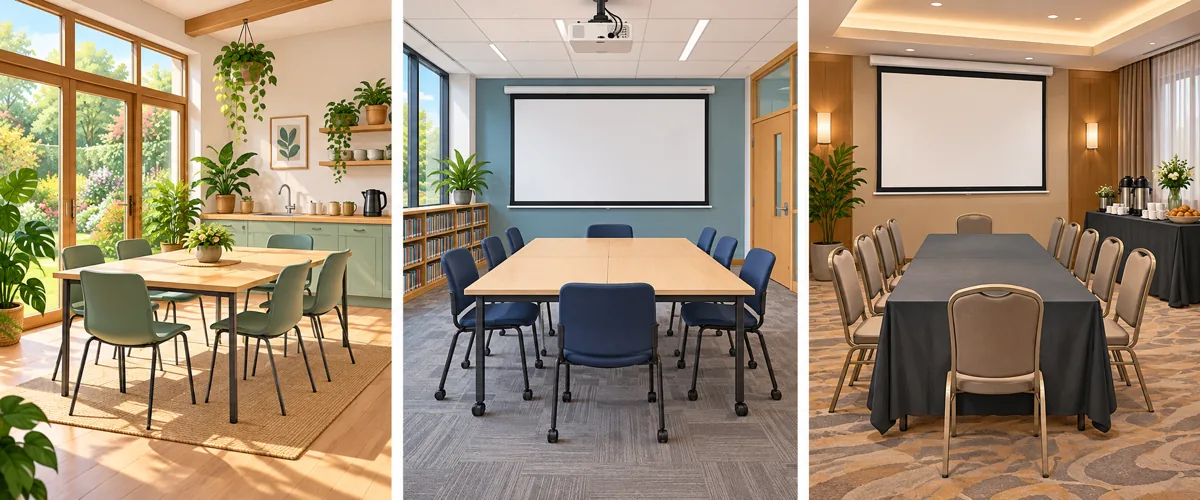
Your neighbour Sam is helping you arrange a three-hour neighbourhood skill-sharing event for 12 people. The venue budget is $300. Choose either Garden Studio or Library Room. After choosing, you will compare your venue with Sam's suggestion and persuade Sam to support your choice. You do not speak during the choosing stage.
Garden Studio
$240 · 12 people · 3 hours
- lift access
- kitchenette
- no projector
Library Room
$160 · 16 people · 3 hours
- step-free access
- projector
- food not allowed
If the choosing timer ends without a selection, Garden Studio is selected. No speaking is required during this stage.
Sam suggests the Hotel Room. Speak directly to Sam and explain why your selected venue is better for this event. Compare relevant features, acknowledge a trade-off, and explain how you would manage it.
Garden Studio
$240 · 12 people · 3 hours
- lift access
- kitchenette
- no projector
Library Room
$160 · 16 people · 3 hours
- step-free access
- projector
- food not allowed
Hotel Room
$360 · 20 people · 3 hours
- step-free access
- projector
- refreshments included
Timer practice works without a microphone. Enabling the microphone asks your browser for permission. Recordings stay in this tab; download anything you want to keep.
Show guide and sample responses
Plan your response
- State your selection early and connect it to the event's needs.
- Use only the listed price, capacity, access, and features when comparing.
- Acknowledge a real advantage of the alternative you cannot select.
- Explain trade-offs clearly; either Garden Studio or Library Room can be justified.
I would choose… because… · For a group of twelve, its capacity… · Compared with the Hotel Room… · Although the other venue offers…, my priority is…
Select A — Garden Studio
Original model recording · 48 seconds · approved AEn4U UK voice.
Sam, I see why the hotel appeals to you, especially with refreshments included, but I would choose the Garden Studio. It costs $240, leaving $60 of our budget for supplies. Its twelve-person capacity matches our group, and the kitchenette could help with drinks during the session. There is lift access too. We would have to organize demonstrations without a projector, but our event can focus on practical activities. The hotel offers a projector and room for twenty, yet its $360 fee exceeds our budget by $60. The studio costs $120 less. Since we only expect twelve people, I think we should keep the smaller venue and spend the remaining money on materials.
Why this works: Addresses Sam directly, compares $240 with $360, preserves the $60 remaining budget, and acknowledges the missing projector. Lift access is stated without assuming every accessibility need is covered.
Text model only; adapt to your natural pace. Word count does not certify spoken timing or a score.
Select B — Library Room
Original model recording · 45 seconds · approved AEn4U UK voice.
Sam, I would book the Library Room instead of the hotel. At $160, it leaves $140 for materials, and its sixteen-person capacity is enough for our twelve guests. Both the library and the hotel offer step-free access and a projector, so we keep those useful features while paying $200 less. I agree that the hotel's included refreshments sound convenient. However, its $360 price is above our $300 budget. Food is not allowed in the library room, so we should explain that when we invite people and plan any snack break elsewhere. The lower price gives us more flexibility for supplies. For this practical event, that seems a better use of our money.
Why this works: Supports choice B with correct differences: $140 remains, and the hotel costs $200 more. Acknowledges refreshments and handles the no-food rule without inventing permission to eat in the library.
Text model only; adapt to your natural pace. Word count does not certify spoken timing or a score.
Task 6: Dealing with a Difficult Situation
You coordinate a neighbourhood skills event. A volunteer tells you shortly before the session that they cannot attend, and their activity has not yet been covered by anyone else. Choose either the event participants or the volunteer as your audience. Explain the situation, propose a practical way forward, and speak in an appropriate tone for that audience.
Timer practice works without a microphone. Enabling the microphone asks your browser for permission. Recordings stay in this tab; download anything you want to keep.
Show guide and sample responses
Plan your response
- Choose one audience and address them directly.
- Be calm and factual without blaming anyone.
- Offer a practical next step and a backup if possible.
- Match the tone to the audience: reassuring for participants, supportive and collaborative with the volunteer.
I wanted to let you know that… · To keep things running smoothly, we can… · Would you be able to…? · Thank you for being flexible/helpful.
Addressing the event participants
Original model recording · 42 seconds · approved AEn4U UK voice.
Hello everyone. One of our volunteers has had to cancel, so we need to change today's schedule. Their activity is not covered yet, but the other confirmed sessions will go ahead. We will begin with introductions and those activities. If anyone has experience with the uncovered topic and feels comfortable helping, please speak to me during the break. There is no pressure to volunteer. If we cannot find a suitable replacement, I will reschedule that activity and let you know the new date. I will confirm the revised order before we start. Thank you for being flexible while we make this change; I want everyone to know what to expect.
Why this works: The announcement is transparent and reassuring, offers a voluntary substitute and a fallback, and avoids blaming the absent volunteer.
Text model only; adapt to your natural pace. Word count does not certify spoken timing or a score.
Addressing the volunteer
Original model recording · 37 seconds · approved AEn4U UK voice.
Thanks for telling me as soon as you could. I understand that plans can change, and I hope everything is all right. Your activity is not covered, so I will start the event with the other sessions and explain the schedule change to participants. If you have an outline you can easily share, it might help us plan a later session. Please do not prepare anything extra now. If we cannot find a suitable replacement today, we will offer the activity another time. We can talk about future dates when things are calmer. For now, please focus on what you need to do, and thank you for the work you have already contributed.
Why this works: The message keeps a respectful tone, requests materials only as an option, and explains how the coordinator will handle participants and future scheduling.
Text model only; adapt to your natural pace. Word count does not certify spoken timing or a score.
Task 7: Expressing Opinions
Some neighbourhood organizations are considering offering practical skill-sharing sessions on weekday evenings, while others prefer weekend sessions. Which schedule do you think is generally better for a community program? Give reasons and examples, and acknowledge one reasonable concern about your view.
Timer practice works without a microphone. Enabling the microphone asks your browser for permission. Recordings stay in this tab; download anything you want to keep.
Show guide and sample responses
Plan your response
- State your position clearly while recognizing that schedules affect people differently.
- Develop two reasons with concrete examples.
- Acknowledge a genuine limitation of your preferred schedule.
- Conclude by connecting your recommendation to the participants' needs.
In general, I would favour… · One reason is that… · For example, people who… · That said, a possible drawback is…
Clear and developed model
Original model recording · 59 seconds · approved AEn4U UK voice.
In general, I would favour weekday evening sessions for a neighbourhood program, especially when the activities are short and practical. One reason is that people who work standard daytime hours can attend without giving up a large part of their weekend. For example, a two-hour repair or budgeting workshop could fit after work and still leave most of the evening free. Weeknight sessions may also create a regular routine, such as meeting on the first Thursday of each month. That said, evenings are not convenient for everyone. Parents may have childcare responsibilities, and people who work shifts could miss the same time each week. I would therefore avoid assuming that one schedule suits the whole community. If the organization can offer some weekend sessions as well, it can reach people with different responsibilities. But if it must start with one option, I would choose weekday evenings and ask participants for feedback after a few sessions.
Why this works: The position is clear, examples support the reasons, and the counterpoint is specific. The closing recommendation includes a way to adapt based on community feedback.
Text model only; adapt to your natural pace. Word count does not certify spoken timing or a score.
Alternative model
Original model recording · 51 seconds · approved AEn4U UK voice.
I think weekend sessions are usually better for neighbourhood skill-sharing, because people often have more time and do not need to rush from work. A longer Saturday session could include a demonstration, practice time, and informal discussion without trying to fit everything into one evening. Weekends may also work for volunteers who have daytime jobs and want to help with setup. However, weekends are valuable personal time, and some residents have family plans, religious commitments, or regular work shifts. For that reason, organizers should not expect everyone to attend every session. They could rotate between a Saturday and a weekday evening, or ask residents which times are most useful before booking a space. My preference is a weekend for the first event because it allows a relaxed start, followed by a schedule shaped by attendance and feedback.
Why this works: This alternative argues the opposite position with relevant examples, then addresses access through rotating times and participant feedback. It avoids claiming that weekends suit everyone.
Text model only; adapt to your natural pace. Word count does not certify spoken timing or a score.
Task 8: Describing an Unusual Situation
You are in an indoor plant shop, speaking to a friend on the phone. Your friend cannot see the scene in this picture. Describe the person and the unusual object they are wearing, and explain what makes the scene surprising.

Timer practice works without a microphone. Enabling the microphone asks your browser for permission. Recordings stay in this tab; download anything you want to keep.
Show guide and sample responses
Plan your response
- Start with the person and the unusual main detail.
- Describe the watering can and the small plant clearly.
- Use light, friendly language without inventing a backstory as fact.
- End with a natural comment or question to your friend.
You will not believe what I can see… · The unusual part is… · He is also carrying… · I wonder whether…
Clear and developed model
Original model recording · 40 seconds · approved AEn4U UK voice.
You will not believe what I can see in this plant shop. A man is walking along the aisle with an enormous terracotta flowerpot upside down on his head. He seems to be wearing it as a hat. The pot is much wider than his head, and a little flowering plant is growing from its top. He is carrying a bright yellow watering can too. Around him, there are ordinary potted plants on shelves, so his outfit almost matches the shop. Still, I have never seen a hat quite like that. Perhaps it is a costume, but I cannot tell. Can you imagine trying to keep that pot balanced while you walk?
Why this works: The description includes the three fixed visual details and keeps the possible explanation open. The final question makes the imagined phone call sound conversational.
Text model only; adapt to your natural pace. Word count does not certify spoken timing or a score.
Alternative model
Original model recording · 35 seconds · approved AEn4U UK voice.
I have just noticed something unexpected among the shelves in this plant shop. There is a man with a huge upside-down flowerpot on his head, almost like a very tall hat. A small plant with flowers is sticking out of the top. As he walks through the shop, he is holding a yellow watering can. Those are ordinary gardening objects, but the way he is wearing the pot makes the scene unusual. I wonder whether he is taking part in a gardening event, although there is nothing that confirms that. You would probably smile if you could see him. Have you ever come across an outfit like that?
Why this works: This response clearly contrasts the ordinary shop setting with the unusual hat and plant. It marks the imagined demonstration as a possibility, not a fact.
Text model only; adapt to your natural pace. Word count does not certify spoken timing or a score.
Finish your practice, then review your attempts and self-assessment.