
Flyers 7 – Test 3 Reading & Writing
100% Original Practice Test
Join a seaside rescue centre open day through original picture tasks, conversations, stories and messages in this seven-part A2 practice test. This A2 reading & writing practice has 7 parts and 50 questions. Complete each part, then submit to grade your work or use Show Answer to review.
Learning guide
Level: A2.
Topic: The Seaside Rescue Centre Open Day
Learning objectives
- Understand familiar A2 words from clear, distinct definitions.
- Read visible details in a picture and decide whether statements are true or false.
- Choose suitable replies and follow connected stories about a community open day.
- Use common A2 grammar and vocabulary in short, familiar texts.
Before you start: Learners should know familiar A2 vocabulary, common past and present forms, simple future, pronouns, prepositions, comparatives and short connected texts.
Teacher tip: Read each sentence or passage all the way through before choosing. For picture questions, check what is clearly shown; for gap questions, use the words around the space.
Reading & Writing strategy: Read the instructions and example first. Use picture details and nearby words as clues, reread the whole sentence, and check spelling before submitting.
Part 1 · 10 questions
Choose the correct words and write them
Choose words from the box to complete the definitions. There is one example. Four words are not needed.
Example: You use this soft piece of cloth to dry your hands or body after a swim. → towel
1. This trained person watches the sea and helps people who get into trouble in the water.
2. A person who comes to see a place for a short time but does not work there.
3. You can carry water or small tools in this round container with a handle.
4. A thick, strong length of twisted material that people can hold or tie.
5. A board or piece of paper with words or a picture that gives people information.
6. The wide area of soft sand beside the sea where people can walk.
7. To bring someone away from danger and help them get to a safe place.
8. You use a brush and coloured liquid to cover a surface with a new colour.
9. A piece of cloth with a picture or colour that can be raised on a pole.
10. Being safe and keeping people away from danger.
Part 2 · 7 questions
Look at the picture and read – yes or no?
Look at the picture. Read the sentences. Write Yes if a sentence matches the picture and No if it does not. There are two examples.
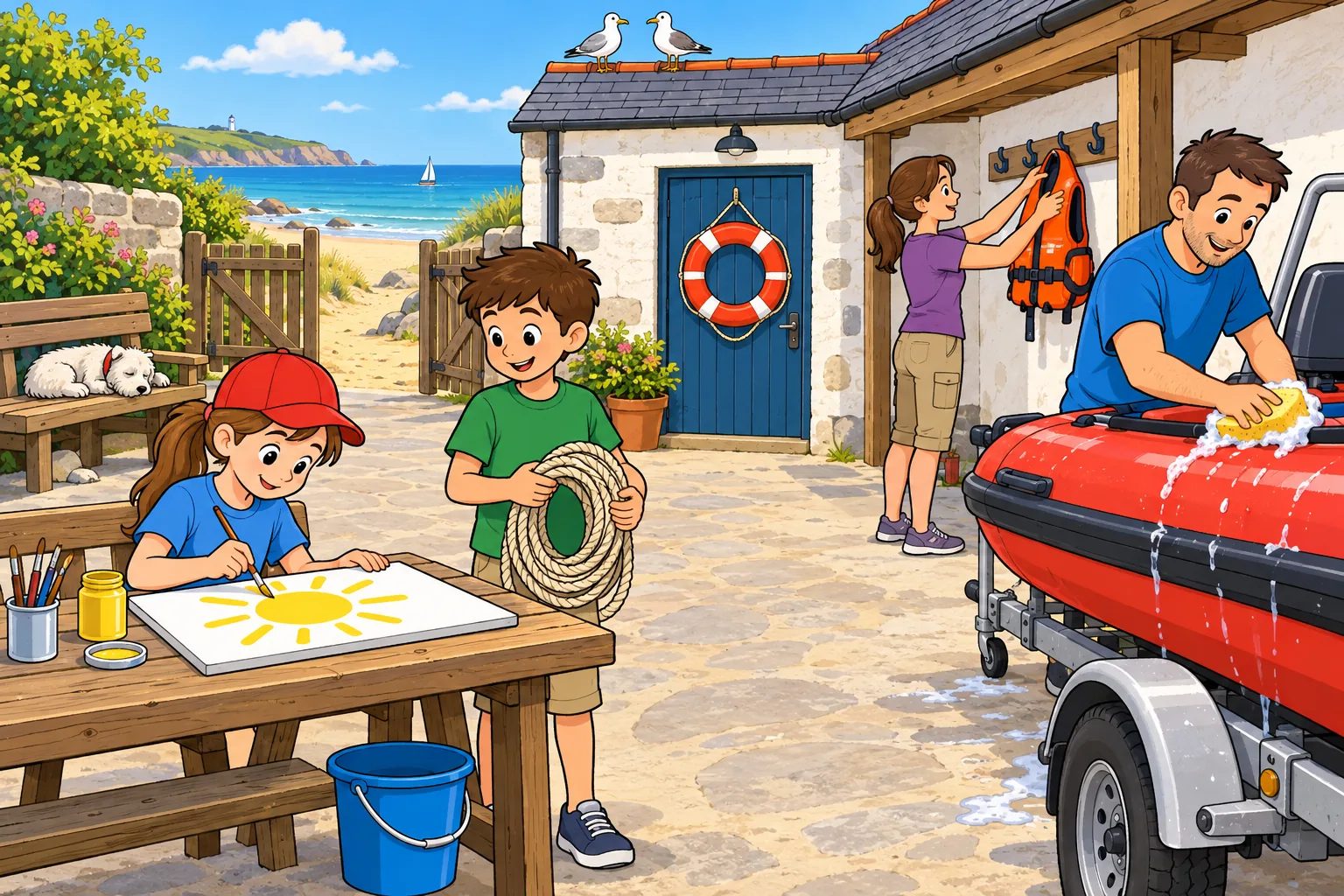
Asha is the girl in the red cap and blue T-shirt. Leo is the boy in the green T-shirt.
Example 1: Asha is painting a yellow sun on a white sign. → Yes
Example 2: The white dog is sleeping under the wooden bench. → No
11. Leo is standing beside the table with a rope in his hands.
12. The woman in the purple shirt is hanging an orange life jacket on the wall.
13. The man in blue is washing a yellow boat beside the centre.
14. There are two seagulls sitting on the roof.
15. The blue bucket is on top of the painting table.
16. A red-and-white ring is hanging on the centre door.
17. The sandy beach is behind a closed gate.
Part 3 · 5 questions
Read the conversation and choose the best answer
Choose a reply from A-H for each question. There is one example. Two replies are not needed.
Read these short conversations between Ella, Finn and the open-day helpers. Choose the reply that best fits each one. Two replies are not needed.
Choose a reply
- It starts at half past two by the front gate.
- Yes, I can carry those paper cups to the table.
- I came with my older sister.
- It's orange, and it hangs on the wall.
- I'm glad you like it; I painted the sun this morning.
- The blue bucket is under the table.
- No, thanks. I brought a bottle of water.
- We saw one yesterday near the harbour.
Example: Ella: Where does the boat talk begin? → It starts at half past two by the front gate.
18. Finn: Can you help me put the cups out for the visitors?
19. Helper: Who came to the open day with you?
20. Finn: Your welcome sign looks lovely!
21. Ella: Do you need a drink before we look at the boat?
22. Helper: Where can I find the blue bucket for the painting table?
Part 4 · 6 questions
Read the story and choose the correct words
Read the story and choose a word from the box for each gap. Use each word once. The example is completed for you; four words are not needed. Then choose the best title.
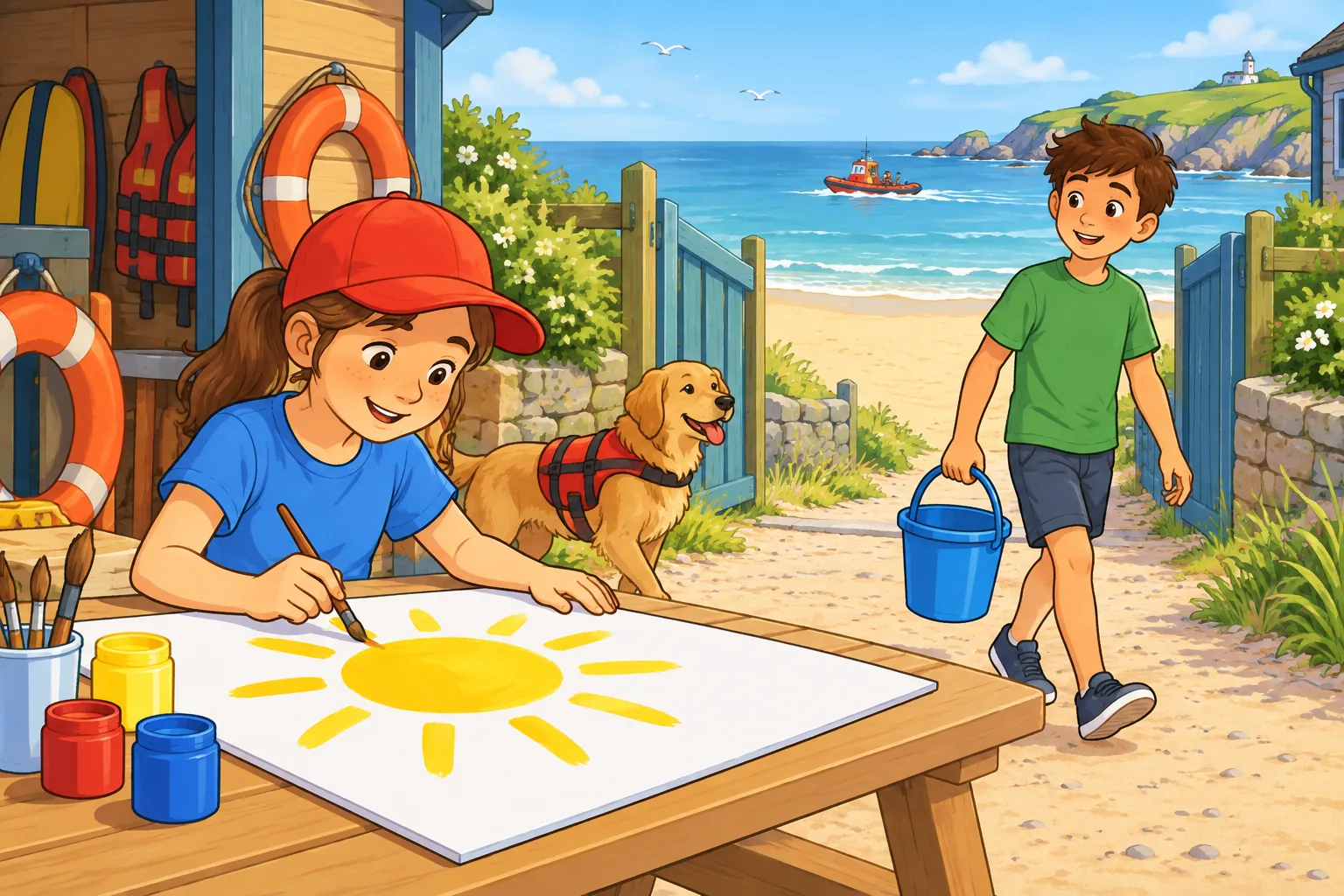
On Saturday, the rescue centre held an open day for local visitors (example). Ella and Finn arrived early to help. They wanted everyone to feel [23] as they came into the courtyard. Ella drew a large sun and painted it [24] yellow. Finn brought a blue bucket of water to wash the brushes. Next, they added a short [25] below the sun to tell people where to find the boat talk. A helper thanked them for working [26] with the paint and brushes. When the sign was ready, the children [27] and carried it to the gate.
Example: On Saturday, the rescue centre held an open day for local ___ . → visitors
28. Choose the best title for the story.
Part 5 · 7 questions
Read the story and complete the sentences
Complete each sentence with one to four words from the story. There is one example.
A Morning at the Rescue Centre
Last Sunday, Maya went to the seaside rescue centre with her uncle. They arrived before the open day began, so a guide named Rowan showed them around. First, Maya saw the red rescue boat resting on its trailer. Rowan explained that the boat was checked after each practice trip. Maya noticed a box beside it and asked what was inside. It held clean towels for visitors who had come in from the beach. Next, they went to a small room where helpers kept maps and spare life jackets. Maya helped Rowan put three folded maps on a shelf near the door. Her uncle listened to a short talk about the centre's work while Maya read a notice about the day's activities. At lunchtime, they sat outside and ate sandwiches. A gentle sea breeze moved the paper napkins, so Maya placed a smooth stone on top of them. Before they left, she thanked Rowan for answering all her questions. She and her uncle promised to return for another open day in summer.
Example: Maya visited the rescue centre with her ___. → uncle
29. The guide who showed Maya around was called ___.
30. The red rescue boat was resting on its ___.
31. The towels in the box were for visitors who had come in from the ___.
32. Maya put three folded maps on a shelf near the ___.
33. Maya's uncle listened to a short talk about the centre's ___.
34. A smooth stone kept the paper ___ from moving in the breeze.
35. Maya and her uncle promised to return in ___.
Part 6 · 10 questions
Read the text and choose the correct word
Choose the correct word for each space. There is one example.
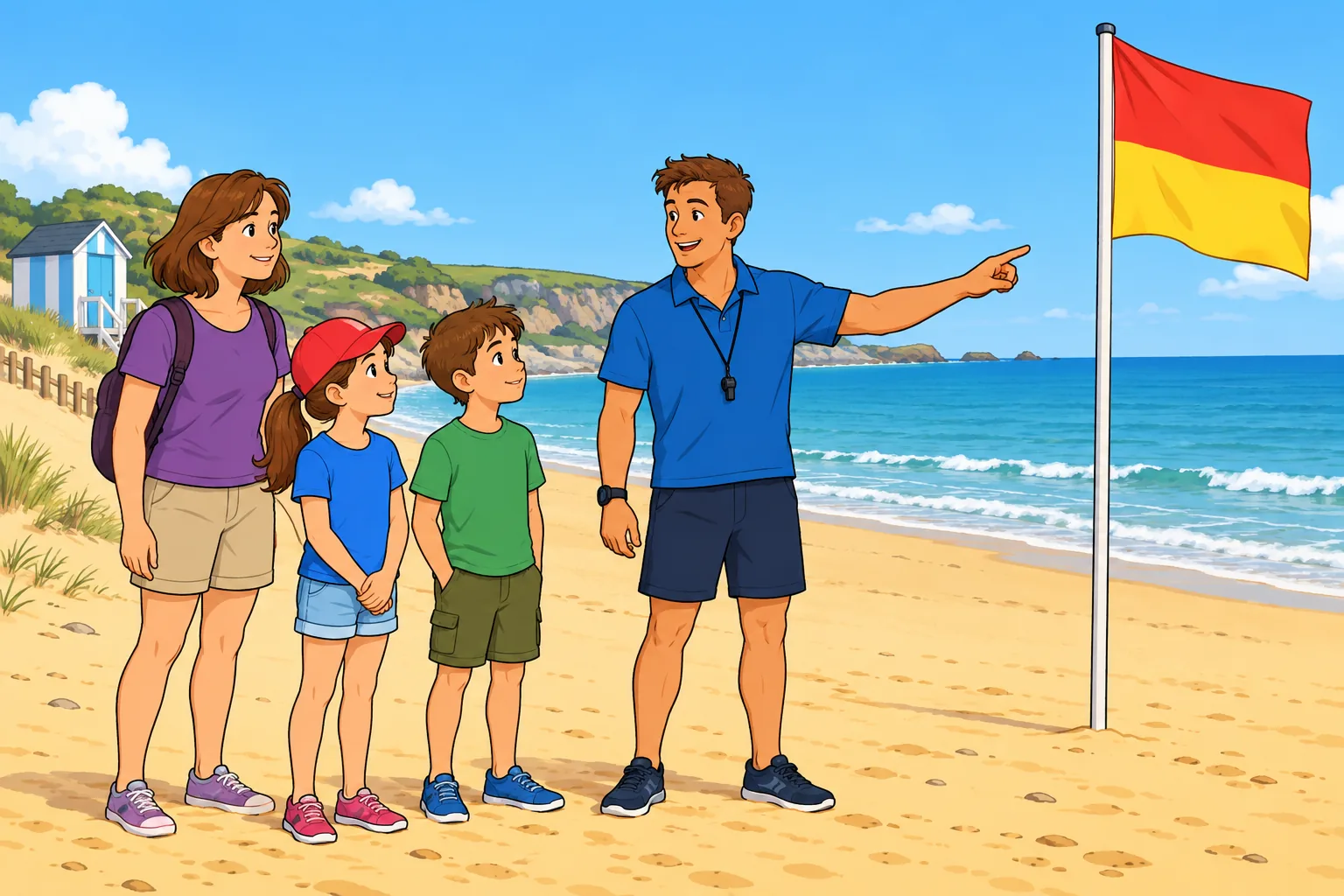
Last Saturday, our group visited (example) the seaside rescue centre. The open day began at noon, and we arrived ten minutes [36] it started. A guide [37] us how the helpers prepared for the event. She spoke [38] so that everyone could hear. Outside, the lifeguard [39] to a red-and-yellow flag on a pole. Two children stood [40] their mother on the dry sand. She asked them to [41] with her while the lifeguard was talking. The guide gave our group a simple map and asked us to look at [42] together. On the map, there was [43] arrow showing the way to the front gate. The centre's door [44] open while families came in. At the end of the visit, we knew [45] about the helpers' work than we had before.
Example: Last Saturday, our group ___ the seaside rescue centre. (visited / visits / visiting) → visited
Part 7 · 5 questions
Complete the thank-you message
Write one word in each space. There is one example.
Dear Rowan,
Thank you for (example) showing us around the rescue centre on Saturday. We took a photo [46] shows everyone beside the red boat. There [47] four people in the photo: you, Mum, my brother and me. We were happy [48] see the sign we had painted near the gate. We hope to return for the next open day. We have already put the date [49] our calendar. Please say thank you [50] all the helpers.
Best wishes, Ella
Example: Thank you ___ showing us around the centre. → for
Ready to check your answers?
Submit to grade your whole test, OR use 👁 Show Answer per part / per question.
Learn from your answers
Answer reasons
- lifeguard — A lifeguard watches over swimmers and can help in an emergency.
- visitor — A visitor comes to a place to look around or take part in an activity.
- bucket — A bucket is a container, often with a handle, that can hold water or other things.
- rope — A rope is a strong cord that can be held or tied.
- sign — A sign displays a short message or picture to tell people something.
- beach — A beach is the land beside the sea, often covered with sand.
- rescue — To rescue someone is to save them from danger.
- paint — Paint is a coloured liquid, and to paint is to put it on a surface.
- flag — A flag is a piece of cloth displayed on a pole.
- safety — Safety means being safe and protected from danger.
- Yes — The boy in the green T-shirt is beside the table holding a rope.
- Yes — The woman in purple is hanging the orange life jacket on a wall hook.
- No — The boat being washed is red, not yellow.
- Yes — The picture shows two seagulls on the roof.
- No — The blue bucket is underneath the painting table.
- Yes — The round red-and-white ring is hanging on the blue door.
- No — The gate is open, and the sandy beach is visible beyond it.
- Yes, I can carry those paper cups to the table. — Finn asks for help with the cups. The speaker agrees and offers to carry them to the table.
- I came with my older sister. — The helper asks who accompanied the child, and the reply names a person.
- I'm glad you like it; I painted the sun this morning. — The reply responds to the compliment and adds a detail about making the sign.
- No, thanks. I brought a bottle of water. — The reply politely refuses a drink and explains that the speaker already has water.
- The blue bucket is under the table. — The question asks where the bucket is, and the reply gives its location.
- welcome — Feel welcome means to feel that people are pleased you have arrived. The children are preparing to greet visitors.
- bright — Bright yellow describes the cheerful colour of the painted sun.
- message — The message gives visitors information about the location of the boat talk.
- carefully — Carefully describes the way the children use the paint and brushes; the other bank words cannot describe how they work here.
- smiled — Smiled fits the happy moment when they finished their sign.
- A Sign for the Open Day — The story describes Ella and Finn making and taking a welcome sign to the rescue centre gate.
- Rowan — The story names the guide Rowan.
- trailer — The story says the boat was resting on its trailer.
- beach — The story states that the clean towels were for visitors who had come in from the beach.
- door — The maps were placed on a shelf near the door.
- work — The story says the talk was about the centre's work.
- napkins — Maya put the stone on the paper napkins to stop the breeze moving them.
- summer — The final sentence says they would return for another open day in summer.
- before — Before links the arrival to the later start of the event. Ago goes after a time phrase and cannot introduce it started; until does not fit this completed arrival.
- told — Use told someone how to describe giving an explanation in this past-tense account.
- clearly — Clearly is the adverb that describes how she spoke.
- pointed — Pointed is the past form required by this account of last Saturday.
- beside — Beside means next to their mother. Between needs two sides or people, and through does not describe standing next to someone.
- stay — Use the base form after to: asked them to stay.
- it — It refers to the one map. They is a subject pronoun and them refers to more than one object.
- an — Arrow starts with a vowel sound, so the singular noun takes an.
- was — Door is singular, and was agrees with it in this past account.
- more — Than signals a comparison. More compares the amount of knowledge before and after the visit.
- that / which — That and which can introduce the clause describing the photo.
- are / were — Four people is plural. Are describes the photo now; were also works when remembering the people at the visit.
- to — Happy is followed by to and the base verb: happy to see.
- on / in — Both on our calendar and in our calendar are natural ways to describe recording a date.
- to — Use say thank you to someone when asking another person to pass on your thanks.
Teacher tip
Read each sentence or passage all the way through before choosing. For picture questions, check what is clearly shown; for gap questions, use the words around the space.