
Flyers 7 – Test 2 Reading & Writing
100% Original Practice Test
Prepare a community radio show, follow a note to find a missing box, record garden birds and complete an original class-radio text and email in this seven-part A2 practice test. This A2 reading & writing practice has 7 parts and 50 questions. Complete each part, then submit to grade your work or use Show Answer to review.
Learning guide
Level: A2.
Topic: Preparing a Community Radio Show
Learning objectives
- Understand short definitions and match them to familiar words.
- Read picture details and a short conversation for meaning.
- Complete stories and factual texts using context, grammar and vocabulary.
- Write short, accurate answers based on information in a text.
Before you start: Learners should know familiar A2 vocabulary, common past and present forms, simple future, pronouns, prepositions, comparatives and short connected texts.
Teacher tip: Ask learners to read each full sentence or passage before choosing an answer. Encourage them to check names, time words and picture details carefully.
Reading & Writing strategy: Read the instructions and example first. Use picture details and nearby words as clues, reread the whole sentence, and check spelling before submitting.
Part 1 · 10 questions
Choose the correct word
Read each definition and write the correct word from the box. There is one example. Four words are not needed.
Example: You speak into this so your voice can be heard by other people. → microphone
1. You wear these over your ears to listen without making the sound loud for everyone.
2. This person introduces a programme and speaks to the listeners.
3. Someone whose house is next to yours, or on the same street, is your ___.
4. You write notes and reminders in this book.
5. A person invited to speak on a programme is a ___.
6. This is a list of the times when programmes will happen.
7. You press this small part of a machine to make something happen.
8. A short piece of information sent to someone is a ___.
9. To save a voice or other sound so it can be heard later is to ___.
10. A place where a radio team makes its programmes is a ___.
Part 2 · 7 questions
Look at the picture and read the sentences
Look carefully at the picture. Write Yes if the sentence is true and No if it is not true. There are two examples.
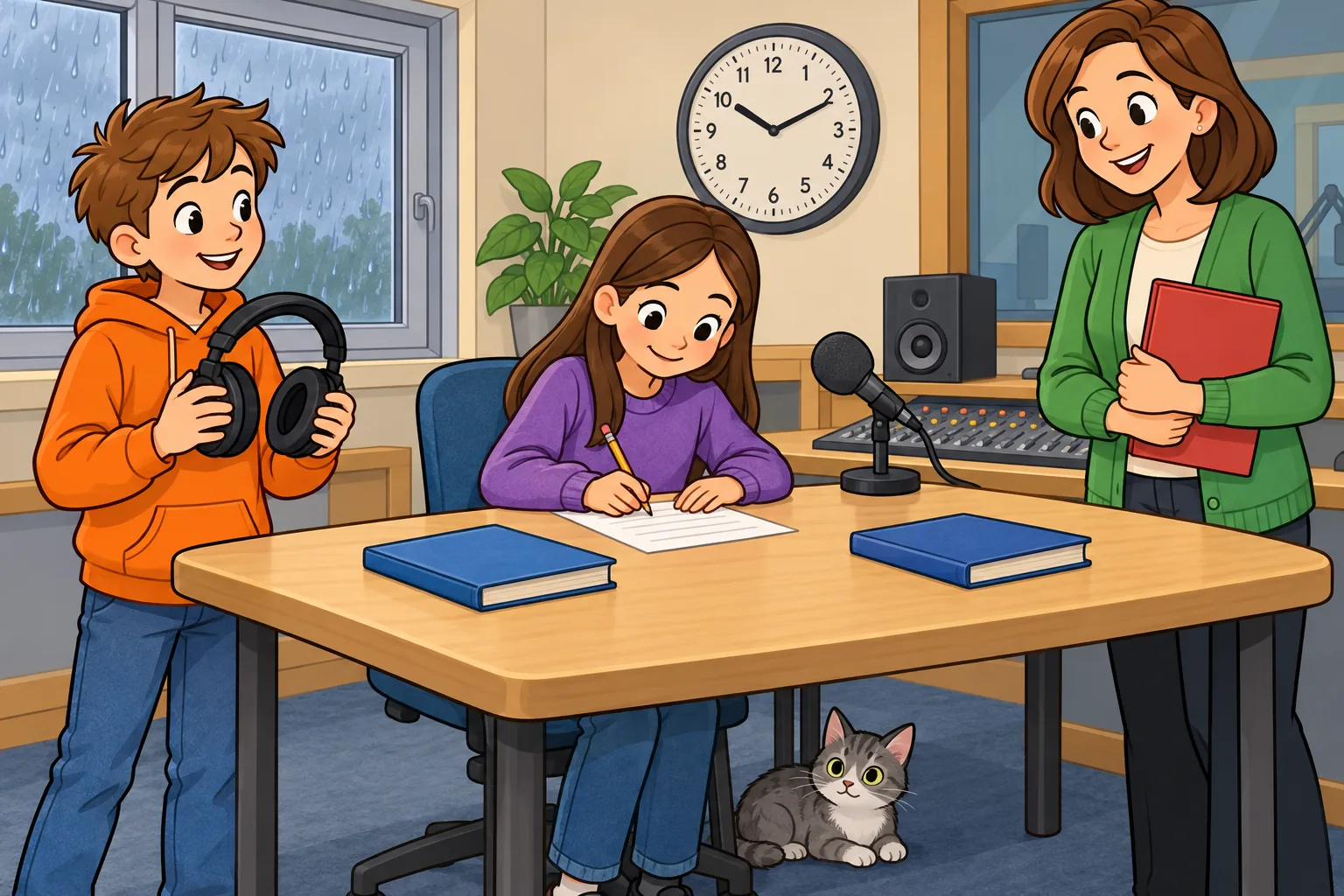
Example 1: The girl is writing with a pencil. → Yes
Example 2: The woman is sitting beside the window. → No
11. The boy is standing on the left and holding headphones.
12. The girl is wearing a green jumper.
13. There are two closed blue books on the table.
14. The grey cat is asleep under the table.
15. The woman is holding a red folder.
16. The round clock is on the table.
17. The window is closed and rain can be seen outside.
Part 3 · 5 questions
Read the conversation and choose the best answer
Choose the best response from the box. There is one example. Two responses are not needed.
Maya and Leo are preparing a short local news show. Mrs Hill, their neighbour, knows about a new footpath. Read their conversation and choose the reply that best fits each question or suggestion.
Choose a reply
- That sounds like a good idea.
- I can ask her after school.
- It starts at half past four.
- Yes, I brought two pencils.
- My uncle travels to work by bus.
- I found it on the low shelf.
- Because the rain stopped.
- No, we have not chosen one yet.
Example: Maya: Have we chosen a name for our little news show yet? → No, we have not chosen one yet.
18. Maya: When can you ask Mrs Hill about the new footpath?
19. Maya: Shall we put the microphone on this small table? Leo: ___
20. Maya: When does our show start? Leo: ___
21. Maya: Where did you find the missing sound-effects box? Leo: ___
22. Maya: Why can we record outside now? Leo: ___
Part 4 · 6 questions
Read the story and choose the correct words
Choose the correct word from the box for each space. There is one example. Four words are not needed.
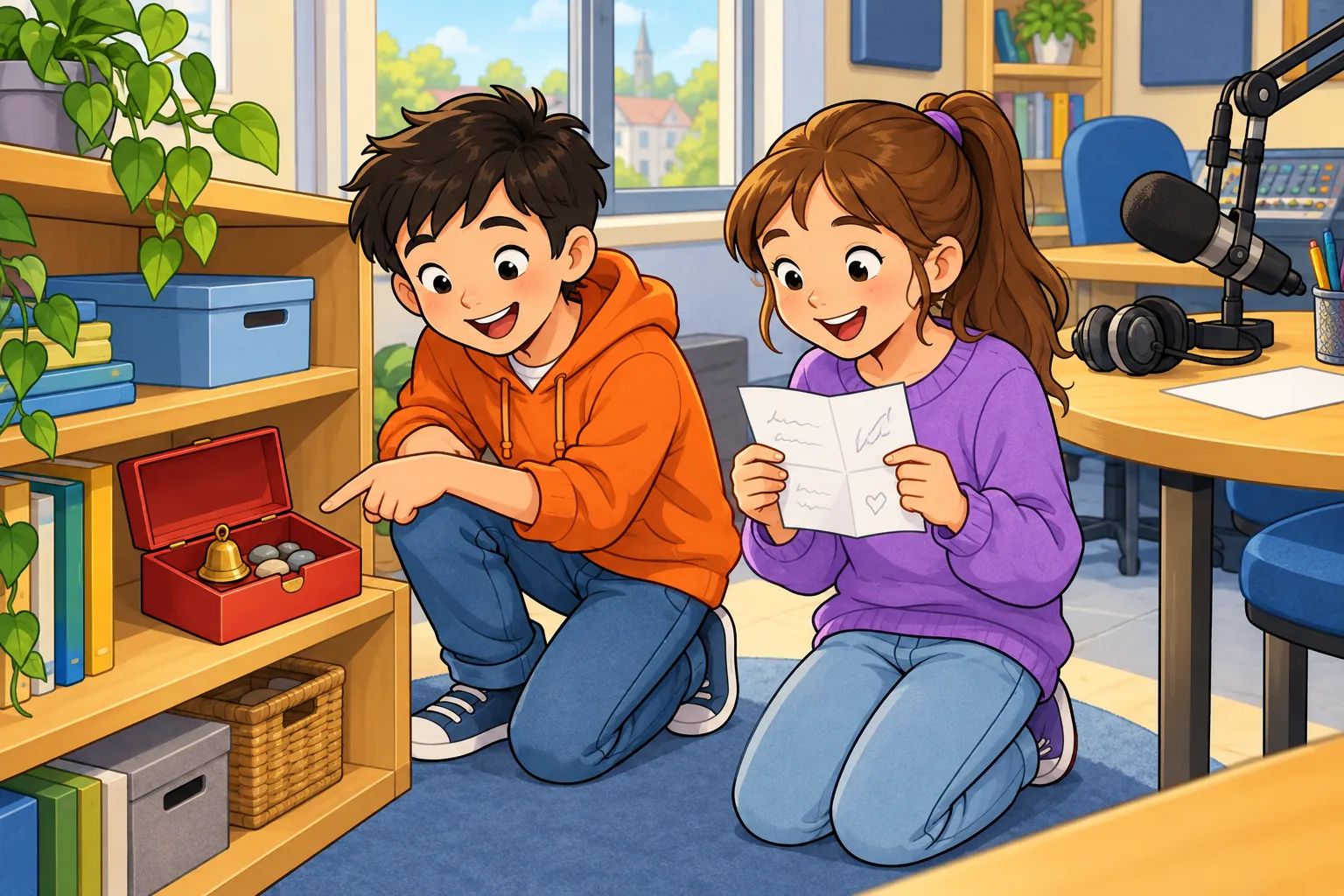
Nora and Sam were helping with the school news show when a small red (example) box disappeared. It held objects the class used to make simple sounds. Nora looked through the [23] at the playground outside, but she could not see the box there. Then Sam spotted a [24] note on the table. Its words had been written with a pencil. It said to look beside the music books. They followed the directions [25] and found the box on a low shelf. Inside, they saw a little [26] that they could ring and some smooth [27] to shake in a bag. Nora smiled because the children could finish their programme. They put everything back in its place before the next class arrived.
Example: Nora and Sam were helping with the school news show when a small ___ box disappeared. → red
28. Choose the best title for the story.
Part 5 · 7 questions
Read the story and complete the sentences
Read the story and complete each sentence with one to four words. There are two examples.
Birds Before Breakfast
On Saturday morning, Rosa went next door to help Mrs Hill make a recording for the community radio show. They wanted listeners to hear the garden birds. Rosa arrived at the garden gate at a quarter to seven. Mrs Hill was waiting with a phone that could record sounds.
They sat quietly beside the kitchen window. The first bird arrived just after seven o'clock. It was a robin, and it landed on the wooden fence. Mrs Hill pressed a button on her phone and held it near the open window. Rosa wrote the time in her diary. For a few minutes, neither of them spoke.
Then a loud noise came from the path. It sounded like rain, but the sky was clear. Mrs Hill's grandson was shaking a paper bag to make a sound for his class play. They laughed and asked him to stop until they had finished recording.
Back in the kitchen, they listened to the birds on the phone. Rosa chose the name "Birds Before Breakfast" for their short programme. Mrs Hill liked the name and made them some toast. On Monday, Rosa would take the recording to school and play it for her friends.
Example 1: Rosa wanted listeners to hear the ___. → garden birds
Example 2: Rosa wrote the time in her ___. → diary
29. Rosa went to Mrs Hill's house on ___.
30. Mrs Hill was waiting with a ___ that could record sounds.
31. The first bird arrived just after ___.
32. The robin landed on the ___.
33. The loud noise was made by someone shaking a ___.
34. The name Rosa chose for the programme was "___".
35. Rosa planned to take the recording to school on ___.
Part 6 · 10 questions
Read the text and choose the correct word
Choose the correct word for each space. There is one example.
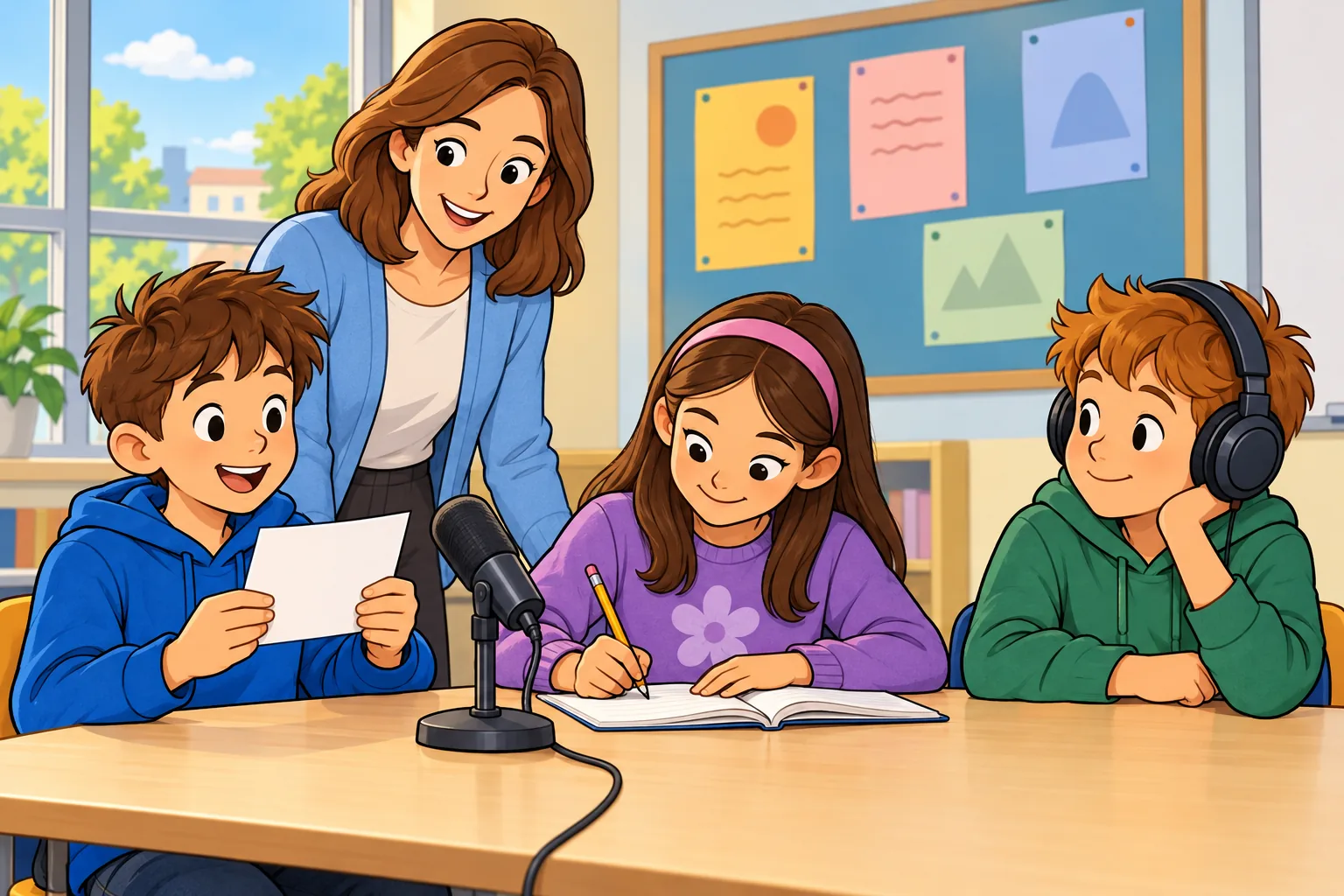
Our class makes (example) a short radio show every month. First, we choose one local story that is interesting [36] our listeners. Each pupil [37] a small job. I write the news [38] my notebook, and Hana checks the names. We speak [39] so that people can understand every word. The teacher is [40] than any of us at asking clear questions, so she helps us practise. We record the show [41] Friday afternoon. Before we begin, everyone [42] their notes once more. Our guest is a gardener [43] works in the park near our school. She tells us [44] the birds that visit her garden. We enjoy making the programme because it [45] our class learn about the neighbourhood.
Example: Our class ___ a short radio show every month. → makes
Part 7 · 5 questions
Complete the email
Write one word in each space. There is one example.
Hi Ben,
I am writing about (example) our class radio show. We made it at school yesterday. This programme was shorter [46] our first one, but it had an interesting guest. Our teacher spoke to a woman [47] grows flowers for the town garden. I was in charge [48] writing down her answers. She told us how she chooses the flowers. Before recording, the teacher asked everyone [49] speak clearly. Our show was not as long [50] last month's programme, so we had time to listen to it twice. I hope you can hear it on Friday!
See you soon, Lily
Example: I am writing ___ our class radio show. → about
Ready to check your answers?
Submit to grade your whole test, OR use 👁 Show Answer per part / per question.
Learn from your answers
Answer reasons
- headphones — Headphones cover the ears and let one person listen privately.
- presenter — A presenter introduces and leads a programme for its listeners.
- neighbour / neighbor — A neighbour is someone who lives near you.
- notebook — A notebook is used for writing notes and reminders.
- guest — A guest is invited to join or speak on a programme.
- schedule — A schedule shows when planned activities or programmes will happen.
- button — Pressing a button can start or control a machine.
- message — A message is a piece of information sent to another person.
- record — To record a sound is to save it so it can be played later.
- studio — A studio is a room or place where programmes are made.
- Yes — The boy in the orange hoodie is at the left, holding the headphones.
- No — The girl is wearing a purple jumper; the woman wears the green cardigan.
- Yes — The picture shows exactly two closed blue books on the table.
- No — The grey cat is awake beneath the table.
- Yes — The woman standing on the right is holding a red folder.
- No — The round clock is on the wall, not on the table.
- Yes — The window is closed, with rain visible outside it.
- I can ask her after school. — Leo offers to ask Mrs Hill after school, which answers when he can speak to her.
- That sounds like a good idea. — Leo agrees with Maya's suggestion. The other replies concern people, times, objects or weather.
- It starts at half past four. — Leo gives the time the planned show starts, which responds to the question about timing in this context.
- I found it on the low shelf. — The question asks where Leo found the missing box; his reply names the low shelf.
- Because the rain stopped. — Leo gives a reason that supports recording outside after the rain has stopped.
- window — A window has glass that you can look through to see the playground outside; the other bank words do not fit this action.
- handwritten — The following sentence says the words were written with a pencil, so the note was handwritten.
- carefully — Carefully describes how they followed the directions on the note.
- bell — The words "that they could ring" identify a bell.
- pebbles — Small smooth stones are pebbles, and they can make a sound when shaken in a bag.
- The Note and the Red Box — Nora and Sam follow a note and find the missing red box.
- Saturday morning — The first sentence gives Saturday morning as the time of the visit.
- phone — Mrs Hill used a phone to record the garden birds.
- seven o'clock / 7 o'clock / seven / 7 — The text says the first bird arrived just after seven o'clock.
- wooden fence / fence — The robin landed on the wooden fence.
- paper bag — Mrs Hill's grandson was shaking a paper bag to make the rain sound.
- Birds Before Breakfast — Rosa named their recording Birds Before Breakfast.
- Monday — The final sentence says she would take it to school on Monday.
- to — Interesting to someone uses the preposition to.
- has — Each pupil is singular, so the present simple form is has.
- in — We write something in a notebook.
- clearly — Clearly is the adverb that describes how we speak.
- better — Than marks a comparison, and the comparative form of good is better.
- on — On is used with a day or a named day period such as Friday afternoon.
- reads — Everyone is singular, so the present simple verb takes -s: reads.
- who — Who refers to a person, the gardener.
- about — Tell us about the birds means give us information about them.
- helps — It is singular, so the present simple verb is helps.
- than — A comparative such as shorter is followed by than when comparing two things.
- who / that — Who or that can introduce a defining clause about the woman.
- of — The expression is in charge of an activity.
- to — Ask someone to do something uses to before the base verb.
- as — The comparison uses not as … as.
Teacher tip
Ask learners to read each full sentence or passage before choosing an answer. Encourage them to check names, time words and picture details carefully.