
Flyers 4 – Test 2 Reading & Writing
100% Original Practice Test
An original seven-part A2 Flyers practice test about helpful children at a seaside centre. This A2 reading & writing practice has 7 parts and 50 questions. Complete each part, then submit to grade your work or use Show Answer to review.
Learning guide
Level: A2.
Topic: Helping at the Seaside Centre
Learning objectives
- Read everyday A2 definitions.
- Use picture details to judge sentences.
- Choose replies and complete short texts.
- Use common A2 vocabulary and grammar in context.
Before you start: Learners should know familiar A2 vocabulary, past and present forms, simple future, pronouns, prepositions, comparatives and short connected texts.
Teacher tip: Read the whole passage before choosing a word. Check the time words and the grammar on both sides of each gap. For picture statements, use the visible action, object or number as evidence.
Reading & Writing strategy: Read the instructions and example first. Use picture details and nearby words as clues, reread the whole sentence, and check spelling before submitting.
Part 1 · 10 questions
Read the definitions and write the words
Choose words from the box. There is one example. Four words are not needed.
Example: A person who lives near your home is your ___. → neighbour
1. A person who watches swimmers and helps them at the beach is a ___.
2. If you pay attention to avoid mistakes, you are being ___.
3. A short piece of information for someone to read is a ___.
4. When you take something back, you ___ it.
5. You walk over a river on a ___.
6. A place with many people in it is ___.
7. When you use your friend's dictionary for a few days and then give it back, you ___ it.
8. You pack clothes in a ___ when you travel.
9. Rain, sunshine and wind are kinds of ___.
10. A place without much noise is ___.
Part 2 · 7 questions
Look and read
Look at the picture. Choose Yes or No. There is one example.
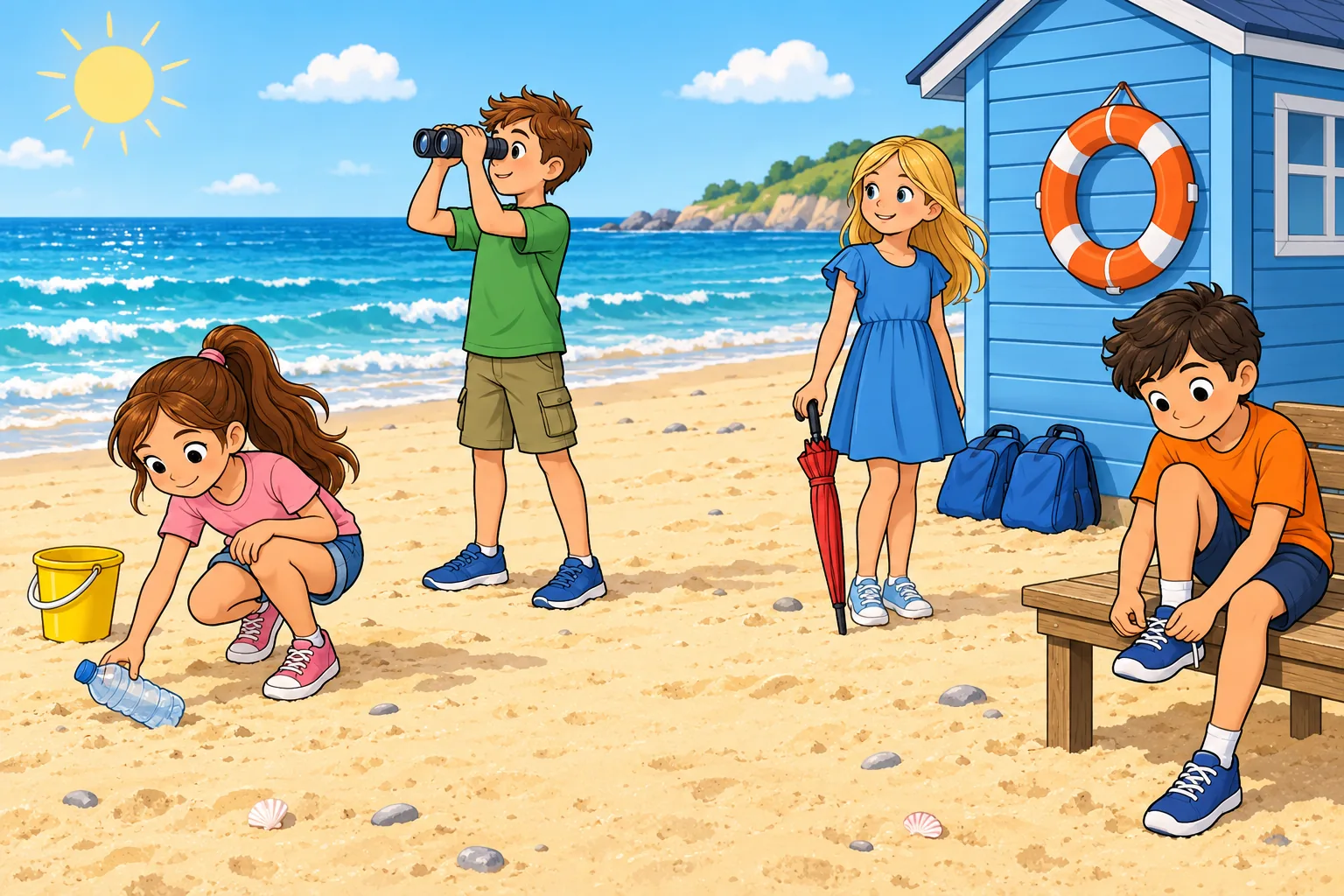
Mia is the girl in a pink T-shirt on the left; Ben is the boy in a green T-shirt in the centre; Ruby is the girl in a blue dress on the right; Sam is the boy in an orange T-shirt at the front right.
Example: Mia is the girl in a pink T-shirt on the left. → Yes
11. Mia is putting the bottle into a blue bag.
12. Mia picks up an empty bottle beside a yellow bucket.
13. Ben looks out towards the sea through binoculars.
14. Ruby carries an open blue umbrella above her head.
15. Sam sits on a wooden bench and ties his shoelace.
16. There are three blue bags beside the hut.
17. An orange and white life ring hangs on the blue hut.
Part 3 · 5 questions
Choose the best response
Choose a reply from the box. There is one example. Two replies are not needed.
Two friends help at the centre and talk about the day.
Choose a reply
- A cheese sandwich and an apple, please.
- No, I left them by the front door.
- The small one with a green handle.
- Because the wind blew it off the table.
- It is beside the blue noticeboard.
- I went there with my aunt last summer.
- At about eleven o'clock.
- We can carry the clean towels together.
Example: Asha: Which brush should I use to clean the sign? → The small one with a green handle.
18. Asha: Where is the shelf for these folded towels?
19. Asha: What time does the welcome talk begin?
20. Asha: Shall we move the clean towels to the shelves?
21. Asha: Why is the information card on the floor?
22. Asha: What would you like for lunch?
Part 4 · 6 questions
Read and complete the story
Choose words from the box. There is one example. Four words are not needed. Then choose the best title.
On Saturday, Eva found (example) a small key near the seaside help hut. She took it to the lost-property desk. A cardboard box stood beside the desk, but there was nothing inside it: it was completely [23]. Eva wrote LOST KEY in large letters on a small [24] and placed it beside the box. Soon a boy arrived. He said he had [25] everywhere for his missing key. He explained that it had fallen out of the front [26] of his shorts. Before handing it over, Eva asked him to describe the key. He said it had a red plastic top. His description matched, so Eva knew that she had found its [27]. The boy thanked her and put the key in his bag.
Example: On Saturday, Eva ___ a small key near the seaside help hut. → found
28. Choose the best title for the story.
Part 5 · 7 questions
Read the story and complete the sentences
Complete each sentence with one to four words. There is one example.
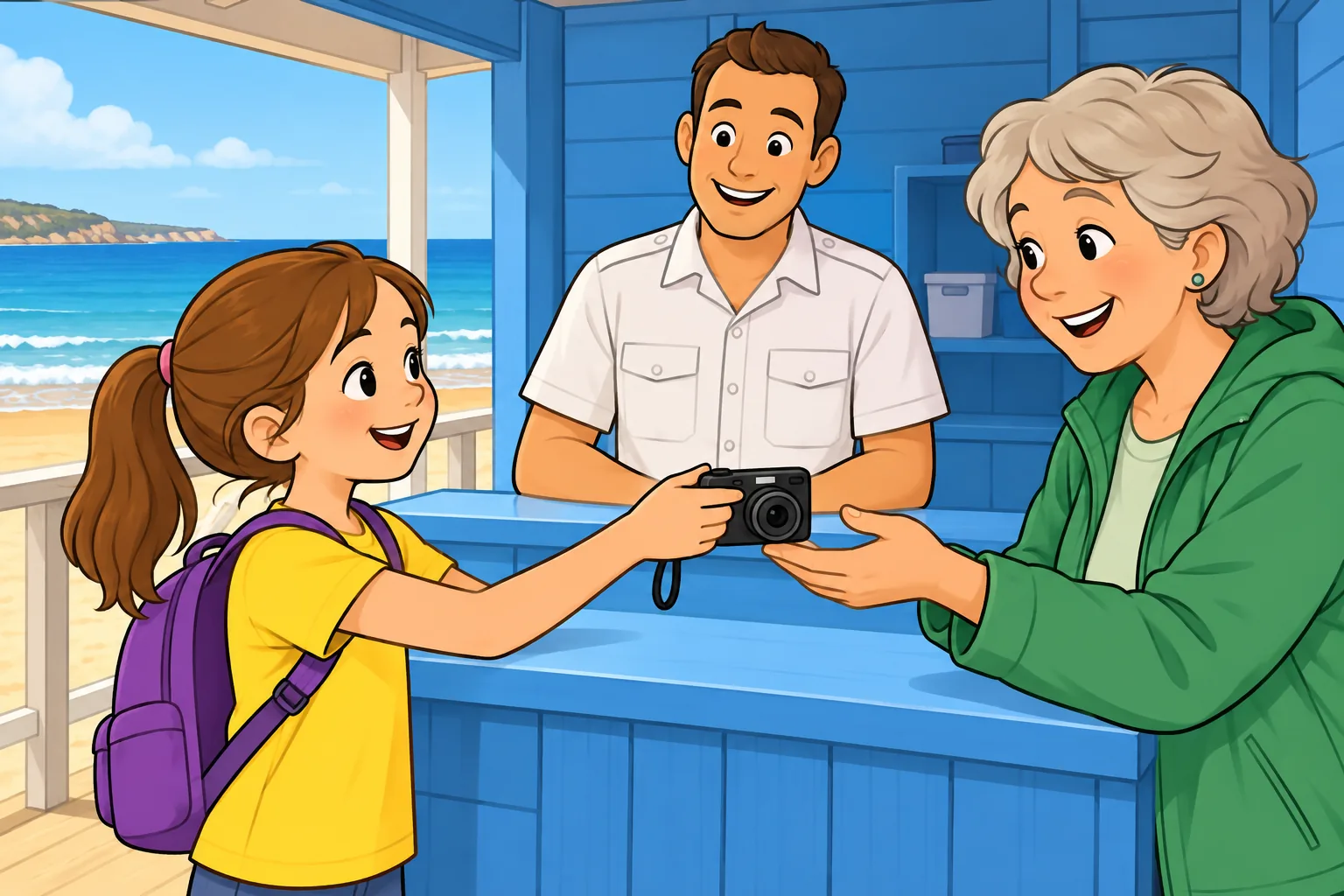
Nia and the Missing Camera
On Sunday afternoon, Nia and her cousin Tom helped at the seaside centre. Tom was arranging leaflets by the door while Nia checked the benches for litter. Under a bench, she noticed a small black camera. At first she thought it belonged to Tom, but he showed her his own red camera.
Nia carried the black camera to the blue help hut. Mr James, the helper behind the desk, wrote down where she had found it. A woman in a green jacket arrived a few minutes later. Her name was Mrs Patel, and she had lost her camera. She described its black strap and a small mark beside the lens. She also said that she had taken family photographs beside the lighthouse that morning.
The details matched, so Nia handed the camera to Mrs Patel. The woman smiled and thanked both children. Before leaving, Nia wrote the time in the lost-property book. Tom said it was a good way to finish their first afternoon of helping visitors.
Example: Nia helped at the centre with her ___. → cousin Tom
29. Nia and Tom helped on ___.
30. Nia found the camera under a ___.
31. The helper behind the desk was called ___.
32. The woman who had lost the camera was called ___.
33. The woman described the camera's black ___.
34. The family photographs were taken beside the ___.
35. Nia wrote the time in the ___ book.
Part 6 · 10 questions
Choose the correct word
Choose the correct word for each space. There is one example.
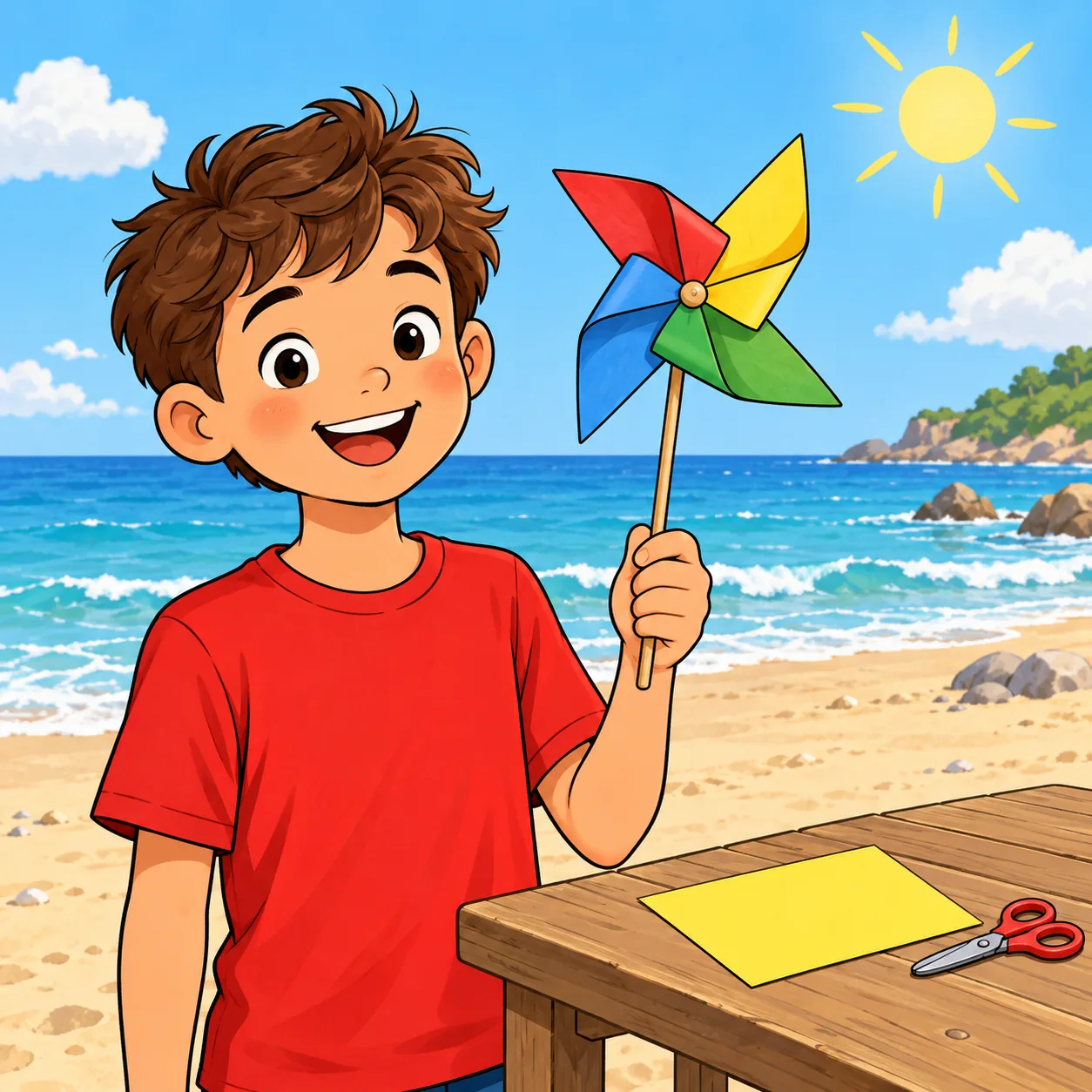
Last Saturday, Max made (example) a paper windmill at the seaside craft club. First, he [36] a square sheet of paper from a tray. Mrs Bell, [37] led the club, showed the class what to do. Max worked [38] because he wanted the paper to stay neat. His sister gave [39] a wooden stick for the handle. Their windmill was [40] than the teacher's large one. An adult helped to fix the paper to the stick. There [41] four colourful blades on the finished toy. It started to turn [42] Max held it in a gentle breeze. Moving air pushes against the folded blades and makes them turn. Max was proud [43] the toy because he had helped make it. He did not want [44] get the paper wet, so he kept it away from the waves. Next week, he [45] bring it to his class and show his friends.
Example: Last Saturday, Max ___ a paper windmill at the seaside craft club. → made
Part 7 · 5 questions
Complete the text
Write one word in each space. There is one example.
Dear Jay,
Our class went to (example) the seaside help centre on Friday. At the desk, there was a box full [46] clean towels. We sorted both umbrellas [47] sunglasses on the lost-property shelf. A small blue bag was heavier [48] a large yellow one because it held several books. Our teacher asked us [49] help with a welcome sign, so we took turns drawing and writing. By lunchtime, we were as busy [50] the helpers! I liked meeting the visitors and hearing their stories. I hope our class can visit again next month.
See you soon, Nora
Example: Our class went ___ the seaside help centre on Friday. → to
Ready to check your answers?
Submit to grade your whole test, OR use 👁 Show Answer per part / per question.
Learn from your answers
Answer reasons
- lifeguard — A lifeguard watches swimmers and helps people.
- careful — Careful describes someone who pays attention.
- message — A message gives information to another person.
- return — Return means to take or give something back.
- bridge — A bridge crosses over a river.
- crowded — Crowded describes a place with many people.
- borrow — Borrow means to use something belonging to someone else and return it afterwards.
- suitcase — A suitcase carries clothes on a trip.
- weather — Weather describes conditions such as rain and wind.
- quiet — Quiet means there is little noise.
- No — Mia is picking up the bottle beside a yellow bucket. The blue bags are beside the hut.
- Yes — The girl in pink picks up the empty bottle, with the yellow bucket next to her.
- Yes — The boy in green holds binoculars to his eyes and faces the sea.
- No — Her umbrella is red and closed, and it points downwards at her side.
- Yes — The boy in orange is seated on the wooden bench with his hands at a shoelace.
- No — There are two blue bags beside the hut, not three.
- Yes — The circular life ring has orange and white sections and hangs on the hut wall.
- It is beside the blue noticeboard. — It refers to the shelf, and the reply tells Asha where that shelf is.
- At about eleven o'clock. — The reply gives the time the talk begins.
- We can carry the clean towels together. — The reply agrees to help move the towels.
- Because the wind blew it off the table. — The reply explains how the card fell.
- A cheese sandwich and an apple, please. — The reply says what Leo would like to eat.
- empty — Nothing was inside the box, so empty is the only suitable description.
- sign — A sign displays a message for other people to see.
- searched — Search for something means to look for it; had searched fits his earlier search.
- pocket — A pocket is the small part of clothing used to carry things.
- owner — The boy described the key correctly, showing that it belonged to him.
- The Key at the Help Desk — Eva takes a lost key to the help desk and checks that the right person receives it.
- Sunday afternoon / Sunday — The opening sentence identifies Sunday afternoon as the time of their visit.
- bench — Nia noticed the camera underneath a bench while checking for litter.
- Mr James / Mr. James — The story names the helper who records where the camera was found.
- Mrs Patel / Mrs. Patel — Mrs Patel arrives at the desk and explains that her camera is missing.
- strap — Mrs Patel mentions the black strap and a mark beside the lens to identify her camera.
- lighthouse — Mrs Patel says that she took the family photographs beside the lighthouse that morning.
- lost-property / lost property — The final paragraph says that Nia records the time in the lost-property book.
- took — The story begins last Saturday, so the past form took follows that past-time setting.
- who — Who introduces extra information about Mrs Bell, a person.
- carefully — The adverb carefully describes how Max worked.
- him — Gave needs an object pronoun for Max: him.
- smaller — Than requires the comparative smaller when the two windmills are compared.
- were — Four blades is plural, and the story is in the past, so were fits.
- when — When introduces the event that caused the windmill to start turning.
- of — Proud of is the expression used to show pleasure in an achievement.
- to — Want is followed by to and the base verb get.
- will — Next week refers to the future; will is followed by the base verb bring.
- of — Full of describes what fills a container.
- and — Both … and … connects the two kinds of lost property.
- than — Than follows the comparative heavier to introduce the second bag.
- to — Ask someone to do something uses to before the base verb.
- as — As … as … compares the children and the helpers equally.
Teacher tip
Read the whole passage before choosing a word. Check the time words and the grammar on both sides of each gap. For picture statements, use the visible action, object or number as evidence.