
Flyers 4 – Test 1 Reading & Writing
100% Original Practice Test
An original seven-part A2 Flyers Reading & Writing practice test about a children's radio workshop and recording a short programme. This A2 reading & writing practice has 7 parts and 50 questions. Complete each part, then submit to grade your work or use Show Answer to review.
Learning guide
Level: A2.
Topic: The Children's Radio Workshop
Learning objectives
- Understand familiar words for people, places and simple recording equipment.
- Compare short statements with a detailed picture and a story.
- Choose suitable replies in a connected conversation.
- Complete short texts using A2 vocabulary, grammar and common one-word patterns.
Before you start: Learners should be familiar with everyday A2 vocabulary, present and past forms, common prepositions, conjunctions, comparatives and short connected texts.
Teacher tip: Read the whole text before choosing a word. In the picture task, check each child's clothing, position and action against the sentence.
Reading & Writing strategy: Read the instructions and example first. Use picture details and nearby words as clues, reread the whole sentence, and check spelling before submitting.
Part 1 · 10 questions
Read the definitions and write the words
Choose words from the box to complete the definitions. There is one example. Four words are not needed.
Example: You use this to take photographs of people or places: a ___. → camera
1. You put these over your ears to hear a recording without playing it aloud: ___.
2. You press the letter keys on this to type your story into a computer: a ___.
3. You move this small computer tool on your desk and click its buttons: a ___.
4. This computer folds shut, and you can carry it from room to room: a ___.
5. This flat part of a computer shows the pictures and words you are looking at: a ___.
6. You hold this small string instrument under your chin and play it with a bow: a ___.
7. You hit the top of this musical instrument with sticks to make a beat: a ___.
8. This has hands that move round a face to show you the time: a ___.
9. This small book has blank pages for writing your plans and ideas: a ___.
10. This piece of furniture has a back and a seat for one person: a ___.
Part 2 · 7 questions
Look and read
Look at the picture. Read the sentences and choose Yes or No. There is one example.
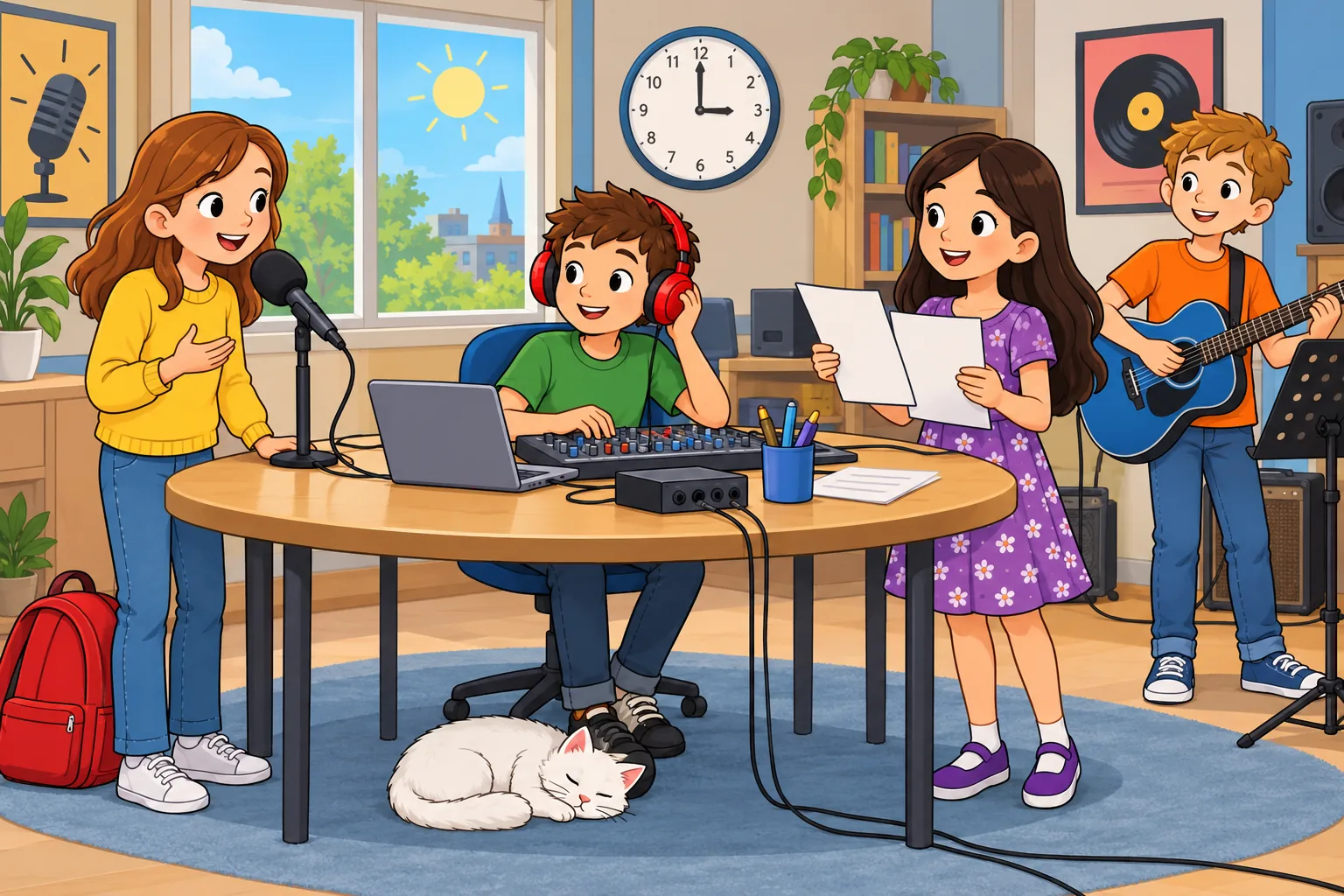
Mia is the girl in the yellow sweater on the left; Leo is the boy in the green T-shirt in the centre; Ruby is the girl in the purple dress on the right; Sam is the boy in the orange shirt at the back right.
Example: Leo is sitting in the centre and wearing red headphones. → Yes
11. Mia is speaking into a black microphone on the table.
12. Leo is standing beside the table.
13. Ruby is holding two white sheets of paper.
14. Sam is holding a blue guitar at the back right.
15. The round clock shows four o'clock.
16. The white cat is sleeping on the table.
17. A red backpack is on the floor by Mia.
Part 3 · 5 questions
Choose the best response
Read the conversation and choose the best response from the box. There is one example. Two responses are not needed.
Mia and Leo are planning a short programme at their children's radio workshop.
Choose a reply
- I brought some sandwiches in my blue bag.
- Let's record it once more, a little more slowly.
- Because Sam has to take his guitar home.
- We could begin with a welcome and say our names.
- The workshop closes at six o'clock.
- Yes, Ruby has written three questions for us.
- It is on the small table beside the window.
- My favourite part is the animal story.
Example: Mia: Where is the microphone? → It is on the small table beside the window.
18. Mia: What should we say at the start of the programme?
19. Mia: Has Ruby prepared any questions for the interview?
20. Mia: I spoke too quickly in that recording. What can we do?
21. Mia: Which part of our show do you like best?
22. Mia: Why is Sam leaving before we finish?
Part 4 · 6 questions
Complete the story
Choose words from the box to complete the story. There is one example. Four words are not needed. Then choose the best title.
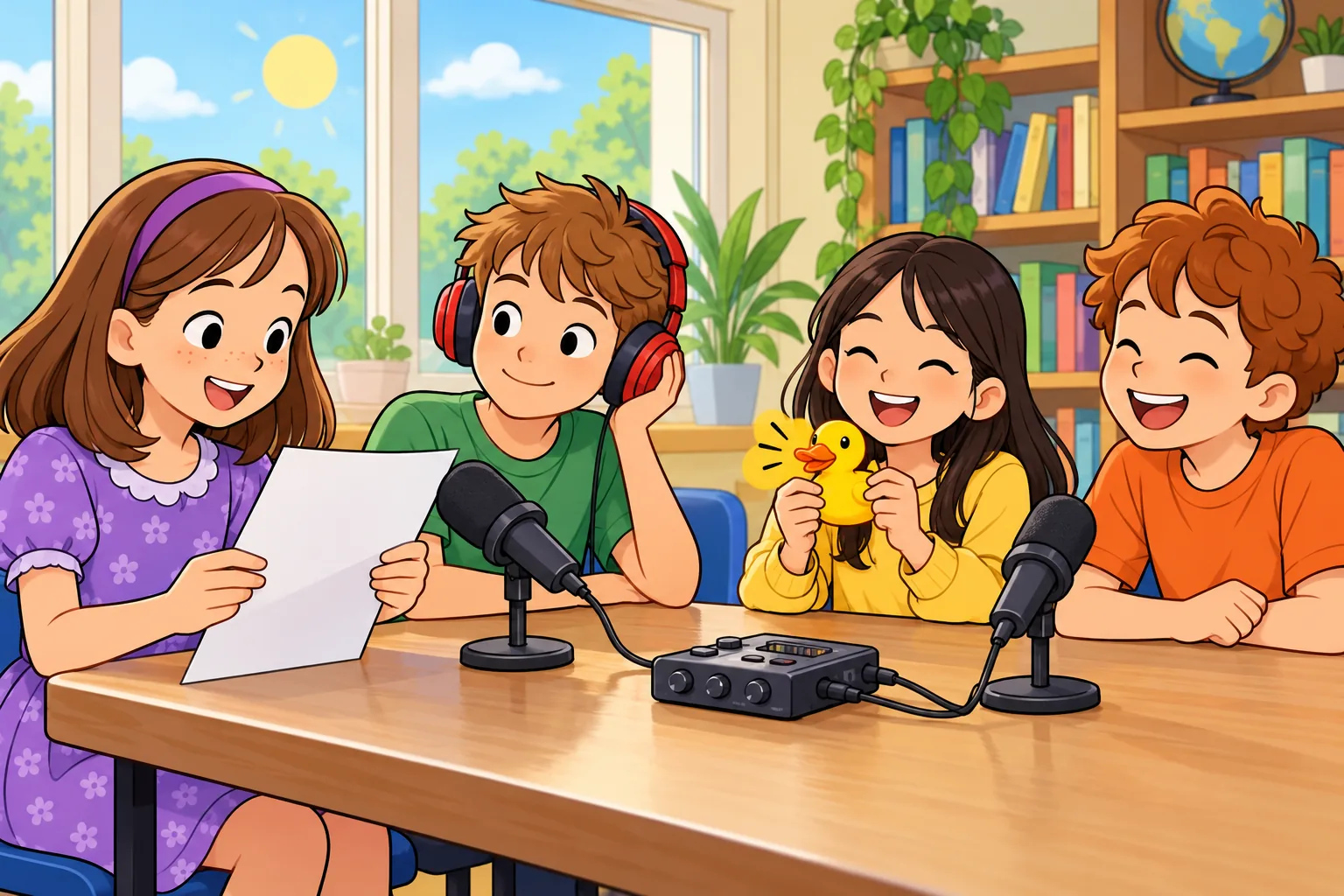
The children at Maple Street Radio Club wanted to make a short story programme. First, they wrote a script (example) about a lost dog. Ruby read it aloud while Leo listened. At first, everyone spoke too [23], so their words were difficult to understand. Their teacher asked them to speak more [24] and leave a little space between sentences.
Next, Mia squeezed a toy duck to add a funny sound to the story. It made Sam [25], and the others joined in. They recorded the story [26] because one line was missing from the first version. After listening together, they were [27] to share the programme with their families.
Example: First, they wrote a ___ about a lost dog. → script
28. Choose the best title for the text.
Part 5 · 7 questions
Read the story and complete the sentences
Read the story. Complete each sentence with one to four words from the text. There is one example.
The Missing Sound
On Friday afternoon, the children at Willow Radio Club stayed after school to record a short programme. They had written a story about a tiny boat that travelled down a river. Leo was going to read it, and Ruby was in charge of the sound effects. Their teacher, Mr Hall, helped them set up the microphone and check the recording machine.
Before they began, Ruby looked in her bag for a small bell. She wanted to ring it when the boat reached a bridge in the story. The bell was missing. Sam remembered seeing it beside the piano in the music room, so he went to look. While he was away, Leo practised reading the first page. He spoke clearly, but he paused at the wrong place and made the story sound funny.
Sam returned with the bell just as Mr Hall showed Leo where to pause. Ruby rang the bell softly, and they recorded the story from the beginning. This time, Leo read at a steady speed and everyone listened carefully. They played the recording back and heard a little noise at the end. Mia had moved her chair too close to the microphone. She moved it away, and they made one final recording.
The children saved the best version with the title “The Little Boat”. Mr Hall said they could play it at the school meeting next week. The group packed the bell and the other equipment into a box. They were pleased because they had worked together and finished their programme before going home.
Example: The children stayed after school on ___. → Friday afternoon
29. The children recorded a story about a tiny ___.
30. Ruby was in charge of the ___.
31. Ruby wanted to ring the bell when the boat reached a ___.
32. Sam thought he had seen the bell beside the ___ in the music room.
33. Mia moved her chair because it was too close to the ___.
34. The children saved the best version with the title ___.
35. They could play the programme at the school ___ next week.
Part 6 · 10 questions
Choose the correct word
Read the text and choose the correct word for each space. There is one example.
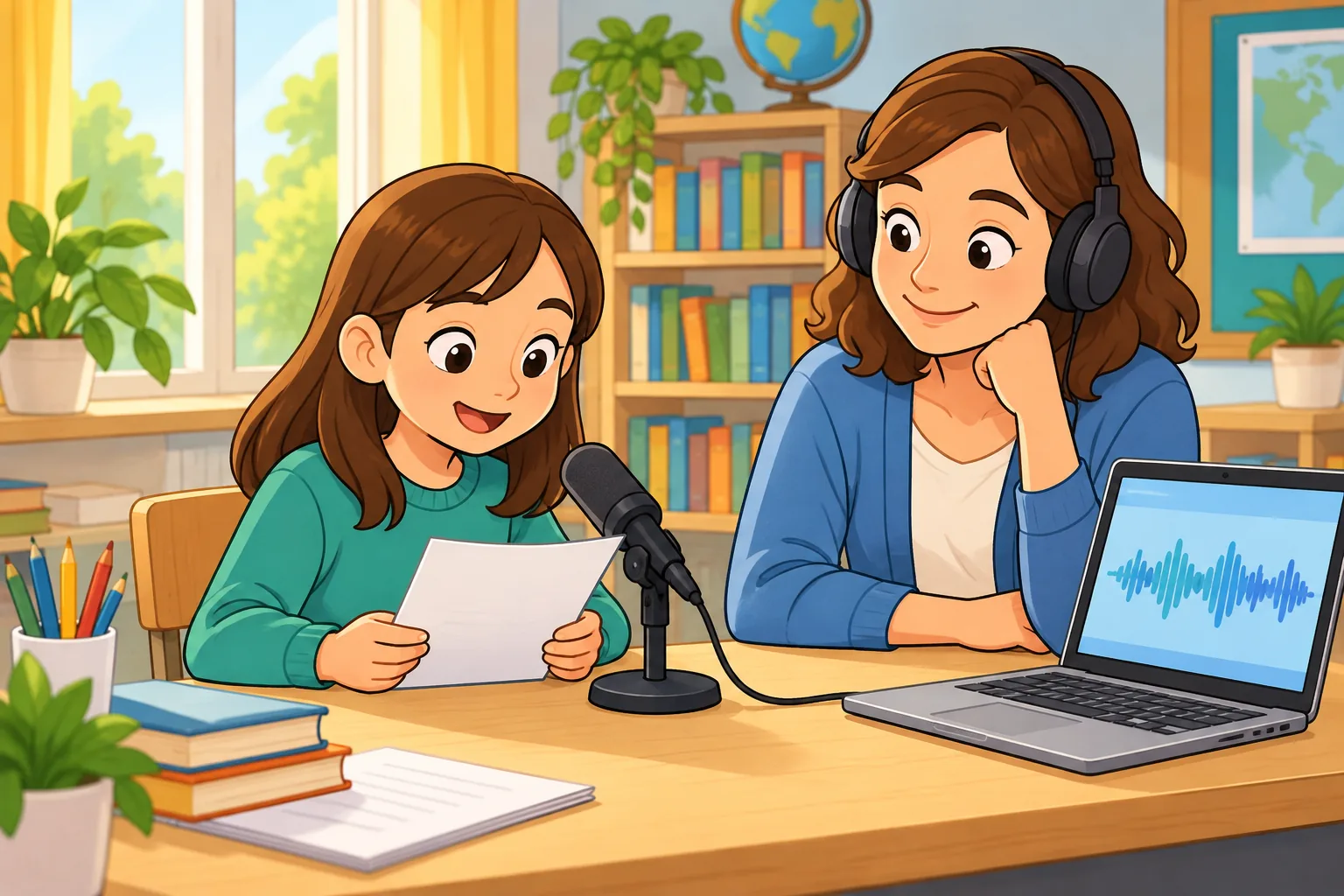
A radio programme can be made by a small team. First, the children decide what (example) the show will be about. They write a short plan and choose who will speak. Before recording, everyone should sit [36] and listen to the instructions. The speaker needs to talk [37] enough for every word to be recorded, but not too loudly.
A recording machine saves the sound [38] the children can play it again. They may hear a mistake and make a new recording. If two people speak [39] the same time, their voices can be hard to understand. It helps [40] take turns. A quiet room is usually [41] than a noisy one for recording voices.
Children can add a short piece of music [42] the beginning or end. They should check that the music is not [43] loud. After the programme is finished, the group can listen [44] it together. They might notice a sound that they did not [45] while recording. Then they can decide whether to make another version.
Example: First, the children decide ___ the show will be about. → what
Part 7 · 5 questions
Complete the text
Read the text and write one word in each space. There is one example.
Hi Ella,
Our radio workshop was great today. We met at (example) the library at ten o'clock and made a short programme about music. First, our teacher showed us how [46] use the recording machine. I read a poem, and Leo played his guitar. We were proud [47] our finished show. It sounded much better [48] our first try last week. Ruby brought a story about a duck. It was [49] funniest story in our programme, and everyone laughed. We will play the programme for our class on Friday. I hope both you [50] your sister can come!
See you, Mia
Example: We met ___ the library at ten o'clock. → at
Ready to check your answers?
Submit to grade your whole test, OR use 👁 Show Answer per part / per question.
Learn from your answers
Answer reasons
- headphones — Headphones play sound directly to your ears.
- keyboard — A keyboard has keys for typing letters.
- mouse — A computer mouse lets you point and click.
- laptop — A laptop is a portable computer that folds closed.
- screen — A screen displays pictures and words.
- violin — A violin is held under the chin and played with a bow.
- drum — A drum makes a beat when you strike it.
- clock — The hands of a clock show the time.
- notebook — A notebook has pages for writing notes.
- chair — A chair provides a seat for one person.
- Yes — Mia stands on the left and speaks into the black microphone on the table.
- No — Leo is sitting in the centre.
- Yes — Ruby stands on the right with two white sheets.
- Yes — Sam is at the back right and holds a blue guitar.
- No — The clock shows three o'clock.
- No — The cat is asleep under the table.
- Yes — The red backpack is on the floor beside the girl on the left, Mia.
- We could begin with a welcome and say our names. — This suggests suitable words for the beginning of a programme.
- Yes, Ruby has written three questions for us. — This directly answers whether Ruby prepared questions.
- Let's record it once more, a little more slowly. — The reply suggests making another slower recording.
- My favourite part is the animal story. — This reply names the part Leo likes best.
- Because Sam has to take his guitar home. — This reply gives a reason for Sam leaving early.
- quickly — Quickly describes the speed of their speaking.
- slowly — The children spoke too quickly, so the teacher asked them to slow down.
- laugh — The funny sound made Sam laugh.
- again — Again means they made another recording.
- ready — Ready means prepared to do something.
- A Story for the Radio — The text is about the children writing, recording and sharing a short story programme.
- boat — The story they had written was about a tiny boat.
- sound effects — The first paragraph says Ruby was in charge of the sound effects.
- bridge — She planned to ring it when the boat reached a bridge.
- piano — Sam remembered seeing the bell beside the piano.
- microphone — The text says Mia had moved her chair too close to the microphone.
- The Little Boat — The story says the best version was saved with that title.
- meeting — Mr Hall said they could play it at the school meeting.
- quietly — Quietly describes sitting without making noise.
- clearly — Clearly is the adverb describing how the speaker talks.
- so — So connects saving the sound with the result: it can be played again.
- at — At the same time is the correct time expression.
- to — It helps to is followed by the base form of a verb.
- better — Than signals a comparison; the comparative of good is better.
- at — At the beginning or end is the natural phrase here.
- too — Too loud means louder than is wanted.
- to — Use listen to followed by the thing you hear.
- hear — After did not, use the base form hear.
- to — How to use is the correct pattern before a base verb.
- of — Use proud of to say what makes you feel pleased.
- than — Than introduces the second part of a comparison.
- the — Use the before the superlative funniest.
- and — Both … and joins the two people.
Teacher tip
Read the whole text before choosing a word. In the picture task, check each child's clothing, position and action against the sentence.