
Flyers 1 – Test 2 Reading & Writing
100% Original Practice Test
An original A2 reading and writing practice test about a school weather club and the children who run a small weather station in their garden. This A2 reading & writing practice has 7 parts and 50 questions. Complete each part, then submit to grade your work or use Show Answer to review.
Learning guide
Level: A2.
Topic: The School Weather Club
Learning objectives
- Understand everyday weather and school-club vocabulary from short definitions.
- Read simple facts in an illustrated school weather-station scene.
- Follow a conversation about joining and taking part in a school club.
- Use word banks and story details to complete short texts.
- Choose common A2 grammar forms and complete a short open cloze.
Before you start: Learners can read familiar A2 vocabulary, follow short conversations and stories, and use common past and present forms, pronouns, adjectives and prepositions.
Teacher tip: Invite learners to scan the whole sentence for meaning before choosing a word. In the picture task, ask them to check visible clothing, objects and positions carefully; every answer can be found in the scene.
Reading & Writing strategy: Read the instructions and example first. Use picture details and nearby words as clues, reread the whole sentence, and check spelling before submitting.
Part 1 · 10 questions
Choose the right word
Read each definition and choose a word from the box. There is one example. Four words are not needed.
Example: A small book in which you write notes is a ___. → notebook
1. A report that tells what the weather may be like later is a ___.
2. You hold this over your head to keep rain off you: an ___.
3. If rain has fallen on your coat, it is ___.
4. If there is no water on your coat now, it is ___.
5. A light wind that you can feel on your face is a ___.
6. The number that tells how warm or cold something is is its ___.
7. When you find out the length, weight or temperature of something, you ___ it.
8. Not inside a building means ___.
9. If the sky becomes sunny after rain, the weather can ___.
10. To bring things together and keep them in one place is to ___ them.
Part 2 · 7 questions
Look and read
Look at the picture. Read the sentences and choose Yes or No. There are two examples.
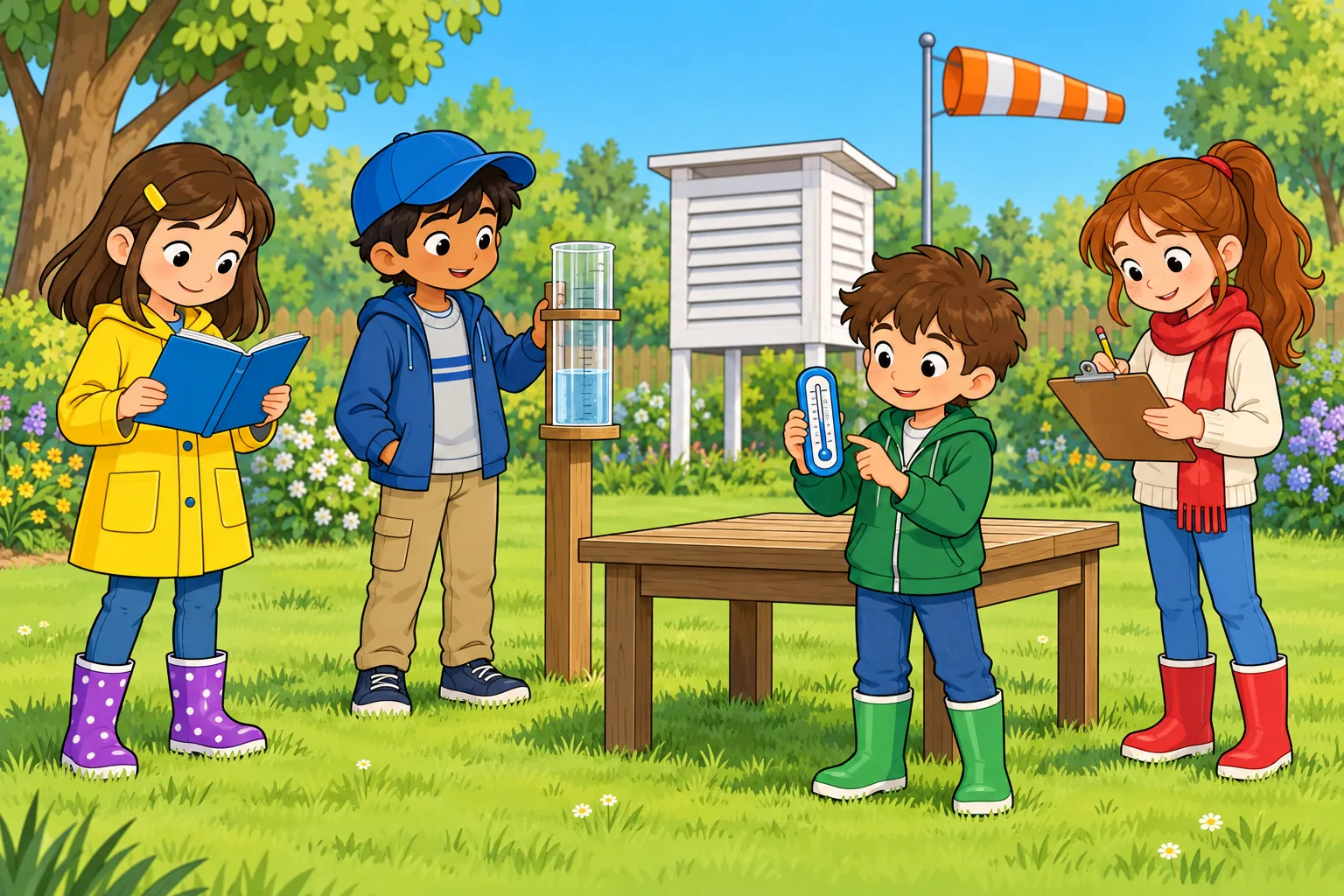
Names: Ada wears the yellow raincoat; Ravi wears the blue cap; Bea wears the red scarf; Omar wears the green boots.
Example 1: Ada is wearing a yellow raincoat. → Yes
Example 2: Ravi is wearing a red scarf. → No
11. Ravi is standing beside a clear rain gauge.
12. Bea is writing on a plain clipboard.
13. Omar is holding a red thermometer.
14. Ada is reading a blue notebook.
15. The windsock is tied to a branch of the tree.
16. Ravi is wearing a green cap.
17. There are two rain gauges beside Ravi.
Part 3 · 5 questions
Choose the best reply
Read the conversation. Choose the best reply from the box for each question. There is one example. Two replies are not needed.
Maya is asking Eli about the School Weather Club. They are looking at the club's picture display. Choose Eli's reply. Each reply is used once. Reply G is used in the example; two other replies are not needed.
Choose a reply
- We meet beside the garden gate.
- I joined because my cousin told me about it.
- We measure the rain and write our notes in a notebook.
- It starts at half past three on Wednesdays.
- The one with the bright yellow sun is my favourite.
- Please bring your own boots if you want to help outside.
- It is called the School Weather Club.
- We finished our picture before lunch.
Example: Maya: What is the name of your group? → It is called the School Weather Club.
18. Maya: When does the club start?
19. Maya: Why did you join it?
20. Maya: What do you do during a meeting?
21. Maya: Where should I go to meet everyone?
22. Maya: Which picture do you like best?
Part 4 · 6 questions
Read and complete the story
Read the text and choose a word from the box for each space. There is one example. Four words are not needed. Then choose the best title.
Before the club arrived, the school garden was quiet (example). Maya put a box of weather cards in her arms and [23] it from the classroom to the shelter. Eli and Sam found some smooth stones beside the path. The stones were [24], like little balls, and the children put them around a pot of flowers. Their teacher had [25] a chart using the classroom printer. They fixed it to the wall so everyone could write notes in one place. The chart was very [26] for the new members because it helped them organise their work. After they had watched the little rain gauge for a while, the children [27] that the puddle near the gate was smaller than it had been at lunchtime. They talked about what they could see and wrote a short note for their club book. Then they put the cards and pencils away before going home.
Example: Before the club arrived, the school garden was ___. → quiet
28. Choose the best title for the text.
Part 5 · 7 questions
Read the story and complete the sentences
Read the story. Complete each sentence with one, two, three or four words. There are two examples.
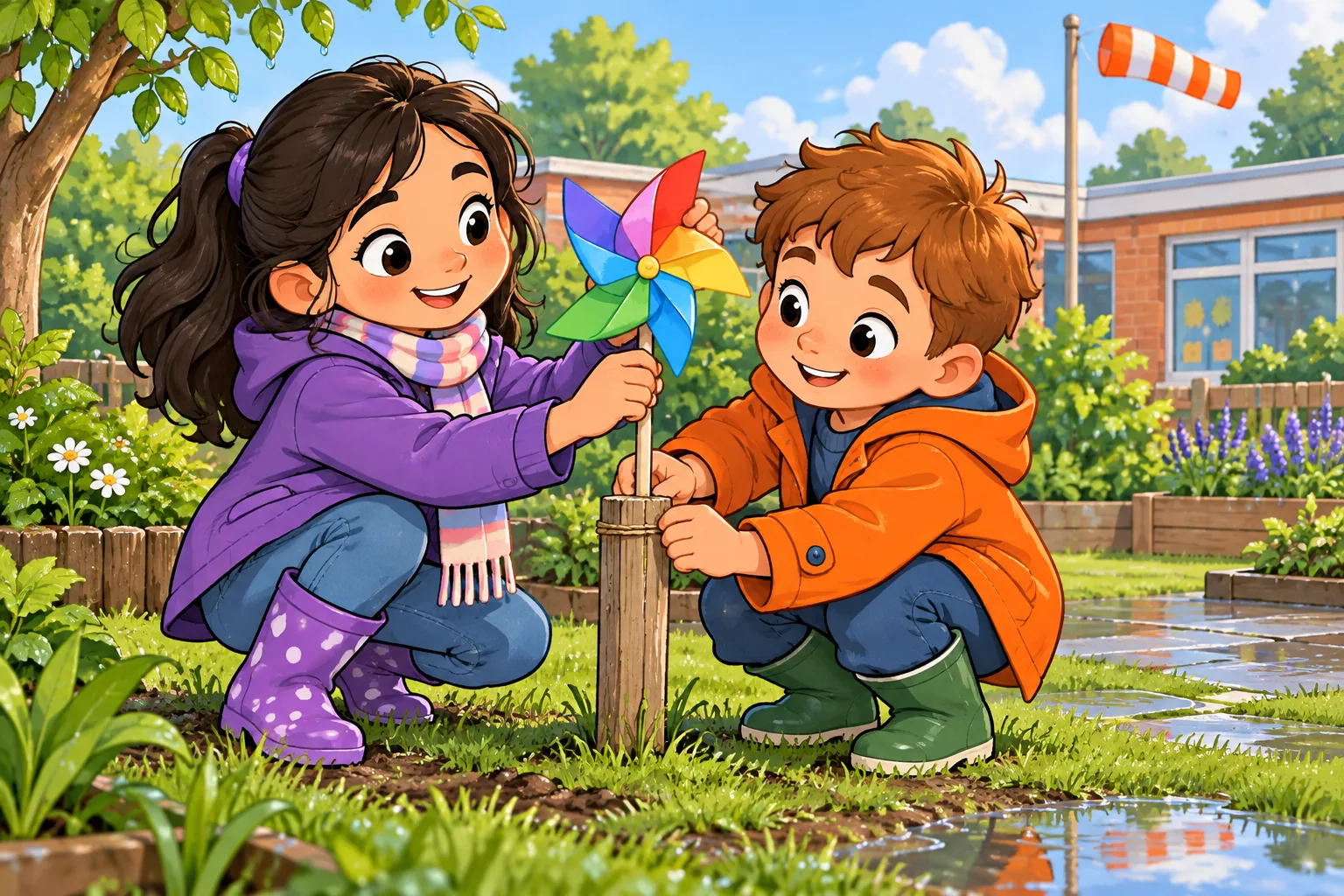
Lila's Garden Pinwheel
Lila joined the School Weather Club in April. She liked drawing clouds, but she had never made anything for the garden before. One Wednesday, Mr Patel asked the children to make pinwheels that could turn in a light breeze. Lila chose brightly coloured paper from the craft shelf. Her friend Tom chose blue and green paper. The children were excited because their pinwheels would stand near the club's little weather station.
Mr Patel gave them wooden sticks with small holes already made at the top. They folded the paper carefully and fixed it to each stick with a paper fastener. Mr Patel showed them how to push the fastener through the hole without making it too tight. Lila's first pinwheel turned slowly, so she loosened it a little. Tom's turned quickly when he blew gently on it. They wrote their names on small cards and went outside. Tom helped Lila tie her pinwheel's stick to a low wooden post beside the garden path. Mr Patel reminded them to keep the path clear.
After lunch, a little rain left a puddle near the wooden post. The children waited until the rain stopped and the path was safe. Lila's pinwheel began to turn when a soft breeze crossed the garden. She compared it with the small windsock on its tall pole and drew both in her club notebook. At home, she told her brother that making things for the garden was more fun than she had expected. Next week, the club plans to make a small paper flag for the station shelter.
Example 1: Lila joined the School Weather Club in ___. → April
Example 2: Mr Patel asked the children to make ___. → pinwheels
29. Lila liked drawing ___.
30. Lila chose brightly coloured ___ from the craft shelf.
31. They fixed the paper to a small stick with a ___.
32. Lila's first pinwheel turned ___.
33. After lunch, a little rain left a ___ near the wooden post.
34. Lila drew a picture in her ___.
35. Next week, the club plans to make a small ___.
Part 6 · 10 questions
Choose the correct word
Read the text and choose the correct word for each space. There is one example.
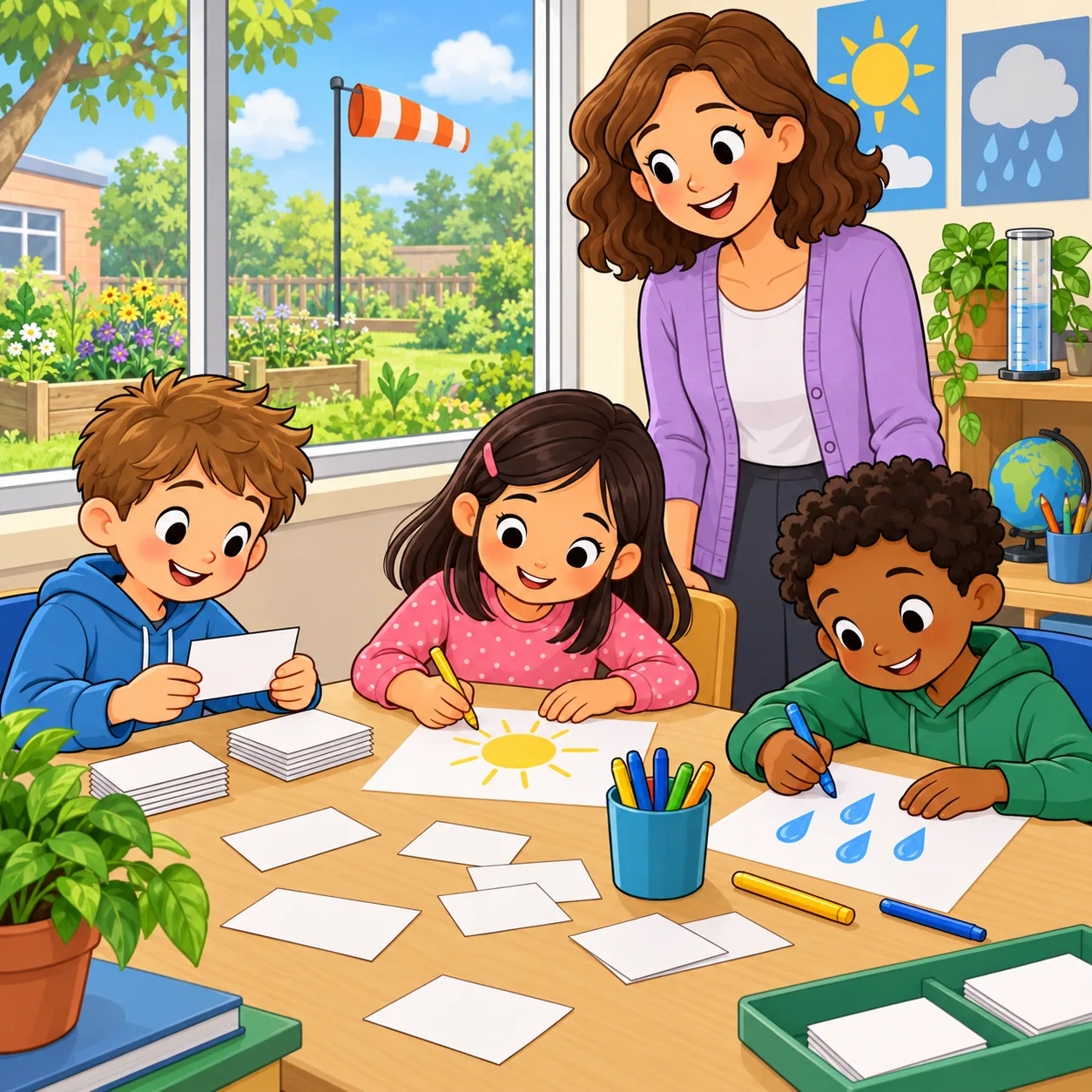
Our weather club meets on (example) Mondays after school. Last week, we [36] a small weather corner in the classroom. Mina, [37] loves drawing, made a picture for the wall. There [38] a rain gauge outside the room, and we wrote its name in our notebook. The children put [39] books on the lower shelf. Each child brought [40] coloured pencil. We listened [41] to Mr Patel while he explained our club plan. My picture was clearer [42] my first one because I used a ruler. Then we [43] our coats and went into the garden. The club room is [44] than the hall, so it is easy to find our things. We drew both a bright sun [45] two small clouds on the club poster. At the end of each meeting, our teacher checks that every pencil is back in its cup. We enjoy planning new pictures together and take turns choosing the colours for the wall.
Example: Our weather club meets ___ Mondays. → on
Part 7 · 5 questions
Complete the text
Read the text and write one word in each space. There is one example.
Dear Ava,
Our club met on (example) Friday. We worked from four o'clock [46] six o'clock and made a small weather corner in the classroom. Our room is [47] the first floor, next to the art room, so it is easy to find. There [48] three notebooks on our table today, one for each group. I have learned [49] draw a rain gauge and write a short note about it. Thank you [50] the lovely blue notebook you gave me. I will bring it next week, when we are going to make a picture for the garden wall. I like having a fresh page for every meeting. When it rains, we look through the classroom window and draw what we can see in the garden. My little sister wants to visit the club, and I hope she can come soon.
Your friend, Mina
Example: Dear Ava, Our club met ___ Friday. → on
Ready to check your answers?
Submit to grade your whole test, OR use 👁 Show Answer per part / per question.
Learn from your answers
Answer reasons
- forecast — A forecast gives information about expected weather.
- umbrella — An umbrella helps keep rain off a person.
- wet — Wet means covered with or holding water.
- dry — Dry means not wet.
- breeze — A breeze is a gentle wind.
- temperature — Temperature is a measure of how warm or cold something is.
- measure — To measure is to find the size, amount or level of something.
- outside — Outside means in the open air rather than inside.
- change — Change means to become different.
- collect — To collect things is to bring them together as a group.
- Yes — Ravi stands beside the clear rain gauge, which is fixed to its own wooden stand.
- Yes — Bea holds a clipboard and writes on it.
- No — The thermometer Omar holds is blue.
- Yes — Ada is looking at an open blue notebook.
- No — The windsock is on a tall separate pole behind the table, not on the tree.
- No — Ravi wears a blue cap; Omar's boots are green.
- No — There is only one transparent rain gauge beside Ravi.
- It starts at half past three on Wednesdays. — This reply gives the starting time and day Maya asks about.
- I joined because my cousin told me about it. — Eli explains the reason he joined the club.
- We measure the rain and write our notes in a notebook. — Eli describes the two activities they do: measuring rain and writing notes.
- We meet beside the garden gate. — This reply tells Maya where the club members meet.
- The one with the bright yellow sun is my favourite. — Eli chooses and describes his favourite picture.
- carried — Maya holds the box in her arms as she moves it to the shelter, so carried fits.
- round — The stones are shaped like little balls, so round describes their shape.
- printed — The teacher used the classroom printer to make the chart, so printed is the correct verb.
- useful — The chart helped the new members write notes in one place.
- noticed — They saw and became aware of the difference in the puddle.
- A Busy Afternoon in the School Garden — The text describes the weather club doing several activities in its school garden.
- clouds — The story says Lila liked drawing clouds.
- paper — The story says that Lila chose brightly coloured paper.
- paper fastener / fastener — The story says they used a paper fastener to attach the paper to the stick.
- slowly — Her first pinwheel turned slowly before she loosened it.
- puddle — The story says a little rain left a puddle near the post.
- club notebook / notebook — She drew the pinwheel and windsock in her club notebook; notebook alone also completes the sentence correctly.
- paper flag / flag — The final sentence says the club plans to make a small paper flag.
- created — Last week signals a completed past action, so the past form created fits.
- who — Who refers to Mina, a person.
- was — The account describes last week. A rain gauge is singular, so the past form was is needed.
- their — Their is the possessive form used before the noun books.
- a — Coloured pencil is a singular countable noun beginning with a consonant sound, so use a.
- carefully — Carefully is the adverb that describes how they listened.
- than — Than is used after a comparative adjective such as clearer.
- put on — Put on means to dress in something. Put is also its past form, matching went.
- smaller — The word than calls for the comparative form smaller.
- and — The paired expression both … and joins the two things they drew.
- until / till / to — Until, till and to all correctly mark the end of the time period beginning at four.
- on — Use on with a floor of a building: on the first floor.
- are — Today sets the present time. Three notebooks is plural, so use there are.
- to — Learned to is followed by the base verb draw.
- for — The expression is thank you for something received.
Teacher tip
Invite learners to scan the whole sentence for meaning before choosing a word. In the picture task, ask them to check visible clothing, objects and positions carefully; every answer can be found in the scene.