
KET 5 Practice Test 1
Reading & Writing
Harbour Lane Community Costume Workshop and Theatre Exhibition: explore a community costume workshop, follow everyday conversations and practise reading and writing in useful situations. This original A2 practice keeps the classic nine-part structure used on this page.
Notices at the Harbour Lane Costume Workshop
Which notice (A–H) matches each statement (1–5)? Use each letter once at most. Notice H is the example.
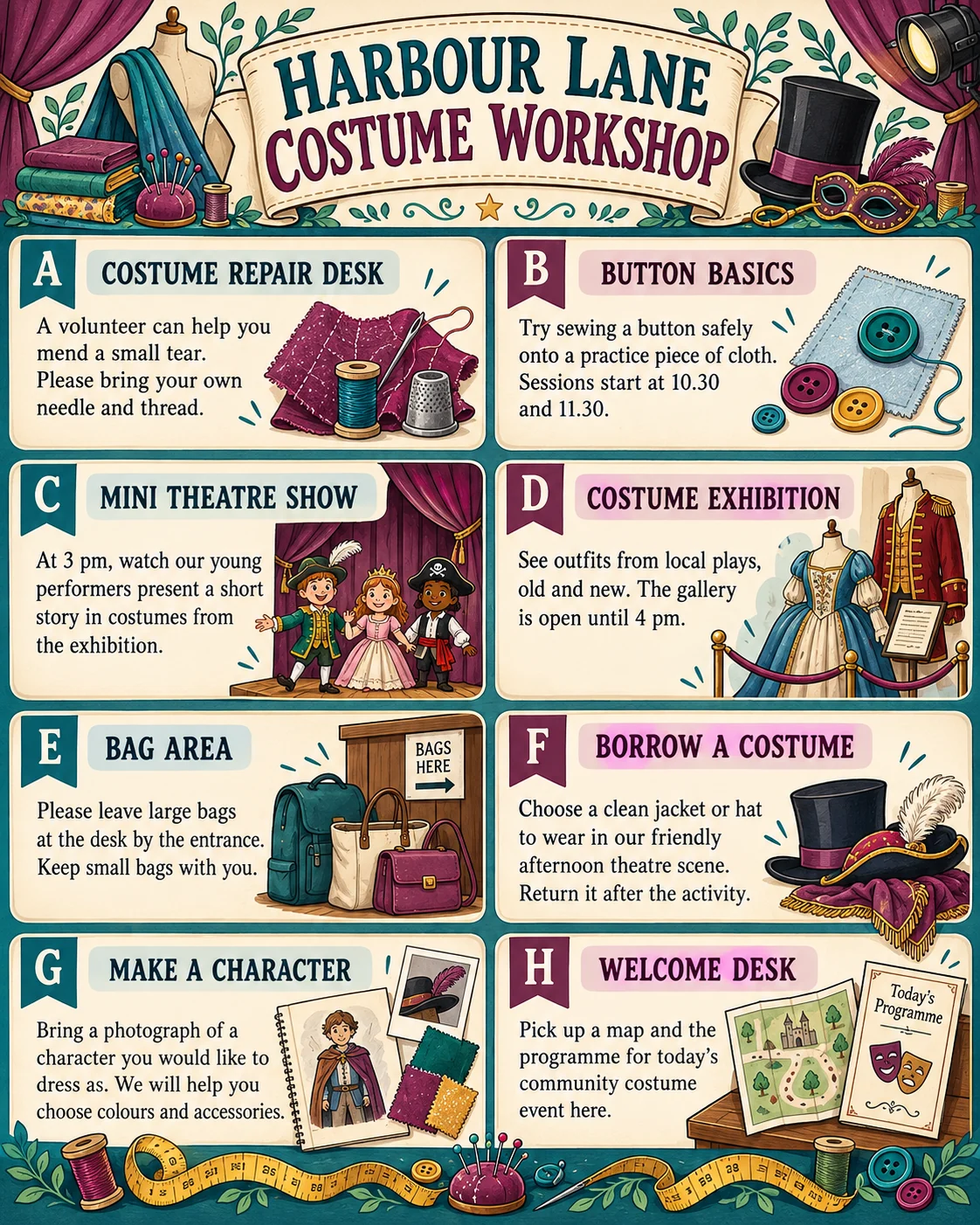
Read notices A–H as text
COSTUME REPAIR DESK
A volunteer can help you mend a small tear. Please bring your own needle and thread.
BUTTON BASICS
Try sewing a button safely onto a practice piece of cloth. Sessions start at 10.30 and 11.30.
MINI THEATRE SHOW
At 3 pm, watch our young performers present a short story in costumes from the exhibition.
COSTUME EXHIBITION
See outfits from local plays, old and new. The gallery is open until 4 pm.
BAG AREA
Please leave large bags at the desk by the entrance. Keep small bags with you.
BORROW A COSTUME
Choose a clean jacket or hat to wear in our friendly afternoon theatre scene. Return it after the activity.
MAKE A CHARACTER
Bring a photograph of a character you would like to dress as. We will help you choose colours and accessories.
WELCOME DESK
Pick up a map and the programme for today's community costume event here.
Example (not scored): You can collect a programme here. → H
1. Answer: F. Notice F allows visitors to borrow a jacket or hat for the scene and return it afterwards.
2. Answer: B. Notice B offers practice in sewing a button onto cloth at two morning sessions.
3. Answer: G. Notice G asks for a photograph of a character and offers advice about colours and accessories.
4. Answer: C. Notice C advertises a short story performed by young actors at 3 pm.
5. Answer: E. Notice E instructs visitors to leave large bags at the entrance desk and keep small bags with them.
Mina's first costume workshop
Read the passage. Choose the best word (A, B or C) for each space.
Example (not scored): Mina arrived ____ the town hall at ten. → at
6. Answer: B. A workshop is an organised activity where people make or learn something.
7. Answer: A. Carefully is an adverb describing how Mina sewed around the loose button. Careful is an adjective; care is a noun or verb.
8. Answer: B. Because introduces the reason Mina chose the hat.
9. Answer: B. Made of identifies the material of the hat: soft felt. Made for and made at cannot identify its material here.
10. Answer: A. Visitors borrow an item and return it later.
Getting ready for a theatre scene
For questions 11–15, choose the best reply (A, B or C). Then complete the longer conversation using choices A–H. Choice H is the example.
Example (not scored): Rosa: Have you been to the workshop before? Jamie: No, this is my first time. → H
11. Answer: A. A answers Beth's request and gives a useful direction.
12. Answer: B. B gives the time Sam asks for. Read the full sentence to confirm the meaning and form.
13. Answer: C. C suggests where Luca can get help. Read the full sentence to confirm the meaning and form.
14. Answer: A. A accepts Ivy's invitation naturally.
15. Answer: B. B is a polite response to thanks. Read the full sentence to confirm the meaning and form.
A longer conversation
A
I have never acted before, but I'd like to try.
B
Which room should I go to first?
C
What should I wear for the performance?
D
I saw a play there when I was little.
E
Could I arrive at about two o'clock?
F
Yes, I can bring some old fabric.
G
That sounds fun. I'll help you choose a hat.
H
No, this is my first time here.
16. Answer: A. A responds to the invitation by saying Jamie is new to acting but interested.
17. Answer: C. C asks what clothing is suitable; Rosa answers by suggesting a jacket.
18. Answer: B. B asks which room to visit; Rosa names Room Two.
19. Answer: E. E asks about arriving at two; Rosa confirms that time works.
20. Answer: F. F offers old fabric, which Rosa says can be used as a market-stall prop.
A family helps at the theatre exhibition
Read the article. For questions 21–27, choose A (Right), B (Wrong) or C (Doesn't say). Choose Doesn't say when the article gives no information about the statement.
Example (not scored): The exhibition was held at the town theatre. → A
Elsie and the costume exhibition
When Elsie's school announced that the town theatre would hold a costume exhibition, she asked her grandfather, Arthur, if they could help. He had worked as a wardrobe assistant at the theatre, and still kept photographs and fabric samples at home. Elsie expected to hear exciting stories about famous actors. Instead, Arthur began with a practical question: “Do you know how to label a costume?”
At the theatre, the exhibition organiser, Mrs Patel, showed them a long rail of clothes. She explained that every costume needed a card with the name of the play and the year it was used. Elsie wrote the cards while Arthur checked the spelling. One green jacket had no label, but Arthur recognised it from a school production of The Clockmaker's Garden. He remembered helping a young actor shorten its sleeves.
The next day, Elsie returned with her friend Priya. They helped arrange hats on a table and placed a small mirror nearby so visitors could see how the hats looked. Priya wanted to put a feather beside each hat, but Mrs Patel asked them to leave the decorations off. The exhibition team wanted visitors to focus on the costumes themselves.
On opening day, Elsie welcomed families at the door. Her favourite part was hearing children guess which jobs the costumes belonged to: a sailor, a queen, or perhaps a baker. Arthur stayed near the green jacket and answered questions about its repair. At the end, Mrs Patel thanked the helpers and gave each of them a theatre programme. Elsie decided she would volunteer again, although she still hoped to learn more about acting.
21. Answer: A. The first paragraph says Elsie asked Arthur if they could help.
22. Answer: A. The article says he still had a box of photographs and fabric samples at home.
23. Answer: A. Arthur recognised it from a school production of The Clockmaker's Garden.
24. Answer: B. Mrs Patel asked them to leave decorations off, so they did not add feathers.
25. Answer: C. The article says the helpers received a theatre programme; it gives no information about a meal.
26. Answer: B. The article says her favourite part was hearing children guess the costumes? jobs.
27. Answer: C. Arthur recognises the jacket and remembers helping an actor with its sleeves. The article never says whether Arthur wore it as a student.
Preparing costumes for the show
Read the text. Choose the best word (A, B or C) for each space.
Example (not scored): They made the stage curtain ____ an old sheet. → from
28. Answer: B. Their is the possessive determiner needed before costumes.
29. Answer: A. Because gives the reason for choosing the hall.
30. Answer: B. The expression is listen to instructions.
31. Answer: B. Neatly is an adverb describing how the children folded the clothes. Careful is an adjective and care cannot modify folded here.
32. Answer: A. The comparative adjective older is followed by than.
33. Answer: A. Too long means longer than suitable for the box.
34. Answer: B. Which introduces a relative clause describing the badge, a thing. Who refers to people and where refers to places.
35. Answer: A. A introduces the singular countable noun phrase a thank-you card. Many and much cannot be used before this singular phrase.
Words for a costume exhibition
Read each description and write the whole word. The first letter is given. Include it in your answer.
Example (not scored): A small round object used to fasten a coat. (b_____) → button
36. Answer: scarf. The description identifies a scarf. It begins with s and has 5 letters in total.
37. Answer: actor. The description identifies a actor. It begins with a and has 5 letters in total.
38. Answer: mirror. The description identifies a mirror. It begins with m and has 6 letters in total.
39. Answer: badge. The description identifies a badge. It begins with b and has 5 letters in total.
40. Answer: cloak. The description identifies a cloak. It begins with c and has 5 letters in total.
An email about the exhibition
Complete the email with ONE word in each space. Use the grammar cues if you need help.
Example (not scored): I have just finished ____ first costume! → my
Amira
41. Answer: of. A choice of three characters means three characters are available to choose from.
42. Answer: me. My aunt showed me how to make a hat: me is the object pronoun after showed.
43. Answer: which / that. Which or that introduces a clause describing the shirt. Both are natural and accepted.
44. Answer: before / until / till. Before, until and till can all link the remaining two days to the beginning of the play.
45. Answer: yet / still. Have yet to learn and have still to learn both mean that the learning is unfinished. Both one-word answers are accepted.
46. Answer: than. The comparison is better than I do. Than introduces the second part of the comparison.
47. Answer: at. Use at with the precise clock time half past six.
48. Answer: do. The present simple negative is you do not need. Do is the auxiliary that agrees with you.
49. Answer: not. Why not invite your sister? is a suggestion. It uses not followed by the base form invite.
50. Answer: of. Both of you refers to Lewis and his sister together. Of links both to the pronoun you.
Plan a visit to the costume exhibition
Read the advertisement and email. Complete the notes using short answers.
Example (not scored): Where will Megan and Daniel meet before entering? → entrance area
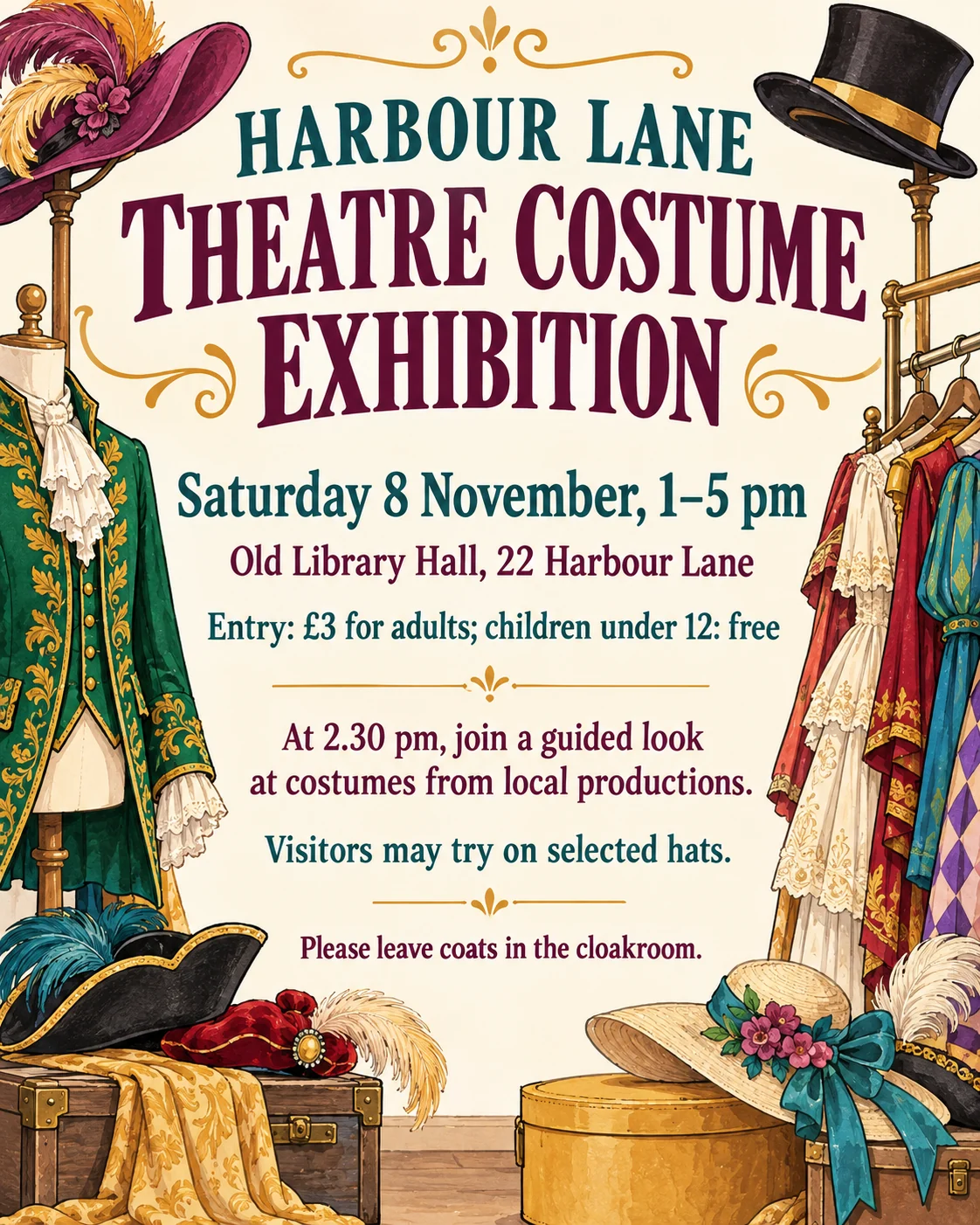
Read text version
Harbour Lane Theatre Costume Exhibition
HARBOUR LANE THEATRE COSTUME EXHIBITION
Saturday 8 November, 1–5 pm
Old Library Hall, 22 Harbour Lane
Entry: £3 for adults; children under 12: free
At 2.30 pm, join a guided look at costumes from local productions. Visitors may try on selected hats. Please leave coats in the cloakroom.
Email from Megan to Daniel
Hi Daniel,
I have booked two adult places for the guided look at the costume exhibition on 8 November. It begins at half past two, so let's meet in the entrance area at 2.15. I will bring the £6 for our tickets. Could you bring my blue umbrella? I left it in your car. We can leave our coats in the cloakroom.
Megan
51. Answer: 8 November / November 8 / 8th November / November 8th / 8 Nov / Nov 8 / Saturday 8 November / Saturday, 8 November / 8th Nov / Nov 8th / November the 8th / the 8th of November. The advertisement gives the exhibition date as Saturday 8 November.
52. Answer: cloakroom / the cloakroom. Both documents identify the cloakroom as the place for coats.
53. Answer: 2.30 / 2:30 / 2.30 pm / 2:30 pm / half past two / 14:30 / 14.30 / 2:30pm / 2.30pm / half past two pm. The advert gives 2.30 pm and Megan writes half past two.
54. Answer: £6 / 6 pounds / six pounds / £6.00 / 6.00 / 6 / £ 6 / £ 6.00 / six / 6.0. The advertisement charges £3 for each adult. Two adults pay £6 altogether, confirmed by Megan in her email.
55. Answer: blue umbrella / umbrella / the blue umbrella. Megan asks Daniel to bring the blue umbrella she left in his car.
Write an email to a friend
Write 25–35 words. Answer all three points. This writing task is self-checked separately from the automatic score.
Your English-speaking friend Ruby wants to visit the costume exhibition with you. Write an email inviting her. Say what you want to see, where and when to meet, and what she should bring. Write 25–35 words.
- Say what you want to see at the exhibition.
- Say where and when you will meet.
- Say what Ruby should bring.
0 words · target 25–35
This writing task is self-checked and is separate from your score out of 55.
Hi Ruby, Shall we see the old theatre costumes on Saturday? Meet me by the library entrance at two. Please bring your camera so we can take a photo together. See you, Lily.
Check: all three points answered; message clear; verbs and spelling checked; 25–35 words.
Ready to check your work?
Submit to grade your whole test, OR use 👁 Show Answer per part / per question.
Learning review & writing checklist
Read each notice for its purpose. Link dialogue replies to the turns before and after each gap. In Part 4, distinguish explicit agreement, contradiction and missing information. Use both source documents for the notes in Part 8.
For grammar gaps, read the whole sentence, choose the correct form, and read it again. For open gaps, type one word only. Check the first letter and spelling in Part 6.
Your writing should answer all three points in 25–35 words. Compare your message with the sample after you finish. The writing sample does not add points to the automatic score.
Show Answer reveals the answer and explanation without filling your response or awarding a mark. After editing a graded answer, submit again for an updated score.