
KET 6 Practice Test 3
Reading & Writing
Larchford Repair Cafe and the community toy hospital: repair and reuse: practise everyday reading, follow conversations and write a short message. This original A2 practice keeps the classic nine-part structure used on this page.
Notices at the Larchford Repair Cafe
Which notice (A–H) matches each statement? Use each letter once at most. Notice H is the example.
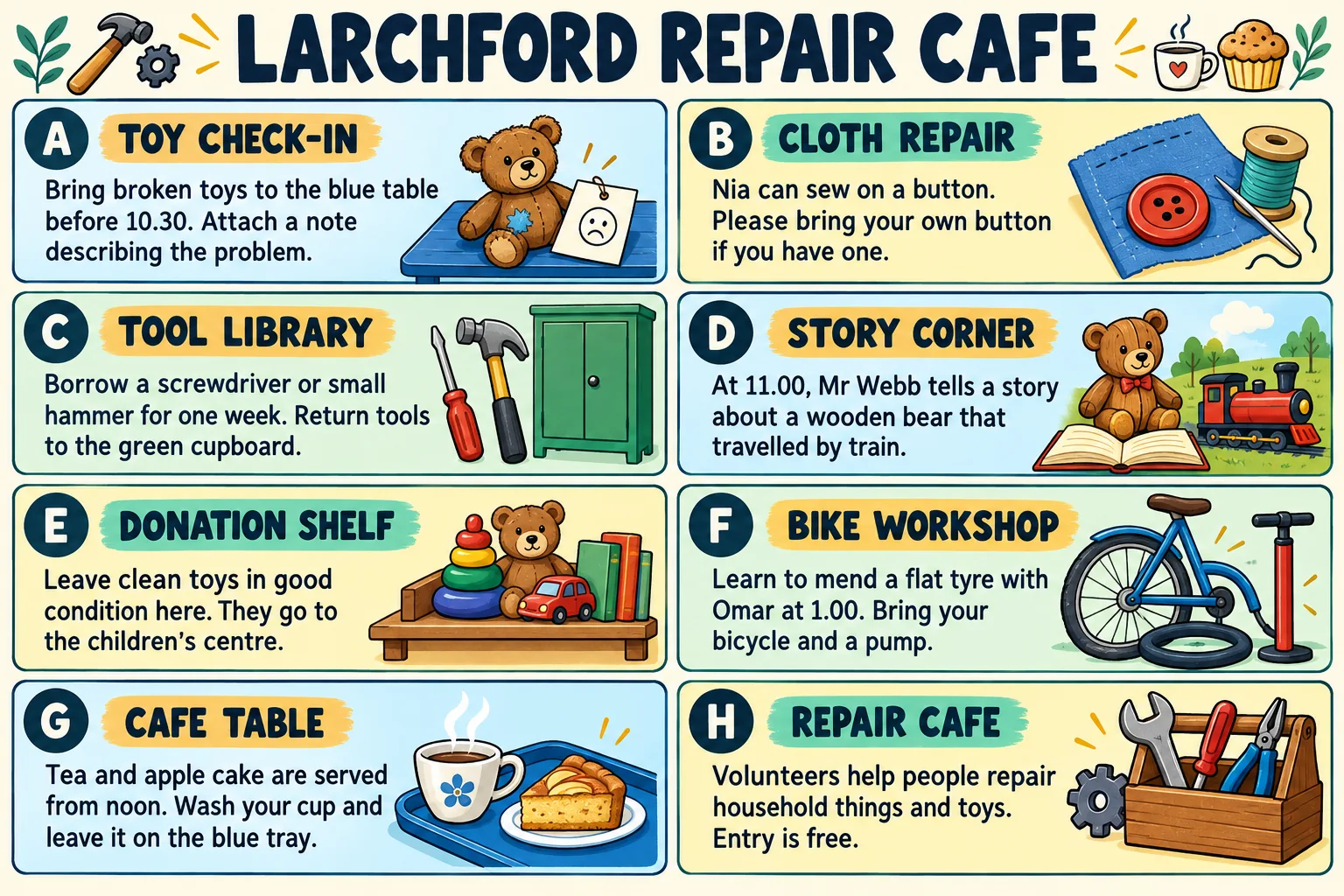
Read notices A–H as text
TOY CHECK-IN
Bring broken toys to the blue table before 10.30. Attach a note describing the problem.
CLOTH REPAIR
Nia can sew on a button. Please bring your own button if you have one.
TOOL LIBRARY
Borrow a screwdriver or small hammer for one week. Return tools to the green cupboard.
STORY CORNER
At 11.00, Mr Webb tells a story about a wooden bear that travelled by train.
DONATION SHELF
Leave clean toys in good condition here. They go to the children's centre.
BIKE WORKSHOP
Learn to mend a flat tyre with Omar at 1.00. Bring your bicycle and a pump.
CAFE TABLE
Tea and apple cake are served from noon. Wash your cup and leave it on the blue tray.
REPAIR CAFE
Volunteers help people repair household things and toys. Entry is free.
Example (not scored): Find out about the event where volunteers mend things. → H
1. Answer: A. Notice A gives the check-in place and says toys must arrive before 10.30.
2. Answer: C. Notice C lets visitors borrow a screwdriver or hammer for one week.
3. Answer: E. Notice E requests clean toys in good condition for the children's centre.
4. Answer: F. Notice F offers a flat-tyre lesson and asks visitors to bring a bicycle.
5. Answer: B. Notice B says Nia can sew on a button. Visitors should bring their own button if they have one.
A toy gets a second life
Read the text. Choose the best word for each gap.
Example (not scored): The boat was made ____ wood. → of
6. Answer: A. Come off means that the sail had become separated from the boat.
7. Answer: B. Soft describes cloth that bends easily and is suitable for a toy sail. Busy describes activity; loud describes sound.
8. Answer: A. Sew means to join cloth with thread, which is how the sail is repaired.
9. Answer: A. Method means a way of doing something, which the writer wants to learn.
10. Answer: B. Thank someone for something is the correct verb and preposition pattern.
At the repair cafe
Choose A, B or C for conversations 11–15. Then complete the longer conversation with A–H for gaps 16–20. Use each letter once at most; F is the example. Two choices are extra.
Example (not scored): Mina: Shall we visit the toy hospital? Rob: Yes, that sounds interesting. Let’s go together. → F
11. Answer: C. The donation shelf is a suitable place to leave a usable toy.
12. Answer: A. Bea offers help, so accepting politely is the natural response.
13. Answer: B. This encouraging reply welcomes Noah and offers a chance to learn.
14. Answer: C. The notice says that entry is free, which answers the price question.
15. Answer: A. Congratulating Hugo and asking about the result responds to his news.
A longer conversation
A
That's brilliant! Does it work again now?
B
I’ll bring a soft rabbit in my bag.
C
I can meet you by the front door.
D
Could you show me how you fixed it?
E
Yes, I'll ask my dad to bring it tomorrow.
F
Yes, that sounds interesting. Let's go together.
G
It belongs to my little brother.
H
We can take the number 12 bus.
16. Answer: B. Rob answers the question about a broken toy by saying he has brought a soft rabbit. Mina then asks who owns that rabbit.
17. Answer: G. Rob identifies the rabbit as his little brother’s. The subject then changes to Mina’s repaired train.
18. Answer: A. Rob reacts to the repair and asks whether the train works. Mina answers yes and explains that they fitted new wheels.
19. Answer: D. Rob asks to see how Mina fixed the train. Her next reply, “Of course”, agrees to demonstrate the repair.
20. Answer: C. Rob offers to meet Mina by the front door of her house. She confirms that she will wait there at half past nine.
The Larchford toy hospital
Read the article and choose A, B or C.
Example (not scored): Who repaired clocks when Amira was a child? A Her grandfather · B Her teacher · C Her neighbour → A — Her grandfather
A place where toys are cared for
Amira Patel grew up in Larchford with her grandfather, who repaired clocks. People brought him things that seemed useless: a clock with a silent bell, a chair with a loose leg or a toy with a missing part. He never promised to save everything, but he tried to discover the problem. Amira remembered how pleased people were when they took an object home again.
Years later, she noticed families throwing toys away when a wheel broke or a seam opened. She spoke to the library and several retired craftspeople. Together they opened a monthly toy hospital in a room behind the library. Only four visitors came to the first session. A notice in the school newsletter soon brought more families.
The hospital does not charge for repairs. Visitors can watch and learn, and may help if it is safe. Some toys need only a new button or a clean battery contact. Others cannot be repaired because a part is too damaged. Volunteers explain the reason and suggest saving a useful piece for another project.
Regular sessions are on the first Saturday of each month, with extra open days at other times. Amira organises bookings, while volunteers choose jobs they know how to do. A local shop donates thread and small wooden pieces, but the team buys its own batteries. The library offered a larger room, yet Amira prefers the little one. 'People can talk easily here,' she says. 'The toys feel at home among the books.'
21. Answer: B. She remembered how pleased people were to take familiar objects home again.
22. Answer: A. She noticed that families threw toys away when they had small faults.
23. Answer: C. A notice in the school newsletter brought more families to the sessions.
24. Answer: B. Visitors can watch and learn, and they may help when it is safe.
25. Answer: A. Volunteers explain why and may suggest keeping a useful part for another project.
26. Answer: C. The team meets on the first Saturday of each month.
27. Answer: B. She says people can talk easily there and toys feel at home among books.
A puppet show
Choose the best word for each gap.
Example (not scored): The show was ____ Friday. → on
28. Answer: A. Want is followed by to before a verb.
29. Answer: B. That introduces the clause describing the box.
30. Answer: C. Their shows that the buttons belonged to the puppets.
31. Answer: B. Responsible for is the correct adjective and preposition pattern.
32. Answer: C. Longer than is the correct comparative construction.
33. Answer: A. Ask someone to do something uses to before the verb.
34. Answer: B. Laugh at something means to find it funny. The enormous hat makes the audience laugh; on and in do not fit this pattern.
35. Answer: B. Would like expresses what the class wants to do in the future.
Repair and reuse words
Write each word from its definition. The first letter and word length are shown.
Example (not scored): A small metal fastener (s____) → screw
36. Answer: wheel. Wheel has five letters and names the round part that lets a car move.
37. Answer: volunteer. Volunteer has nine letters and means a person who helps without pay.
38. Answer: reuse. Reuse has five letters and means to use something another time.
39. Answer: thread. Thread has six letters and is the material used to sew cloth.
40. Answer: carpenter. Carpenter has nine letters and names a person who works with wood.
Two messages about the next repair session
Complete each gap with ONE word. Hints are optional.
Example (not scored): It is ____ the shelf. → on
Thank you 41. (preposition after “thank you”) lending me your toy robot. One arm fell off, but a volunteer at the repair cafe fixed it 42. (word meaning “using”) a small screw. It is stronger 43. (word after a comparative) before. I would like 44. (word after “would like”) take my toy bus there next month. Would you like to come 45. (preposition meaning “together with”) me?
Maya
Yes, please! I have 46. (indefinite article before a vowel sound) old truck with a missing wheel. I haven’t used it 47. (preposition before a period of time) two years. Could we go 48. (preposition meaning “in” or “during”) the morning? My dad has offered to drive both of us. He can take 49. (object pronoun for “you and me”) in his car, so we won’t need bus tickets. We haven’t chosen a time yet. 50. (question word before “time”) time would you like to meet?
Leo
41. Answer: for. Thank you for doing something is the fixed expression. For introduces the reason for Maya’s thanks.
42. Answer: with / using. With or using introduces the small screw used to repair the robot. Both completed sentences are natural.
43. Answer: than. Stronger than compares the repaired robot with its earlier condition. Than is required after stronger here.
44. Answer: to. Would like to is followed by the base form of a verb: Maya would like to take her toy bus.
45. Answer: with. Come with me invites Leo to accompany Maya to the repair cafe. With connects the two people.
46. Answer: an. An is the indefinite article before old, which begins with a vowel sound. A does not fit before old.
47. Answer: for / in. I haven’t used it for two years and I haven’t used it in two years both describe a two-year period without using the truck.
48. Answer: in / during. In the morning is the usual expression. During the morning is also grammatical and refers to the same part of the day; both are accepted.
49. Answer: us. Us refers to both Leo and Maya. It is the object pronoun after take, agreeing with both of us in the previous sentence.
50. Answer: what / which. What time asks an open question about a meeting time. Which time can ask someone to choose a time; both are accepted.
Larchford Toy Hospital Open Day
Read the advertisement and message. Answer 51-55 briefly. Example is unscored.
Example (not scored): What day is the event? → Saturday
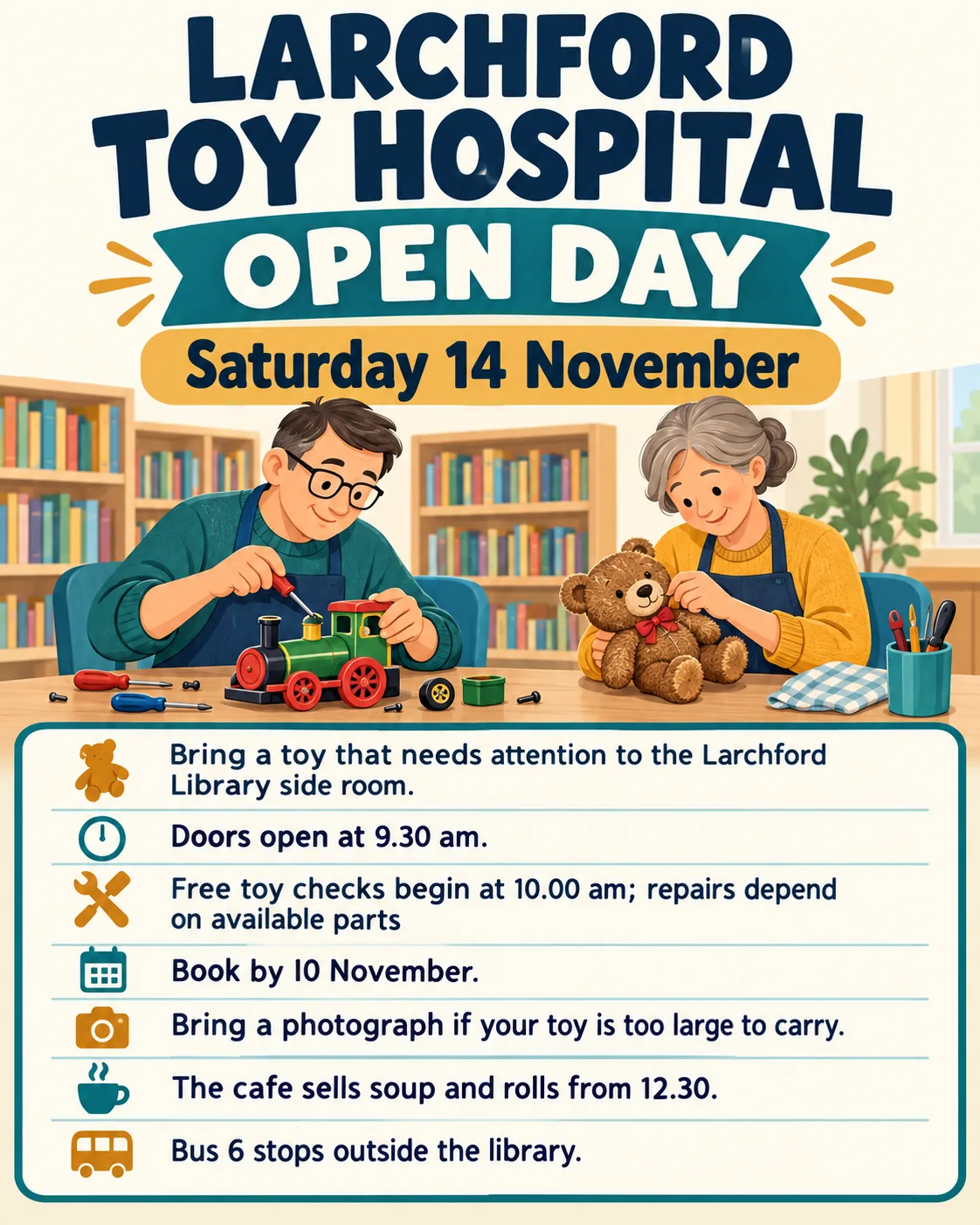
Read text version
Open Day advertisement
Saturday 14 November.
Bring a toy that needs attention to the Larchford Library side room.
Doors open at 9.30 am.
Free toy checks begin at 10.00 am; repairs depend on available parts.
Book by 10 November.
Bring a photograph if your toy is too large to carry.
The cafe sells soup and rolls from 12.30.
Bus 6 stops outside the library.
Message from Rosa to Imran
Hi Imran, I booked us both for 14 November. Meet at the library entrance at 9.20. I'll bring my red pull-along horse; its back wheel is loose. Bring a photo of your wooden play kitchen because it is too large to carry. I'll pack sandwiches. Rosa
51. Answer: 10 November / November 10 / 10 Nov / Nov 10 / November 10th / 10th November. The advertisement gives 10 November as the booking deadline.
52. Answer: 9.30 am / 9:30 am / 9.30 / 9:30 / 09:30 / 09.30 / 9.30am / 9:30am / 9.30 a.m. / 9:30 a.m.. The advertisement says the doors open at 9.30 in the morning.
53. Answer: library entrance / the library entrance / at the library entrance / Larchford Library entrance / the Larchford Library entrance. Rosa asks Imran to meet her at the library entrance.
54. Answer: loose back wheel / a loose back wheel / back wheel is loose / the back wheel is loose / its back wheel is loose / loose wheel / a loose wheel. Rosa explains that the horse's back wheel is loose.
55. Answer: photo / photograph / a photo / a photograph. The notice requests a photograph for an oversized toy, and Rosa repeats that request.
Write an email to a friend
Write 25-35 words and answer all three points. Check this task separately.
Invite Alex to visit the toy hospital. Say which toy you will bring, where and when to meet, and what Alex should bring. Write 25-35 words.
- Say which toy you will bring.
- Say where and when you will meet.
- Say what Alex should bring.
0 words · target 25–35
This writing task is self-checked and is separate from your score out of 55.
Hi Alex, Visit the toy hospital with me on Saturday. Meet at the library at nine twenty. I'll bring my wooden train. Please bring a photo of your large toy kitchen. Nina.
Check: all three points answered; message clear; verbs and spelling checked; 25–35 words.
Ready to check your work?
Submit to grade your whole test, OR use 👁 Show Answer per part / per question.
Learning review & writing checklist
Repair cafe review: find the rule or service that each visitor needs in the notices. For the longer conversation, read both sides of each gap before selecting a reply. For the repair cafe article, compare all three choices and find evidence for the best answer. Compare the booking message with the advertisement before completing the notes.
For each cloze, reconstruct the complete repair project or activity before checking the individual words. Test the other choices against the whole sentence. In the spelling task, use the definition, first letter and word length together. Part 7 requires exactly one word in each gap; its small hints identify the language pattern.
For your message, tick off the three requested details, then count your words and check the verbs. Aim for 25–35 words. Read the sample only after writing your own version; other clear messages that answer all three points are also valid. Your writing is assessed separately from the 55 automatic marks.
Use the eye button when you want to study an answer and its reason. It leaves your response empty or unchanged and gives no credit. If you revise an answer after grading, submit the test again to obtain a fresh score.