
KET 6 Practice Test 2
Reading & Writing
Town Clock Repair Café and a school repair project: practise everyday reading, follow conversations and write a short message. This original A2 practice keeps the classic nine-part structure used on this page.
Town Clock Repair Café notices
Match statements 1–5 with notices A–H. Use each letter once at most. H is used in the example.
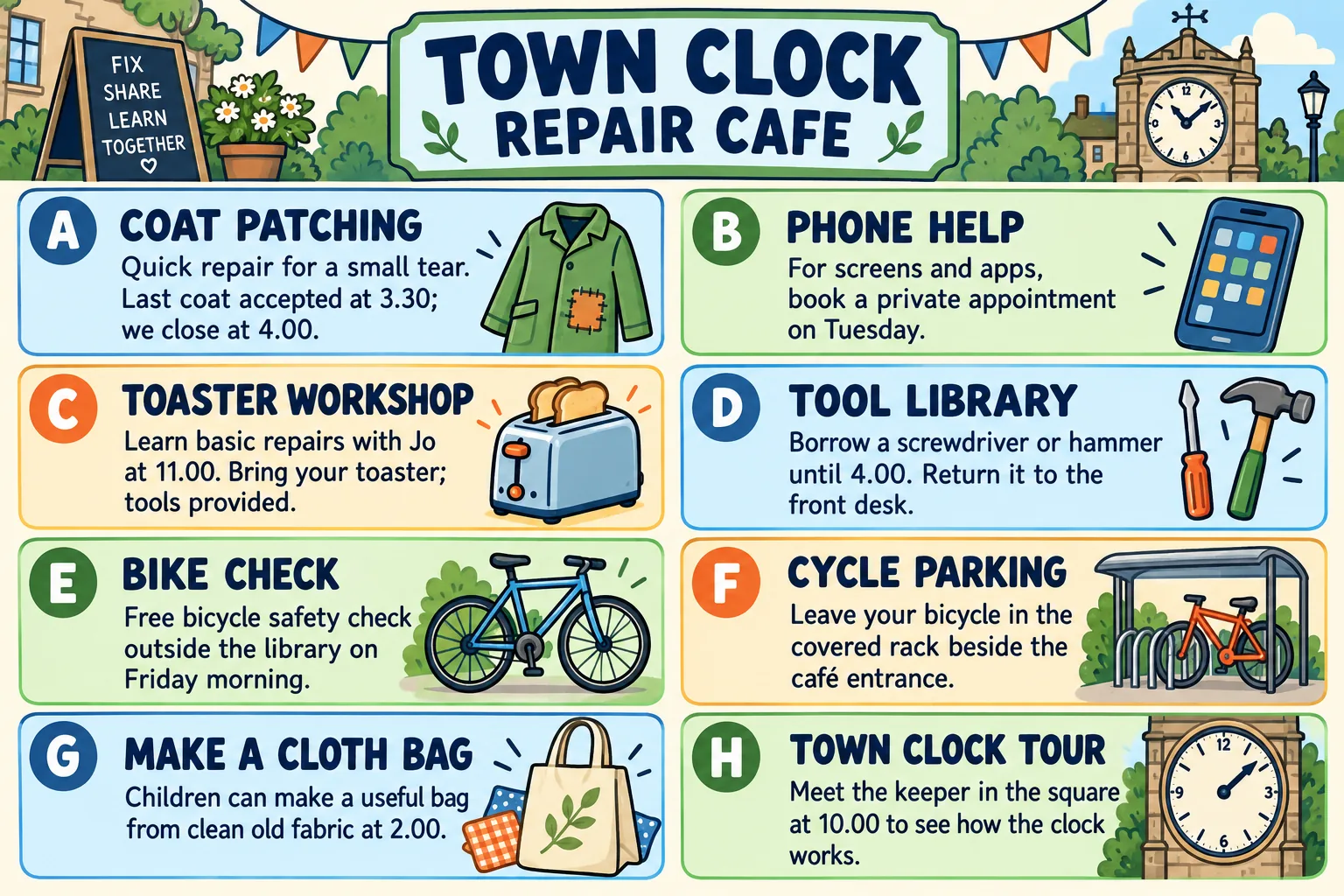
Read notices A–H as text
COAT PATCHING — Quick repair for a small tear. Last coat accepted at 3.30; we close at 4.00.
PHONE HELP — For screens and apps, book a private appointment on Tuesday.
TOASTER WORKSHOP — Learn basic repairs with Jo at 11.00. Bring your toaster; tools provided.
TOOL LIBRARY — Borrow a screwdriver or hammer until 4.00. Return it to the front desk.
BIKE CHECK — Free bicycle safety check outside the library on Friday morning.
CYCLE PARKING — Leave your bicycle in the covered rack beside the café entrance.
MAKE A CLOTH BAG — Children can make a useful bag from clean old fabric at 2.00.
TOWN CLOCK TOUR — Meet the keeper in the square at 10.00 to see how the clock works.
Example (not scored): You want to see inside the town clock with its keeper. → H
1. Answer: A. Notice A offers quick coat patching and accepts the last coat at 3.30, before the 4.00 closing time.
2. Answer: C. Notice C is a practical toaster repair lesson with tools provided.
3. Answer: D. Notice D lends screwdrivers until 4.00 and tells borrowers where to return them.
4. Answer: F. Notice F says the covered bicycle rack is beside the café entrance.
5. Answer: G. Notice G invites children to make a useful bag from clean old fabric.
A useful old radio
Read Ben’s account. Choose A, B or C for gaps 6–10.
Example (not scored): We put the books on a ____ near the window. → shelf
6. Answer: B. Stopped working means the radio no longer operated; walking and sleeping do not describe a radio.
7. Answer: A. Carefully describes Ruby holding a lamp safely while someone works.
8. Answer: B. A wire that is secure is firmly in place and can work safely.
9. Answer: B. A pleasant surprise is a good result that they did not expect.
10. Answer: A. A dry place protects the radio from water; place is the fitting noun.
The school repair project
Choose the best reply A, B or C for 11–15. Then complete gaps 16–20 with replies A–H. F is used in the example; use each other letter once at most. Two replies are not needed.
Example (not scored): Dad: Did you visit the repair café yesterday? Lina: Yes, I went after school. → F
11. Answer: B. B answers the question about experience; A gives a time and C gives a place.
12. Answer: A. A accepts the request and offers help with the zip.
13. Answer: C. C gives a possible reason for the clock being slow.
14. Answer: B. B politely accepts the offer; the other replies do not answer it.
15. Answer: A. A suggests a sensible way to search for the missing screw.
A longer conversation
A
Yes, we can use the large one in the art room.
B
That was kind of you to bring them in.
C
I’d like to, but I need to finish my poster first.
D
It stopped because the battery was loose.
E
I think we should ask Mr Patel before moving it.
F
Yes, I went after school.
G
No, the workshop is in the school hall.
H
We can put them in the box by the door.
16. Answer: D. D explains that the clock stopped because its battery was loose.
17. Answer: E. E responds to moving the clock by suggesting they ask their teacher first.
18. Answer: A. A identifies a large table in the art room when Owen asks for a bigger one.
19. Answer: B. B thanks Owen for bringing the clean jars for pencil holders.
20. Answer: C. C responds to the invitation to paint together: Lina must finish her poster first.
A school joins the repair café
Read the article. For questions 21–27 choose A if the sentence is Right, B if it is Wrong, or C if the article Does not say.
Example (not scored): The café meets twice each month. → A
A place to learn repairs
The Town Clock Repair Café opened in a room behind the library three years ago. Local volunteers meet there twice a month to mend everyday objects and teach simple skills. Anyone can bring one item, but visitors write their name on a card before work begins. The café does not charge for help; a small donation for tea is welcome.
Last spring, the school joined the project. Teacher Ms Green asked pupils to collect broken things that were safe to handle. On the first visit, the children brought a desk lamp, two clocks and a toy boat. Volunteer Mr Patel checked a lamp after unplugging it. The children watched him work. The pupils watched and then worked in pairs. Ruby and Alex repaired the lamp together, while another pair cleaned the clock faces. The toy boat needed a new wheel, so the volunteers kept it for a later session.
The school now has a repair table in its hall every Thursday. Pupils may bring small objects from home, but an adult must check them first. The group also makes labels explaining how each object was fixed. At the summer fair, visitors will see the repaired items and ask the pupils questions. The class hopes this will help more families mend things instead of throwing them away. The next café meeting is on the second Saturday of the month.
21. Answer: A. The first paragraph says it opened three years ago, so the statement is Right.
22. Answer: B. The café does not charge for help; donations for tea are welcome, so the statement is Wrong.
23. Answer: C. The article describes Ms Green arranging the project but gives no information about how she travels.
24. Answer: B. Ruby and Alex repaired the lamp; volunteers kept the toy boat for later, so this is Wrong.
25. Answer: A. The article says the school has a repair table in its hall every Thursday.
26. Answer: B. The summer fair is still in the future, where visitors will see the items; they have not already been sold.
27. Answer: C. The last sentence gives the day of the next meeting but no start time, so this detail is not stated.
A repaired desk lamp
Read the story. Choose A, B or C for gaps 28–35.
Example (not scored): I ____ my book on the desk yesterday. → left
28. Answer: A. Took is the past form for carrying the box to the café.
29. Answer: B. Was not working is the past form with the singular subject lamp.
30. Answer: C. Who refers to Mr Patel, a person, and introduces information about him.
31. Answer: A. Unplugged is the past simple form needed for the action Mr Patel completed before checking the lamp.
32. Answer: B. But contrasts the safe cable with the burned-out bulb.
33. Answer: C. Easier than is the correct comparative form before than.
34. Answer: A. The fixed comparison is as well as; as completes that pattern.
35. Answer: B. Hope is followed by to and the base verb: we hope to put it on the reading table.
Repair words
Read each definition. The first letter and spaces show the complete word. Type the whole word for questions 36–40.
Example (not scored): You use this to join two pieces of paper. (g___) → glue
36. Answer: screwdriver. A screwdriver turns screws; this eleven-letter word begins with s.
37. Answer: bulb. A bulb gives light in a lamp; the four-letter word begins with b.
38. Answer: face. A clock face shows its numbers; this four-letter word starts with f.
39. Answer: volunteer. A volunteer offers time to help without pay; this nine-letter word starts with v.
40. Answer: battery. A battery stores power; the seven-letter answer begins with b.
Lina writes to her cousin
Complete Lina’s email. Write ONE word in each gap 41–50.
Example (not scored): Thanks ____ your message. → for
41. Answer: in. In is used with the month March to say when the project started.
42. Answer: with. With means Lina and Elsie go to the table together.
43. Answer: to. Learned to mend uses to before the base form of the verb.
44. Answer: was. A clock is singular; was not working describes its problem at that past time.
45. Answer: to. Asked us to write is the correct pattern after asked plus a person.
46. Answer: so. So many visitors that introduces the result: they needed another table.
47. Answer: which / that. Both which and that can introduce information identifying the toy car with the missing wheel.
48. Answer: in. The spare wheel was inside the parts box, so in gives its location.
49. Answer: with / about / by / at. Pleased with, about, by or at the result can all express satisfaction in this context.
50. Answer: are. We are going to make signs is a future plan with the subject we.
The school repair fair
Read both documents. Complete visitor notes for questions 51–55. Write a word, number or short phrase.
Example (not scored): Day of the fair: → Saturday
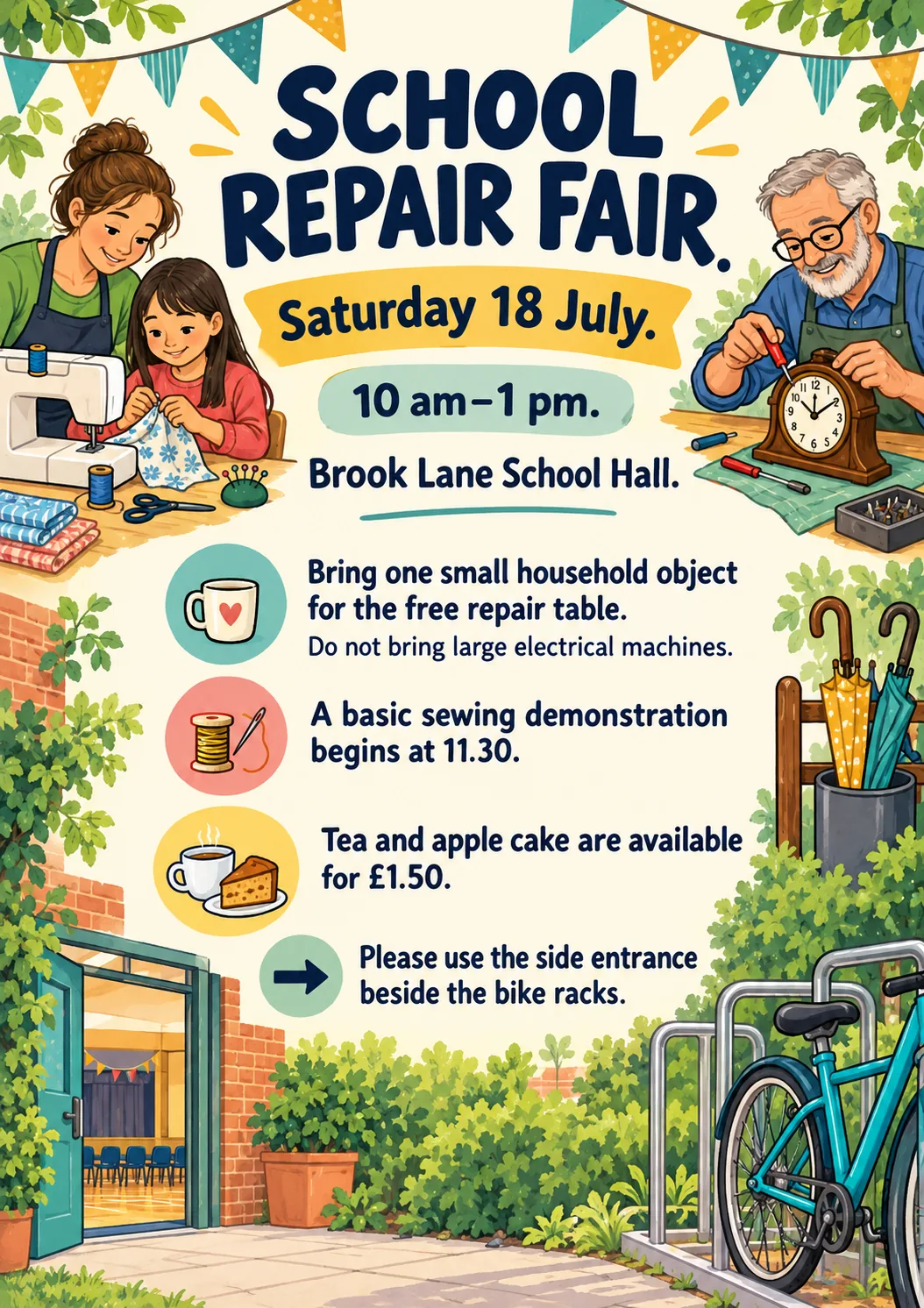
Read text version
Town Clock Repair Café: School Fair
SCHOOL REPAIR FAIR — Saturday 18 July, 10 am–1 pm, in Brook Lane School Hall. Bring one small household object for the free repair table. Do not bring large electrical machines. A basic sewing demonstration begins at 11.30. Tea and apple cake are available for £1.50. Please use the side entrance beside the bike racks.
Message from Elsie to Noah
Hi Noah, I’ll meet you at the school side entrance at 10.15. I’m bringing Mum’s blue umbrella because rain is forecast. Please bring your old desk lamp, but leave its battery at home. I’ll carry a notebook so we can write down the repair tips. Elsie
51. Answer: Brook Lane School Hall / the Brook Lane School Hall / school hall / Brook Lane School / the school hall / the hall at Brook Lane School. The notice names Brook Lane School Hall as the venue; the side entrance is where visitors should enter.
52. Answer: 11.30 / 11:30 / 11.30 am / 11:30 am / half past eleven / 11.30 a.m. / 11:30 a.m. / 11 30 / 11.30am / 11:30am / 11.30 a.m / 11:30 a.m. The fair notice says the sewing demonstration begins at 11.30.
53. Answer: £1.50 / 1.50 / one pound fifty / one pound and fifty pence / £1.5 / 1.5 / 1.50 pounds / £1.50 together / 150p / 150 pence. The advertisement offers tea and apple cake together for £1.50.
54. Answer: blue / a blue one / blue umbrella / a blue umbrella. Elsie says she is bringing Mum’s blue umbrella.
55. Answer: battery / the battery / its battery. Elsie specifically reminds Noah to leave the lamp’s battery at home.
Write about a repair
Write a message of 25–35 words for question 56. Include all three points. Writing is assessed separately.
You helped at a school repair project. Write a message to a friend. Write 25–35 words.
- Say what you repaired.
- Say who helped you and what you did.
- Invite your friend to the repair fair.
0 words · target 25–35
This writing task is self-checked and is separate from your score out of 55.
Hi Leo, I fixed a desk lamp with my friend Elsie. We changed its battery and tested the light together. Would you like to visit our school repair fair on Saturday?
Check: all three points answered; message clear; verbs and spelling checked; 25–35 words.
Ready to check your work?
Submit to grade your whole test, OR use 👁 Show Answer per part / per question.
Learning review & writing checklist
Repair café review: find the rule or service that each visitor needs in the notices. For the longer conversation, read both sides of each gap before selecting a reply. Check what the repair café article actually tells you: a missing detail cannot be marked Right or Wrong. Compare the booking message with the advertisement before completing the notes.
For each cloze, reconstruct the complete repair story or activity before checking the individual words. Test the other choices against the whole sentence. In the spelling task, use the definition, first letter and word length together. Part 7 requires exactly one word in each gap; its small hints identify the language pattern.
For your message, tick off the three requested details, then count your words and check the verbs. Aim for 25–35 words. Read the sample only after writing your own version; other clear messages that answer all three points are also valid. Your writing is assessed separately from the 55 automatic marks.
Use the eye button when you want to study an answer and its reason. It leaves your response empty or unchanged and gives no credit. If you revise an answer after grading, submit the test again to obtain a fresh score.