
KET 3 Practice Test 3
Reading & Writing
A community radio open day: practise everyday reading, follow conversations and write a short message. This original A2 practice keeps the classic nine-part structure used on this page.
At the community radio open day
Match statements 1–5 with notices A–H. Use each letter once at most. H is used in the example.
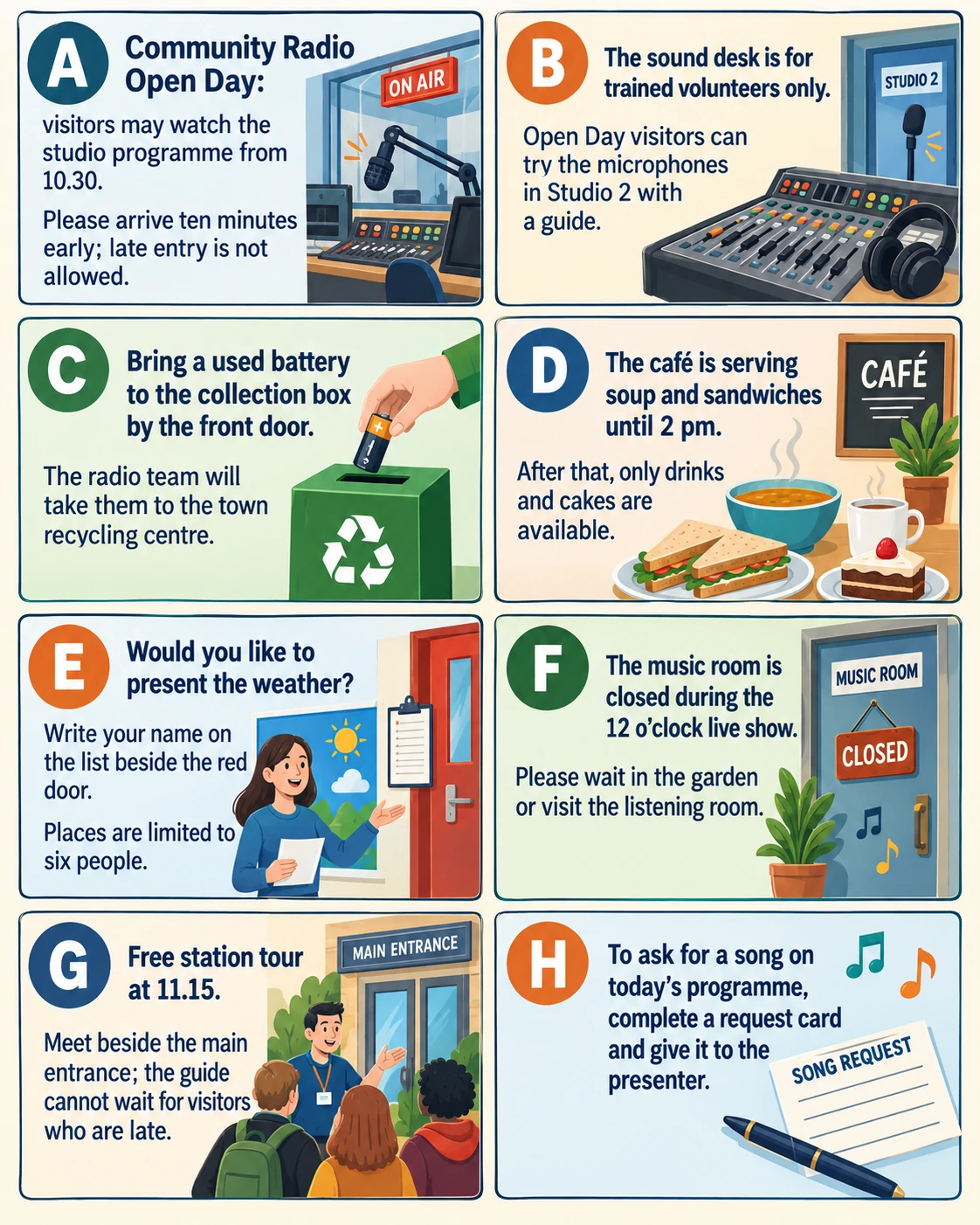
Read notices A–H as text
Community Radio Open Day: visitors may watch the studio programme from 10.30. Please arrive ten minutes early; late entry is not allowed.
The sound desk is for trained volunteers only. Open Day visitors can try the microphones in Studio 2 with a guide.
Bring a used battery to the collection box by the front door. The radio team will take them to the town recycling centre.
The café is serving soup and sandwiches until 2 pm. After that, only drinks and cakes are available.
Would you like to present the weather? Write your name on the list beside the red door. Places are limited to six people.
The music room is closed during the 12 o’clock live show. Please wait in the garden or visit the listening room.
Free station tour at 11.15. Meet beside the main entrance; the guide cannot wait for visitors who are late.
To ask for a song on today’s programme, complete a request card and give it to the presenter.
Example (not scored): You want the presenter to play a song you choose. → H
1. Answer: B. Notice B allows visitors to try the microphones in Studio 2 with a guide. The sound desk is restricted to trained volunteers.
2. Answer: A. Notice A lets visitors watch a studio programme and asks them to arrive ten minutes early.
3. Answer: E. Notice E offers a weather presenting activity and requires visitors to add their name to the list; only six places are available.
4. Answer: C. Notice C provides a collection box for used batteries. The radio team takes them to a recycling centre, where their materials can be recovered.
5. Answer: G. Notice G offers a station tour and says the guide cannot wait for late visitors.
Maya visits the station
Read about Maya’s visit. Choose A, B or C for each gap 6–10.
Example (not scored): Maya arrived before the doors opened. → arrived — reached a place
6. Answer: B. An open day is an event when visitors can look around an organisation. A competition or a holiday does not describe this station visit.
7. Answer: A. Volunteers make or prepare programmes; the following sentence about presenters and headphones confirms this work. Repairing and borrowing programmes do not fit.
8. Answer: C. The phrase listen to one another is the natural way to describe hearing each other through headphones. Watch and wait do not fit the meaning.
9. Answer: B. Speak needs an adverb to describe how Maya should use her voice. Clearly is the adverb; clear is an adjective and clearness is a noun.
10. Answer: A. Maya enjoyed the visit, so enjoyable describes the morning positively. Empty and noisy do not match the experience described.
Conversations at the station
Choose the best reply A, B or C for questions 11–15. Then complete spaces 16–20 in the longer conversation with replies A–H. F is used in the example. Use each other letter once at most; two replies are not needed.
Example (not scored): Sophie: Did you enjoy the local history programme? Daniel: F → F — It was lovely, especially the story about the old train station.
11. Answer: B. The reply answers the question with yes and describes a studio visit last year. A closing time and the location of a coat do not say whether the speaker has visited a studio.
12. Answer: A. That is all right politely accepts Nina’s apology, and thanks for telling me acknowledges her message. The other replies do not respond appropriately to her inability to help.
13. Answer: C. The number 6 identifies which bus goes to the town hall. The building’s age and the date of a meeting do not answer the travel question.
14. Answer: B. This is a polite agreement to lower the volume. The other options do not respond to the request.
15. Answer: A. Offering to send the address again directly helps Leo. The other replies discuss the weather or the visit duration.
A longer conversation
A
Do I need to write my name on a list first?
B
Where is the script that we need to read?
C
Yes, please. Can you give me a copy of the script?
D
Which day does your aunt usually come here?
E
I think the last bus has already left.
F
It was lovely, especially the story about the old train station.
G
Of course. Shall we start with the photographs in that box?
H
The batteries in my kitchen clock need changing.
16. Answer: D. Daniel asks which day Sophie’s aunt visits. Sophie answers On Thursdays, so D fits both surrounding turns.
17. Answer: A. Sophie’s next reply tells Daniel to add his name, directly answering his question about a list.
18. Answer: C. Sophie offers to read a scene together. Daniel accepts and asks for a script; Sophie confirms that copies are available.
19. Answer: B. Daniel asks where the script is. Sophie answers that it is in the blue folder on the desk.
20. Answer: G. Daniel agrees to help choose photographs and suggests starting with a box. Sophie’s final reply refers to pictures in that box.
An open day at Harbour Voice
Read the article. Are sentences 21–27 Right (A), Wrong (B) or Doesn't say (C)?
Example (not scored): The station has always tried to share local news and stories. → A — Right
A station that belongs to the town
When Harbour Voice began broadcasting from a room above the old post office, its volunteers had only one microphone and a small collection of records. Today the community radio station reaches listeners across the town, but its purpose has stayed much the same: to share local news, music and stories.
On Saturday, the station is opening its doors to the public. Visitors can look into the main studio through a glass window while the morning programme is on air. They must stay behind the yellow line and keep quiet so the presenters can work. A guide will take small groups around the building at 11.15 and 1.30. Each tour lasts about twenty minutes.
There will also be short activities in Studio 2. Anyone who wants to try reading the weather can add their name to a list at the entrance. The activity is free, but only six visitors can take part in each session. The first session starts at 10.45 and the second at 2.15. Children under twelve need to come with an adult.
The station’s café will sell tea, coffee, fruit and homemade cakes. All the money from the café will help pay for new headphones. Visitors can listen to recordings made by local people in the small listening room. One recording is a story about a lighthouse keeper, told by a retired fisherman. The station hopes to hold another open day next spring, although the date has not been chosen yet.
21. Answer: A. The first paragraph says Harbour Voice began in a room above the old post office. This statement agrees with the article.
22. Answer: B. The article says visitors must keep quiet while the presenters work. It does not allow them to talk to the presenters during the programme.
23. Answer: C. The article gives the tour times and duration but says nothing about the guides’ previous jobs. The retired fisherman tells a recorded story; he is not identified as a tour guide.
24. Answer: B. Only six visitors can take part in each session, so more than six is incorrect.
25. Answer: A. The article explicitly says children under twelve need to come with an adult.
26. Answer: B. The article states that café money will help pay for new headphones. It is not being given to an animal centre.
27. Answer: C. The article says the story can be heard in the listening room and was told by a retired fisherman. It does not say where it was recorded, so the statement cannot be confirmed or contradicted.
A programme for the town
Read the story. Choose the correct word or form A, B or C for each gap 28–35.
Example (not scored): We recorded the programme last month. → recorded — past form of record
28. Answer: B. Last month marks a finished past time, so the past simple made is needed. Makes is present and making cannot follow the subject in this sentence.
29. Answer: A. Work in pairs is the standard expression for two people working together. At and by do not fit this phrase.
30. Answer: C. Who refers to Hana, a person, as the subject of the relative clause. Which is for things and where is for places.
31. Answer: B. Questions for the gardener means questions intended to ask him. Questions from would suggest that he wrote them.
32. Answer: A. Very well describes the way the gardener answered. Good is an adjective, and very best cannot be used as an adverb in this sentence.
33. Answer: A. After recording is a grammatical preposition plus -ing phrase: they recorded the interview, added music, then listened. During recording the interview and until recording the interview do not fit this sentence.
34. Answer: B. Shorter than is the comparative structure used to compare the programme with their expectation. From and as do not complete this comparison.
35. Answer: A. Hope is followed by a to-infinitive: hope to make another programme. Making and made do not complete this construction.
Useful objects and people
Read each definition. The first letter and spaces show the complete word. Type the whole word, including the first letter, for questions 36–40.
Example (not scored): This person listens to a programme. (l________) → listener — eight letters
36. Answer: microphone. A microphone carries a speaker’s voice into a recording or broadcast. It begins with m and has ten letters.
37. Answer: presenter. A presenter leads a radio programme and speaks to its listeners. The nine-letter answer begins with p.
38. Answer: headphones. Headphones fit over your ears and let you listen privately. The word has ten letters, starting with h.
39. Answer: ticket. A ticket is proof that you have paid to enter an event such as a concert. It has six letters and begins with t.
40. Answer: screen. A computer screen displays words and pictures. Screen has six letters and begins with s.
A day at the food festival
Complete Tessa’s letter. Write ONE word in each gap 41–50. Use the short grammar hint to help you.
Example (not scored): Dear Rowan, I hope you are well. → are — present plural of be
Tessa
41. Answer: for. Thank you for + an -ing form is the standard pattern: thank you for inviting me.
42. Answer: on. On is used before a day of the week: on Saturday morning.
43. Answer: from. The fixed movement pattern is walk from one place to the next. The following phrase gives the two endpoints, so from is required.
44. Answer: were. Lots of stalls is plural, so the past form of be is were.
45. Answer: seen. Have never seen is the present perfect form for an experience up to now. Seen is the past participle of see.
46. Answer: into / in. Put dough into the oven describes movement to its inside. Put dough in the oven is also natural English, so both into and in are accepted.
47. Answer: for. For introduces a length of time: they waited for ten minutes. The later phrase explains what they were waiting for.
48. Answer: under / beneath / underneath. The branches are above the people, so they are sitting under the tree. Beneath and underneath express the same position and are accepted.
49. Answer: to. Use phone to do something takes the infinitive with to: used my phone to take photos.
50. Answer: will. Will you come with me? is the future question formed with will + subject + base verb. The question mark confirms it is a direct question.
A visit to the radio café
Read both documents. Complete the visitor notes for questions 51–55. Write a word, number or short phrase as needed. Use the information from both documents.
Example (not scored): Day of the open day: → Saturday
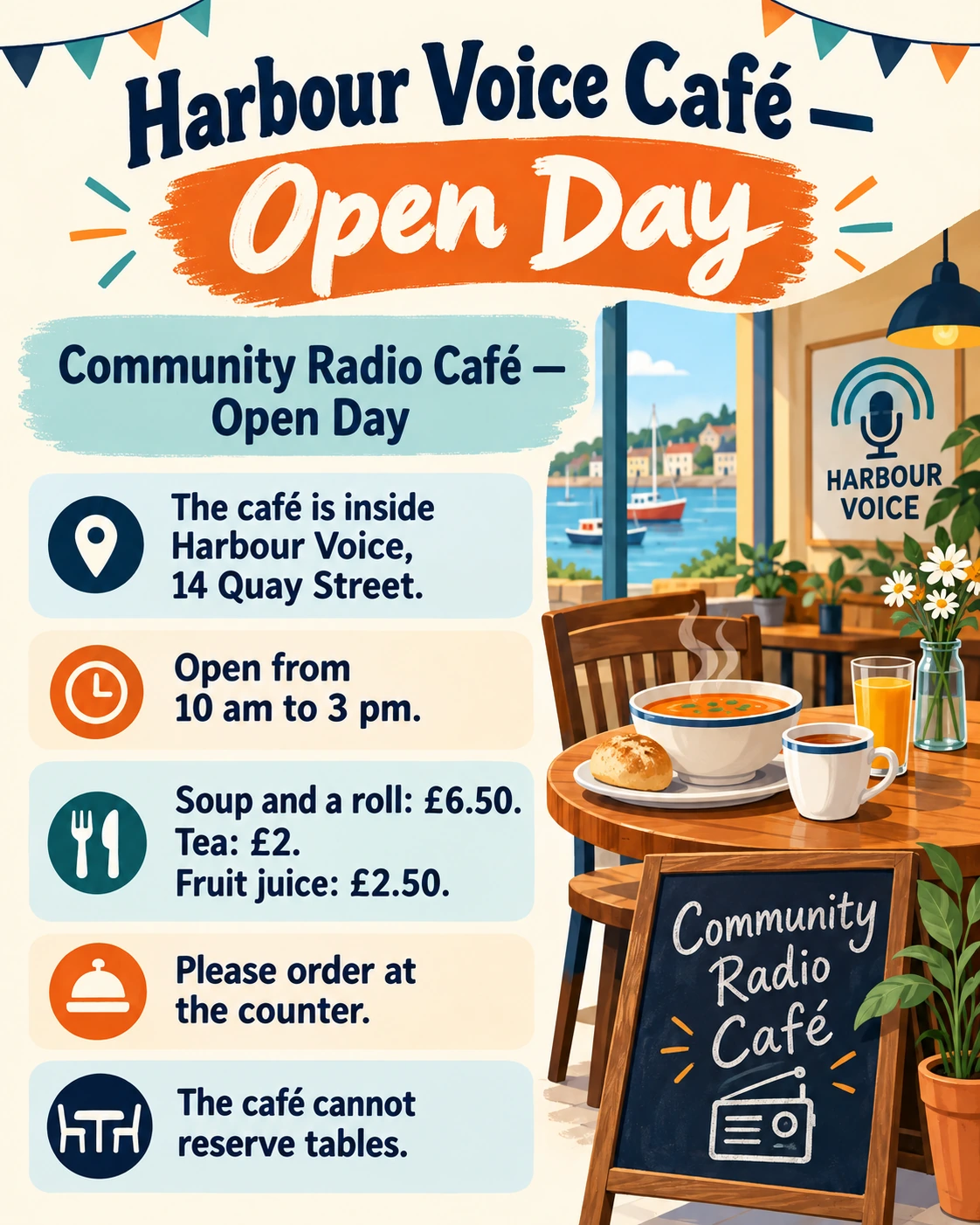
Read text version
Harbour Voice Café — Open Day
Community Radio Café — Open Day
The café is inside Harbour Voice, 14 Quay Street. Open from 10 am to 3 pm. Soup and a roll: £6.50. Tea: £2. Fruit juice: £2.50. Please order at the counter. The café cannot reserve tables.
Message from Isla to Ben
Message from Isla to Ben
Hi Ben, I’m bringing my cousin, Freya, to the radio open day on Saturday. We’ll arrive at 11.20. Could you meet us by the garden entrance? I’m hoping to have soup and a roll for lunch. Freya would like a fruit juice. I’ll bring some cash, so please don’t buy our drinks. See you there, Isla.
51. Answer: 14 Quay Street / 14 Quay St / 14 Quay St.. The café information gives its address as 14 Quay Street. The garden entrance is where Ben will meet them, not the postal address.
52. Answer: Freya. Isla says she is bringing her cousin, Freya. Ben is the recipient of the message and Isla is the sender.
53. Answer: 11.20 / 11:20 / 11.20 am / 11:20 am / 11.20am / 11:20am / 11.20 a.m. / 11:20 a.m.. Isla says they will arrive at 11.20. The café opening time is 10 am and is not their arrival time.
54. Answer: soup and a roll / soup with a roll / soup and roll. Isla says she hopes to have soup and a roll for lunch. This is one listed café meal.
55. Answer: 2.50 / 2.5 / £2.50 / £2.5 / two pounds fifty / two pounds and fifty pence. Freya wants fruit juice, which costs £2.50. Tea costs £2, and the soup and roll are food rather than her drink.
Write a message about a community event
Write a message of 25–35 words for question 56. Include all three points. Check the sample after you finish. Writing is assessed separately from the score out of 55.
You visited a local community event with a friend. Write a message to another friend about it. Write 25–35 words.
- Say where the event was.
- Say what you enjoyed there.
- Invite your friend to go with you next time.
0 words · target 25–35
This writing task is self-checked and is separate from your score out of 55.
Hi Alex, I went to the community radio open day at Harbour Voice on Saturday. I loved hearing the local music. Would you like to come with me next time?
Check: all three points answered; message clear; verbs and spelling checked; 25–35 words.
Ready to check your work?
Submit to grade your whole test, OR use 👁 Show Answer per part / per question.
Learning review & writing checklist
Read each notice for its purpose. Link dialogue replies to the turns before and after each gap. In Part 4, distinguish explicit agreement, contradiction and information that is not given. Use both source documents for the notes in Part 8.
For grammar gaps, read the whole sentence, choose the correct form, and read it again. For open gaps, type one word only. Check the first letter and spelling in Part 6.
Your writing should answer all three points in 25–35 words. Compare your message with the sample after you finish. The writing sample does not add points to the automatic score.
Show Answer reveals the answer and explanation without filling your response or awarding a mark. After editing a graded answer, submit again for an updated score.