
KET 3 Practice Test 1
Reading & Writing
The Cedar Lane Repair Club: help a community repair club, follow everyday conversations and practise reading and writing in useful situations. This original A2 practice keeps the classic nine-part structure used on this page.
Notices at the repair club
Read notices A-H. Match statements 1-5 to the notices. Use each letter once at most. H is the example.
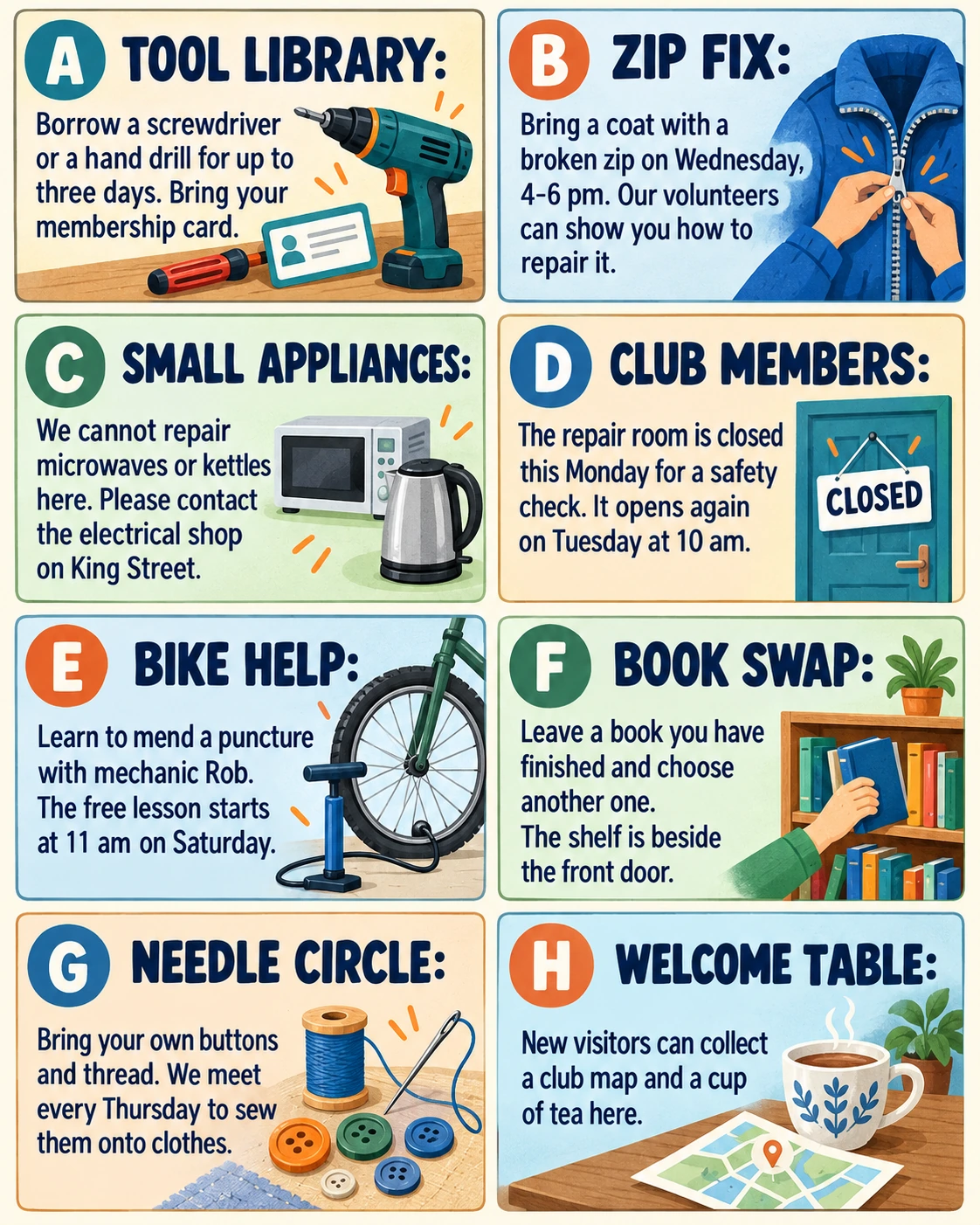
Read notices A–H as text
TOOL LIBRARY: Borrow a screwdriver or a hand drill for up to three days. Bring your membership card.
ZIP FIX: Bring a coat with a broken zip on Wednesday, 4-6 pm. Our volunteers can show you how to repair it.
SMALL APPLIANCES: We cannot repair microwaves or kettles here. Please contact the electrical shop on King Street.
CLUB MEMBERS: The repair room is closed this Monday for a safety check. It opens again on Tuesday at 10 am.
BIKE HELP: Learn to mend a puncture with mechanic Rob. The free lesson starts at 11 am on Saturday.
BOOK SWAP: Leave a book you have finished and choose another one. The shelf is beside the front door.
NEEDLE CIRCLE: Bring your own buttons and thread. We meet every Thursday to sew them onto clothes.
WELCOME TABLE: New visitors can collect a club map and a cup of tea here.
Example (not scored): You are new and want a map and a drink. → H
1. Answer: A. Notice A lends tools for three days, so it meets the need to borrow one for home use.
2. Answer: B. Notice B invites people with a broken coat zip to bring it for repair help.
3. Answer: D. Notice D says the room is closed Monday and opens again Tuesday at 10 am.
4. Answer: E. Notice E offers a lesson on mending a bicycle puncture, which is a tyre repair.
5. Answer: F. Notice F lets visitors leave a finished book and choose a different one.
A backpack gets a second life
Read the story. Choose the best word A, B or C for each gap 6-10.
Example (not scored): Mina carried her books in a large ____. → backpack
6. Answer: A. A work bench is a sturdy surface for practical jobs. A roof covers a building, and a path is a route for walking.
7. Answer: B. To sew is to join cloth with a needle and thread. Washing cleans cloth and folding bends it over.
8. Answer: C. A piece of thread is a length cut from a larger amount. Litres measure liquid and kilos measure weight.
9. Answer: A. Mina asks to borrow scissors so she can use them temporarily. Lend means give them to someone else, and own means possess them.
10. Answer: B. The expression is thanked someone for being patient. Invited and promised do not fit this meaning and sentence pattern.
Conversations at Cedar Lane
Choose the best reply A, B or C for exchanges 11-15. Then complete the longer conversation 16-20 with replies A-H. H is the example; use each other letter once and leave two unused.
Example (not scored): Sara asks who came with Leo. He says his cousin came too. → H
11. Answer: A. A gives permission and says where the pliers are; B and C do not answer the request.
12. Answer: B. About an hour answers a question about duration. The other choices give a place and a companion.
13. Answer: C. Offering to show Ravi is a natural response to his lack of experience; the others give unrelated details.
14. Answer: A. A politely accepts the offer. B gives a time and C does not refer clearly to tea.
15. Answer: B. B identifies a shelf, answering where to put the books. The other options give opening time and preference.
A longer conversation
A
I tightened the screw and checked it twice.
B
Yes, I tested it, and it feels steady now.
C
I found it beside the old furniture shelf.
D
Friday is fine. I can bring my small tool kit.
E
One of its legs moved whenever I sat down.
F
The room is painted yellow and has two windows.
G
I usually walk here because I live nearby.
H
I came with my cousin, who is waiting outside.
16. Answer: C. Sara asks where Leo found the chair. C names the place he found it.
17. Answer: E. Sara asks what was wrong with the chair. Reply E says one leg moved when Leo sat down; it describes the problem.
18. Answer: A. Sara asks how Leo repaired the chair leg. Reply A describes tightening the screw and checking it twice.
19. Answer: B. Sara asks whether Leo has tested the repaired chair. Reply B confirms he has and says the chair now feels steady.
20. Answer: D. Sara asks Leo to help with her lamp on Friday. D agrees to meet then.
Yusuf finds a repair club
Read the article. Are statements 21-27 Right (A), Wrong (B) or Doesn't say (C)? Choose C only when the article does not give enough information.
Example (not scored): The club meets behind the library. → A – Right
Yusuf gives old things another chance
When Yusuf moved to Cedar Lane, he thought the old things in his flat would have to be thrown away. A desk drawer stuck, his battery radio made a crackling sound, and two kitchen chairs had loose seats. His neighbour, Mrs Green, told him about the Repair Club, which met every Saturday in a room behind the library.
Yusuf was surprised that visitors did not need to be experts. Each person worked with a volunteer who knew about that kind of object. At his first visit, Yusuf chose the battery radio because he liked listening to music while he cooked. Volunteer June, who repaired radios for her job, checked it with him. They did not have to buy anything; the club kept a box of spare parts donated by local families. The radio played clearly again after they replaced a short cable.
Yusuf then looked at the chairs. A woodworker called Sam showed him how to make the seats firm with simple tools. Yusuf enjoyed learning, although he found the first repair harder than he had expected.
The club also has a quiet table where children can draw while adults work. People bring their own objects and can leave a small donation for tea and materials.
Yusuf now visits twice a month. He says the best thing is meeting neighbours and learning to care for useful objects. He plans to bring the desk drawer next time, but he will ask June for help before taking it apart.
21. Answer: A. The article says his neighbour, Mrs Green, told him about the Repair Club.
22. Answer: A. He chose the radio first because he liked listening to music while he cooked.
23. Answer: B. Sam, the woodworker, helped with the chair seats; June worked with Yusuf on the radio.
24. Answer: C. The article mentions Yusuf and his neighbour, but gives no information about his sister or whether she has visited the club.
25. Answer: A. The article says there is a quiet table where children can draw while adults work.
26. Answer: B. He plans to bring the desk drawer next time, so he did not repair it during the first visit.
27. Answer: C. The article identifies Sam as a woodworker, but does not describe how he travels to the club. A bus journey cannot be confirmed or contradicted.
A class visit
Read the story. Choose the best word A, B or C for each gap 28-35.
Example (not scored): We arrived ____ the club at ten. → at
28. Answer: B. Visited is the past form needed after last month.
29. Answer: B. Use to plus the infinitive to express purpose: to learn.
30. Answer: C. The visit happened last month, so had is the past form needed here. Has and have are present forms.
31. Answer: A. Which refers to the stool and is the subject of had. Where describes a place, and who refers to a person.
32. Answer: A. Removed is the past simple verb following we.
33. Answer: B. The pattern is show someone how to do something.
34. Answer: A. Because introduces the reason for working slowly: the narrator wanted to check each step. Although expresses contrast and unless sets a condition.
35. Answer: A. Use proud of followed by a thing or achievement: the narrator was proud of the repair. For and with do not complete this phrase.
Things you might carry
Complete each word from its definition. The first letter is given in brackets. Type the whole word for questions 36-40.
Example (not scored): You can use this to write a quick note. (p__) → pen
36. Answer: wallet. Wallet is the everyday word described by this clue. It begins with w and has 6 letters.
37. Answer: umbrella. Umbrella is the everyday word described by this clue. It begins with u and has 8 letters.
38. Answer: ticket. Ticket is the everyday word described by this clue. It begins with t and has 6 letters.
39. Answer: bottle. Bottle is the everyday word described by this clue. It begins with b and has 6 letters.
40. Answer: diary. Diary is the everyday word described by this clue. It begins with d and has 5 letters.
Messages about a repair morning
Complete the messages with ONE word in each space 41-50. The hints show the kind of word needed.
Example (not scored): Please write ____ me when you arrive. → to
41. Answer: on. Use on before a day or date: on Saturday morning.
42. Answer: to. Use go to before the name of a destination: going to the Repair Club. The preposition to shows the destination.
43. Answer: to. The purpose is to help fix the clock.
44. Answer: whether. Use whether immediately before 'or not': 'whether or not you can come'. If cannot be placed directly before or not.
45. Answer: of. A photo of the object means an image showing it.
46. Answer: than. Use than after the comparative busier to compare this week with the usual situation: busier than usual.
47. Answer: an. Use an before old, which begins with a vowel sound.
48. Answer: with. The preposition with links help to the object needing attention: help me with it. The cue asks for a preposition.
49. Answer: past. Half past nine means 9.30. Half to nine is not a standard expression for this time.
50. Answer: there. Is there a place introduces whether one exists.
Club open day details
Read both sources and complete notes 51-55. Write the requested date, place, time, number or price. Short phrases are allowed.
Example (not scored): What time does the event finish? (pm) → 1 pm
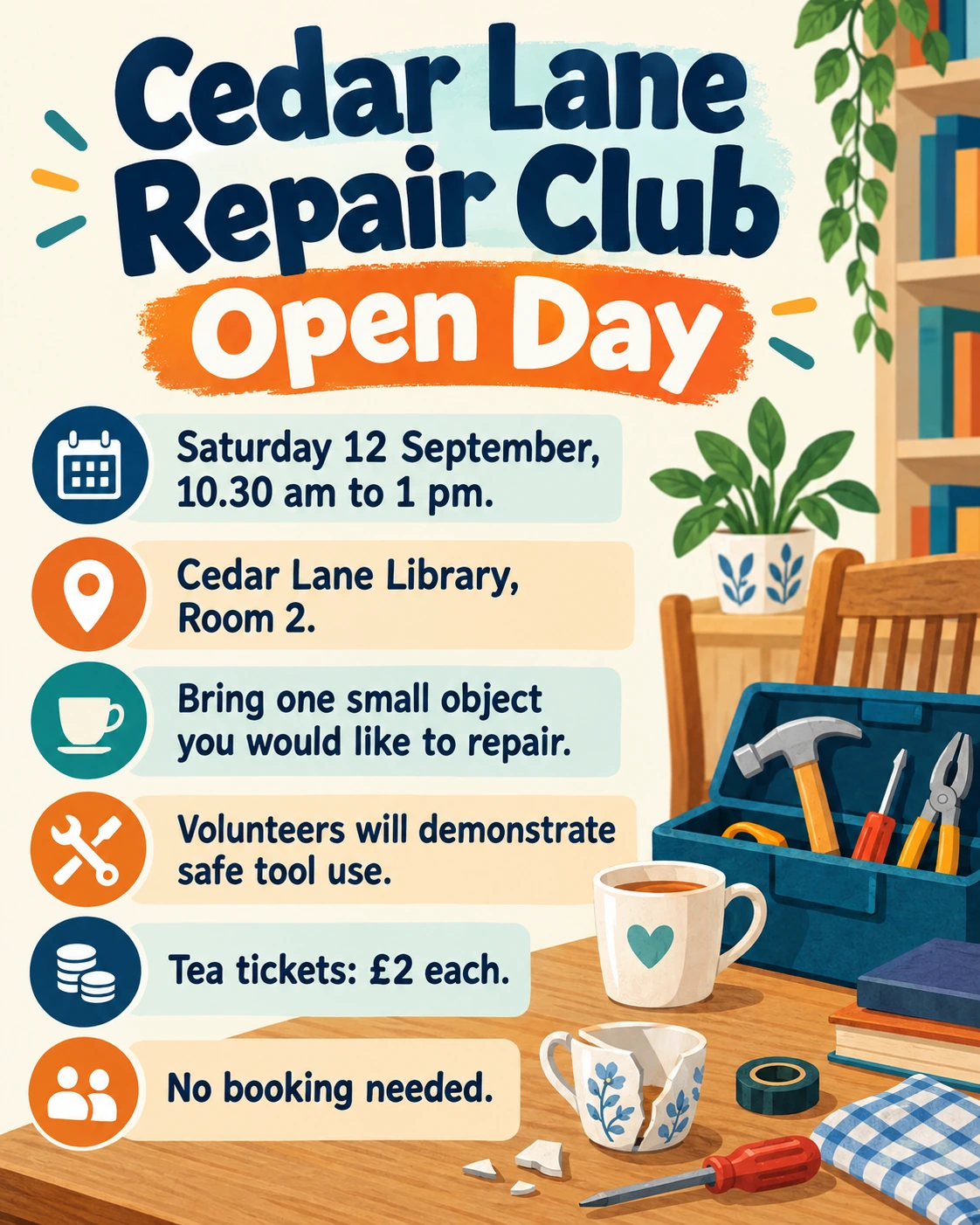
Read text version
Cedar Lane Repair Club Open Day
Saturday 12 September, 10.30 am to 1 pm. Cedar Lane Library, Room 2. Bring one small object you would like to repair. Volunteers will demonstrate safe tool use. Tea tickets: £2 each. No booking needed.
Message from Mia to Owen
Hi Owen, I saw the open day notice. Let's meet inside the library entrance at 10.15 am, then find Room 2 together. I'll bring my little desk fan. I'll buy a tea ticket there. Mia
51. Answer: 12 September / September 12 / 12th September / September 12th / 12 Sep / Sep 12 / 12/9 / 12/09. The club notice gives the open day as 12 September.
52. Answer: 2 / two / room 2 / room two. The open day notice names Room 2. The library entrance is where Mia and Owen will meet before they go to that room.
53. Answer: 10.30 am / 10:30 am / 10.30 / 10:30 / 10:30am / 10.30am / half past ten / 10.30 a.m. / 10:30 a.m.. The notice says the event begins at 10.30 am. The friends plan to meet at 10.15 am, which is a different time.
54. Answer: one / 1. The notice asks each visitor to bring one small object. Both the digit 1 and the word one are accepted.
55. Answer: 2 / two / £2 / £2.00 / £ 2 / 2 pounds / two pounds. The notice lists tea tickets at £2 each. The question asks for the price in pounds.
Write a postcard
Write a postcard of 25-35 words for question 56. Include all three points. Check the sample after you finish; this writing is assessed separately from the automatic score.
Your English-speaking friend Alex has invited you to visit the Cedar Lane Repair Club on Saturday. Alex asks: How will you travel here? What time will you arrive? What would you like to do at the club? Write Alex a postcard of 25-35 words.
- Say how you will travel there.
- Say what time you will arrive.
- Say what you would like to do at the club.
0 words · target 25–35
This writing task is self-checked and is separate from your score out of 55.
Hi Alex, I'll come by bus on Saturday and arrive at ten. I'd like to learn to mend my backpack at the club. Can you meet me outside? See you, Jamie
Check: all three points answered; message clear; verbs and spelling checked; 25–35 words.
Ready to check your work?
Submit to grade your whole test, OR use 👁 Show Answer per part / per question.
Learning review & writing checklist
Read each notice for its purpose. Link dialogue replies to the turns before and after each gap. In Part 4, distinguish facts the article confirms, facts it contradicts, and information it does not give. Use both source documents for the notes in Part 8.
For grammar gaps, read the whole sentence, choose the correct form, and read it again. For open gaps, type one word only. Check the first letter and spelling in Part 6.
Your writing should answer all three points in 25–35 words. Compare your message with the sample after you finish. The writing sample does not add points to the automatic score.
Show Answer reveals the answer and explanation without filling your response or awarding a mark. After editing a graded answer, submit again for an updated score.