
KET 1 Practice Test 3
Reading & Writing
Harbour Town Discovery Weekend: read everyday notices, complete conversations and use short texts to practise A2 reading and writing. This original practice keeps the classic nine-part structure used on this page.
Find an activity
Which notice (A–H) matches each statement (1–5)? Use each letter once at most. Notice H is the example.
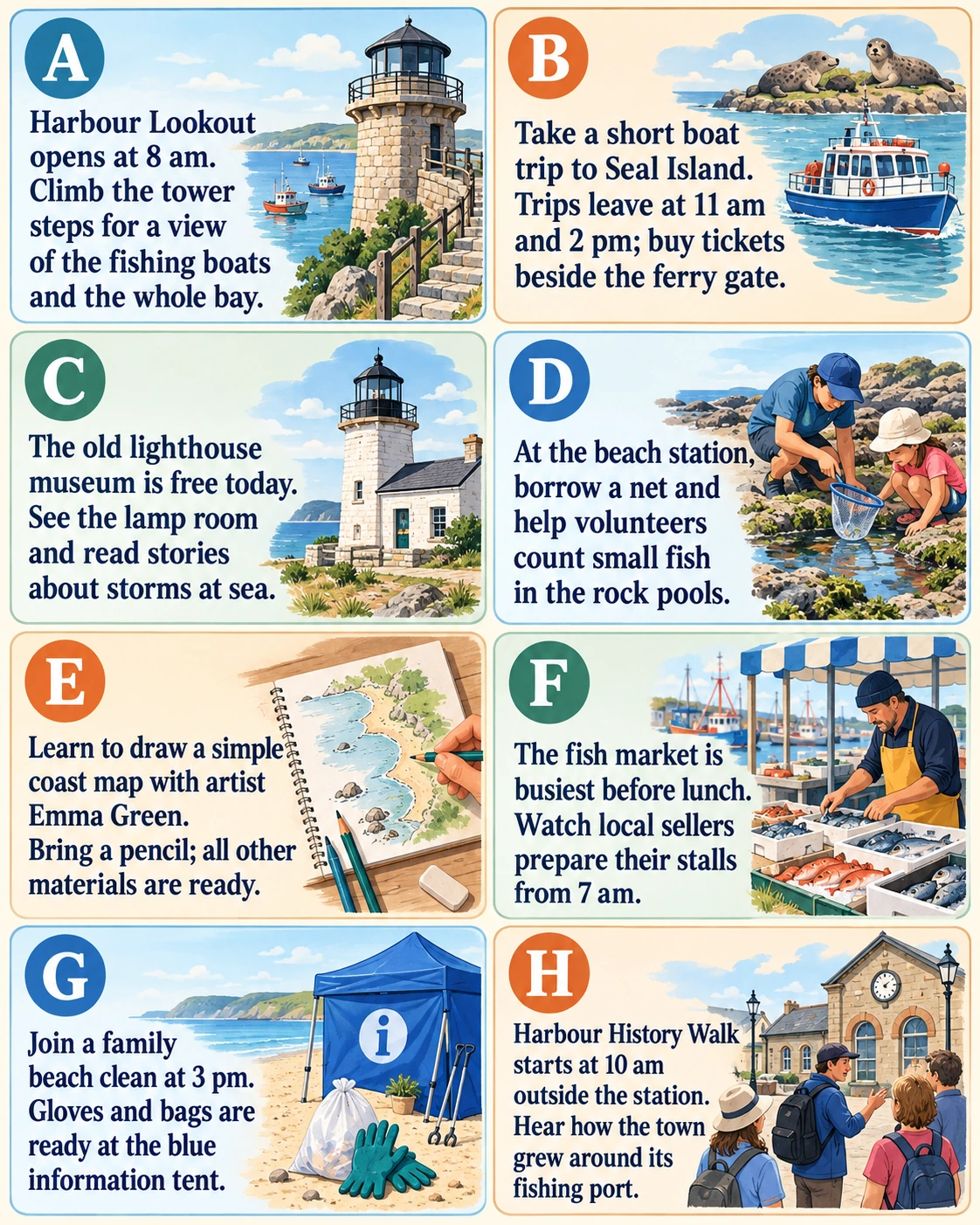
Read notices A–H as text
Harbour Lookout opens at 8 am. Climb the tower steps for a view of the fishing boats and the whole bay.
Take a short boat trip to Seal Island. Trips leave at 11 am and 2 pm; buy tickets beside the ferry gate.
The old lighthouse museum is free today. See the lamp room and read stories about storms at sea.
At the beach station, borrow a net and help volunteers count small fish in the rock pools.
Learn to draw a simple coast map with artist Emma Green. Bring a pencil; all other materials are ready.
The fish market is busiest before lunch. Watch local sellers prepare their stalls from 7 am.
Join a family beach clean at 3 pm. Gloves and bags are ready at the blue information tent.
Harbour History Walk starts at 10 am outside the station. Hear how the town grew around its fishing port.
Example (not scored): You want to hear how the town grew around its fishing port. → H
1. Answer: G. The beach clean welcomes helpers at 3 pm and provides gloves and bags.
2. Answer: B. Notice B offers trips to Seal Island, with two departure times.
3. Answer: C. The lighthouse museum is free today, so visitors do not need to pay to enter. The history walk is the example, not this answer.
4. Answer: D. Visitors can borrow a net and help count fish in the rock pools.
5. Answer: E. Emma Green leads a coast-map drawing session. Visitors only need to bring a pencil; the other materials are provided.
A morning at the harbour
Choose the correct word A, B or C for each space.
Example (not scored): They walked beside the water and looked at the boats. → water = the large area of sea in the harbour
6. Answer: A. A boat can arrive beside a pier; borrow and decide do not describe its movement here.
7. Answer: B. A route is a way to travel from one place to another. Price describes cost, and noise describes a sound.
8. Answer: C. A coat keeps Ava warm in cold wind. A plate and a ticket cannot be worn outdoors.
9. Answer: B. A model is a small object to take home; a message or a season is not.
10. Answer: C. Tell a story is the usual expression for giving a spoken account. Carry and build do not describe what the guide does here.
Everyday conversations
For 11–15, choose the best reply A, B or C. For 16–20, Jack and Mia are two friends planning a visit to Harbour Town. Choose Mia's missing reply A–H. Use each letter once. E is the example; two other replies are not needed.
Example (not scored): Jack: Have you been on the island boat trip before? Mia: I saw seals from the boat last summer. → E
11. Answer: C. Maya asks whether she may sit there; an invitation to sit answers her question.
12. Answer: A. Leo asks for a time, and half past ten gives a clear starting time.
13. Answer: B. Anna offers food. Accepting politely and thanking her responds to the offer; the other replies do not.
14. Answer: C. Harry explains a problem. Offering to let him use another camera responds helpfully to that problem.
15. Answer: B. Ella asks for an opinion about a completed trip; the reply gives an experience and feeling.
A longer conversation
A
A quarter past eleven works for me.
B
A bottle of water would be useful, thanks.
C
Yes, I will sit here, thank you.
D
Yes, I'll pack sandwiches for both of us.
E
I saw seals from the boat last summer.
F
The blue one is beside the window.
G
That sounds great; I'd love to see the fish.
H
Let's meet by the clock outside the museum.
16. Answer: B. Jack offers to bring drinks and asks what Mia would like. A bottle of water answers his question about a drink.
17. Answer: H. Jack asks where to meet. The clock outside the museum gives a specific meeting place.
18. Answer: A. Jack proposes a quarter past eleven. Mia says that this time works for her, so the two friends agree on it.
19. Answer: D. Jack asks Mia to bring food for both of them. Packing sandwiches for both friends agrees to that request.
20. Answer: G. Jack suggests the aquarium after lunch. Mia agrees and says she would like to see the fish there.
Discovery Saturday by the sea
Read the article. For each statement, choose A if it is Right, B if it is Wrong or C if the article Doesn't say.
Example (not scored): The history walk begins at eleven o'clock. → B — the article says it begins at ten o'clock.
A day to discover Harbour Town
Harbour Town is planning a Discovery Saturday for visitors who want to learn about the coast. The programme runs for one day only, on Saturday. The day begins with a history walk at ten o'clock. Everyone meets outside the railway station ten minutes earlier. A local guide explains how fishing families used the harbour and points out buildings that are more than a hundred years old. Visitors can then choose from several activities. At the beach station, volunteers lend nets to people who want to look for small fish in the rock pools. Anyone taking part must return the net before leaving the beach. Artist Emma Green leads a coast-map session in the library hall. People should bring a pencil, while the paper and coloured pens are supplied. In the afternoon, boats leave for Seal Island from the ferry gate. Tickets are sold at the blue kiosk near the harbour entrance. The lighthouse museum is open throughout the day, and a short talk about storms takes place in the old signal room at one o'clock. Some activities are outside, so visitors are advised to check the weather and wear comfortable shoes. There is no need to book for the walk or map session, but boat places are limited.
21. Answer: B. The article explicitly says the programme runs for one day only, on Saturday. This contradicts the statement that it also takes place on Sunday.
22. Answer: C. The article says boat tickets are sold at the kiosk but gives no child age rule or free fare.
23. Answer: A. The article directly says people should bring a pencil to Emma Green's map session. Paper and coloured pens are provided.
24. Answer: C. The article describes the museum and its talk but gives no height comparison for the tower.
25. Answer: A. The walk begins at ten, and the article says everyone meets outside the station ten minutes earlier.
26. Answer: B. The history walk, beach-station activity and boat trip take place outdoors or on the water.
27. Answer: A. The article states that anyone taking part must return the borrowed net before leaving the beach.
The lighthouse visitor centre
Choose the correct word A, B or C for each space.
Example (not scored): The centre is open on Sundays as well. → as well = also
28. Answer: A. The singular subject visitor centre takes is in the present simple to describe its location.
29. Answer: C. Yesterday signals the past, and our class visited the centre on that completed trip.
30. Answer: B. Which refers to the display, a thing, and is the subject of included. Who refers to a person; where cannot be the subject of included.
31. Answer: A. At the moment signals an action happening now; plural workers take are preparing.
32. Answer: B. Some visitors is plural and the sentence describes what they are doing now: are reading.
33. Answer: C. Ask someone not to do something uses ask + object + not to + verb.
34. Answer: A. Has been is present perfect; already fits the meaning that this visit happened before now.
35. Answer: B. Hope is followed by a to-infinitive: hope to visit again.
Complete the definitions
Read each definition and type the WHOLE word, including the first letter shown. The lines show the number of missing letters.
Example (not scored): A place where you can borrow books. (l______) → library — type all seven letters
36. Answer: guide. Guide has five letters and means a person who helps visitors understand a place.
37. Answer: lighthouse. Lighthouse has ten letters: light (5) plus house (5), and helps ships near the coast.
38. Answer: pier. Pier has four letters and is a platform where boats may stop beside the shore.
39. Answer: storm. Storm has five letters and means very bad weather with strong wind.
40. Answer: nurse. Nurse has five letters and names a trained person who cares for sick people.
A message about Saturday
Write ONE word in each space. Use the short hints in parentheses. Read the whole message before answering.
Example (not scored): I am looking forward to our day out. → forward — part of the expression look forward to
Ava
41. Answer: for. Thank you for is the fixed expression used before an -ing form such as inviting.
42. Answer: on. On is used before a day of the week: on Saturday.
43. Answer: to. Need is followed by a to-infinitive: need to leave.
44. Answer: has. My sister is singular, so present perfect uses has already visited.
45. Answer: of. In front of is the fixed phrase used to describe the position of the bus stop in relation to the station.
46. Answer: an. Umbrella begins with a vowel sound, so the singular noun needs an.
47. Answer: whether / if. Whether or if introduces an indirect yes/no question after know.
48. Answer: instead. Instead of + -ing expresses a replacement: visiting the museum replaces taking the boat when the sea is rough.
49. Answer: which / that. Which and that can both introduce a defining clause describing the map.
50. Answer: as. As soon as is the fixed expression meaning when possible.
Plan a harbour visit
Read the event notice and Mia's message. Complete Jack's notes with a short answer. Use words or numbers as appropriate.
Example (not scored): How long before an activity should visitors arrive? → ten minutes before
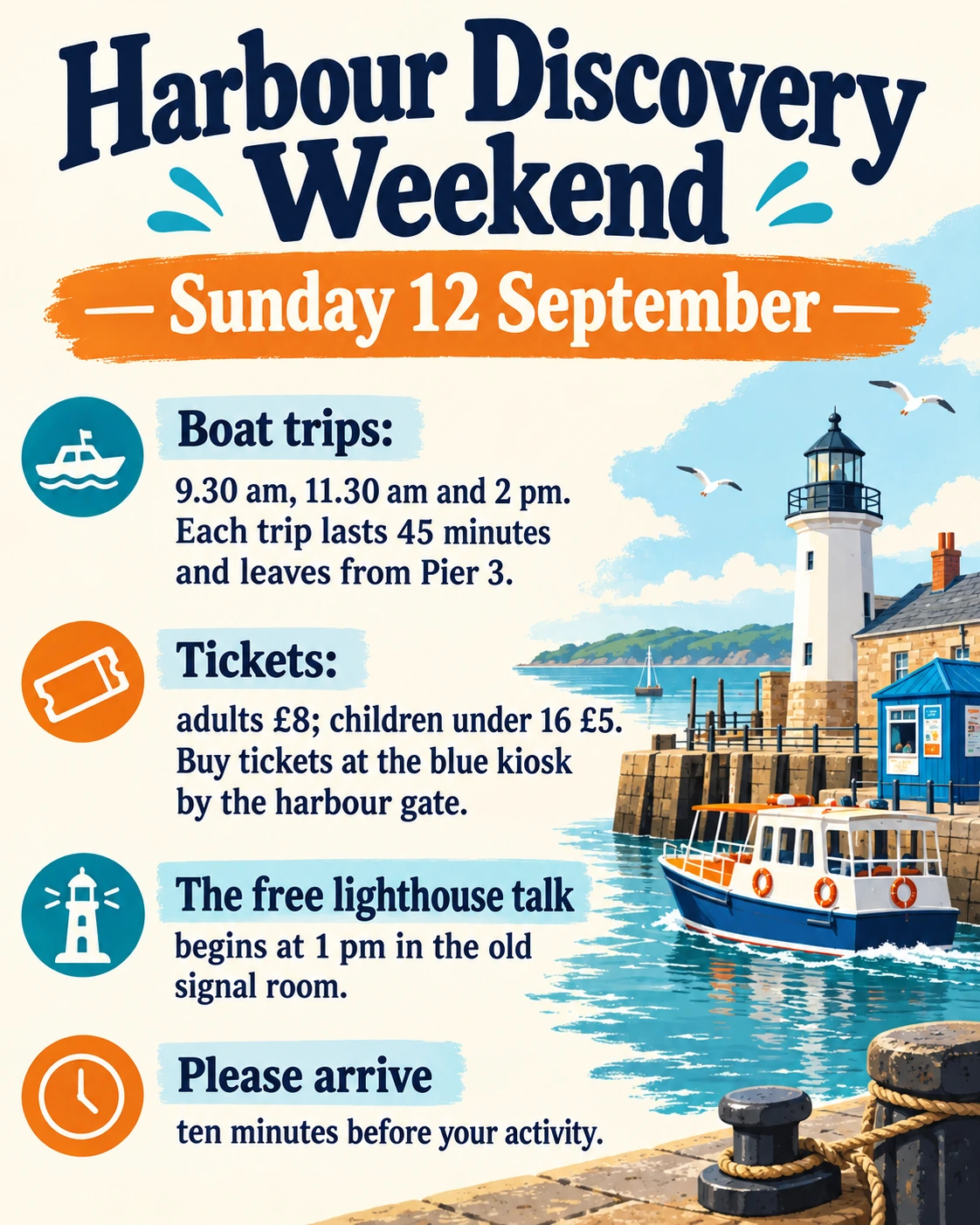
Read text version
Harbour Discovery Weekend — Sunday 12 September
Boat trips: 9.30 am, 11.30 am and 2 pm. Each trip lasts 45 minutes and leaves from Pier 3. Tickets: adults £8; children under 16 £5. Buy tickets at the blue kiosk by the harbour gate. The free lighthouse talk begins at 1 pm in the old signal room. Please arrive ten minutes before your activity.
Message from Mia to Jack
Hi Jack, I would love to go on the 11.30 boat trip on 12 September. I am 14, so I think my ticket is £5. Let's meet by the blue kiosk at 11.10, then we can buy our tickets together. After the trip, we can go to the lighthouse talk if there is time. See you! Mia.
51. Answer: 12 September / September 12 / 12th September / September 12th / 12/9 / 12/09 / Sunday 12 September / Sunday 12th September / 12 sep / 12 sept / Sep 12 / Sept 12. The event notice and Mia's message both identify Sunday 12 September as the visit date.
52. Answer: Pier 3 / 3 / number 3 / pier three / three / number three. The notice says all boat trips leave from Pier 3, the departure point for Mia's chosen trip.
53. Answer: 45 minutes / 45 mins / three quarters of an hour / 45 / forty-five minutes / forty five minutes / 45 min. Each boat trip lasts 45 minutes; 11.30 is the departure time, not the duration.
54. Answer: £5 / 5 / five pounds / £5.00 / 5 pounds / 5.00 / 5.00 pounds / five. Mia is 14, so she is under 16 and pays the children's price of £5.
55. Answer: by the blue kiosk / the blue kiosk / at the blue kiosk / blue kiosk / by blue kiosk / at blue kiosk. Mia asks Jack to meet by the blue kiosk before they buy their tickets.
Write a message
Write 25–35 words. Include all three points. This task is self-checked and is separate from the automatic score.
You spent a day in Harbour Town. Write a message to your English-speaking friend Ben. Include the three points below. Write 25–35 words.
- Say which activity you enjoyed most.
- Describe something you learned.
- Invite Ben to come with you next time.
0 words · target 25–35
This writing task is self-checked and is separate from your score out of 55.
Hi Ben, I visited Harbour Town on Sunday. My favourite activity was the boat trip. I learned how the lighthouse helps ships. Would you like to come with me next weekend? Write soon, Emma.
Check: all three points answered; message clear; verbs and spelling checked; 25–35 words.
Ready to check your work?
Submit to grade your whole test, OR use 👁 Show Answer per part / per question.
Learning review & writing checklist
Read harbour notices for their purpose. In conversations, connect each response to the surrounding turns. In Part 4, choose Right when the article supports the statement, Wrong when it gives conflicting information, and Doesn’t say when it gives no answer. Use both documents in Part 8 to complete the notes.
For grammar gaps, read the whole sentence, choose the correct form, and read it again. For open gaps, type one word only. Check the first letter and spelling in Part 6.
Your writing should answer all three points in 25–35 words. Compare your message with the sample after you finish. The writing sample does not add points to the automatic score.
Show Answer reveals the answer and explanation without filling your response or awarding a mark. After editing a graded answer, submit again for an updated score.