
DET to IELTS & TOEFL Score Conversion (Official 2026 Charts)
The complete official concordance between the Duolingo English Test, IELTS and TOEFL — total scores and skill-by-skill — plus what the new TOEFL 1–6 scale means for your conversion.
Searching “DET 120 in IELTS” returns dozens of conflicting tables. Here is the simple truth: there is exactly one source that matters — Duolingo’s official concordance published at englishtest.duolingo.com/scores, built from thousands of test takers who took both exams. Everything below comes from that source, verified in July 2026.
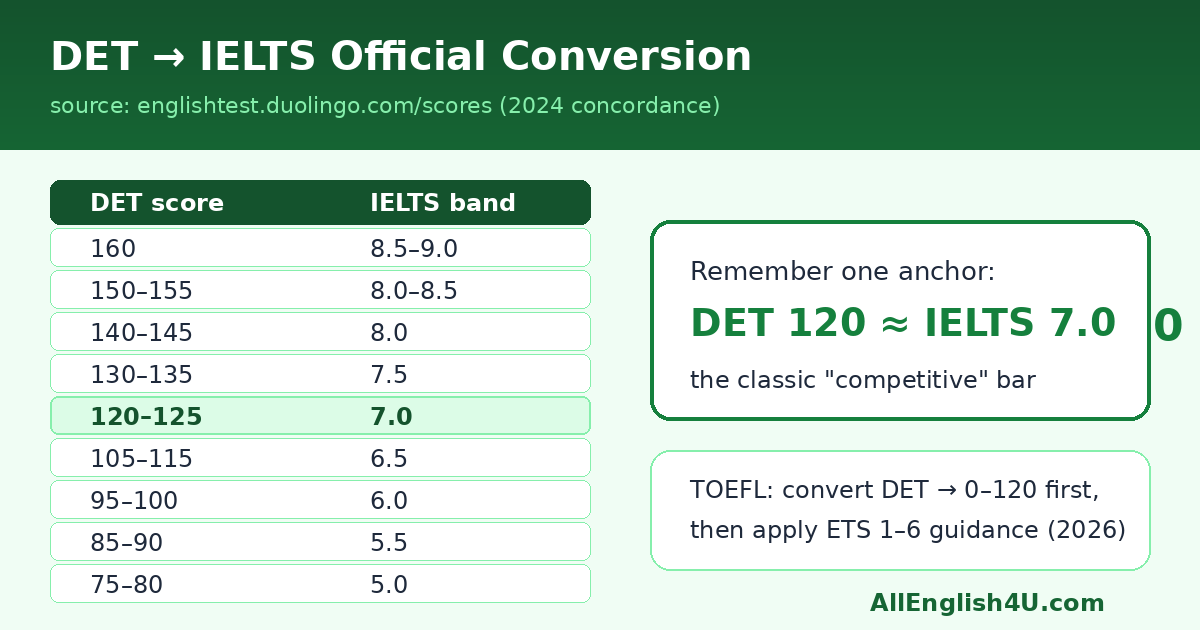
The one number to remember: DET 120 ≈ IELTS 7.0.
Why you should only trust the official chart
Duolingo’s DET–IELTS concordance was updated in 2024 using 3,586 paired official score reports — real people who took both tests within a short window. Third-party tables you find on agency websites are often copied from older versions, rounded differently, or simply invented. Universities use the official table; so should you.
DET → IELTS conversion table
| DET score | IELTS band (approx.) |
|---|---|
| 160 | 8.5–9.0 |
| 150–155 | 8.0–8.5 |
| 140–145 | 8.0 |
| 130–135 | 7.5 |
| 120–125 | 7.0 |
| 105–115 | 6.5 |
| 95–100 | 6.0 |
| 85–90 | 5.5 |
| 75–80 | 5.0 |
| 65–70 | 4.5 |
| 10–60 | ≤4.0 |
DET → TOEFL conversion (and the new 1–6 TOEFL scale)
The official concordance maps DET 10–160 to the TOEFL iBT 0–120 scale, including section subscores. Key anchor points:
| DET score | TOEFL iBT (0–120, approx.) |
|---|---|
| 160 | 120 |
| 120 | 104–108 |
| 100 | 93–97 |
| 80 | 76–81 |
| 60 | 53–58 |
Skill-by-skill conversion — the part most sites skip
Here is something few conversion articles mention: the official /scores page also publishes concordance for each individual skill — Speaking, Writing, Reading and Listening — mapped to IELTS bands and TOEFL section scores.
Why this matters: many universities set per-skill minimums (for example, “IELTS 6.5 overall with no band below 6.0”). If a program requires a specific writing level, an agency-made overall table cannot tell you whether your DET Writing subscore qualifies — the official skill charts can. Your DET score report includes all four individual subscores (plus four integrated ones: Production, Literacy, Comprehension, Conversation), so you can check each requirement directly against the official chart at englishtest.duolingo.com/scores.
DET and CEFR levels
Duolingo publishes an official CEFR alignment chart (A1 → C2 on the 10–160 scale) on the same /scores page, based on an independent expert alignment study. If a European university states its requirement in CEFR terms (e.g., “B2 required”), use that official chart rather than third-party approximations. As a rough orientation from the IELTS equivalences above: the IELTS 7.0 zone (DET ≈ 120) sits in solid B2–C1 territory.
DET vs IELTS vs TOEFL at a glance
Score conversion only matters if you’re choosing between tests, so here is the practical comparison behind the numbers:
| DET | IELTS Academic | TOEFL iBT | |
|---|---|---|---|
| Fee | US$70 | ~US$200–260 (varies by country) | ~US$200–250 (varies by country) |
| Where | At home, anytime | Test centre (computer or paper) | Test centre / home edition |
| Length | ~1 hour | ~2h45m | ~2 hours |
| Results | ~48 hours | ~1–13 days | ~4–8 days |
| Score scale | 10–160 | Bands 0–9 | 0–120 (new 1–6 bands from 2026) |
| Score sending | Free, unlimited | Limited free copies, then paid | Limited free copies, then paid |
The catch, as always, is acceptance: IELTS and TOEFL work almost everywhere including visas; the DET is admission-focused and has hard limits in Australia and for Canadian work permits — details in our Australia & Canada guide.
Four common conversion mistakes
1. Using an outdated table. The DET–IELTS concordance was rebuilt in 2024; tables copied from before that (still everywhere on agency sites) can be off by half a band at some levels. Check the /scores page date, not a blog’s.
2. Assuming the conversion is linear. It isn’t — notice how IELTS 8.0 spans DET 140–155, while IELTS 6.5 spans 105–115. Interpolating between rows yourself will mislead you at the top of the scale.
3. Ignoring per-skill minimums. Meeting the overall requirement while missing a “no band below X” clause is the most common silent rejection reason. Use the official skill-by-skill charts described above.
4. Forgetting validity windows. DET scores are valid for 2 years, same as IELTS and TOEFL — but the clock runs from your test date, and some universities require validity through enrollment day, not application day. A score expiring mid-process is a conversion-adjacent detail that trips up gap-year applicants.
How to use these numbers in a real application
Step 1. Find your program’s English requirement (IELTS or TOEFL number, or a direct DET requirement — over 6,000 programs publish one).
Step 2. If the school lists a DET score, ignore conversion entirely — their number wins.
Step 3. If they only list IELTS/TOEFL, convert with the official tables above, then aim 5 points above the converted DET score. Concordance is a statistical estimate, not a guarantee, and a small buffer keeps you safely over the line.
Step 4. Check per-skill minimums against the official skill-by-skill charts.
Frequently asked questions
Is DET 120 good enough for US universities?
DET 120 ≈ IELTS 7.0, which meets or exceeds the published requirement at many US universities. Selective programs often ask for 125–130+. Always check your specific program’s page.
What DET score equals IELTS 6.5?
DET 105–115 corresponds to IELTS 6.5 on the official concordance.
Can I convert DET directly to the new TOEFL 1–6 scale?
Not directly. Convert DET → TOEFL 0–120 using the official concordance, then apply ETS’s own guidance for the 0–120 ↔ 1–6 relationship. No official direct table exists as of July 2026.
Do universities accept converted scores?
Universities that accept the DET publish their own DET requirement — that number always overrides any conversion. Conversion tables are for orientation when a school only lists IELTS/TOEFL requirements.