
KET 3 Practice Test 4
Reading & Writing
Alderwick Community Radio Weekend: explore a local radio weekend, follow everyday conversations and practise reading and writing in useful situations. This original A2 practice keeps the classic nine-part structure used on this page.
Notices at Alderwick Radio Weekend
Which notice (A–H) matches each statement (1–5)? Use each letter once at most. Notice H is the example.
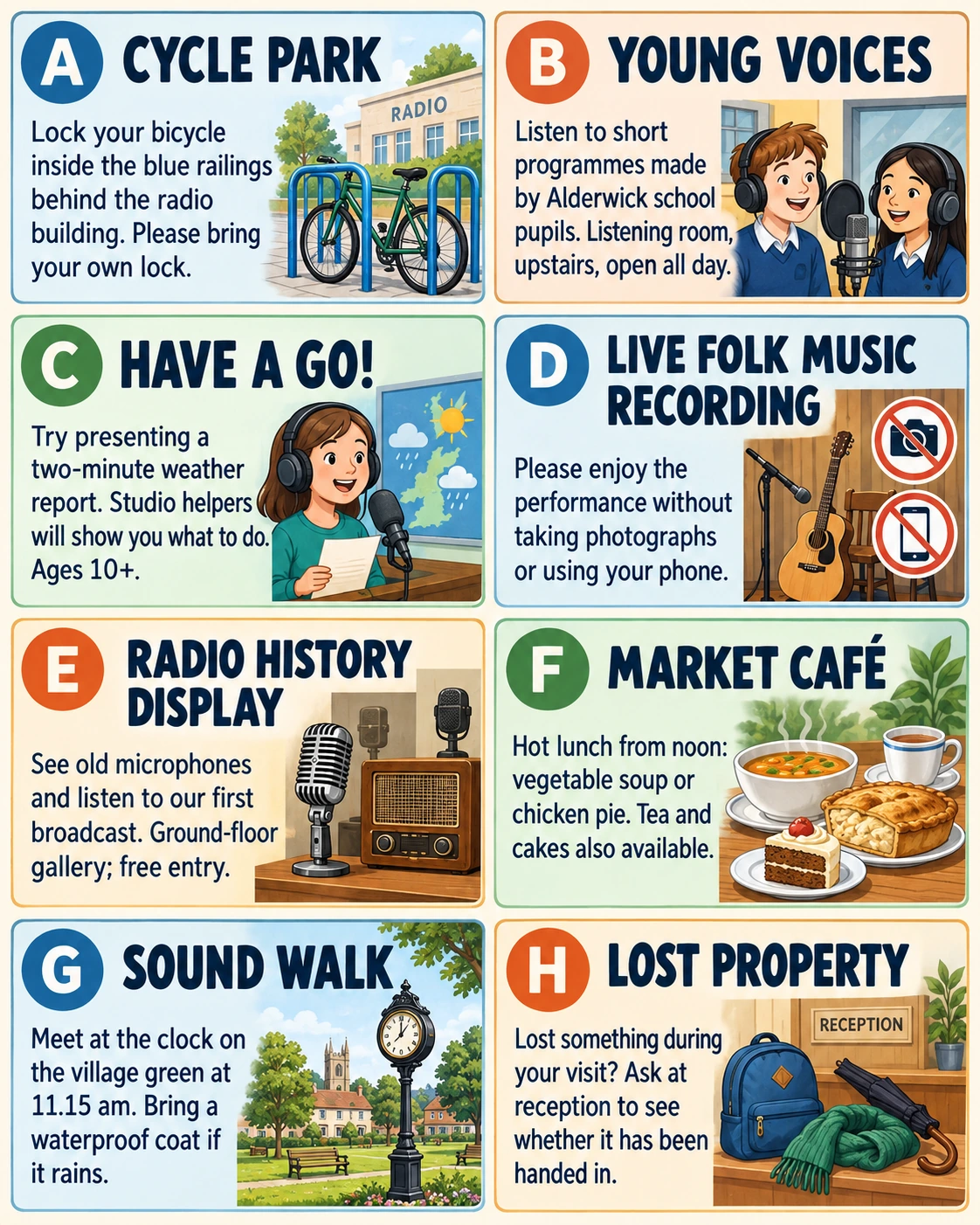
Read notices A–H as text
CYCLE PARK
Lock your bicycle inside the blue railings behind the radio building. Please bring your own lock.
YOUNG VOICES
Listen to short programmes made by Alderwick school pupils. Listening room, upstairs, open all day.
HAVE A GO!
Try presenting a two-minute weather report. Studio helpers will show you what to do. Ages 10+.
LIVE FOLK MUSIC RECORDING
Please enjoy the performance without taking photographs or using your phone.
RADIO HISTORY DISPLAY
See old microphones and listen to our first broadcast. Ground-floor gallery; free entry.
MARKET CAFÉ
Hot lunch from noon: vegetable soup or chicken pie. Tea and cakes also available.
SOUND WALK
Meet at the clock on the village green at 11.15 am. Bring a waterproof coat if it rains.
LOST PROPERTY
Lost something during your visit? Ask at reception to see whether it has been handed in.
Example (not scored): You should ask here if you cannot find something you brought. → H
1. Answer: C. Notice C invites visitors to try presenting a two-minute weather report with help from the studio team.
2. Answer: A. Notice A says visitors may lock bicycles inside the marked area behind the radio building.
3. Answer: F. Notice F lists vegetable soup as the meat-free lunch choice at the market café.
4. Answer: D. Notice D asks people to keep cameras and phones away during the live music recording.
5. Answer: B. Notice B advertises recordings made by Alderwick school pupils in the listening room.
Getting ready for a radio visit
Read the passage. Choose the best word (A, B or C) for each space.
Example (not scored): Our class went to the station by ____ because it was too far to walk. → bus
6. Answer: A. A schedule is a plan showing when activities will happen. The visitors need to know the times for each part of the open day.
7. Answer: C. The natural phrase is take a photograph of the outside of a building. The other verbs do not fit this meaning.
8. Answer: B. Quiet means making little noise, which is suitable for a room where people are listening carefully.
9. Answer: A. Checked means examined something to make sure it was correct. The presenter checked the sound before the recording went on air.
10. Answer: B. Visitors can ask questions about how radio works. Ask questions is the natural phrase here.
Quick conversations and a weekend plan
For questions 11–15, choose the best reply (A, B or C). Then complete the longer conversation using choices A–H. Choice H is the example.
Example (not scored): Martha: Are you coming to the radio open day? Callum: Yes, I am. → H
11. Answer: B. B politely accepts the offer and states the amount. The other replies do not answer the question.
12. Answer: C. At half past five gives the closing time. The other replies describe a place and a person.
13. Answer: A. A gives practical advice about looking in a likely place. The other answers do not help with a missing ticket.
14. Answer: B. B is a natural response to thanks. The other choices discuss the books without replying politely.
15. Answer: C. C accepts the suggestion and gives a reason to walk. The other replies do not respond to Ben's invitation.
A longer conversation
A
I've never done that, but I'd like to.
B
Good idea. Which exit should I use?
C
What time should I get there?
D
I heard it on the radio last night.
E
I have a pair at home. I'll bring them.
F
Could we eat at the market café? It has vegetable soup.
G
I think my uncle used to work at a station.
H
Yes, I am. (example)
16. Answer: A. Choice A accepts the invitation to try presenting and says Callum has never done it. Martha then reassures him that the presenter will explain what to do.
17. Answer: B. Martha suggests meeting at the station. Choice B agrees and asks which exit to use, which Martha answers next.
18. Answer: C. After Martha names the north exit, Callum asks what time he should arrive. Martha supplies the time in her next turn.
19. Answer: E. Martha asks whether Callum can bring headphones for the recorded tour. E confirms that he has a pair and will bring them.
20. Answer: F. Choice F suggests the market café and mentions vegetable soup. Martha agrees and says she likes that soup too.
A new voice on Alderwick Radio
Read the article. For questions 21–27, choose A (Right), B (Wrong) or C (Doesn't say). Choose Doesn't say when the article gives no information about the statement.
Example (not scored): Milly remembers a red light above the studio door. → A — Right
From school visitor to presenter
Milly first went to Alderwick Radio on a school trip when she was in Year 7. She remembers the small studio and the red light above its door. The presenter played a short song and explained how people speak clearly into a microphone. Milly enjoyed the visit, but she did not imagine that she would return to work there.
Several months later, her English teacher told the class about a Saturday club for young people at the station. Milly joined with her friend Priya. At first, they helped choose music and checked that each song was suitable for the programme. Later, the station manager asked them to prepare a five-minute show about things happening in Alderwick.
Milly now presents the show once a month. She usually interviews someone who is organising a local activity, such as a book sale or a sports day. Before each interview, she writes a short list of questions. She still feels nervous sometimes, but Priya helps her practise. The young presenters volunteer, so they do not receive money. Their families were pleased when the first show went out.
Milly says radio has helped her feel more confident when she speaks to new people. She also enjoys hearing about events she might not otherwise know about. Next year, she hopes to visit some local gardens and talk to the people who look after them. She thinks their advice could help listeners grow plants at home.
21. Answer: A. The article says her first visit was a school trip in Year 7.
22. Answer: B. On the first visit she only watched a presenter. She started helping with a programme several months later, so the statement is wrong.
23. Answer: C. The article says the presenters' families were pleased. It gives no information about Milly's father's job, so the answer is Doesn't say.
24. Answer: A. She prepares a short list of questions before each interview, which means she writes them down in advance.
25. Answer: B. The article says the young presenters volunteer and do not receive money. This directly contradicts the statement.
26. Answer: C. The article gives no details about how she travels to the station.
27. Answer: A. In the final paragraph, Milly says she would like to visit local gardens and speak to the people who look after them next year.
The school recording project
Read the passage. Choose the correct word (A, B or C) for each space.
Example (not scored): The pupils worked together ____ a team. → as
28. Answer: C. Our is the possessive form needed before the noun project. We is a subject pronoun and us is an object pronoun.
29. Answer: A. Because introduces the reason the students chose the room: it was away from the playground.
30. Answer: B. The phrase listen to a recording uses to after listen. The other prepositions do not fit this verb here.
31. Answer: A. Better is the comparative form used with than when comparing two recordings.
32. Answer: C. A sound that is too quiet cannot be heard easily. Too marks a degree that causes the problem.
33. Answer: B. Which introduces a clause describing the machine. Who is for people, and where is for places.
34. Answer: A. There were a few mistakes means there were some mistakes, but not many. Few is used with plural countable nouns.
35. Answer: C. The action happened yesterday, so the past simple sent is needed. Send and sending do not match the finished past time.
Words connected with sound and communication
Read each description and write the whole word. The first letter is given. Include it in your answer.
Example (not scored): A person who writes news stories for a newspaper or radio station. (r_______) → reporter
36. Answer: presenter. A presenter introduces and speaks during a programme. Presenter has nine letters and begins with p.
37. Answer: microphone. A microphone records or carries a person's voice. It has ten letters and begins with m.
38. Answer: screen. A screen is the part of a computer that displays words and pictures. Screen has six letters and starts with s.
39. Answer: listener. A listener is someone who hears a programme or other sound. It has eight letters and begins with l.
40. Answer: playlist. A playlist is a list of music or recordings selected to play. It has eight letters and begins with p.
A message about volunteering
Complete the email with ONE word in each space. Use the grammar cues if you need help.
Example (not scored): Hi Grace, Thanks for your message. → for — thank someone for something
Oliver
41. Answer: to. Would love is followed by to and the base form of a verb: would love to help.
42. Answer: at. Use at before the exact starting time of an event: the welcome talk starts at nine on Saturday.
43. Answer: than. The comparative older is followed by than when comparing two people.
44. Answer: how. How many asks about the number of a countable plural noun, such as chairs.
45. Answer: of. The fixed expression is plenty of, meaning more than enough.
46. Answer: an. Use an before a singular noun phrase beginning with a vowel sound: an extra camera. The first sound of extra is a vowel.
47. Answer: in. The adjective interested is followed by in before a subject or activity.
48. Answer: where. Where asks about a place. Here it introduces the place where the writer and friend can meet.
49. Answer: been / gone. Has never been inside describes a place someone has not visited. Has never gone inside is also grammatical here, so both been and gone are accepted.
50. Answer: if / whether. If or whether introduces the indirect yes/no question: ask if she can come, or ask whether she can come. Both words are valid here.
Sign up for a radio workshop
Read the notice and the message. Complete the booking notes using short answers. Write the time with a colon or a full stop if you wish.
Example (not scored): Equipment the staff will lend participants: → headphones
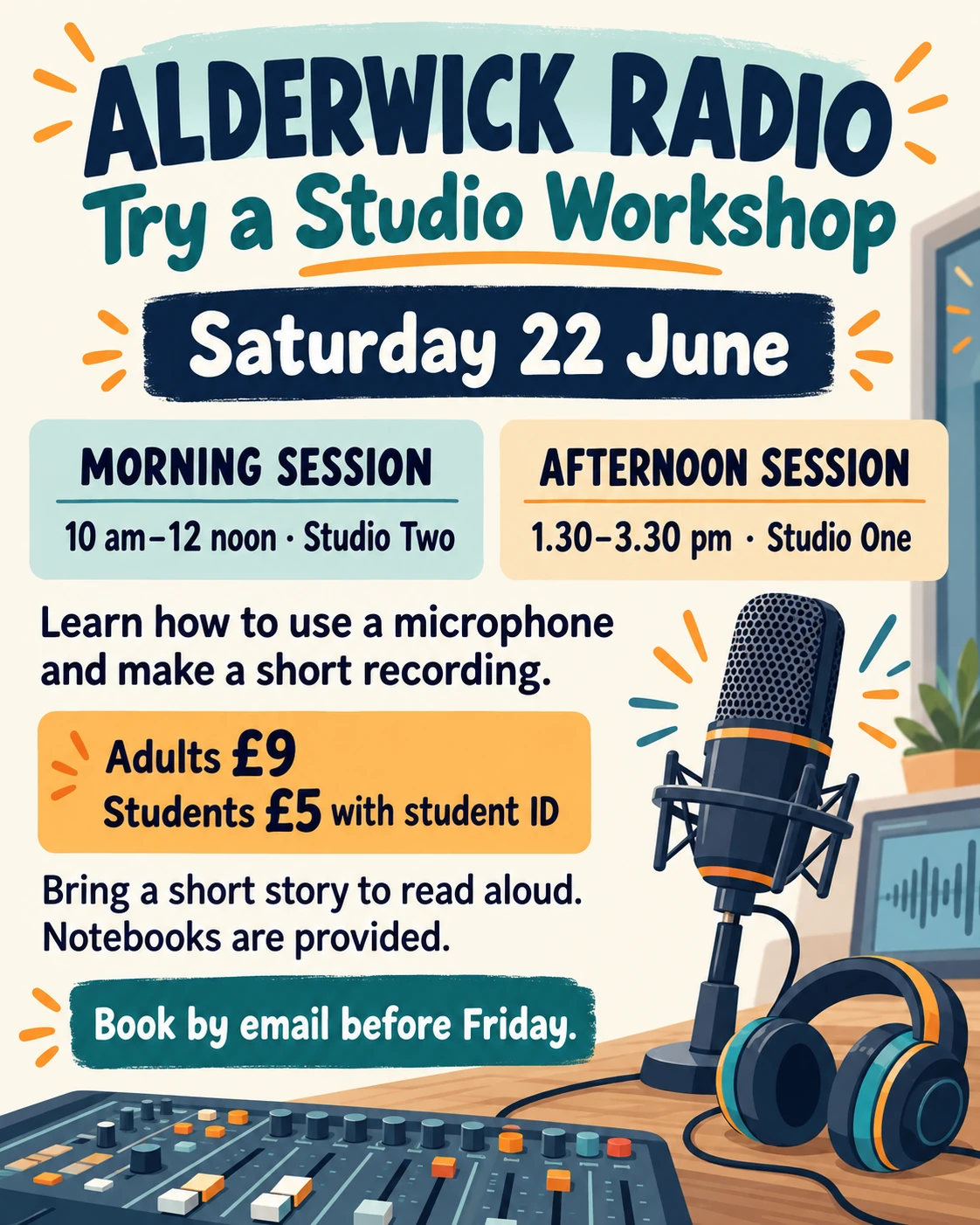
Read text version
Alderwick Radio: Try a Studio Workshop
Saturday 22 June. Morning session: 10 am–12 noon in Studio Two. Afternoon session: 1.30–3.30 pm in Studio One. Learn how to use a microphone and make a short recording. Fee: adults £9; students £5 with student ID. Bring a short story to read aloud. Notebooks are provided. Book by email before Friday.
Message from Priya to Sam
Hi Sam, I've booked the morning session for both of us on 22 June. We both have college cards, so I booked the student rate of £5 each. Bring your card with you. Let's meet at the café at 9.40 and walk over together. Remember to bring a short story for the recording activity. The radio staff will lend us headphones. See you, Priya
51. Answer: 22 June / June 22 / 22nd June / June 22nd / 22 Jun / Jun 22 / 22/6 / 22/06. The workshop notice gives 22 June, and Priya's message says she has booked for that date.
52. Answer: studio two / studio 2. The notice places the workshop in Studio Two. The café is the suggested place to meet before the session.
53. Answer: 10 / 10.00 / 10:00 / 10 am / 10am / 10.00 am / 10:00 am / 10.00am / 10:00am / ten / ten o'clock / ten o’clock. The morning workshop starts at 10 am. Priya suggests meeting at 9.40, twenty minutes earlier.
54. Answer: 5 / 5.00 / £5 / £5.00 / five / five pounds / 5 pounds / £ 5 / £ 5.00. The notice gives a student price of £5 with student ID. Priya says both visitors have college cards and she booked that rate for each of them.
55. Answer: a short story / short story / story / a story. The notice asks each participant to bring a short story to read aloud. A notebook is provided at the workshop.
Write to a friend
Write 25–35 words. Answer all three points. This writing task is self-checked separately from the automatic score.
Your English-speaking friend Jamie would like to visit Alderwick Radio Weekend with you. Write an email inviting Jamie. Say which activity you want to try, where and when you will meet, and what Jamie should bring. Write 25–35 words.
- Say which radio activity you want to try.
- Say where and when you will meet.
- Say what Jamie should bring.
0 words · target 25–35
This writing task is self-checked and is separate from your score out of 55.
Hi Jamie, Shall we try the weather report at Alderwick Radio on Saturday? Meet me by the north station exit at ten fifteen. Please bring your headphones and a notebook. See you there, Alex.
Check: all three points answered; message clear; verbs and spelling checked; 25–35 words.
Ready to check your work?
Submit to grade your whole test, OR use 👁 Show Answer per part / per question.
Learning review & writing checklist
Read each notice for its purpose. Link dialogue replies to the turns before and after each gap. In Part 4, distinguish explicit agreement, contradiction and missing information. Use both source documents for the notes in Part 8.
For grammar gaps, read the whole sentence, choose the correct form, and read it again. For open gaps, type one word only. Check the first letter and spelling in Part 6.
Your writing should answer all three points in 25–35 words. Compare your message with the sample after you finish. The writing sample does not add points to the automatic score.
Show Answer reveals the answer and explanation without filling your response or awarding a mark. After editing a graded answer, submit again for an updated score.