
KET 2 Practice Test 1
Reading & Writing
Community Book Exchange and Everyday Learning: practise everyday reading, follow conversations and write a short message. This original A2 practice keeps the classic nine-part structure used on this page.
Notices for a community learning day
Read the eight notices A–H. Match statements 1–5 to the notices. Use each letter once at most. H is used in the example; two other notices are not needed.
Read notices A–H as text
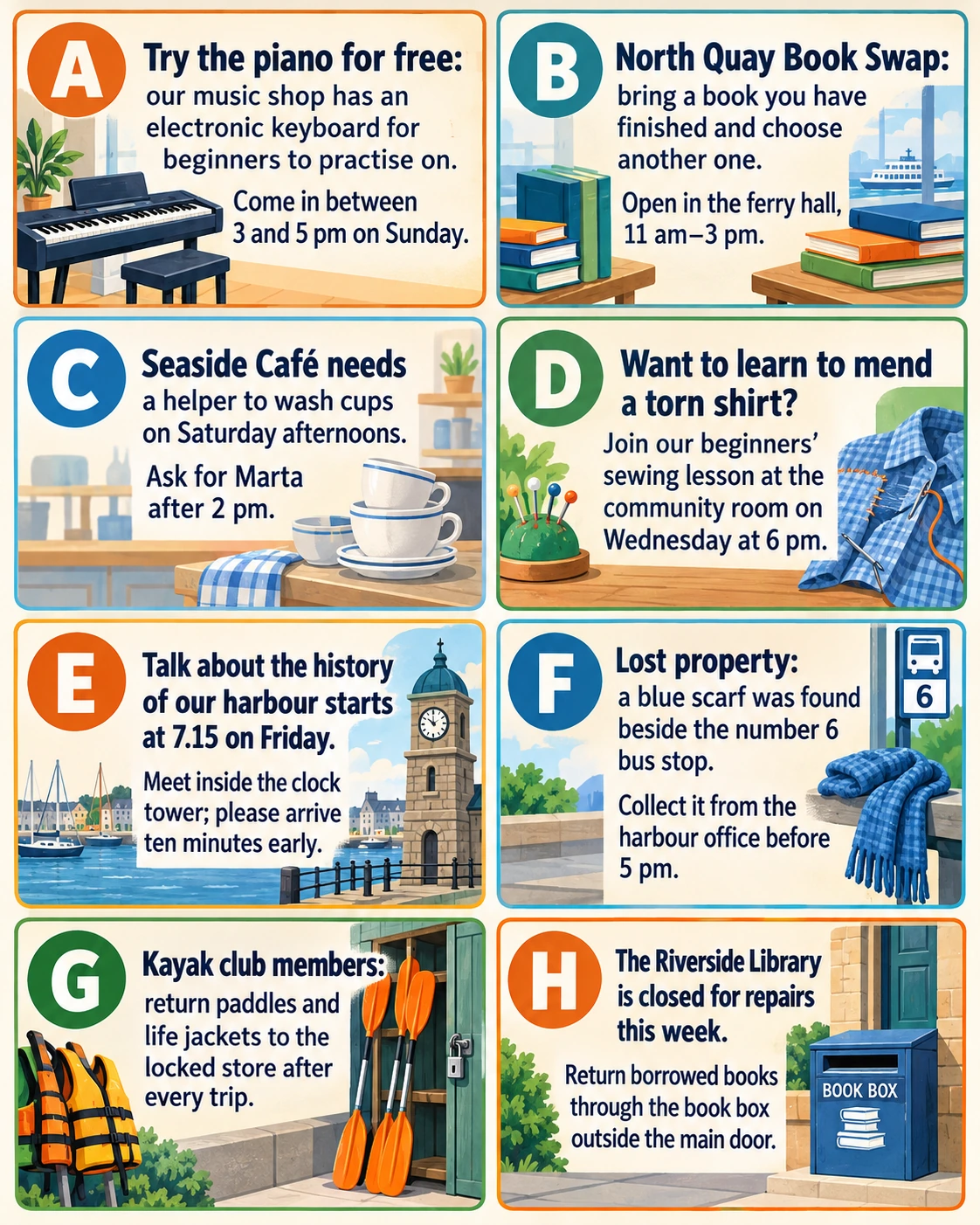
Try the piano for free: our music shop has an electronic keyboard for beginners to practise on. Come in between 3 and 5 pm on Sunday.
North Quay Book Swap: bring a book you have finished and choose another one. Open in the ferry hall, 11 am–3 pm.
Seaside Café needs a helper to wash cups on Saturday afternoons. Ask for Marta after 2 pm.
Want to learn to mend a torn shirt? Join our beginners’ sewing lesson at the community room on Wednesday at 6 pm.
Talk about the history of our harbour starts at 7.15 on Friday. Meet inside the clock tower; please arrive ten minutes early.
Lost property: a blue scarf was found beside the number 6 bus stop. Collect it from the harbour office before 5 pm.
Kayak club members: return paddles and life jackets to the locked store after every trip.
The Riverside Library is closed for repairs this week. Return borrowed books through the book box outside the main door.
Example (not scored): You need to give library books back while the building is shut. → H — use the book box outside the main door.
1. Answer: B. Notice B invites people to bring a finished book and choose another at the swap.
2. Answer: D. Notice D offers a beginners’ lesson about mending a torn shirt.
3. Answer: F. Notice F describes a blue scarf found at the number 6 bus stop and says its owner can collect it from the harbour office before 5 pm.
4. Answer: E. Notice E advertises a harbour history talk and asks visitors to arrive ten minutes early.
5. Answer: A. Notice A invites beginners to practise on the music shop’s electronic keyboard for free. No other notice offers an opportunity to play an instrument.
A book exchange by the sea
Read the text and choose the best word (A, B or C) for each space. There is one example.
Example (not scored): The neighbours held a book exchange. Here, held means organised an event. → held — organised
6. Answer: A. A long table is a surface on which the volunteers can lay out books for visitors to look through. A ceiling is above the room, and a pocket is too small for this display.
7. Answer: C. A visitor can choose one book to take home. Lend means give something temporarily, and hide does not fit the friendly exchange activity.
8. Answer: B. A note is a short written message. A ticket is used for travel or entry, and a map shows places.
9. Answer: A. The visitors shared ideas: they told one another what they thought. Shared is past tense to agree with talked. Repaired and borrowed do not express exchanging opinions.
10. Answer: B. The phrase take part means join an activity. Take care and take off have different meanings and do not fit the invitation.
Short conversations and a reading group
For questions 11–15, choose the best reply (A, B or C). For questions 16–20, choose the missing line from the list A–H. One example has been done. Two lines are not needed.
Example (not scored): Mina asks about two places. Owen says that two places are still available. → E
11. Answer: A. A accepts the invitation naturally. B answers who owns something, and C gives a past time rather than responding to the invitation.
12. Answer: B. B gives the requested location and offers help. A describes a story and C says how much someone read.
13. Answer: B. B gives an opinion about the talk. A gives its ending time and C describes travel.
14. Answer: A. A answers whether a notebook is needed. B gives an unrelated past action, and C names a place.
15. Answer: A. A is a natural response to thanks. B gives a price and C describes where someone sat.
A longer conversation
A
No, the first meeting is free, and you can bring a friend.
B
It is in the small room behind the information desk.
C
We read it last month, so I remember the ending.
D
You can borrow one from the box by the door.
E
Yes. The organiser said there are two places left.
F
About an hour, with a short break in the middle.
G
Not today. The library keeps them until next week.
H
I think I'll choose the mystery story.
16. Answer: B. B answers Mina's question about the meeting place by naming a clear location inside the building.
17. Answer: D. D says she can borrow a notebook, directly answering whether she needs to bring one. The box is a plausible place to find it.
18. Answer: A. Mina asks whether there is a fee. A begins No and explains that the first meeting is free. The invitation to bring a friend also fits Mina’s next reply about her brother.
19. Answer: F. F gives the length of the session and mentions a break, answering how long they will stay.
20. Answer: H. Mina asks which type of book Owen will choose. H identifies a mystery story, and Mina then says she likes mysteries too. C discusses a previously read ending; G discusses returning items. Neither answers this question.
A reading room in an old station office
Read the article. For questions 21–27, choose Right (A), Wrong (B) or Doesn't say (C).
Example (not scored): The reading room is inside the old ticket office. → A — Right
A room with a view
When the old station ticket office in Mill Lane closed, local residents wanted to keep the small brick building useful. Librarian Hannah Cole suggested making it a reading room. The council lent it to a volunteer group for one year, and they began work in May.
The room opened in July. Volunteers painted the walls yellow and placed a long table by the window. A local carpenter made it from wood taken from an old boat. Visitors may bring a book, read one from the shelves or leave a book for another reader. The room has no computer because there is no internet connection.
It is open on Tuesday and Thursday afternoons and on Saturday mornings. Entry is free. On the first Saturday each month, a volunteer reads a short story aloud. Children can come with an adult, and picture books are available. People cannot borrow books to take away, but they can exchange a book or read it inside.
Hannah enjoys hearing neighbours talk about their reading. She hopes the council will let the group use the building after the first year, but no decision has been made. In winter, volunteers will ask visitors what activities they would like next year. For now, the group is pleased that the old ticket office has become a quiet place to read and meet.
21. Answer: C. Doesn’t say: the article names Hannah and explains her work, but it gives no information about where she lives or how she travels to the room.
22. Answer: B. Wrong: the council agreed to lend it to the group for one year, and the council has not decided whether they may keep it after that.
23. Answer: B. Wrong: the group began work in May and the room opened in July, so the work began first.
24. Answer: A. Right: the article explicitly says that a local carpenter made the table from wood taken from an old boat. It does not say the carpenter repaired the boat.
25. Answer: C. Doesn’t say: the article describes the table, shelves and books, but it says nothing about buying chairs or where any chairs came from.
26. Answer: A. Right: the article says children may attend with an adult and that the story is read on the first Saturday of each month.
27. Answer: B. Wrong: visitors cannot borrow books to take away. They may exchange one for another or read it in the room.
Learning at the community workshop
Read the text and choose the best word (A, B or C) for each space. There is one example.
Example (not scored): The class took place last Tuesday. → took place — happened
28. Answer: C. Last Tuesday is a finished time in the past, so held is needed. Holds is present simple; holding cannot stand alone as the main verb after our school.
29. Answer: A. To introduces the purpose of taking the object apart: so learners could understand its parts. By and at do not express this purpose.
30. Answer: B. Carefully describes how the learners examined the tool. Careful is an adjective and care is a noun, so neither fits this verb phrase.
31. Answer: C. The modal verb could is followed by the base form repair. Repaired is a past form and repairs has a third-person ending; neither can follow could here.
32. Answer: A. We refers to the writer and the other pupils. It also agrees with the later words we wanted. It and She would change the subject and do not refer to this group.
33. Answer: B. A method for doing something uses for followed by an -ing form: a method for making a compass. At and of do not fit this pattern.
34. Answer: C. The subject is we, so the reflexive pronoun is ourselves. It shows that the pupils made the compass themselves. Himself and itself refer to singular subjects.
35. Answer: A. Next month places the action in the future, so will use fits. Used describes a past action. Using needs an auxiliary verb and cannot stand alone after our class.
Words about people and places
Use each definition, first letter and word-length clue. Type the complete word, including its first letter, for questions 36–40.
Example (not scored): A person who teaches learners at school. (t______; 7 letters) → teacher — type all seven letters
36. Answer: guide. A guide explains a place or activity to visitors. It has five letters and begins with g.
37. Answer: author. An author writes books or other texts. It has six letters and begins with a.
38. Answer: sign. A sign gives a short message or direction. It has four letters and begins with s.
39. Answer: shelter. A shelter is a covered place that protects people or objects from weather. The seven-letter word begins with s.
40. Answer: librarian. A librarian works with and organises library books. The nine-letter word begins with l.
Messages about a language club
Complete both messages. Write ONE word in each space. The parenthetical hints show the kind of word needed.
Example (not scored): See you at the club! Here, at introduces the meeting place. → at — place preposition
Freya
Nia
41. Answer: to. Would like to is followed by the infinitive join.
42. Answer: on. Use on directly before a day of the week: on Wednesday.
43. Answer: at. Use at before a particular clock time: at 5.30.
44. Answer: because / as / since. Because, as and since can each introduce the clear reason that Nia wants to practise. Each is one word and fits the full clause.
45. Answer: for. The phrase save a place for someone uses for to show who the place is intended for.
46. Answer: or. Either is paired with or to present two alternatives: either short stories or news reports. And cannot complete the either … or pattern.
47. Answer: it. The statement has the verb is and the subject the meeting. Its negative tag is isn’t it? The pronoun it refers back to the meeting.
48. Answer: than. Shorter is a comparative adjective. Than introduces the second walk in the comparison: shorter than the walk to the old classroom.
49. Answer: an. Use an before idea because idea begins with a vowel sound.
50. Answer: to. In look forward to, to is a preposition and is followed here by the -ing form hearing.
Details from two community notices
Read both source documents. Complete the notes with words or numbers. Follow each hint in parentheses. There is one example.
Example (not scored): Who will show visitors how she plans a story? (person) → Imogen Reed
Read text version
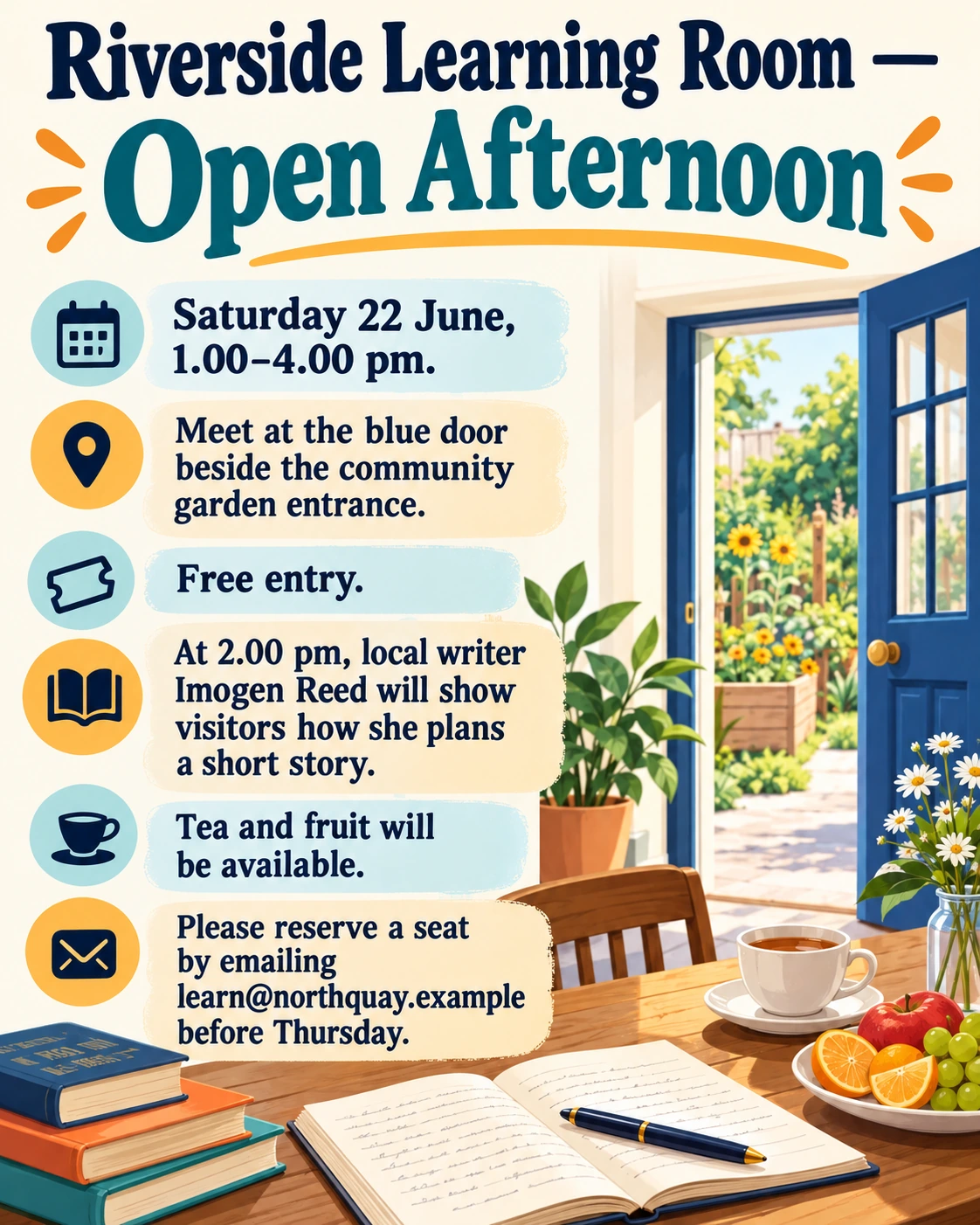
Riverside Learning Room — Open Afternoon
Saturday 22 June, 1.00–4.00 pm. Meet at the blue door beside the community garden entrance. Free entry. At 2.00 pm, local writer Imogen Reed will show visitors how she plans a short story. Tea and fruit will be available. Please reserve a seat by emailing learn@northquay.example before Thursday.
Message from Ellis to Mae
Hi Mae, I've reserved two seats for Imogen Reed's story session on 22 June. Let's meet at the blue door at 1.40, so we can look around before it starts at two. I'll bring a notebook and two pencils. Could you bring a bottle of water? The writer will talk for about 35 minutes, then we'll have time to ask questions. See you, Ellis.
51. Answer: 22 June / June 22 / 22nd June / June 22nd / 22 Jun / Jun 22 / 22/6 / 22/06 / 22nd Jun / 22nd June.. Both the notice and Ellis's message give the date as 22 June. The answer accepts common day–month forms.
52. Answer: blue door / the blue door. The notice says to meet at the blue door beside the community garden entrance, and Ellis repeats that meeting place.
53. Answer: 2.00 / 2:00 / 2 pm / 2.00 pm / 2:00 pm / 2pm / 2.00pm / 2:00pm / 14.00 / 14:00 / 2 / two / two pm / two o’clock / two o clock. Both sources say the session begins at two. Accept standard clock formats for 2 pm.
54. Answer: two / 2. Ellis’s message explicitly says two seats have been reserved, so write two or 2. This is a quantity rather than a meeting time.
55. Answer: 35 / thirty-five / thirty five / 35 minutes / thirty-five minutes / thirty five minutes. Ellis's message says the writer will talk for about 35 minutes. The other source does not give the duration.
Write an email about learning together
Write one email of 25–35 words for question 56. Include all three points below. Use the sample to check your work after writing; this task is separate from the automatic score.
Your English-speaking friend Mae wants to learn something new with you. Write her an email suggesting a short activity. Cover the three points below in 25–35 words.
- Say what you would like to learn together.
- Say where you could do it.
- Explain why the activity would be useful or enjoyable.
0 words · target 25–35
This writing task is self-checked and is separate from your score out of 55.
Hi Mae, Let's learn a few easy guitar chords at the youth centre on Saturday. We can practise together, and then play a song for our friends. It sounds fun! See you, Ellis
Check: all three points answered; message clear; verbs and spelling checked; 25–35 words.
Ready to check your work?
Submit to grade your whole test, OR use 👁 Show Answer per part / per question.
Learning review & writing checklist
Read each notice for its purpose. Link dialogue replies to the turns before and after each gap. In Part 4, distinguish explicit agreement, contradiction and missing information. Use both source documents for the notes in Part 8.
For grammar gaps, read the whole sentence, choose the correct form, and read it again. For open gaps, type one word only. Check the first letter and spelling in Part 6.
Your writing should answer all three points in 25–35 words. Compare your message with the sample after you finish. The writing sample does not add points to the automatic score.
Show Answer reveals the answer and explanation without filling your response or awarding a mark. After editing a graded answer, submit again for an updated score.